Azerbaijan Electronic Components Market Summary
The azerbaijan electronic components market was estimated at USD 1034 Million in 2025 and is projected to reach USD 1762 Million by 2032, growing at a CAGR of 9.1% from 2026 to 2032.
Azerbaijan Electronic Components Market Year-wise Growth Rate and Key Drivers
This graph highlights how the Azerbaijan Electronic Components Market has steadily grown over the past five years, supported by major growth factors.
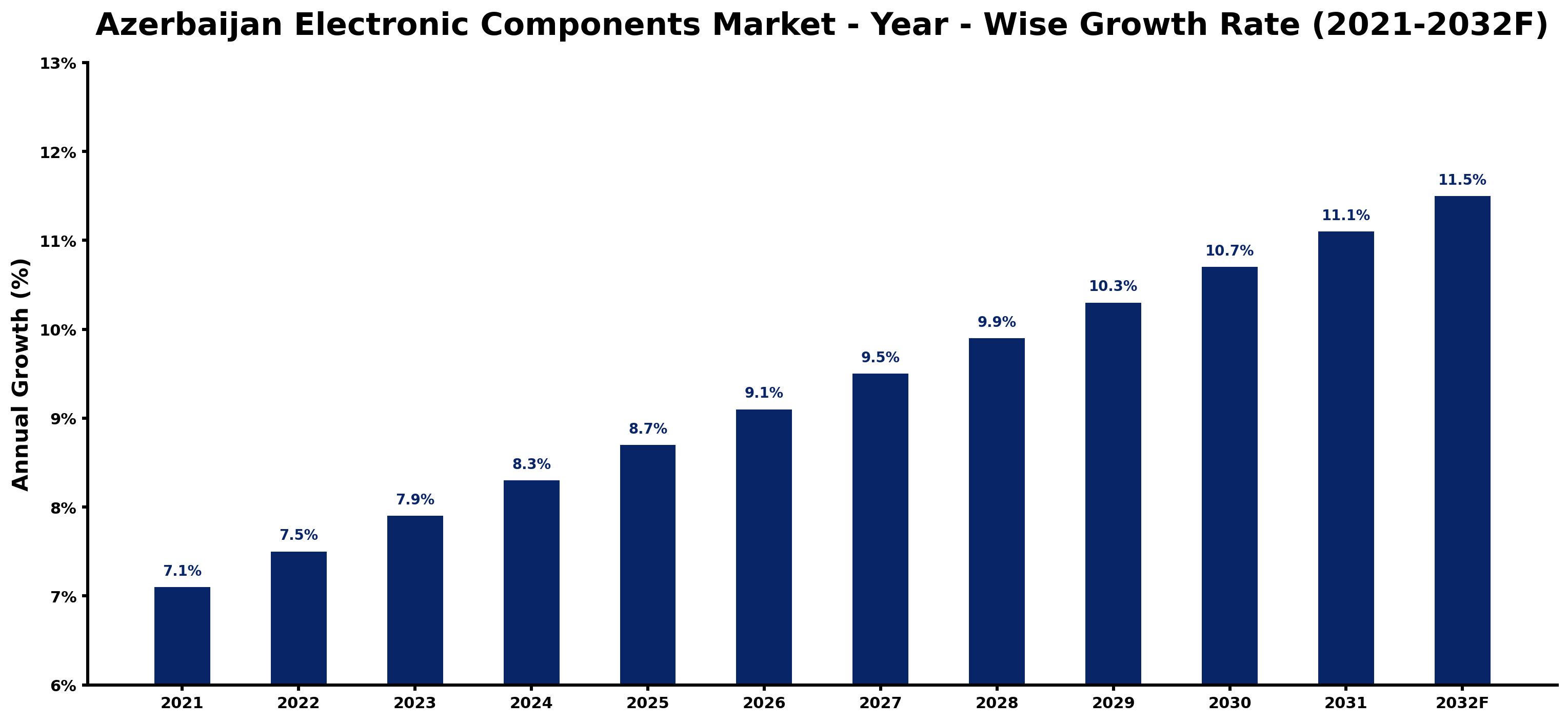
The table below presents the year wise growth rates along with the key drivers influencing the market
| Year | Growth Rate | Major Drivers |
| 2021 | 7.1% | A focus on telecommunications infrastructure modernization stimulates component demand across Azerbaijan. |
| 2022 | 7.5% | Rising energy needs prompt investments in renewable energy projects and electronic components. |
| 2023 | 7.9% | Local companies amplify production capabilities to meet demands from various technology sectors. |
| 2024 | 8.3% | The shift towards smart city initiatives brings new electronic components requirements into focus. |
| 2025 | 8.7% | Emerging automotive technologies require advanced electronics, enhancing local manufacturing opportunities. |
| 2026 | 9.1% | Disruptions in global supply chains inspire regional manufacturers to boost local sourcing efforts. |
| 2027 | 9.5% | Partnerships with international tech firms increase knowledge transfer and component innovation opportunities. |
| 2028 | 9.9% | Urbanization trends drive the necessity for more sophisticated electronic infrastructure in major cities. |
| 2029 | 10.3% | Increased consumer electronics demand creates a surge in component imports and local production. |
| 2030 | 10.7% | A wave of startups in tech fosters competition and innovation in electronic components market. |
| 2031 | 11.1% | Educational initiatives support workforce training, enabling growth in skilled labor for manufacturing. |
| 2032 | 11.5% | Sustainability concerns elevate the demand for energy-efficient electronic components across sectors. |
Note - Market size estimations and growth projections presented in this report are based on 6Wresearch's advanced forecasting approach, validated with industry datasets as of June 2026.
Azerbaijan Electronic Components Market Synopsis
The Azerbaijan Electronic Components Market is projected to reach 9.1% and witness significant growth during the forecast period (2026-2032). This market is progressively shaped by an increase in demand across sectors such as consumer electronics, automotive electronics, and industrial automation systems. The diverse range of electronic components— including semiconductors, passive components, connectors, and sensors— serves as a backbone for various applications, with the growing adoption of Internet of Things (IoT) devices and smart technologies driving further expansion.
Azerbaijan Electronic Components Market Growth Drivers
The growth of the Azerbaijan Electronic Components Market is underpinned by several key drivers. The rising demand for consumer electronics has been a primary catalyst, fueled by increasing disposable income among consumers. Additionally, the surge in automotive electronics is contributing significantly to the market, as more vehicles incorporate advanced electronic systems.
- The expansion of industrial automation systems is creating a substantial need for reliable electronic components, thereby fostering market growth.
- Technological advancements in electronic design and manufacturing processes are driving demand for high-quality components that meet industry standards.
- Government initiatives promoting digital transformation and smart technology adoption are encouraging investments in electronic component infrastructure.
- The increasing prevalence of IoT devices across various sectors necessitates specialized electronic components, further stimulating market demand.
- Moreover, the rising trend towards miniaturization in electronic devices is compelling manufacturers to innovate and develop more compact electronic components.
Azerbaijan Electronic Components Market Trends and Opportunities
Current trends in the Azerbaijan Electronic Components Market reflect a transition towards greater efficiency and sustainability. Notably, there is a discernible shift towards the use of environmentally-friendly components, driven by global sustainability initiatives. Manufacturers are increasingly focusing on innovation to develop products that cater to the evolving needs of the market.
- The demand for high-performance electronic components is escalating as telecommunications and automotive sectors continue to expand.
- Advancements in wireless communication technologies are prompting a surge in demand for specialized components, reflecting a move towards 5G and beyond.
- Additionally, the rapid proliferation of smart devices is creating lucrative opportunities for manufacturers to supply components that enhance device functionality.
- The emphasis on energy efficiency in electronic devices is leading to increased interest in power management components, which offer both performance and sustainability benefits.
- Furthermore, local and international collaborations aim to improve supply chain efficiency and technological capabilities, fostering market growth.
Azerbaijan Electronic Components Market Challenges and Restraints
The Azerbaijan Electronic Components Market faces several challenges that could impede progress. A significant hurdle is the limited domestic production capacity, which leads to heavy reliance on imports for essential components. This dependency makes the market vulnerable to currency fluctuations and geopolitical risk.
- Moreover, the presence of counterfeit products undermines consumer trust and poses serious risks to product quality and reliability.
- A lack of established local manufacturing ecosystems hinders the growth of domestic suppliers, creating barriers to innovation.
- Supply chain disruptions resulting from external factors, such as global economic volatility, can adversely affect component availability and pricing.
- The regulatory landscape surrounding electronic imports may introduce additional complexities, further complicating market dynamics.
- To navigate these challenges, substantial investment in local manufacturing capabilities and quality assurance measures will be imperative.
Azerbaijan Electronic Components Market Investment Opportunities
Investment opportunities within the Azerbaijan Electronic Components Market are burgeoning, particularly as the electronics manufacturing sector expands. The government's initiatives to bolster the technology industry present attractive avenues for stakeholders.
- Investments in semiconductor manufacturing are poised to gain traction, given the rising demand across various sectors.
- Strategic partnerships with local manufacturers and distributors could provide international companies with insights and access to the market.
- Additional focus on the developing IoT sector highlights the need for specialized components, positioning investors to capitalize on this trend.
- Government incentives for research and development can further enhance the attractiveness of investment in this burgeoning market.
- Collaborations aimed at enhancing local supply chain resilience can offer both economic benefits and improved market dynamics.
Azerbaijan Electronic Components Market Government Investment and Initiatives
The Azerbaijan government has been proactive in facilitating the growth of the electronic components market through a range of strategic policies and initiatives. These efforts include the provision of tax incentives and subsidies designed to attract both local and foreign investment.
- The government is promoting research and development activities to bolster innovation within the sector and enhance competitiveness.
- Regulatory measures have been implemented to ensure the quality and safety of electronic components, fostering consumer confidence.
- Infrastructure investments aimed at modernizing telecommunications and energy sectors are expected to catalyze demand for electronic components.
- Special economic zones have been established to encourage electronics manufacturing, offering businesses favorable operational conditions.
- By creating a conducive ecosystem for technology advancement, the government aims to develop a robust local manufacturing base and reduce dependency on imports.
Azerbaijan Electronic Components Market Latest Developments (May 2025 - June 2026)
Recent developments in the Azerbaijan Electronic Components Market indicate a positive trajectory for the industry. The period from May 2025 to June 2026 has witnessed increased focus on establishing local manufacturing capabilities, with various initiatives aimed at reducing reliance on imported components.
- Sector stakeholders have been actively engaged in discussions on enhancing regulatory frameworks to promote local production and quality assurance.
- New partnerships have emerged between technology firms and educational institutions focused on developing workforce skills relevant to the electronics industry.
- Investment activities in renewable energy sectors are expected to stimulate demand for electronic components that support sustainable practices.
- The introduction of advanced manufacturing technologies has been noted, which is contributing to greater efficiency in production processes.
- Overall, these developments point towards a concerted effort to advance the electronic components landscape in Azerbaijan.
Azerbaijan Electronic Components Market - Key Attractiveness of the Report
- 10 Years of Market Numbers
- Historical Data Starting from 2022 to 2025
- Base Year: 2025
- Forecast Data until 2032
- Key Performance Indicators Impacting the Market
- Major Upcoming Developments and Projects
Key Highlights of the Report:
- Azerbaijan Electronic Components Market Outlook
- Market Size of Azerbaijan Electronic Components Market, 2025
- Forecast of Azerbaijan Electronic Components Market, 2032F
- Historical Data and Forecast of Azerbaijan Electronic Components Revenues & Volume for the Period 2022-2032F
- Azerbaijan Electronic Components Market Trend Evolution
- Azerbaijan Electronic Components Market Drivers and Challenges
- Azerbaijan Electronic Components Price Trends
- Azerbaijan Electronic Components Porter's Five Forces
- Azerbaijan Electronic Components Industry Life Cycle
- Historical Data and Forecast of Azerbaijan Electronic Components Market Revenues & Volume By Types for the Period 2022-2032F
- Historical Data and Forecast of Azerbaijan Electronic Components Market Revenues & Volume By Passive for the Period 2022-2032F
- Historical Data and Forecast of Azerbaijan Electronic Components Market Revenues & Volume By Active for the Period 2022-2032F
- Historical Data and Forecast of Azerbaijan Electronic Components Market Revenues & Volume By Electro Mechanic for the Period 2022-2032F
- Historical Data and Forecast of Azerbaijan Electronic Components Market Revenues & Volume By Applications for the Period 2022-2032F
- Historical Data and Forecast of Azerbaijan Electronic Components Market Revenues & Volume By Automotive for the Period 2022-2032F
- Historical Data and Forecast of Azerbaijan Electronic Components Market Revenues & Volume By Communications for the Period 2022-2032F
- Historical Data and Forecast of Azerbaijan Electronic Components Market Revenues & Volume By Industrial for the Period 2022-2032F
- Historical Data and Forecast of Azerbaijan Electronic Components Market Revenues & Volume By Computing Applications for the Period 2022-2032F
- Historical Data and Forecast of Azerbaijan Electronic Components Market Revenues & Volume By Others for the Period 2022-2032F
- Azerbaijan Electronic Components Import Export Trade Statistics
- Market Opportunity Assessment By Types
- Market Opportunity Assessment By Applications
- Azerbaijan Electronic Components Top Companies Market Share
- Azerbaijan Electronic Components Competitive Benchmarking By Technical and Operational Parameters
- Azerbaijan Electronic Components Company Profiles
- Azerbaijan Electronic Components Key Strategic Recommendations






































