Azerbaijan Holster Market Size, Share & Growth Rate
The Azerbaijan Holster Market was estimated at USD 1038 Million in 2025 and is projected to reach USD 1769 Million by 2032, growing at a CAGR of 7.9% from 2026 to 2032. This significant growth can be attributed to the rising interest in shooting sports and a growing emphasis on personal security among civilians. Additionally, as law enforcement agencies seek advanced holster solutions, the market is expected to expand further, driven by innovative product offerings and a diverse range of materials.
Azerbaijan Holster Market Year-wise Growth Rate and Key Drivers
This graph highlights how the Azerbaijan Holster Market has steadily grown over the years, supported by major growth factors.
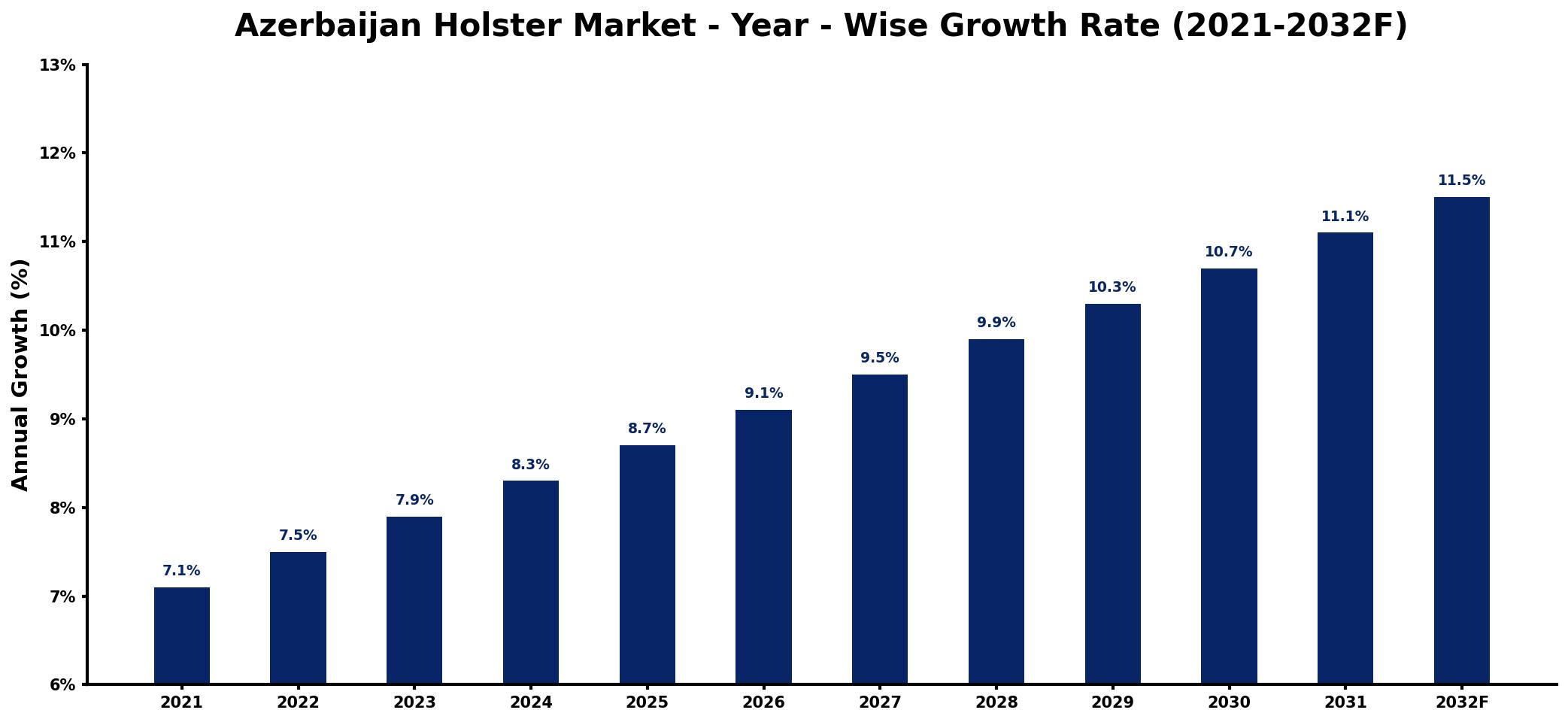
The table below presents the year‑wise growth rates along with the key drivers influencing the market
| Year | Growth Rate | Major Drivers |
| 2021 | 7.1% | rising consumer protection awareness |
| 2022 | 7.5% | increased outdoor recreational activities |
| 2023 | 7.9% | growing personal security concerns |
| 2024 | 8.3% | rising end-use demand growth |
| 2025 | 8.7% | surge in military procurement contracts |
| 2026 | 9.1% | enhanced training programs for professionals |
| 2027 | 9.5% | development of new safety regulations |
| 2028 | 9.9% | growing trend in self-defense education |
| 2029 | 10.3% | increased adoption of tactical gear |
| 2030 | 10.7% | rising investments in safety technology |
| 2031 | 11.1% | expansion of customization options |
| 2032 | 11.5% | growing demand for innovative designs |
Note: Market size estimations and growth projections presented in this report are based on 6Wresearch's proprietary forecasting methodology, utilizing the latest available industry data, government publications, and primary research inputs.
Azerbaijan Holster Market Synopsis
The Azerbaijan Holster Market has recently seen a surge in demand, particularly due to the increasing number of gun owners and the popularity of shooting sports. However, the market is poised for further growth as consumers become more educated about the advantages of high-quality holsters. This momentum indicates a transition towards a more mature market that caters to specialized needs.
Looking ahead, the focus on safety and security will continue to drive demand, along with the emergence of customizable and innovative designs. As consumers increasingly seek versatile and comfortable holster options, there is a clear shift towards products that prioritize functionality while enhancing user experience.
Azerbaijan Holster Market Key Takeaways
- The Azerbaijan Holster Market is anticipated to grow significantly, driven by the increasing need for personal safety and law enforcement efficiency.
- Innovative designs that emphasize comfort, versatility, and customization are becoming prominent trends among consumers.
- Challenges related to product awareness and competition from cheaper alternatives exist but can be mitigated through targeted marketing strategies.
- Investment opportunities abound for local and international players looking to penetrate a growing and evolving market.
- The government is actively promoting local manufacturing, which enhances the market's competitiveness and product quality.
Evaluation of Restraints in Azerbaijan Holster Market
Despite the promising growth trajectory, several restraints could impede the Azerbaijan Holster Market. The influx of cheaper imported products presents a formidable challenge, as does fluctuating raw material prices that can affect manufacturing costs and profitability. Moreover, there exists a noticeable lack of consumer awareness regarding the tangible benefits of investing in high-quality holsters, which could hinder potential sales. Finally, regulatory inconsistencies in holster manufacturing and sales may impact product quality, complicating the market landscape.
Azerbaijan Holster Market Trends
The current landscape in the Azerbaijan Holster Market is shaped by an increasing demand for versatile and multipurpose holsters that cater to both compact and larger firearms. Customers are gravitating towards products featuring adjustable retention mechanisms and various carry positions. Moreover, there is a distinct shift toward materials such as Kydex and polymer, which provide a balance of durability and comfort. Customization options are on the rise, allowing gun owners to select holsters that reflect their personal preferences and needs, thereby enhancing overall satisfaction.
Azerbaijan Holster Market Opportunities
The Azerbaijan Holster Market is ripe with opportunities for growth and investment. As the number of gun owners expands, there is a clear demand for tailored, high-quality holsters designed specifically for Azerbaijani consumers. Innovators focusing on advanced designs, ergonomic features, and sustainable materials will likely find a receptive market. Furthermore, collaboration with local distributors and participation in shooting sports events can facilitate a deeper penetration into this niche market. Investing in educational campaigns about product benefits can also play a crucial role in shaping consumer behavior.
Government Initiatives in the Azerbaijan Holster Market
The Azerbaijani government has instituted various policies to regulate the holster market, focusing on consumer safety and product quality. These regulations include the establishment of manufacturing standards and monitoring the importation of holsters to combat the entry of substandard goods. Additionally, the government encourages local production through various incentives and support programs aimed at domestic manufacturers, which helps to foster a competitive environment while ensuring consumer interests are safeguarded.
Future Insights of the Azerbaijan Holster Market
Looking ahead to 2026-2032, the Azerbaijan Holster Market is projected to undergo steady expansion, propelled by the increasing demand for firearms among civilians and law enforcement alike. As shooting sports gain more popularity, the need for innovative and practical holster solutions will intensify. Although challenges such as stringent firearm regulations and varying consumer knowledge may persist, the overall outlook remains positive. Continued advancements in design and materials will likely attract a diverse consumer base, creating a fertile environment for both new and established players in the market.
Azerbaijan Holster Market Latest Developments (2025 - 2026)
Recent developments in the Azerbaijan Holster Market indicate a shift toward incorporating advanced manufacturing techniques to enhance product quality and reduce costs. Innovations in materials have led to the creation of lighter and more durable holsters that cater to consumer demands. Additionally, there has been a noticeable uptick in collaborations between manufacturers and local retailers to improve distribution channels and consumer engagement. Events and workshops aimed at educating consumers on holster benefits and proper usage have also gained traction, indicating a proactive approach to market growth.
Azerbaijan Holster Market - Key Attractiveness of the Report
- 10 Years of Market Numbers
- Historical Data Starting from 2022 to 2025
- Base Year: 2025
- Forecast Data until 2032
- Key Performance Indicators Impacting the Market
- Major Upcoming Developments and Projects
Key Highlights of the Report:
- Azerbaijan Holster Market Outlook
- Market Size of Azerbaijan Holster Market, 2025
- Forecast of Azerbaijan Holster Market, 2032
- Historical Data and Forecast of Azerbaijan Holster Revenues & Volume for the Period 2022-2032F
- Azerbaijan Holster Market Trend Evolution
- Azerbaijan Holster Market Drivers and Challenges
- Azerbaijan Holster Price Trends
- Azerbaijan Holster Porter's Five Forces
- Azerbaijan Holster Industry Life Cycle
- Historical Data and Forecast of Azerbaijan Holster Market Revenues & Volume By Type for the Period 2022-2032F
- Historical Data and Forecast of Azerbaijan Holster Market Revenues & Volume By Leather for the Period 2022-2032F
- Historical Data and Forecast of Azerbaijan Holster Market Revenues & Volume By Nylon for the Period 2022-2032F
- Historical Data and Forecast of Azerbaijan Holster Market Revenues & Volume By Plastic for the Period 2022-2032F
- Historical Data and Forecast of Azerbaijan Holster Market Revenues & Volume By Other for the Period 2022-2032F
- Historical Data and Forecast of Azerbaijan Holster Market Revenues & Volume By Application for the Period 2022-2032F
- Historical Data and Forecast of Azerbaijan Holster Market Revenues & Volume By Civil for the Period 2022-2032F
- Historical Data and Forecast of Azerbaijan Holster Market Revenues & Volume By Armed Forces for the Period 2022-2032F
- Historical Data and Forecast of Azerbaijan Holster Market Revenues & Volume By others for the Period 2022-2032F
- Azerbaijan Holster Import Export Trade Statistics
- Market Opportunity Assessment By Type
- Market Opportunity Assessment By Application
- Azerbaijan Holster Top Companies Market Share
- Azerbaijan Holster Competitive Benchmarking By Technical and Operational Parameters
- Azerbaijan Holster Company Profiles
- Azerbaijan Holster Key Strategic Recommendations






































