Azerbaijan Railway Maintenance Machinery Market Size, Share & Growth Rate
The Azerbaijan Railway Maintenance Machinery Market was estimated at USD 895 Million in 2025 and is projected to reach USD 1559 Million by 2032, growing at a CAGR of 8.3% from 2026 to 2032. This growth trajectory is fueled by extensive government investments in railway infrastructure, aiming to modernize and expand the existing network. The increasing demand for efficient maintenance solutions to support these developments is vital for ensuring the railway systems' operational efficiency and safety standards.
Azerbaijan Railway Maintenance Machinery Market Year-wise Growth Rate and Key Drivers
This graph highlights how the Azerbaijan Railway Maintenance Machinery Market has steadily grown over the years, supported by major growth factors.
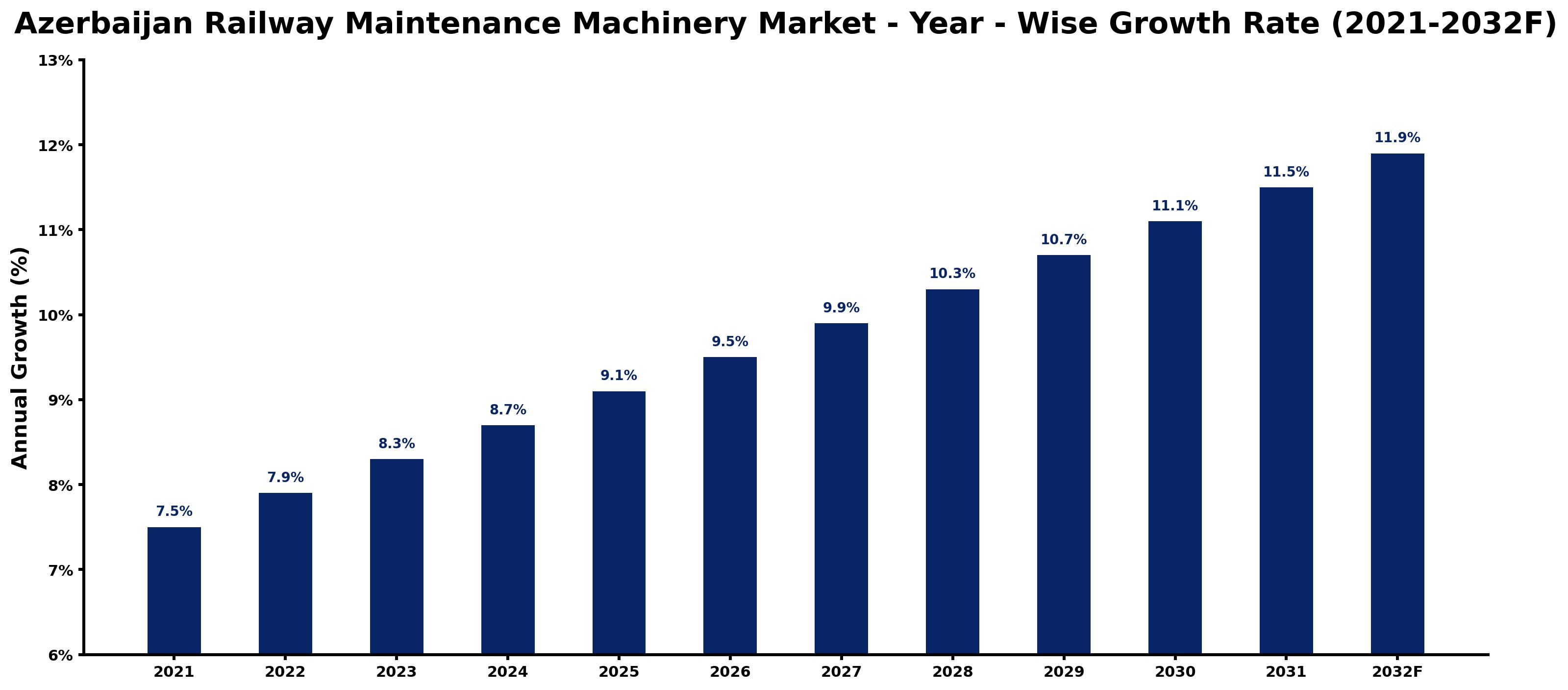
The table below presents the year‑wise growth rates along with the key drivers influencing the market
| Year | Growth Rate | Major Drivers |
| 2021 | 7.5% | Increasing industrial automation investments |
| 2022 | 7.9% | Increasing adoption of advanced technologies |
| 2023 | 8.3% | Increasing industrial infrastructure investments |
| 2024 | 8.7% | Rising electricity demand across industries |
| 2025 | 9.1% | Increasing smart city development projects |
| 2026 | 9.5% | Increasing adoption of advanced technologies |
| 2027 | 9.9% | Increasing industrial automation investments |
| 2028 | 10.3% | Government infrastructure modernization initiatives |
| 2029 | 10.7% | Expansion of commercial construction activities |
| 2030 | 11.1% | Rapid growth in telecom and data center sectors |
| 2031 | 11.5% | Expansion of transportation and logistics networks |
| 2032 | 11.9% | Increasing industrial automation investments |
Note - Market size estimations and growth projections presented in this report are based on 6Wresearch's advanced forecasting approach, validated with industry datasets as of June 2026.
Azerbaijan Railway Maintenance Machinery Market Synopsis
The Azerbaijan Railway Maintenance Machinery Market is currently characterized by a notable shift toward advanced technology adoption. As the country modernizes its railways, the need for sophisticated maintenance machinery becomes increasingly critical. Stakeholders are focusing on solutions that promise to enhance both the safety and efficiency of railway operations.
Moreover, with Azerbaijan's strategic geographic position as a crucial transit point between Europe and Asia, the demand for reliable railway infrastructure and maintenance machinery has surged. This dynamic landscape offers various opportunities for businesses involved in the manufacture and distribution of railway maintenance solutions.
Azerbaijan Railway Maintenance Machinery Market Key Takeaways
- The market is witnessing steady growth driven by government infrastructure investments.
- Technological advancements are pushing the demand for smart and sustainable maintenance machinery.
- Government policies are aligning with international standards to attract foreign investment.
- The increasing focus on eco-friendly solutions is reshaping the machinery offerings.
- Strategic partnerships are essential for overcoming limitations related to skilled labor and procurement.
Evaluation of Restraints in Azerbaijan Railway Maintenance Machinery Market
Despite the promising outlook, several restraints hinder the growth of the Azerbaijan Railway Maintenance Machinery Market. A significant challenge is the aging infrastructure, which necessitates the modernization of existing machinery to comply with international standards. Additionally, the limited availability of specialized maintenance equipment constrains operations. The high costs associated with maintaining outdated infrastructure coupled with a shortage of skilled technicians well-versed in advanced maintenance technologies further exacerbate these issues. Consequently, addressing these barriers through strategic partnerships and workforce development initiatives is imperative for market advancement.
Azerbaijan Railway Maintenance Machinery Market Trends
A prominent trend in the Azerbaijan Railway Maintenance Machinery Market is the increasing adoption of predictive maintenance systems. This shift aims to enhance operational efficiency, minimize downtime, and boost safety protocols. Additionally, there's a growing inclination towards eco-friendly machinery, with more companies investing in electric and hybrid options to reduce carbon footprints. Innovations in technology, particularly those that enable remote monitoring, are also transforming the landscape of railway maintenance.
Azerbaijan Railway Maintenance Machinery Market Opportunities
The market presents substantial investment opportunities, particularly for businesses that can provide innovative railway maintenance solutions tailored to the evolving needs of the Azerbaijani railway sector. As the government continues to commit resources to rail infrastructure projects, there is significant demand for state-of-the-art machinery, including ballast regulators and rail grinders. Additionally, investors are encouraged to consider procurement and leasing options that align with the country's strategic vision of enhancing operational efficiency and connectivity with neighboring nations.
Government Initiatives in the Azerbaijan Railway Maintenance Machinery Market
The Azerbaijani government has implemented a variety of policies designed to foster growth in the Railway Maintenance Machinery Market. These include substantial public investments aimed at modernizing railway infrastructure and establishing public-private partnerships that invite foreign investment into the sector. Furthermore, there is a strong emphasis on promoting innovation and the adoption of new technologies to improve both efficiency and safety in railway maintenance operations.
Future Insights of the Azerbaijan Railway Maintenance Machinery Market
Looking ahead to the period between 2026 and 2032, the Azerbaijan Railway Maintenance Machinery Market is poised for significant expansion. This optimistic forecast is largely attributable to the sustained commitment of the government toward infrastructure enhancement and the increasing demand for advanced maintenance solutions. As the focus on enhancing regional connectivity intensifies, market players are likely to invest in sustainable and innovative technologies, aligning their offerings with the evolving needs of the railway sector.
Azerbaijan Railway Maintenance Machinery Market Latest Developments (May 2025 - June 2026)
In recent months, the market has seen a push towards adopting smart technologies, with several initiatives focused on integrating advanced monitoring systems into maintenance machinery. This transition aims to improve predictive maintenance capabilities and operational efficiency. There are ongoing discussions among industry stakeholders regarding potential partnerships to enhance skills training programs for technicians, ensuring they are equipped to handle the latest advancements in railway maintenance technology.
Azerbaijan Railway Maintenance Machinery Market - Key Attractiveness of the Report
- 10 Years of Market Numbers
- Historical Data Starting from 2022 to 2025
- Base Year: 2025
- Forecast Data until 2032
- Key Performance Indicators Impacting the Market
- Major Upcoming Developments and Projects
Key Highlights of the Report:
- Azerbaijan Railway Maintenance Machinery Market Outlook
- Market Size of Azerbaijan Railway Maintenance Machinery Market, 2025
- Forecast of Azerbaijan Railway Maintenance Machinery Market, 2032F
- Historical Data and Forecast of Azerbaijan Railway Maintenance Machinery Revenues & Volume for the Period 2022-2032F
- Azerbaijan Railway Maintenance Machinery Market Trend Evolution
- Azerbaijan Railway Maintenance Machinery Market Drivers and Challenges
- Azerbaijan Railway Maintenance Machinery Price Trends
- Azerbaijan Railway Maintenance Machinery Porter's Five Forces
- Azerbaijan Railway Maintenance Machinery Industry Life Cycle
- Historical Data and Forecast of Azerbaijan Railway Maintenance Machinery Market Revenues & Volume By Type for the Period 2022-2032F
- Historical Data and Forecast of Azerbaijan Railway Maintenance Machinery Market Revenues & Volume By Tamping Machine for the Period 2022-2032F
- Historical Data and Forecast of Azerbaijan Railway Maintenance Machinery Market Revenues & Volume By Stabilizing Machinery for the Period 2022-2032F
- Historical Data and Forecast of Azerbaijan Railway Maintenance Machinery Market Revenues & Volume By Rail Handling Machinery for the Period 2022-2032F
- Historical Data and Forecast of Azerbaijan Railway Maintenance Machinery Market Revenues & Volume By Ballast Cleaning Machine for the Period 2022-2032F
- Historical Data and Forecast of Azerbaijan Railway Maintenance Machinery Market Revenues & Volume By Other for the Period 2022-2032F
- Historical Data and Forecast of Azerbaijan Railway Maintenance Machinery Market Revenues & Volume By Applications for the Period 2022-2032F
- Historical Data and Forecast of Azerbaijan Railway Maintenance Machinery Market Revenues & Volume By Ballast Track for the Period 2022-2032F
- Historical Data and Forecast of Azerbaijan Railway Maintenance Machinery Market Revenues & Volume By Ballastless Track for the Period 2022-2032F
- Azerbaijan Railway Maintenance Machinery Import Export Trade Statistics
- Market Opportunity Assessment By Type
- Market Opportunity Assessment By Applications
- Azerbaijan Railway Maintenance Machinery Top Companies Market Share
- Azerbaijan Railway Maintenance Machinery Competitive Benchmarking By Technical and Operational Parameters
- Azerbaijan Railway Maintenance Machinery Company Profiles
- Azerbaijan Railway Maintenance Machinery Key Strategic Recommendations






































