Bahrain 5G Core Market Size, Share & Growth Rate
The Bahrain 5G Core Market was estimated at USD 301 Million in 2025 and is projected to reach USD 533 Million by 2032, growing at a CAGR of 8.5% from 2026 to 2032. This impressive growth is driven by an aggressive shift from traditional network architectures to cloud-native solutions, allowing operators to provide more efficient and reliable services. The demand for enhanced mobile broadband and innovative applications is further propelling investments in this sector, indicating a pivotal transformation in Bahrain's telecommunications landscape.
Bahrain 5G Core Market Year-wise Growth Rate and Key Drivers
This graph highlights how the Bahrain 5G Core Market has steadily grown over the years, supported by major growth factors.
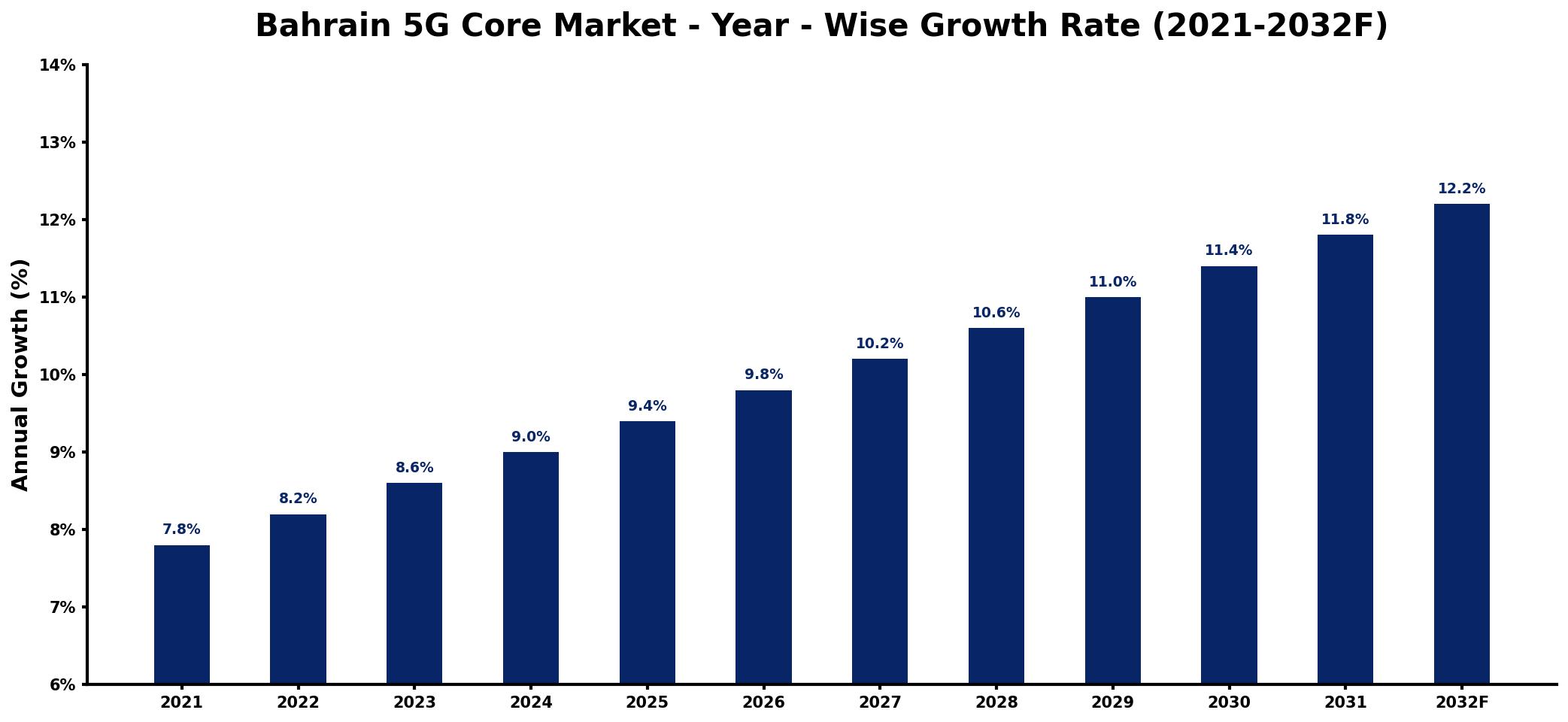
The table below presents the year‑wise growth rates along with the key drivers influencing the market
| Year | Growth Rate | Major Drivers |
| 2021 | 7.8% | Increased demand for connectivity solutions |
| 2022 | 8.2% | Rise in digital transformation initiatives |
| 2023 | 8.6% | Expansion of IoT applications market |
| 2024 | 9.0% | Investment in smart city projects |
| 2025 | 9.4% | Growth in mobile broadband usage |
| 2026 | 9.8% | Development of advanced cloud services |
| 2027 | 10.2% | Surge in remote working technologies |
| 2028 | 10.6% | Advancements in augmented reality solutions |
| 2029 | 11.0% | Increased adoption of autonomous vehicles |
| 2030 | 11.4% | increased production capacity utilization |
| 2031 | 11.8% | growing emerging market penetration |
| 2032 | 12.2% | improved raw material availability |
Note: Market size estimations and growth projections presented in this report are based on 6Wresearch's proprietary forecasting methodology, utilizing the latest available industry data, government publications, and primary research inputs.
Bahrain 5G Core Market Synopsis
Bahrain's telecom operators are actively transitioning towards standalone 5G core architectures, paving the way for unprecedented levels of network performance and flexibility. This evolution supports critical use cases, such as industrial automation and remote surgery, demonstrating the market's potential to address the future needs of both enterprise and consumer applications.
The integration of service-based architecture (SBA) and advanced network slicing technologies is redefining service delivery in Bahrain. This strategic focus enables operators to offer personalized services while improving operational efficiency, driving substantial interest and investment in the 5G core ecosystem.
Bahrain 5G Core Market Key Takeaways
- Bahrain's 5G core market is on a robust growth trajectory, expected to reach USD 533 Million by 2032.
- Operators are embracing cloud-native core networks to capitalize on ultra-reliable low-latency communications.
- Regulatory support is fostering the deployment of standalone 5G architectures across the telecommunications landscape.
- Integration of network slicing and service-based architectures is critical for delivering customized user experiences.
- Investment opportunities abound in software solutions and AI-driven network management tools.
Evaluation of Restraints in Bahrain 5G Core Market
Despite the promising landscape, several challenges hinder the acceleration of the 5G core market in Bahrain. The transition to standalone architectures necessitates substantial investments, which many operators are hesitant to commit to, resulting in a reliance on non-standalone deployments. Additionally, technical complexities, especially in managing multiple network slices and functions, present significant obstacles. The shortage of qualified personnel in advanced 5G technologies further restricts progress. Coupled with concerns regarding network security and interoperability between diverse systems, these factors collectively slow the pace of innovation and infrastructure development.
Bahrain 5G Core Market Trends
The Bahrain 5G core market is characterized by several notable trends that shape its development. The shift towards fully virtualized and cloud-native architectures is at the forefront, enabling operators to deploy advanced features like edge computing and network slicing effectively. Furthermore, there is a growing emphasis on the integration of AI in network management, which enhances operational efficiency and minimizes downtime. The emergence of IoT applications is also accelerating demand, as businesses seek to harness the capabilities of 5G for improved automation and connectivity.
Bahrain 5G Core Market Opportunities
The current landscape presents numerous investment opportunities in the Bahrain 5G core market. As telecom operators seek to upgrade their infrastructure, there is a significant demand for cloud-native solutions, orchestration tools, and software-based core network functionalities. Potential investors can capitalize on this trend by developing innovative technologies that facilitate the adoption of 5G use cases, particularly in autonomous transport and smart cities. Strategic partnerships with telecom providers and government entities can also unlock additional avenues for growth and expansion.
Government Initiatives in the Bahrain 5G Core Market
The Bahraini government plays a crucial role in advancing the 5G core market through comprehensive regulatory frameworks and proactive spectrum management. The Telecommunications Regulatory Authority (TRA) has initiated auctions for 5G frequencies and issued licenses for both standalone and non-standalone deployments. Policies promoting cloud-native, service-based architectures are also in place, which encourages innovation within the telecom infrastructure. Moreover, national cybersecurity guidelines are enforced to ensure the integrity of critical communication systems, further bolstering operator confidence in deploying next-generation services.
Future Insights of the Bahrain 5G Core Market
Looking ahead to 2026-2032, the Bahrain 5G core market is poised for transformative growth as operators increasingly adopt fully virtualized architectures. Enhanced demand for low-latency applications, coupled with the rising importance of IoT and AI integration, will continue to shape the industry's evolution. The ongoing governmental support for infrastructure development and the establishment of clear regulatory guidelines will further enable telecom operators to innovate and expand their service offerings. As a result, Bahrain is likely to emerge as a leading hub for 5G technology in the region.
Bahrain 5G Core Market Latest Developments (2025 - 2026)
Recent developments in the Bahrain 5G core market indicate a strong commitment from local telecom operators to enhance their core network capabilities. Initiatives aimed at deploying advanced network slicing techniques are gaining traction, facilitating more personalized service delivery. Additionally, there is a notable uptick in collaborations between telecom providers and technology firms focusing on AI-driven network management solutions. The market is also witnessing increased pilot projects targeting industrial automation and smart city applications, signaling a dynamic shift towards more practical 5G implementations.
Bahrain 5G Core Market - Key Attractiveness of the Report
- 10 Years of Market Numbers
- Historical Data Starting from 2022 to 2025
- Base Year: 2025
- Forecast Data until 2032
- Key Performance Indicators Impacting the Market
- Major Upcoming Developments and Projects
Key Highlights of the Report:
- Bahrain 5G Core Market Outlook
- Market Size of Bahrain 5G Core Market, 2025
- Forecast of Bahrain 5G Core Market, 2032
- Historical Data and Forecast of Bahrain 5G Core Revenues & Volume for the Period 2022-2032F
- Bahrain 5G Core Market Trend Evolution
- Bahrain 5G Core Market Drivers and Challenges
- Bahrain 5G Core Price Trends
- Bahrain 5G Core Porter's Five Forces
- Bahrain 5G Core Industry Life Cycle
- Historical Data and Forecast of Bahrain 5G Core Market Revenues & Volume By Component for the Period 2022-2032F
- Historical Data and Forecast of Bahrain 5G Core Market Revenues & Volume By Solutions for the Period 2022-2032F
- Historical Data and Forecast of Bahrain 5G Core Market Revenues & Volume By Services for the Period 2022-2032F
- Historical Data and Forecast of Bahrain 5G Core Market Revenues & Volume By Network Function for the Period 2022-2032F
- Historical Data and Forecast of Bahrain 5G Core Market Revenues & Volume By Access for the Period 2022-2032F
- Historical Data and Forecast of Bahrain 5G Core Market Revenues & Volume By Mobility Management Function for the Period 2022-2032F
- Historical Data and Forecast of Bahrain 5G Core Market Revenues & Volume By Policy Control Function for the Period 2022-2032F
- Historical Data and Forecast of Bahrain 5G Core Market Revenues & Volume By Unified Data Management for the Period 2022-2032F
- Historical Data and Forecast of Bahrain 5G Core Market Revenues & Volume By Deployment Model for the Period 2022-2032F
- Historical Data and Forecast of Bahrain 5G Core Market Revenues & Volume By Cloud for the Period 2022-2032F
- Historical Data and Forecast of Bahrain 5G Core Market Revenues & Volume By On-premises for the Period 2022-2032F
- Historical Data and Forecast of Bahrain 5G Core Market Revenues & Volume By End User for the Period 2022-2032F
- Historical Data and Forecast of Bahrain 5G Core Market Revenues & Volume By Telecom Operators for the Period 2022-2032F
- Historical Data and Forecast of Bahrain 5G Core Market Revenues & Volume By Enterprises for the Period 2022-2032F
- Bahrain 5G Core Import Export Trade Statistics
- Market Opportunity Assessment By Component
- Market Opportunity Assessment By Network Function
- Market Opportunity Assessment By Deployment Model
- Market Opportunity Assessment By End User
- Bahrain 5G Core Top Companies Market Share
- Bahrain 5G Core Competitive Benchmarking By Technical and Operational Parameters
- Bahrain 5G Core Company Profiles
- Bahrain 5G Core Key Strategic Recommendations






































