Bahrain Artificial Intelligence in Retail Market Size & Growth Rate (2026-2032)
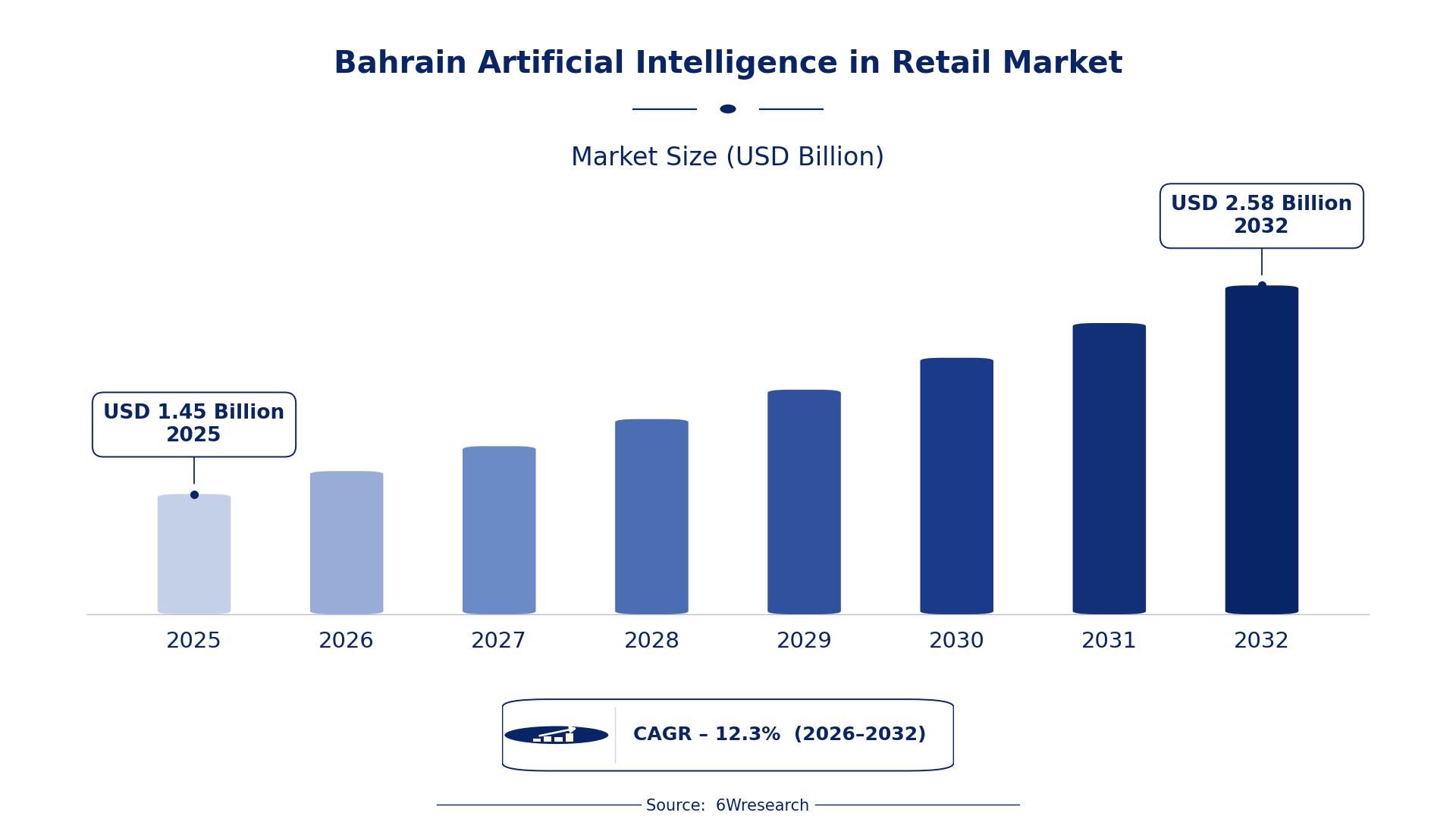
The Bahrain Artificial Intelligence in Retail Market was estimated at USD 1449 Million in 2025 and is projected to reach USD 2581 Million by 2032, growing at a CAGR of 12.3% from 2026 to 2032.
Bahrain Artificial Intelligence in Retail Market Synopsis
The Bahrain Artificial Intelligence in Retail Market has gained impressive momentum, driven by the growing adoption of AI technologies across various retail sectors. As businesses increasingly recognize the potential of AI in enhancing customer experiences and operational efficiency, the market is set for substantial expansion in the years to come.
With the backing of government initiatives and a tech-savvy consumer base, Bahrain is positioning itself as a regional leader in AI integration within the retail space. The demand for AI solutions is not just a trend; it is becoming a necessity for retailers aiming to remain competitive in an ever-changing market.
Bahrain Artificial Intelligence in Retail Market Year-wise Growth Rate and Key Drivers
This graph illustrates the annual growth rates of the Bahrain Artificial Intelligence in Retail Market from 2021 to 2032, highlighting a steady upward trajectory and projected expansion over the forecast period.
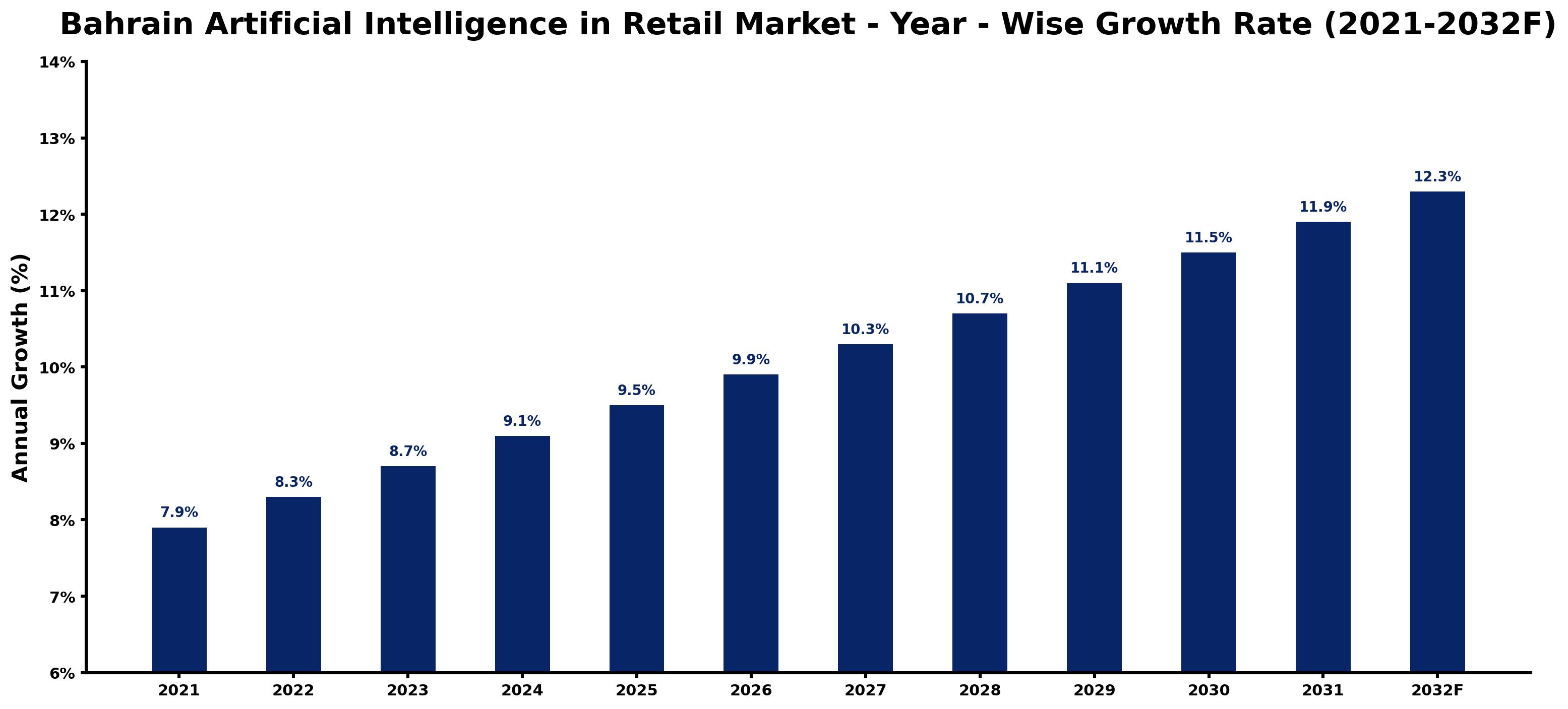
The table below presents the year‑wise growth rates along with the key drivers influencing the market
| Year | Growth Rate | Major Drivers |
| 2021 | 7.9% | Bahrain's Vision 2030 promotes AI in various sectors. |
| 2022 | 8.3% | Increased consumer spending supports AI retail innovations. |
| 2023 | 8.7% | Growing local startups focusing on AI retail solutions. |
| 2024 | 9.1% | Government funded AI research initiatives boost retail tech. |
| 2025 | 9.5% | Retail sector digitization initiatives drive AI implementations. |
| 2026 | 9.9% | Strategic partnerships between retailers and AI providers emerge. |
| 2027 | 10.3% | Surge in mobile app usage enhances AI retail accessibility. |
| 2028 | 10.7% | Local consumer demand for tech-driven shopping experiences rises. |
| 2029 | 11.1% | Increased internet penetration facilitates AI-driven retail growth. |
| 2030 | 11.5% | Bahrain Economic Development Board supports AI retail projects. |
| 2031 | 11.9% | AI regulations foster a secure environment for retail tech. |
| 2032 | 12.3% | Urbanization trends lead to increased smart retail technology adoption. |
Note: Market size estimations and growth projections presented in this report are based on 6Wresearch's proprietary forecasting methodology, utilizing the latest available industry data, government publications, and primary research inputs.
Bahrain Artificial Intelligence in Retail Market Key Takeaways
Below are some of the specific key takeaways from the market, including:
- AI technologies are enhancing customer personalization and streamlining inventory management.
- The market is witnessing an influx of AI-powered chatbots and automated customer service solutions.
- Investment opportunities are increasing in areas such as demand forecasting and personalized marketing.
- Government initiatives are fostering a conducive environment for AI adoption in retail.
- Emerging technologies are reshaping the retail landscape, pushing businesses towards data-driven strategies.
Evaluation of Restraints in Bahrain Artificial Intelligence in Retail Market
Several challenges are currently holding back the Bahrain Artificial Intelligence in Retail Market. A significant barrier is the shortage of skilled professionals capable of implementing and managing AI technologies. Smaller retailers face high initial costs associated with AI adoption, which can deter investment. Additionally, concerns regarding data privacy and security remain paramount, with retailers needing to navigate regulatory frameworks while building consumer trust. Addressing these issues will be essential for unlocking the full potential of AI in Bahrain's retail sector.
Bahrain Artificial Intelligence in Retail Market Trends
The Bahrain Artificial Intelligence in Retail Market is currently influenced by several key trends. Retailers are increasingly utilizing AI-powered chatbots to facilitate personalized customer interactions, enhancing user satisfaction. Demand forecasting algorithms are gaining traction as businesses strive for more efficient inventory management, reducing waste and optimizing stock levels.
Computer vision technologies are emerging for automated checkout processes, providing a frictionless shopping experience. Retailers are also leveraging AI for targeted marketing, analyzing customer behavior and sentiments gleaned from social media. This trend towards data-driven decision-making is reshaping how retailers engage with consumers and streamline operations.
Bahrain Artificial Intelligence in Retail Market Opportunities
Investment opportunities within the Bahrain Artificial Intelligence in Retail Market are both diverse and promising. With the rise of AI technologies, there is a growing demand for solutions that offer personalized marketing and efficient inventory management. Retailers are increasingly looking for AI systems that can predict consumer behavior and enhance customer engagement.
As Bahrain continues to strengthen its position as a regional business hub, there is significant potential for investors to capitalize on innovative retail solutions. The government’s supportive policies further amplify these opportunities, creating an attractive environment for technological advancements.
Government Initiatives in the Bahrain Artificial Intelligence in Retail Market
The Bahraini government is actively fostering the growth of artificial intelligence in the retail sector through various targeted initiatives. By promoting digital transformation, the government aims to enhance efficiency and customer experience across the industry. The establishment of supportive regulatory frameworks is crucial for building trust and ensuring compliance with data privacy standards.
- A recently completed National Artificial Intelligence Strategy aims to integrate AI technologies into retail operations for improved efficiency.
- A current initiative focuses on collaboration with educational institutions to develop AI talent tailored for the retail industry.
- A regulatory framework introduced in 2025 addresses ethical considerations surrounding AI deployment in retail.
- Upcoming public-private partnerships are expected to enhance AI infrastructure and capabilities in the retail sector.
- The Bahrain Economic Development Board is actively supporting businesses in implementing AI solutions, streamlining the process for retailers.
Future Insights of the Bahrain Artificial Intelligence in Retail Market
Looking ahead, the Bahrain Artificial Intelligence in Retail Market is set to witness accelerated growth from 2026 to 2032. As retailers continue to adopt AI technologies, the focus will shift towards enhancing customer experiences and operational efficiencies. The increasing trend of online shopping will compel retailers to invest in AI solutions to remain competitive.
In a landscape that is rapidly evolving, the integration of AI into retail strategies will be vital for businesses aiming to thrive. The government's supportive stance and ongoing investment in technology will serve as catalysts for this transformation, marking a new chapter in Bahrain’s retail history.
Bahrain Artificial Intelligence in Retail Market Latest Developments
Recent activity in the Bahrain Artificial Intelligence in Retail Market has been marked by a surge in technological innovation and strategic partnerships. Retailers are increasingly embracing AI solutions to enhance their operations and meet evolving consumer demands. This trend signifies a robust shift towards digitalization in the sector.
- A major technology vendor launched a comprehensive AI-powered analytics platform for retail businesses in early 2025, aimed at optimizing inventory management.
- An initiative began in mid-2025 to implement AI-driven chatbots across several retail outlets, enhancing customer service efficiency.
- Plans are underway for a rollout of computer vision technology in stores, expected to begin in Q3 2026, to streamline checkout processes.
- A partnership between retailers and local universities was established in late 2025 to foster AI talent development, enhancing workforce readiness.
- Newly developed AI marketing tools are currently being tested by several retailers, focusing on personalized customer outreach strategies.
Bahrain Artificial Intelligence in Retail Market - Key Attractiveness of the Report
- 10 Years of Market Numbers
- Historical Data Starting from 2022 to 2025
- Base Year: 2025
- Forecast Data until 2032
- Key Performance Indicators Impacting the Market
- Major Upcoming Developments and Projects
Key Highlights of the Report:
- Bahrain Artificial Intelligence in Retail Market Outlook
- Market Size of Bahrain Artificial Intelligence in Retail Market, 2025
- Forecast of Bahrain Artificial Intelligence in Retail Market, 2032
- Historical Data and Forecast of Bahrain Artificial Intelligence in Retail Revenues & Volume for the Period 2022-2032F
- Bahrain Artificial Intelligence in Retail Market Trend Evolution
- Bahrain Artificial Intelligence in Retail Market Drivers and Challenges
- Bahrain Artificial Intelligence in Retail Price Trends
- Bahrain Artificial Intelligence in Retail Porter's Five Forces
- Bahrain Artificial Intelligence in Retail Industry Life Cycle
- Historical Data and Forecast of Bahrain Artificial Intelligence in Retail Market Revenues & Volume By Type for the Period 2022-2032F
- Historical Data and Forecast of Bahrain Artificial Intelligence in Retail Market Revenues & Volume By Online for the Period 2022-2032F
- Historical Data and Forecast of Bahrain Artificial Intelligence in Retail Market Revenues & Volume By Offline for the Period 2022-2032F
- Historical Data and Forecast of Bahrain Artificial Intelligence in Retail Market Revenues & Volume By Service for the Period 2022-2032F
- Historical Data and Forecast of Bahrain Artificial Intelligence in Retail Market Revenues & Volume By Professional for the Period 2022-2032F
- Historical Data and Forecast of Bahrain Artificial Intelligence in Retail Market Revenues & Volume By Managed for the Period 2022-2032F
- Historical Data and Forecast of Bahrain Artificial Intelligence in Retail Market Revenues & Volume By Technology for the Period 2022-2032F
- Historical Data and Forecast of Bahrain Artificial Intelligence in Retail Market Revenues & Volume By Machine Learning for the Period 2022-2032F
- Historical Data and Forecast of Bahrain Artificial Intelligence in Retail Market Revenues & Volume By Deep Learning for the Period 2022-2032F
- Historical Data and Forecast of Bahrain Artificial Intelligence in Retail Market Revenues & Volume By NLP for the Period 2022-2032F
- Bahrain Artificial Intelligence in Retail Import Export Trade Statistics
- Market Opportunity Assessment By Type
- Market Opportunity Assessment By Service
- Market Opportunity Assessment By Technology
- Bahrain Artificial Intelligence in Retail Top Companies Market Share
- Bahrain Artificial Intelligence in Retail Competitive Benchmarking By Technical and Operational Parameters
- Bahrain Artificial Intelligence in Retail Company Profiles
- Bahrain Artificial Intelligence in Retail Key Strategic Recommendations






































