Bahrain Contactless Payment Market Size & Growth Rate (2026-2032)
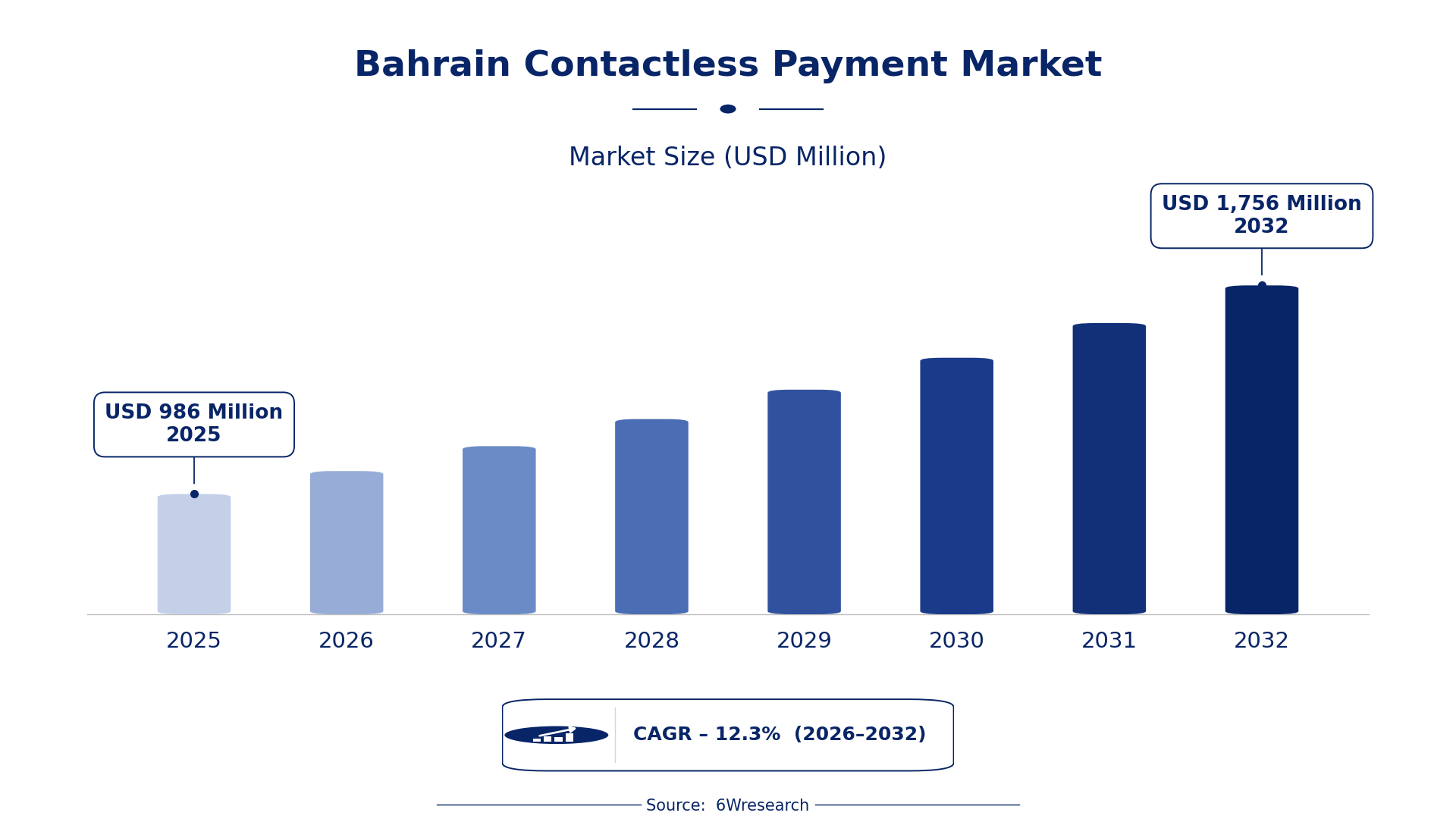
The Bahrain Contactless Payment Market was estimated at USD 986 Million in 2025 and is projected to reach USD 1756 Million by 2032, growing at a CAGR of 12.3% from 2026 to 2032.
Bahrain Contactless Payment Market Synopsis
The adoption of contactless payment technologies in Bahrain is on an upward trajectory, largely fueled by changing consumer preferences for convenience and speed in transactions. Financial institutions, merchants, and consumers are increasingly leaning towards digital solutions, making contactless payment methods more prevalent across various sectors.
As health concerns prompt a shift towards touchless interactions, contactless payment solutions are becoming indispensable in retail, hospitality, and transportation. With ongoing investments in digital payment infrastructure, the market is positioned for sustained growth, driven by both consumer demand and regulatory support.
Bahrain Contactless Payment Market Year-wise Growth Rate and Key Drivers
This graph illustrates the annual growth rates of the Bahrain Contactless Payment Market from 2021 to 2032, highlighting a steady upward trajectory and projected expansion over the forecast period.
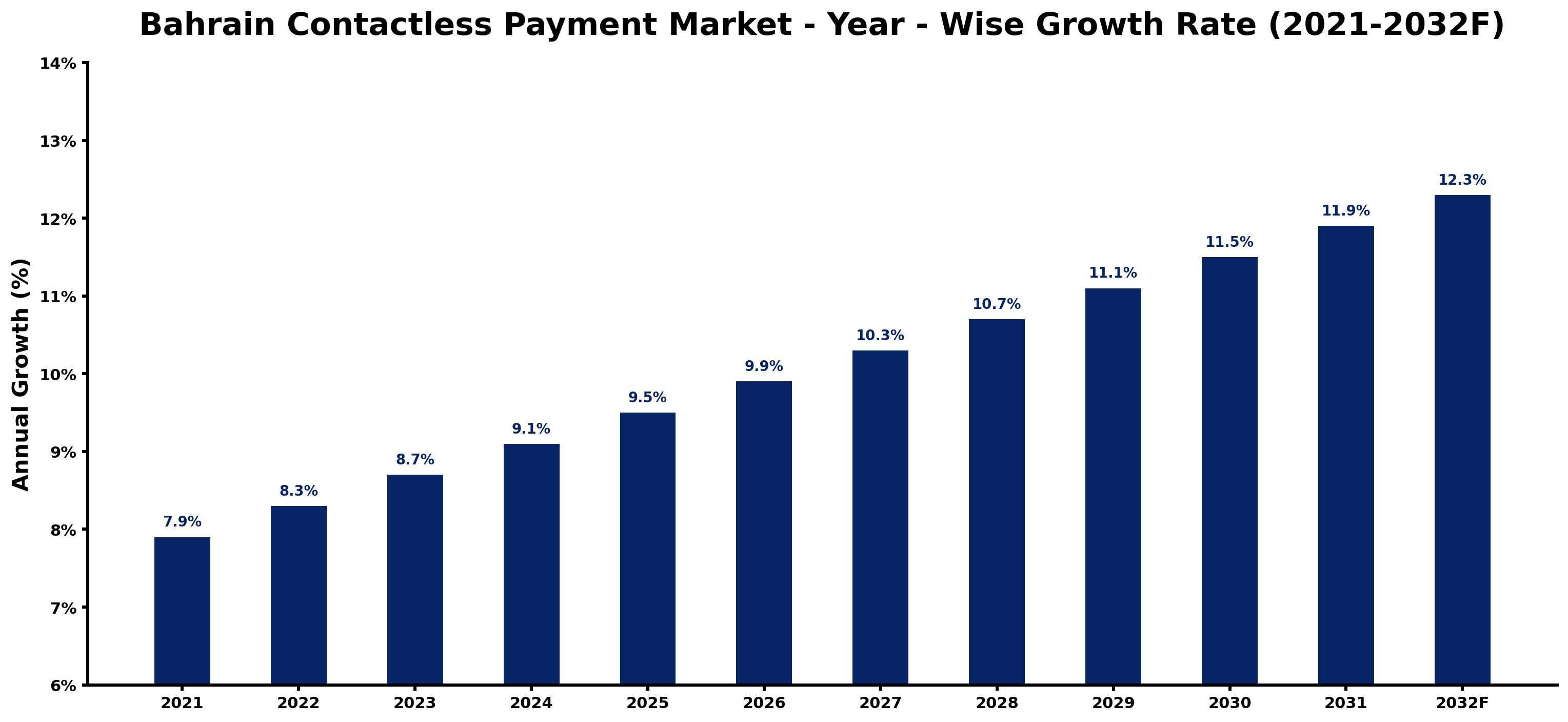
The table below presents the year‑wise growth rates along with the key drivers influencing the market
| Year | Growth Rate | Major Drivers |
| 2021 | 7.9% | Central Bank of Bahrain promotes cashless transactions initiative. |
| 2022 | 8.3% | Increase in smartphone penetration drives app-based payments. |
| 2023 | 8.7% | Bahrain's economic recovery boosts card usage frequency. |
| 2024 | 9.1% | Government incentives for digital wallet adoption launched. |
| 2025 | 9.5% | Growing popularity of e-commerce spurs contactless payment adoption. |
| 2026 | 9.9% | Local banks enhance security features for contactless services. |
| 2027 | 10.3% | Regulatory support for fintech innovations accelerates market growth. |
| 2028 | 10.7% | COVID-19 habits bolster consumer preference for contactless payments. |
| 2029 | 11.1% | Emerging fintechs offer tailored contactless solutions for enterprises. |
| 2030 | 11.5% | Youth demographic increasingly favors seamless payment experiences. |
| 2031 | 11.9% | Integration of loyalty programs with contactless payments expands. |
| 2032 | 12.3% | Growing tourism sector enhances demand for contactless solutions. |
Note: Market size estimations and growth projections presented in this report are based on 6Wresearch's proprietary forecasting methodology, utilizing the latest available industry data, government publications, and primary research inputs.
Bahrain Contactless Payment Market Key Takeaways
Below are some of the specific key takeaways from the market, including:
- The Bahrain Contactless Payment Market is rapidly expanding, driven by increased consumer adoption.
- Mobile wallets and NFC technology are central to the growth of contactless payments.
- Public health concerns are accelerating the demand for hygienic payment solutions.
- Regulatory frameworks are evolving to support secure payment technologies.
- Investment in payment infrastructure is vital for enhancing market accessibility.
Evaluation of Restraints in Bahrain Contactless Payment Market
Despite its promising growth, the Bahrain contactless payment market faces hurdles that could impede its full potential. Consumer reluctance remains a significant barrier, as many individuals are hesitant to shift from traditional cash payments to digital solutions. This skepticism often stems from a lack of understanding about security measures in place.
On the merchant side, the challenge lies in the investment needed to upgrade payment infrastructure. While the benefits of contactless payments are clear, smaller businesses may struggle to justify the costs of adopting new technology, especially without immediate returns. Addressing these concerns is essential for driving widespread adoption.
Bahrain Contactless Payment Market Trends
A noticeable trend in the Bahrain contactless payment market is the rapid integration of mobile wallets into daily transactions. As smartphone penetration increases, consumers are favoring mobile payment solutions over traditional methods. This shift is further enhanced by the rise of digital banking services that facilitate seamless transactions.
Another trend is the emphasis on enhancing security measures. As concerns about fraud and data breaches grow, payment providers are investing in advanced technologies such as biometric authentication and tokenization, which bolster consumer confidence in using contactless methods.
Bahrain Contactless Payment Market Opportunities
The future holds substantial opportunities for growth in the Bahrain contactless payment market, particularly in sectors like e-commerce and transportation. With the surge in online shopping, merchants who adopt contactless payment solutions can enhance customer experience and streamline transactions.
Additionally, partnerships between technology firms and financial institutions could lead to innovative payment solutions tailored to local consumer needs. Expanding educational initiatives to raise awareness about the advantages of contactless payments can also serve as a catalyst for market growth.
Government Initiatives in the Bahrain Contactless Payment Market
Government policies are playing a crucial role in shaping the Bahrain contactless payment market. There is a clear focus on fostering financial inclusion, enhancing payment security, and promoting technological innovation. These initiatives are critical as they establish a supportive environment for the growth of digital payment solutions.
- A regulatory framework introduced in 2025 mandating standards for contactless payment infrastructure to enhance security.
- Currently ongoing consumer education initiatives aimed at increasing awareness and adoption of contactless payment methods.
- A planned public-private initiative to upgrade national digital infrastructure expected to enhance payment accessibility by 2028.
- Incentive programs for merchants to adopt secure payment technologies and infrastructure.
- Collaboration with fintech companies to promote the development of innovative mobile payment solutions.
Future Insights of the Bahrain Contactless Payment Market
Looking ahead to 2026-2032, the Bahrain contactless payment market is set to experience accelerated growth. With the rising acceptance of digital payments, there will be a push for enhanced technological integration across various sectors. Businesses will likely prioritize contactless solutions not only for convenience but also for customer retention in a competitive market.
The market's evolution will also depend on how effectively stakeholders address security concerns and consumer education. As more individuals become comfortable with digital transactions, the market will expand, paving the way for innovative payment solutions that cater to diverse consumer needs.
Bahrain Contactless Payment Market Latest Developments
Recent developments in the Bahrain contactless payment market indicate a strong commitment to enhancing digital payment solutions. Over the past year, various initiatives have emerged that signal a robust shift towards contactless technologies.
- An initiative that began in early 2025 focused on upgrading payment infrastructure in key urban areas, enhancing transaction speed and reliability.
- A leading regional operator launched a new mobile wallet in Q2 2025, enabling users to make contactless payments at multiple retail locations.
- Partnerships formed in late 2025 between banks and fintech firms to develop new contactless payment solutions tailored to small businesses.
- A regulatory review that commenced in early 2025 aimed at updating transaction authentication guidelines for enhanced security.
- Upcoming expansion of contactless payment capabilities in public transportation systems planned for the second half of 2026, promoting wider usage.
Bahrain Contactless Payment Market - Key Attractiveness of the Report
- 10 Years of Market Numbers
- Historical Data Starting from 2022 to 2025
- Base Year: 2025
- Forecast Data until 2032
- Key Performance Indicators Impacting the Market
- Major Upcoming Developments and Projects
Key Highlights of the Report:
- Bahrain Contactless Payment Market Outlook
- Market Size of Bahrain Contactless Payment Market, 2025
- Forecast of Bahrain Contactless Payment Market, 2032
- Historical Data and Forecast of Bahrain Contactless Payment Revenues & Volume for the Period 2022-2032F
- Bahrain Contactless Payment Market Trend Evolution
- Bahrain Contactless Payment Market Drivers and Challenges
- Bahrain Contactless Payment Price Trends
- Bahrain Contactless Payment Porter's Five Forces
- Bahrain Contactless Payment Industry Life Cycle
- Historical Data and Forecast of Bahrain Contactless Payment Market Revenues & Volume By Component for the Period 2022-2032F
- Historical Data and Forecast of Bahrain Contactless Payment Market Revenues & Volume By Hardware for the Period 2022-2032F
- Historical Data and Forecast of Bahrain Contactless Payment Market Revenues & Volume By Solutions for the Period 2022-2032F
- Historical Data and Forecast of Bahrain Contactless Payment Market Revenues & Volume By Services for the Period 2022-2032F
- Historical Data and Forecast of Bahrain Contactless Payment Market Revenues & Volume By Vertical for the Period 2022-2032F
- Historical Data and Forecast of Bahrain Contactless Payment Market Revenues & Volume By Retail for the Period 2022-2032F
- Historical Data and Forecast of Bahrain Contactless Payment Market Revenues & Volume By Hospitality for the Period 2022-2032F
- Historical Data and Forecast of Bahrain Contactless Payment Market Revenues & Volume By Healthcare for the Period 2022-2032F
- Historical Data and Forecast of Bahrain Contactless Payment Market Revenues & Volume By Energy and Utilities for the Period 2022-2032F
- Historical Data and Forecast of Bahrain Contactless Payment Market Revenues & Volume By Transportation and Logistics for the Period 2022-2032F
- Historical Data and Forecast of Bahrain Contactless Payment Market Revenues & Volume By BFSI for the Period 2022-2032F
- Historical Data and Forecast of Bahrain Contactless Payment Market Revenues & Volume By Others (Government, telecommunications, and education) for the Period 2022-2032F
- Bahrain Contactless Payment Import Export Trade Statistics
- Market Opportunity Assessment By Component
- Market Opportunity Assessment By Vertical
- Bahrain Contactless Payment Top Companies Market Share
- Bahrain Contactless Payment Competitive Benchmarking By Technical and Operational Parameters
- Bahrain Contactless Payment Company Profiles
- Bahrain Contactless Payment Key Strategic Recommendations






































