Malaysia Contactless Payment Market Size & Growth Rate (2026-2032)
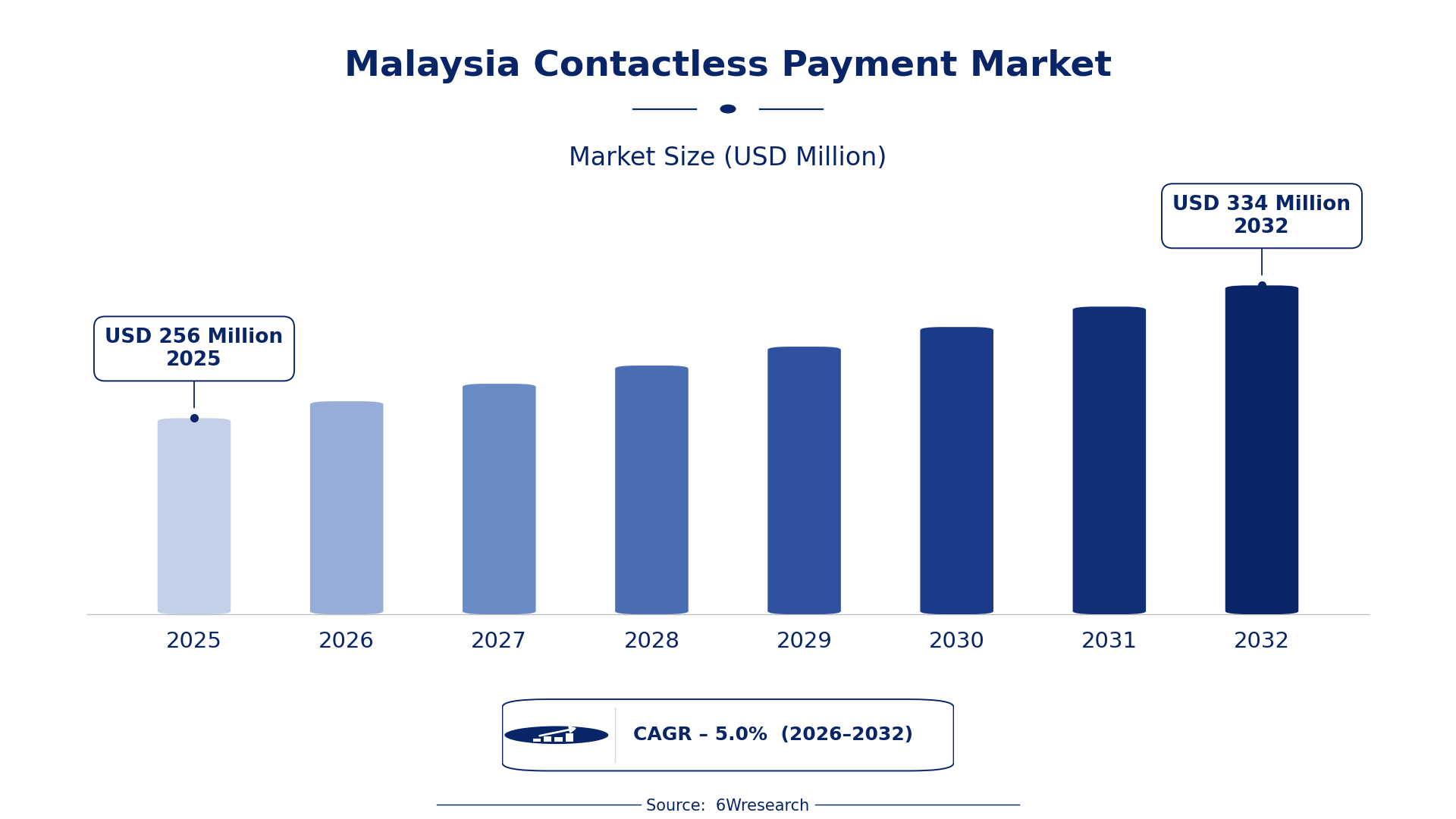
The Malaysia Contactless Payment Market was estimated at USD 256 Million in 2025 and is projected to reach USD 334 Million by 2032, growing at a CAGR of 5.0% from 2026 to 2032.
Malaysia Contactless Payment Market Synopsis
The contactless payment market in Malaysia is gaining momentum, driven by a shift toward cashless transactions and the increasing prevalence of mobile payment options. With consumers prioritizing convenience and security, methods such as NFC-enabled cards and digital wallets are becoming standard practice.
The COVID-19 pandemic significantly accelerated this trend, as more people sought safer payment alternatives. In this dynamic market, both local players and international firms are fiercely competing to capture consumer interest and loyalty, underscoring the vital role of innovation in payment technologies.
Malaysia Contactless Payment Market Year-wise Growth Rate and Key Drivers
This graph illustrates the annual growth rates of the Malaysia Contactless Payment Market from 2021 to 2032, highlighting a steady upward trajectory and projected expansion over the forecast period.
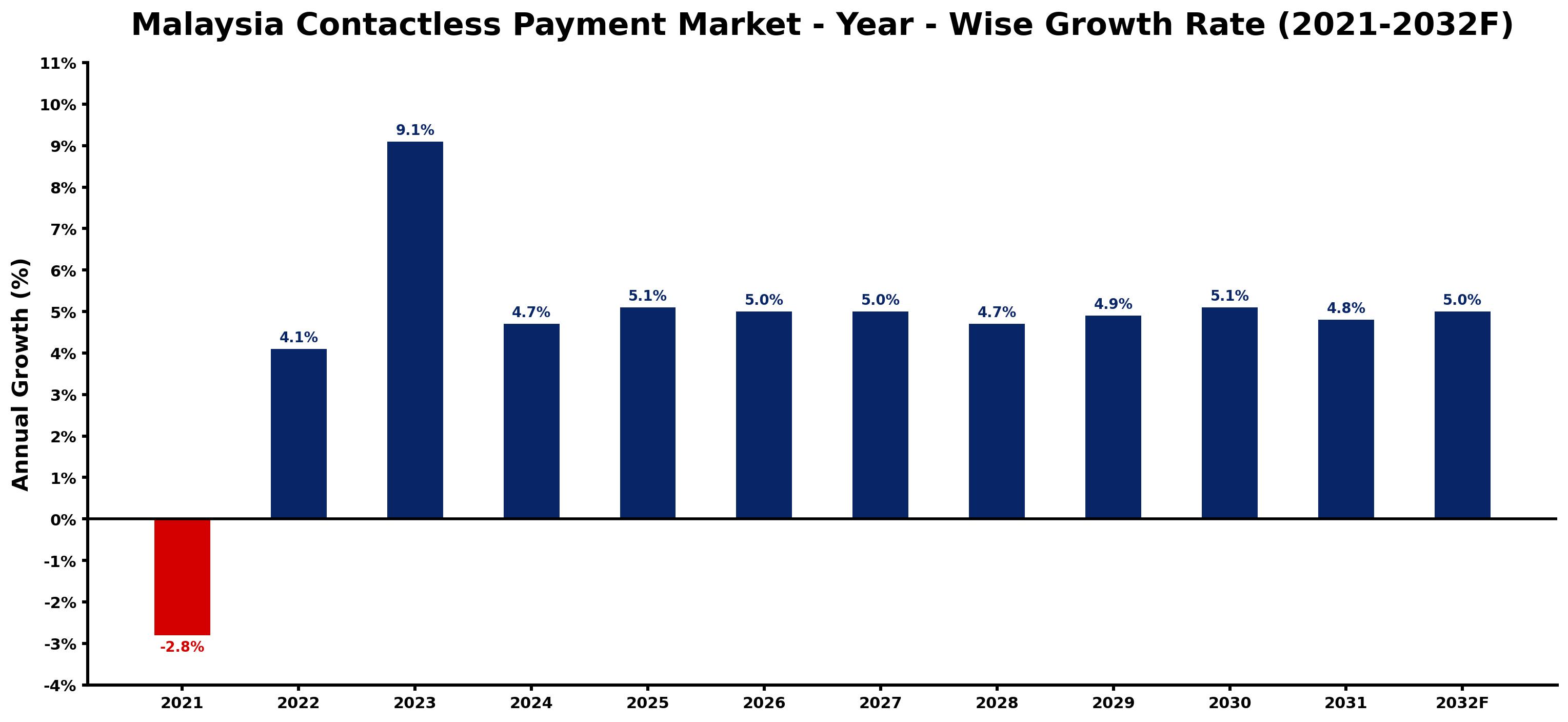
The table below presents the year‑wise growth rates along with the key drivers influencing the market
| Year | Growth Rate | Major Drivers |
| 2021 | -2.8% | Central Bank's regulatory changes hindered contactless adoption. |
| 2022 | 4.1% | Malaysian government's cashless payment initiative promotion. |
| 2023 | 9.1% | Increase in smartphone penetration driving contactless adoption. |
| 2024 | 4.7% | Implementation of national QR payment standard by Bank Negara. |
| 2025 | 5.1% | Rise in e-commerce transactions boosting mobile payment usage. |
| 2026 | 5.0% | Bank Negara's regulations supporting fintech innovation in payments. |
| 2027 | 5.0% | Young population's preference for digital payment solutions. |
| 2028 | 4.7% | Increased merchant acceptance of contactless payment terminals. |
| 2029 | 4.9% | Government incentives for businesses adopting digital payment solutions. |
| 2030 | 5.1% | Partnerships between banks and fintech enhancing payment systems. |
| 2031 | 4.8% | COVID-19 recovery driving sustained digital payment habits. |
| 2032 | 5.0% | Rise of loyalty programs integrating contactless payment options. |
Note: Market size estimations and growth projections presented in this report are based on 6Wresearch's proprietary forecasting methodology, utilizing the latest available industry data, government publications, and primary research inputs.
Malaysia Contactless Payment Market Key Takeaways
Below are some of the specific key takeaways from the market, including:
- Rapid adoption of contactless payments is reshaping consumer behavior in Malaysia.
- Local and international firms are intensifying competition to enhance market share.
- Technological advancements are crucial for meeting rising consumer expectations.
- Infrastructure development remains a key focus for expanding acceptance across sectors.
- Security concerns must be addressed to build consumer trust and confidence.
Evaluation of Restraints in Malaysia Contactless Payment Market
While the market is on an upward trajectory, several restraints are hindering its full potential. Consumer trust issues, particularly around security and data protection, remain a significant barrier. Many potential users are still hesitant to fully embrace contactless payment technologies due to fears of fraud and data breaches. Additionally, uneven infrastructure development across urban and rural areas limits the widespread adoption of these payment methods. Retailers that are slow to adopt this technology further complicate the situation, as consumers may find fewer opportunities to utilize contactless payments in everyday transactions.
Malaysia Contactless Payment Market Trends
A noticeable trend is the increasing integration of loyalty programs with contactless payment systems, appealing to consumers' desire for added value. Additionally, the rise of mobile wallets, especially among younger demographics, is shifting the payment paradigm. Enhanced security features, such as biometric authentication, are becoming prevalent as consumers seek reassurance. Finally, as more businesses accept contactless payments, the market is likely to see an increase in acceptance across a wider range of industries, including retail, hospitality, and transportation.
Malaysia Contactless Payment Market Opportunities
The future holds genuine opportunities for growth, especially in digital wallets that integrate various services, such as e-commerce and peer-to-peer transactions. Companies focusing on enhancing user experience through innovative technology stand to gain substantial market share. on top of that, the expansion of infrastructure to support contactless payments, including partnerships with retailers and financial institutions, will be pivotal. The post-pandemic world presents an opportunity to capitalize on changing consumer behavior, particularly as individuals prioritize hygiene and safety in their payment methods.
Government Initiatives in the Malaysia Contactless Payment Market
Government initiatives are playing a critical role in shaping the Malaysia Contactless Payment Market. Policymakers are increasingly focused on creating a regulatory environment conducive to the growth of digital payment methods. By prioritizing digital infrastructure and cybersecurity, the government is not only boosting the economy but also enhancing public trust in these technologies.
- A national digital infrastructure upgrade programme now in its rollout phase is aimed at improving connectivity and access to contactless payment solutions across the country.
- Ongoing initiatives include partnerships between government bodies and private firms to promote financial literacy and consumer awareness around contactless payments.
- A regulatory framework introduced in 2025 mandating billing transparency seeks to bolster consumer trust in digital transactions.
- Future plans include a public-private initiative expected to expand contactless payment adoption in rural areas by 2028.
Future Insights of the Malaysia Contactless Payment Market
Looking ahead to 2026-2032, the Malaysia Contactless Payment Market is set to flourish. As technology continues to evolve, we can expect further integration of AI and machine learning to personalize user experiences. Enhanced security protocols will likely emerge, addressing consumer concerns about fraud and data safety. Additionally, the growing trend of cross-border transactions through contactless methods could pave the way for increased global acceptance, further solidifying Malaysia's position in the digital economy.
Malaysia Contactless Payment Market Latest Developments
Recent months have seen significant activity within the Malaysia Contactless Payment Market, reflecting a clear trend towards innovation and consumer-centric solutions. Companies are actively investing in technology and partnerships to enhance their offerings, demonstrating a commitment to meeting evolving consumer demands.
- A major technology vendor launched a new mobile wallet feature in early 2025, designed to streamline user experience and improve transaction speed.
- An initiative that began in mid-2025 and remains underway is focused on integrating loyalty rewards with contactless payment methods across various retail sectors.
- In late 2025, a prominent regional operator partnered with local businesses to expand contactless payment acceptance at major event venues.
- A rollout expected to begin in the second half of 2026 will introduce new security measures aimed at enhancing consumer confidence in contactless transactions.
Malaysia Contactless Payment Market - Key Attractiveness of the Report
- 10 Years of Market Numbers
- Historical Data Starting from 2022 to 2025
- Base Year: 2025
- Forecast Data until 2032
- Key Performance Indicators Impacting the Market
- Major Upcoming Developments and Projects
Key Highlights of the Report:
- Malaysia Contactless Payment Market Outlook
- Market Size of Malaysia Contactless Payment Market, 2025
- Forecast of Malaysia Contactless Payment Market, 2032
- Historical Data and Forecast of Malaysia Contactless Payment Revenues & Volume for the Period 2022-2032F
- Malaysia Contactless Payment Market Trend Evolution
- Malaysia Contactless Payment Market Drivers and Challenges
- Malaysia Contactless Payment Price Trends
- Malaysia Contactless Payment Porter's Five Forces
- Malaysia Contactless Payment Industry Life Cycle
- Historical Data and Forecast of Malaysia Contactless Payment Market Revenues & Volume By Component for the Period 2022-2032F
- Historical Data and Forecast of Malaysia Contactless Payment Market Revenues & Volume By Hardware for the Period 2022-2032F
- Historical Data and Forecast of Malaysia Contactless Payment Market Revenues & Volume By Solutions for the Period 2022-2032F
- Historical Data and Forecast of Malaysia Contactless Payment Market Revenues & Volume By Services for the Period 2022-2032F
- Historical Data and Forecast of Malaysia Contactless Payment Market Revenues & Volume By Vertical for the Period 2022-2032F
- Historical Data and Forecast of Malaysia Contactless Payment Market Revenues & Volume By Retail for the Period 2022-2032F
- Historical Data and Forecast of Malaysia Contactless Payment Market Revenues & Volume By Hospitality for the Period 2022-2032F
- Historical Data and Forecast of Malaysia Contactless Payment Market Revenues & Volume By Healthcare for the Period 2022-2032F
- Historical Data and Forecast of Malaysia Contactless Payment Market Revenues & Volume By Energy and Utilities for the Period 2022-2032F
- Historical Data and Forecast of Malaysia Contactless Payment Market Revenues & Volume By Transportation and Logistics for the Period 2022-2032F
- Historical Data and Forecast of Malaysia Contactless Payment Market Revenues & Volume By BFSI for the Period 2022-2032F
- Historical Data and Forecast of Malaysia Contactless Payment Market Revenues & Volume By Others (Government, telecommunications, and education) for the Period 2022-2032F
- Malaysia Contactless Payment Import Export Trade Statistics
- Market Opportunity Assessment By Component
- Market Opportunity Assessment By Vertical
- Malaysia Contactless Payment Top Companies Market Share
- Malaysia Contactless Payment Competitive Benchmarking By Technical and Operational Parameters
- Malaysia Contactless Payment Company Profiles
- Malaysia Contactless Payment Key Strategic Recommendations






































