Bahrain Food Retail Market Summary
The bahrain food retail market was estimated at USD 830 Million in 2025 and is projected to reach USD 1446 Million by 2032, growing at a CAGR of 9.5% from 2026 to 2032.
Bahrain Food Retail Market Year-wise Growth Rate and Key Drivers
This graph highlights how the Bahrain Food Retail Market has steadily grown over the past five years, supported by major growth factors.
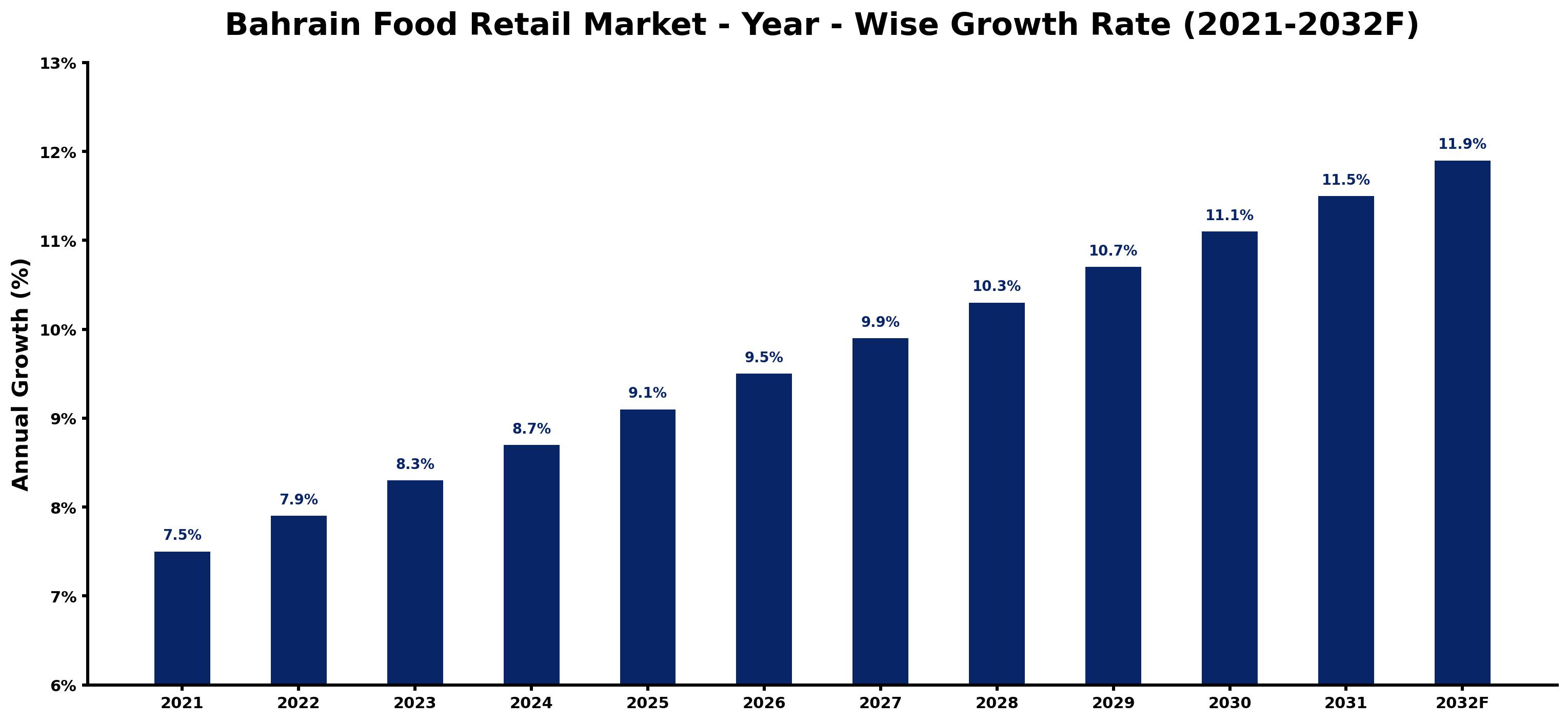
The table below presents the year wise growth rates along with the key drivers influencing the market
| Year | Growth Rate | Major Drivers |
| 2021 | 7.5% | Post-lockdown retail projects revitalized the food sector and attracted consumer interest. |
| 2022 | 7.9% | E-commerce expansion provided a convenient avenue for grocery shopping across Bahrain. |
| 2023 | 8.3% | Local sourcing initiatives gained momentum, enhancing quality and community engagement in offerings. |
| 2024 | 8.7% | Health-conscious trends influenced supermarket layouts and promoted organic product ranges significantly. |
| 2025 | 9.1% | Technological integration streamlined operations, improving inventory management and customer experiences. |
| 2026 | 9.5% | Increased tourism led to diverse culinary options, expanding food retail outlets in key areas. |
| 2027 | 9.9% | Sustainability efforts gained traction, motivating retailers to adopt eco-friendly practices and packaging. |
| 2028 | 10.3% | Urbanization trends prompted the development of modern shopping complexes with comprehensive food sections. |
| 2029 | 10.7% | Culinary festivals and local markets showcased Bahraini cuisine, driving consumer interest in local products. |
| 2030 | 11.1% | The introduction of food delivery apps revolutionized accessibility, reshaping consumer shopping habits. |
| 2031 | 11.5% | Competitive pricing strategies became essential as new entrants entered the food retail sector. |
| 2032 | 11.9% | Cultural shifts towards convenience foods catalyzed product diversification and shelf space competition. |
Note - Market size estimations and growth projections presented in this report are based on 6Wresearch's advanced forecasting approach, validated with industry datasets as of June 2026.
Bahrain Food Retail Market Synopsis
The Bahrain Food Retail Market is projected to reach 9.5% and witness significant growth during the forecast period (2026-2032). This thriving sector, characterized by a blend of traditional souks, supermarkets, and hypermarkets, is experiencing transformative trends driven by evolving consumer preferences, increased disposable incomes, and the increasing urbanization of the population. As consumers gravitate towards convenience, variety and health-focused food options, the market landscape is adapting to meet these changes.
Bahrain Food Retail Market Growth Drivers
The growth trajectory of the Bahrain Food Retail Market is underpinned by several critical factors:
- Population Growth: A consistently growing population is expanding the consumer base, resulting in increased demand for a diverse range of food products.
- Rising Disposable Incomes: As Bahrain's economy continues to develop, consumers are benefiting from higher disposable incomes, enabling them to explore premium grocery options.
- Expansion of Retail Formats: The increasing establishment of supermarkets and hypermarkets is enhancing accessibility to various food products, contributing significantly to market growth.
- Digital Transformation: The shift towards online grocery shopping and e-commerce platforms is reshaping traditional retail, allowing consumers to conveniently purchase products from home.
- Health and Wellness Trends: A burgeoning focus on personal health and nutrition is leading to a surge in demand for organic, gluten-free, and plant-based offerings, influencing retailers to adapt their product lines accordingly.
Bahrain Food Retail Market Challenges and Restraints
Despite its robust growth, the Bahrain Food Retail Market faces formidable challenges:
- Intense Competition: Local retailers are contending with fierce competition from international supermarket chains and online grocery providers, which offer a broad array of products often at competitive prices.
- Health and Organic Sourcing Costs: The shift in consumer preferences towards healthier and organic options necessitates higher sourcing costs that may not always be feasible for local retailers.
- Fluctuations in Global Food Prices: Variations in global food prices can lead to increased costs for imported goods, impacting profit margins and pricing strategies for local retailers.
- Regulatory Compliance: Adhering to stringent food safety and labeling standards requires ongoing investment in quality control systems, which can strain smaller retailers.
- Market Saturation: As international chains expand, the market faces saturation risks, necessitating innovative strategies for local retailers to maintain relevance.
Bahrain Food Retail Market Trends and Opportunities
The evolving dynamics of the Bahrain Food Retail Market present numerous opportunities for investors and retailers:
- Premium Grocery Stores: The growing demand for gourmet and organic products creates opportunities to launch specialty stores catering to health-conscious consumers.
- Online Delivery Services: With the increasing popularity of online shopping, establishing efficient delivery systems can enhance customer convenience and satisfaction.
- International Food Imports: Rising interest in diverse international cuisine offers a niche for businesses focusing on importing specialty food items.
- Health-Conscious Offerings: Retailers can capitalize on the trend towards health-focused products by expanding their selections of organic and gluten-free items.
- Collaborations with Local Producers: Partnering with local producers not only supports the community but also aligns with consumer preferences for fresh, locally-sourced products.
Bahrain Food Retail Market Government Investment and Initiatives
The Bahrain Food Retail Market benefits significantly from government initiatives aimed at bolstering the sector:
- Regulatory Framework: The Bahrain government has established robust regulations to ensure food safety, hygiene, and quality standards in retail outlets, enhancing consumer protection.
- Support for Local Producers: The government actively promotes local food production through financial incentives and tax reductions, encouraging investment in domestic food retail businesses.
- Development Programs: Various public development programs are underway to improve infrastructure, which can facilitate smoother supply chain operations for food retailers.
- Encouragement of Local Sourcing: Policies aimed at promoting locally sourced food products are gaining traction, aligning with the global trend towards sustainable consumption.
- Quality Standards for Imports: The government enforces stringent import policies to ensure that foreign food products meet established safety and quality benchmarks, which ultimately benefits consumer health.
Bahrain Food Retail Market Latest Developments (May 2025 - June 2026)
Recent developments in the Bahrain Food Retail Market highlight a significant shift towards digitalization and health-oriented products. Retailers have increasingly adopted e-commerce platforms, enhancing their online presence and catering to the growing demand for home delivery services. Additionally, local retailers are expanding their offerings of organic and health-focused product lines to meet changing consumer preferences. Innovations in supply chain management technologies have also been implemented, improving efficiency and product availability. Moreover, collaborations between local producers and retailers are fostering community support and offering fresher, locally sourced products to consumers.
Bahrain Food Retail Market - Key Attractiveness of the Report
- 10 Years of Market Numbers
- Historical Data Starting from 2022 to 2025
- Base Year: 2025
- Forecast Data until 2032
- Key Performance Indicators Impacting the Market
- Major Upcoming Developments and Projects
Key Highlights of the Report:
- Bahrain Food Retail Market Outlook
- Market Size of Bahrain Food Retail Market, 2025
- Forecast of Bahrain Food Retail Market, 2032F
- Historical Data and Forecast of Bahrain Food Retail Revenues & Volume for the Period 2022-2032F
- Bahrain Food Retail Market Trend Evolution
- Bahrain Food Retail Market Drivers and Challenges
- Bahrain Food Retail Price Trends
- Bahrain Food Retail Porter's Five Forces
- Bahrain Food Retail Industry Life Cycle
- Historical Data and Forecast of Bahrain Food Retail Market Revenues & Volume By Product Types for the Period 2022-2032F
- Historical Data and Forecast of Bahrain Food Retail Market Revenues & Volume By Unpackaged Food for the Period 2022-2032F
- Historical Data and Forecast of Bahrain Food Retail Market Revenues & Volume By Packaged Food for the Period 2022-2032F
- Historical Data and Forecast of Bahrain Food Retail Market Revenues & Volume By Drinks for the Period 2022-2032F
- Historical Data and Forecast of Bahrain Food Retail Market Revenues & Volume By Household Products for the Period 2022-2032F
- Historical Data and Forecast of Bahrain Food Retail Market Revenues & Volume By Packaging Types for the Period 2022-2032F
- Historical Data and Forecast of Bahrain Food Retail Market Revenues & Volume By Boxes for the Period 2022-2032F
- Historical Data and Forecast of Bahrain Food Retail Market Revenues & Volume By Cans for the Period 2022-2032F
- Historical Data and Forecast of Bahrain Food Retail Market Revenues & Volume By Cellophane Wrapping for the Period 2022-2032F
- Historical Data and Forecast of Bahrain Food Retail Market Revenues & Volume By Cylindrical Cardboard for the Period 2022-2032F
- Bahrain Food Retail Import Export Trade Statistics
- Market Opportunity Assessment By Product Types
- Market Opportunity Assessment By Packaging Types
- Bahrain Food Retail Top Companies Market Share
- Bahrain Food Retail Competitive Benchmarking By Technical and Operational Parameters
- Bahrain Food Retail Company Profiles
- Bahrain Food Retail Key Strategic Recommendations






































