Bahrain Hams, Shoulders and Cuts of Swine Market: Import Trend Analysis
In the Bahrain hams, shoulders, and cuts of swine market, imports experienced a growth rate of 10.53% from 2023 to 2024, contrasting with a compound annual growth rate (CAGR) of -5.56% for the period 2020-2024. This shift could be attributed to evolving consumer preferences or changes in trade policies impacting import momentum.
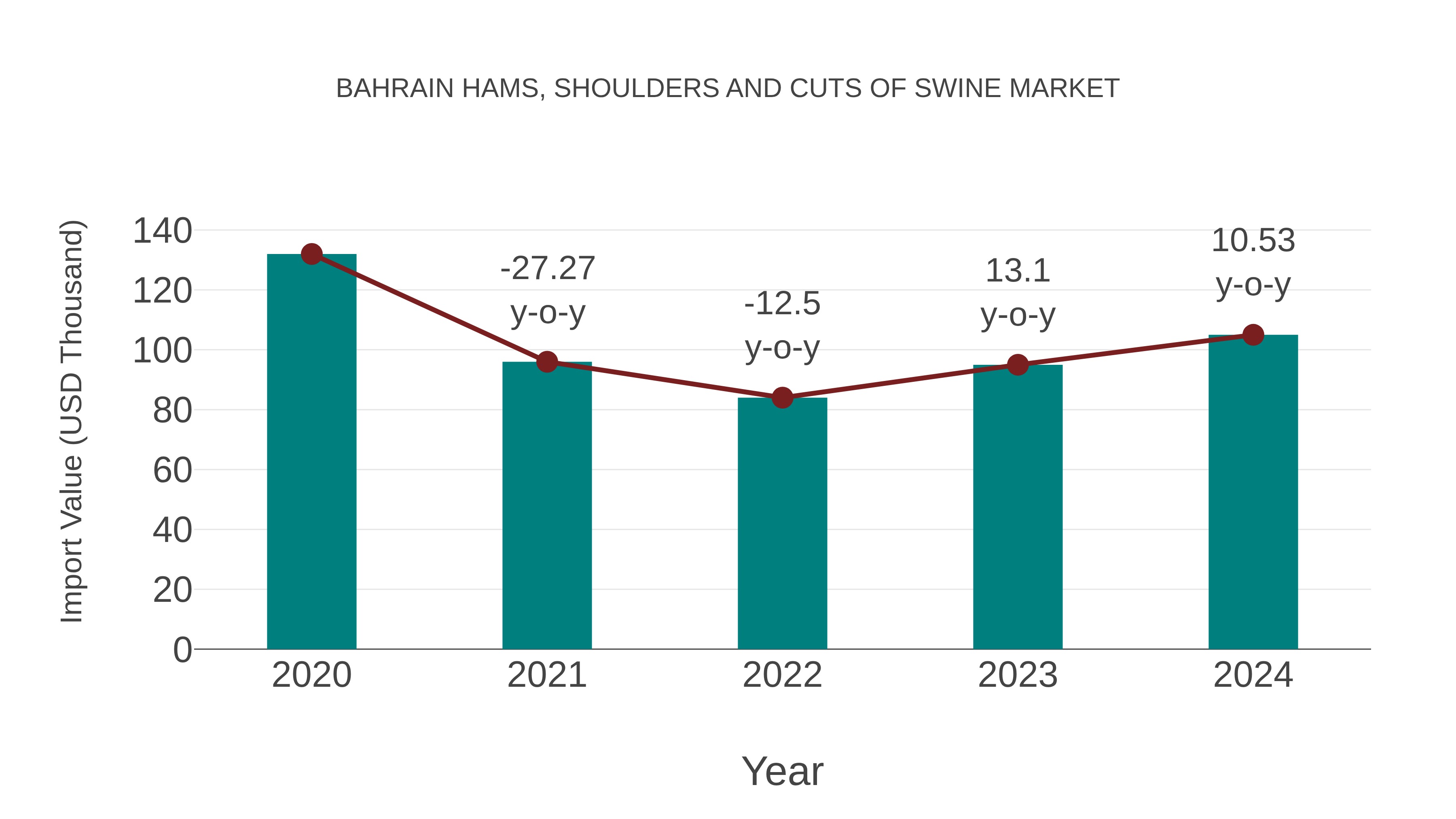
Bahrain Hams Shoulders and Cuts of Swine Market Synopsis
This market segment is limited in Bahrain due to religious constraints, similar to the broader pork market. However, select retail outlets catering to non-Muslims offer imported products such as hams and pork shoulders. The demand is modest and focused on expatriates, hotels, and specific restaurants.
Trends of the market
Due to cultural and religious norms in Bahrain, the market for swine meat including hams and shoulders is minimal and highly regulated. However, there is a niche demand within expatriate communities and the hospitality sector that caters to international visitors. Imports from Europe and the Americas dominate this highly specialized segment. Availability is generally limited to select hotel chains and international grocery retailers with appropriate licensing. Market trends show slow growth and are heavily dependent on tourism and expatriate population dynamics. Regulatory compliance and certification standards are strictly enforced in this sector.
Challenges of the market
This segment of the pork industry is highly niche in Bahrain due to religious restrictions on pork consumption. Products like ham and pork shoulder cater almost exclusively to non-Muslim expatriates and require separate handling and retail spaces. High import duties and limited shelf space in stores make these products expensive and scarce. Licensing and regulatory compliance for businesses selling pork adds to operational costs. The lack of local production and marketing limits consumer engagement. These factors severely restrict market scalability.
Investment opportunities in the Market
Similar to the general pork market, hams and specialty swine cuts are niche but viable within Bahrains regulated import and distribution framework. These products are primarily consumed by expats, international tourists, and diplomatic or business communities. Investment opportunities lie in high-end food retail and hospitality supply chains, focusing on premium and gourmet offerings. Careful branding, storage, and discrete distribution are essential due to cultural sensitivities. Importers must work within strict guidelines while ensuring consistent quality and supply.
Government Policy of the market
The market for hams, shoulders, and cuts of swine in Bahrain is limited due to religious restrictions that prohibit the consumption of pork among the Muslim majority. While pork products are not widely consumed in Bahrain, there is still a niche market for these products, catering primarily to expatriates and non-Muslim communities. The Bahrain Food and Drug Authority (BFDA) oversees the importation and regulation of pork products, ensuring they meet safety standards and are segregated from halal products. Government policies are tailored to respect Bahrains cultural and religious values while accommodating the needs of its diverse population. The demand for pork products is small but steady, driven by expatriate communities from countries where pork consumption is common. As the market remains niche, it is unlikely to experience significant growth but will continue to serve specific demand segments.
Key Highlights of the Report:
- Bahrain Hams, Shoulders and Cuts of Swine Market Outlook
- Market Size of Bahrain Hams, Shoulders and Cuts of Swine Market, 2025
- Forecast of Bahrain Hams, Shoulders and Cuts of Swine Market, 2032
- Historical Data and Forecast of Bahrain Hams, Shoulders and Cuts of Swine Revenues & Volume for the Period 2022 - 2032F
- Bahrain Hams, Shoulders and Cuts of Swine Market Trend Evolution
- Bahrain Hams, Shoulders and Cuts of Swine Market Drivers and Challenges
- Bahrain Hams, Shoulders and Cuts of Swine Price Trends
- Bahrain Hams, Shoulders and Cuts of Swine Porter's Five Forces
- Bahrain Hams, Shoulders and Cuts of Swine Industry Life Cycle
- Historical Data and Forecast of Bahrain Hams, Shoulders and Cuts of Swine Market Revenues & Volume By Product Type for the Period 2022 - 2032F
- Historical Data and Forecast of Bahrain Hams, Shoulders and Cuts of Swine Market Revenues & Volume By Processed Meat for the Period 2022 - 2032F
- Historical Data and Forecast of Bahrain Hams, Shoulders and Cuts of Swine Market Revenues & Volume By Frozen Meat for the Period 2022 - 2032F
- Historical Data and Forecast of Bahrain Hams, Shoulders and Cuts of Swine Market Revenues & Volume By Chilled Meat for the Period 2022 - 2032F
- Historical Data and Forecast of Bahrain Hams, Shoulders and Cuts of Swine Market Revenues & Volume By Canned Meat for the Period 2022 - 2032F
- Historical Data and Forecast of Bahrain Hams, Shoulders and Cuts of Swine Market Revenues & Volume By Fresh Meat for the Period 2022 - 2032F
- Historical Data and Forecast of Bahrain Hams, Shoulders and Cuts of Swine Market Revenues & Volume By Animal Type for the Period 2022 - 2032F
- Historical Data and Forecast of Bahrain Hams, Shoulders and Cuts of Swine Market Revenues & Volume By Cattle and Buffalo for the Period 2022 - 2032F
- Historical Data and Forecast of Bahrain Hams, Shoulders and Cuts of Swine Market Revenues & Volume By Pig for the Period 2022 - 2032F
- Historical Data and Forecast of Bahrain Hams, Shoulders and Cuts of Swine Market Revenues & Volume By Poultry for the Period 2022 - 2032F
- Historical Data and Forecast of Bahrain Hams, Shoulders and Cuts of Swine Market Revenues & Volume By Sheep and Goat for the Period 2022 - 2032F
- Historical Data and Forecast of Bahrain Hams, Shoulders and Cuts of Swine Market Revenues & Volume By Other Animals for the Period 2022 - 2032F
- Historical Data and Forecast of Bahrain Hams, Shoulders and Cuts of Swine Market Revenues & Volume By Distribution Channel for the Period 2022 - 2032F
- Historical Data and Forecast of Bahrain Hams, Shoulders and Cuts of Swine Market Revenues & Volume By Business to Consumers (B2C) for the Period 2022 - 2032F
- Historical Data and Forecast of Bahrain Hams, Shoulders and Cuts of Swine Market Revenues & Volume By Modern Groceries for the Period 2022 - 2032F
- Historical Data and Forecast of Bahrain Hams, Shoulders and Cuts of Swine Market Revenues & Volume By Wet & Butcher Shops for the Period 2022 - 2032F
- Historical Data and Forecast of Bahrain Hams, Shoulders and Cuts of Swine Market Revenues & Volume By Convenience Stores for the Period 2022 - 2032F
- Historical Data and Forecast of Bahrain Hams, Shoulders and Cuts of Swine Market Revenues & Volume By Business to Business (B2B) for the Period 2022 - 2032F
- Historical Data and Forecast of Bahrain Hams, Shoulders and Cuts of Swine Market Revenues & Volume By Other Channel for the Period 2022 - 2032F
- Bahrain Hams, Shoulders and Cuts of Swine Import Export Trade Statistics
- Market Opportunity Assessment By Product Type
- Market Opportunity Assessment By Animal Type
- Market Opportunity Assessment By Distribution Channel
- Bahrain Hams, Shoulders and Cuts of Swine Top Companies Market Share
- Bahrain Hams, Shoulders and Cuts of Swine Competitive Benchmarking By Technical and Operational Parameters
- Bahrain Hams, Shoulders and Cuts of Swine Company Profiles
- Bahrain Hams, Shoulders and Cuts of Swine Key Strategic Recommendations






































