Bahrain Logistics Automation Market Size & Growth Rate (2026-2032)
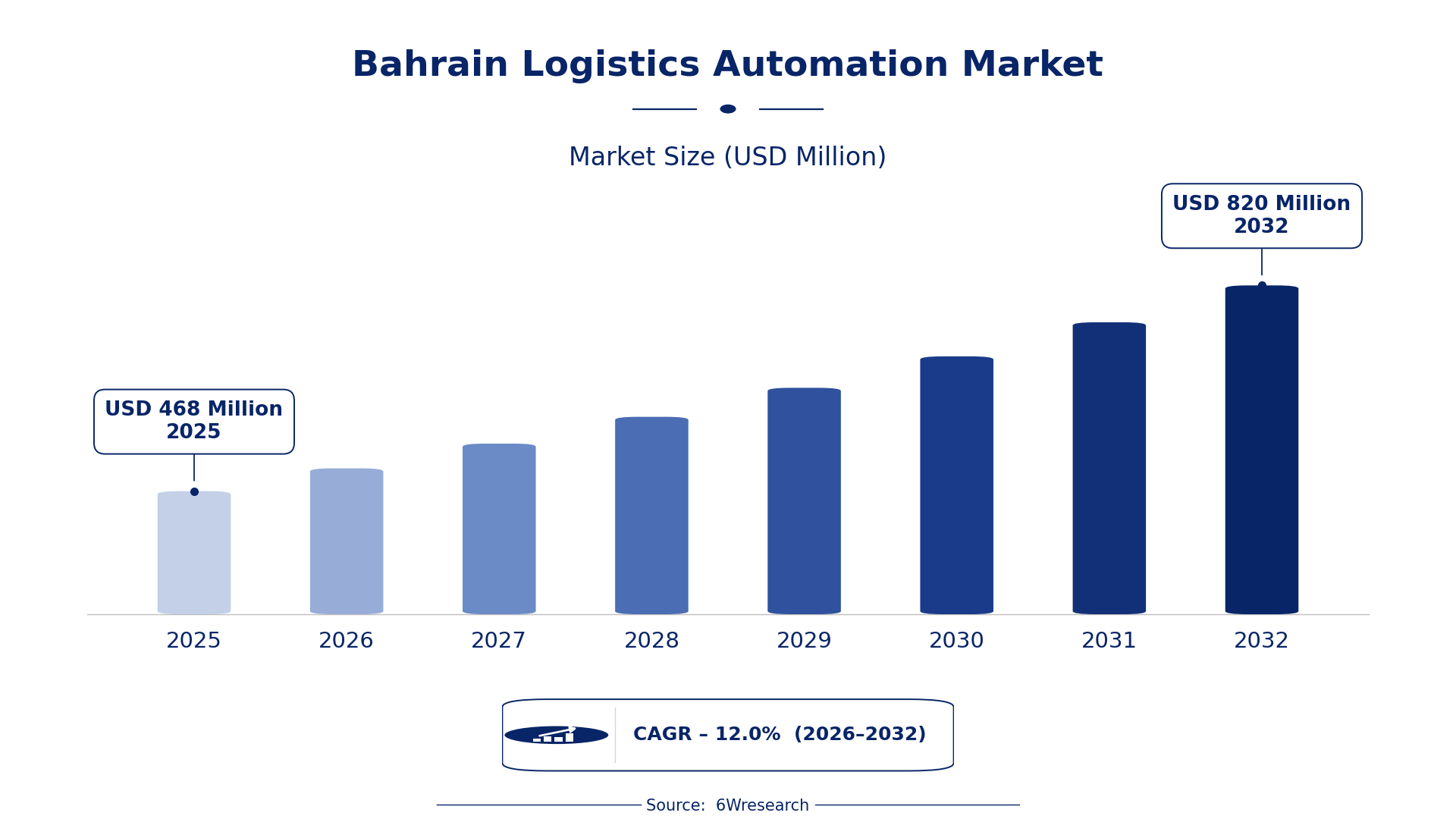
The Bahrain Logistics Automation Market was estimated at USD 468 Million in 2025 and is projected to reach USD 820 Million by 2032, growing at a CAGR of 12.0% from 2026 to 2032.
Bahrain Logistics Automation Market Synopsis
The Bahrain Logistics Automation Market is currently experiencing a surge, driven by increasing demand for efficient supply chain operations. As e-commerce expands and trade networks become more complex, the need for automation solutions has never been more pressing.
Looking ahead, Bahrain's strategic location and favorable investment policies are set to attract even more players in the logistics sector. This combination of factors suggests a strong growth trajectory for logistics automation in the coming years.
Bahrain Logistics Automation Market Year-wise Growth Rate and Key Drivers
This graph illustrates the annual growth rates of the Bahrain Logistics Automation Market from 2021 to 2032, highlighting a steady upward trajectory and projected expansion over the forecast period.
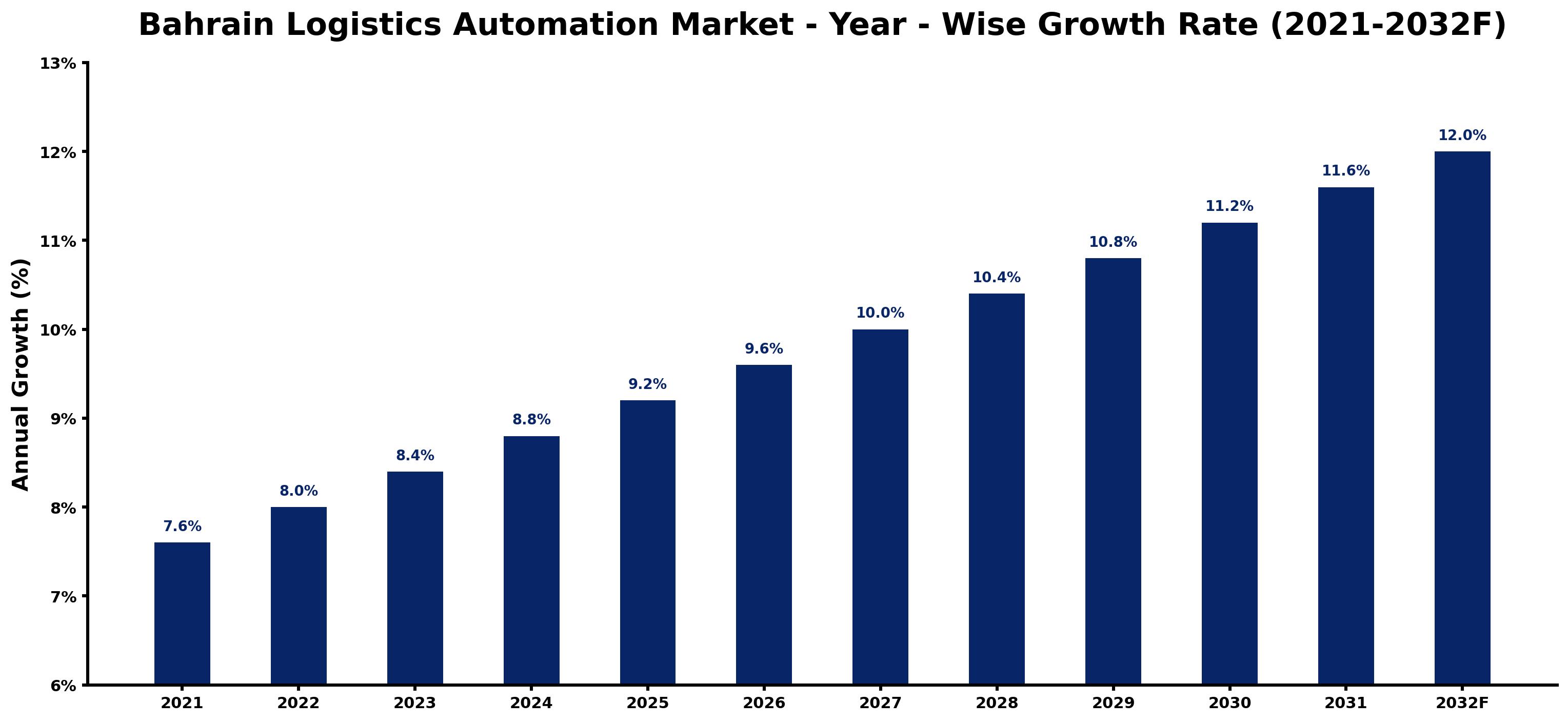
The table below presents the year‑wise growth rates along with the key drivers influencing the market
| Year | Growth Rate | Major Drivers |
| 2021 | 7.6% | Bahrain’s Logistics Vision 2030 boosting automation initiatives. |
| 2022 | 8.0% | Increased investment in AI technologies for logistics efficiency. |
| 2023 | 8.4% | Government subsidies for automated warehousing technologies. |
| 2024 | 8.8% | Growth in fintech fueling logistics and payment automation. |
| 2025 | 9.2% | Bahrain's strategic location enhancing regional shipping automation. |
| 2026 | 9.6% | Increased adoption of IoT in supply chain management. |
| 2027 | 10.0% | Local startups innovating in logistics robotics technology. |
| 2028 | 10.4% | Bahrain Maritime Authority promoting smart port solutions. |
| 2029 | 10.8% | Improved connectivity infrastructure enhancing automated logistics services. |
| 2030 | 11.2% | Digital transformation initiatives under Bahrain Economic Vision 2030. |
| 2031 | 11.6% | Rising tech talent pool driving automation solutions uptake. |
| 2032 | 12.0% | Sustainability initiatives prompting green logistics automation trends. |
Note: Market size estimations and growth projections presented in this report are based on 6Wresearch's proprietary forecasting methodology, utilizing the latest available industry data, government publications, and primary research inputs.
Bahrain Logistics Automation Market Key Takeaways
Below are some of the specific key takeaways from the market, including:
- The market's growth is significantly influenced by government initiatives focused on logistics infrastructure.
- There is a notable uptick in the adoption of automation technologies among logistics companies in Bahrain.
- The rise of e-commerce is creating a strong demand for efficient logistics solutions.
- Initial investment costs and integration challenges are the main obstacles to rapid adoption.
- Bahrain's favorable geographical location enhances its attractiveness for logistics operations.
Evaluation of Restraints in Bahrain Logistics Automation Market
Despite the promising growth of the Bahrain Logistics Automation Market, significant barriers exist. The initial capital required for implementing automation solutions can be daunting for many businesses. This financial burden is compounded by the complexities of integrating new technologies with existing systems. Many companies fear disruptions to their operations, which often leads to hesitation in adopting automation. Consequently, these factors can stifle growth and slow the pace of innovation in the sector.
Bahrain Logistics Automation Market Trends
As the market evolves, several key trends are emerging. First, the use of artificial intelligence in logistics management is gaining traction, allowing for smarter decision-making and improved efficiency. Second, there's an increased focus on data analytics, enabling companies to optimize their supply chain operations. Third, automation in warehousing is becoming more prevalent, as businesses look to reduce labor costs and improve accuracy. Together, these trends are shaping a more streamlined and responsive logistics environment in Bahrain.
Bahrain Logistics Automation Market Opportunities
The Bahrain Logistics Automation Market presents several avenues for growth. Companies that invest in cutting-edge technologies, such as robotics and AI, stand to gain a competitive edge. Additionally, with the rise of e-commerce, there is a growing need for logistics services tailored to online retail. Partnerships between technology providers and logistics firms can also unlock new efficiencies, making it a ripe area for investment.
Government Initiatives in the Bahrain Logistics Automation Market
The Bahraini government is actively shaping the logistics automation sector through various strategic initiatives. These policies aim to streamline customs processes, bolster transportation infrastructure, and promote the adoption of automation technologies. Such government support is crucial for enhancing the efficiency and competitiveness of the logistics industry, directly impacting the market's growth potential.
- A recently completed infrastructure upgrade has improved connectivity at key logistics hubs, facilitating smoother operations.
- A current initiative is underway to reduce customs clearance times, enhancing overall operational efficiency in the logistics sector.
- Future plans include a comprehensive regulatory framework expected to incentivize automation technology adoption by 2027.
- The government has introduced funding programs aimed at assisting small and medium-sized enterprises in transitioning to automated logistics solutions.
- A planned public-private partnership will enhance digital infrastructure to support logistics operations by 2026.
Future Insights of the Bahrain Logistics Automation Market
From 2026 to 2032, the Bahrain Logistics Automation Market is projected to undergo transformative changes. With increased investment in automation technologies, businesses will likely see enhanced efficiency and reduced operational costs. The continued expansion of e-commerce will necessitate further advancements in logistics capabilities, driving demand for innovative solutions. As companies adapt to these shifts, Bahrain’s logistics sector is set to become a regional hub for automated logistics solutions.
Bahrain Logistics Automation Market Latest Developments
Recent activity in the Bahrain Logistics Automation Market indicates a trend towards greater technological adoption. Over the past year, companies have been increasingly focused on integrating advanced automation solutions to stay competitive. This shift is reflective of broader trends in the logistics industry, where efficiency and speed are paramount.
- A major technology vendor launched an advanced warehouse management system in Q1 2025, aimed at optimizing inventory control.
- An initiative that began in mid-2025 is focusing on training logistics personnel in the use of new automation technologies.
- A partnership between logistics firms is currently underway to develop a shared automated delivery network, expected to enhance last-mile delivery efficiencies.
- Upcoming in early 2026, a pilot program for autonomous vehicles in logistics operations is set to commence, showcasing Bahrain's commitment to innovation.
Bahrain Logistics Automation Market - Key Attractiveness of the Report
- 10 Years of Market Numbers
- Historical Data Starting from 2022 to 2025
- Base Year: 2025
- Forecast Data until 2032
- Key Performance Indicators Impacting the Market
- Major Upcoming Developments and Projects
Key Highlights of the Report:
- Bahrain Logistics Automation Market Outlook
- Market Size of Bahrain Logistics Automation Market, 2025
- Forecast of Bahrain Logistics Automation Market, 2032
- Historical Data and Forecast of Bahrain Logistics Automation Revenues & Volume for the Period 2022-2032F
- Bahrain Logistics Automation Market Trend Evolution
- Bahrain Logistics Automation Market Drivers and Challenges
- Bahrain Logistics Automation Price Trends
- Bahrain Logistics Automation Porter's Five Forces
- Bahrain Logistics Automation Industry Life Cycle
- Historical Data and Forecast of Bahrain Logistics Automation Market Revenues & Volume By Function for the Period 2022-2032F
- Historical Data and Forecast of Bahrain Logistics Automation Market Revenues & Volume By Inventory and Storage Management for the Period 2022-2032F
- Historical Data and Forecast of Bahrain Logistics Automation Market Revenues & Volume By Transportation logistics for the Period 2022-2032F
- Historical Data and Forecast of Bahrain Logistics Automation Market Revenues & Volume By Vertical for the Period 2022-2032F
- Historical Data and Forecast of Bahrain Logistics Automation Market Revenues & Volume By Retail & eCommerce for the Period 2022-2032F
- Historical Data and Forecast of Bahrain Logistics Automation Market Revenues & Volume By Manufacturing for the Period 2022-2032F
- Historical Data and Forecast of Bahrain Logistics Automation Market Revenues & Volume By Healthcare & Pharmaceuticals for the Period 2022-2032F
- Historical Data and Forecast of Bahrain Logistics Automation Market Revenues & Volume By Food & Beverages for the Period 2022-2032F
- Historical Data and Forecast of Bahrain Logistics Automation Market Revenues & Volume By Automotive for the Period 2022-2032F
- Historical Data and Forecast of Bahrain Logistics Automation Market Revenues & Volume By Aerospace and Defense for the Period 2022-2032F
- Historical Data and Forecast of Bahrain Logistics Automation Market Revenues & Volume By Chemicals for the Period 2022-2032F
- Historical Data and Forecast of Bahrain Logistics Automation Market Revenues & Volume By Other Verticals (paper and printing, and textiles and clothing) for the Period 2022-2032F
- Historical Data and Forecast of Bahrain Logistics Automation Market Revenues & Volume By Organization Size for the Period 2022-2032F
- Historical Data and Forecast of Bahrain Logistics Automation Market Revenues & Volume By SMES for the Period 2022-2032F
- Historical Data and Forecast of Bahrain Logistics Automation Market Revenues & Volume By Large Enterprises for the Period 2022-2032F
- Historical Data and Forecast of Bahrain Logistics Automation Market Revenues & Volume By Logistics Type for the Period 2022-2032F
- Historical Data and Forecast of Bahrain Logistics Automation Market Revenues & Volume By Sales Logistics for the Period 2022-2032F
- Historical Data and Forecast of Bahrain Logistics Automation Market Revenues & Volume By Production Logistics for the Period 2022-2032F
- Historical Data and Forecast of Bahrain Logistics Automation Market Revenues & Volume By Recovery Logistics for the Period 2022-2032F
- Historical Data and Forecast of Bahrain Logistics Automation Market Revenues & Volume By Procurement Logistics for the Period 2022-2032F
- Historical Data and Forecast of Bahrain Logistics Automation Market Revenues & Volume By Software Application for the Period 2022-2032F
- Historical Data and Forecast of Bahrain Logistics Automation Market Revenues & Volume By Inventory Management for the Period 2022-2032F
- Historical Data and Forecast of Bahrain Logistics Automation Market Revenues & Volume By Order Management for the Period 2022-2032F
- Historical Data and Forecast of Bahrain Logistics Automation Market Revenues & Volume By Yard Management for the Period 2022-2032F
- Historical Data and Forecast of Bahrain Logistics Automation Market Revenues & Volume By Shipping Management for the Period 2022-2032F
- Historical Data and Forecast of Bahrain Logistics Automation Market Revenues & Volume By Labor Management for the Period 2022-2032F
- Historical Data and Forecast of Bahrain Logistics Automation Market Revenues & Volume By Vendor Management for the Period 2022-2032F
- Historical Data and Forecast of Bahrain Logistics Automation Market Revenues & Volume By Customer Support for the Period 2022-2032F
- Bahrain Logistics Automation Import Export Trade Statistics
- Market Opportunity Assessment By Function
- Market Opportunity Assessment By Vertical
- Market Opportunity Assessment By Organization Size
- Market Opportunity Assessment By Logistics Type
- Market Opportunity Assessment By Software Application
- Bahrain Logistics Automation Top Companies Market Share
- Bahrain Logistics Automation Competitive Benchmarking By Technical and Operational Parameters
- Bahrain Logistics Automation Company Profiles
- Bahrain Logistics Automation Key Strategic Recommendations






































