Bahrain Oil & Gas Pumps Market Size, Share & Growth Rate
The Bahrain Oil & Gas Pumps Market was estimated at USD 1438 Million in 2025 and is projected to reach USD 2660 Million by 2032, growing at a CAGR of 9.2% from 2026 to 2032. This significant growth is propelled by Bahrain's continued investments in enhancing its oil and gas infrastructure, especially in response to the increasing demand for high-efficiency pumps capable of withstanding challenging operational conditions. The rise of smart pump systems and a push for energy-efficient designs are also playing vital roles in shaping the future of this market.
Bahrain Oil & Gas Pumps Market Year-wise Growth Rate and Key Drivers
This graph highlights how the Bahrain Oil & Gas Pumps Market has steadily grown over the years, supported by major growth factors.
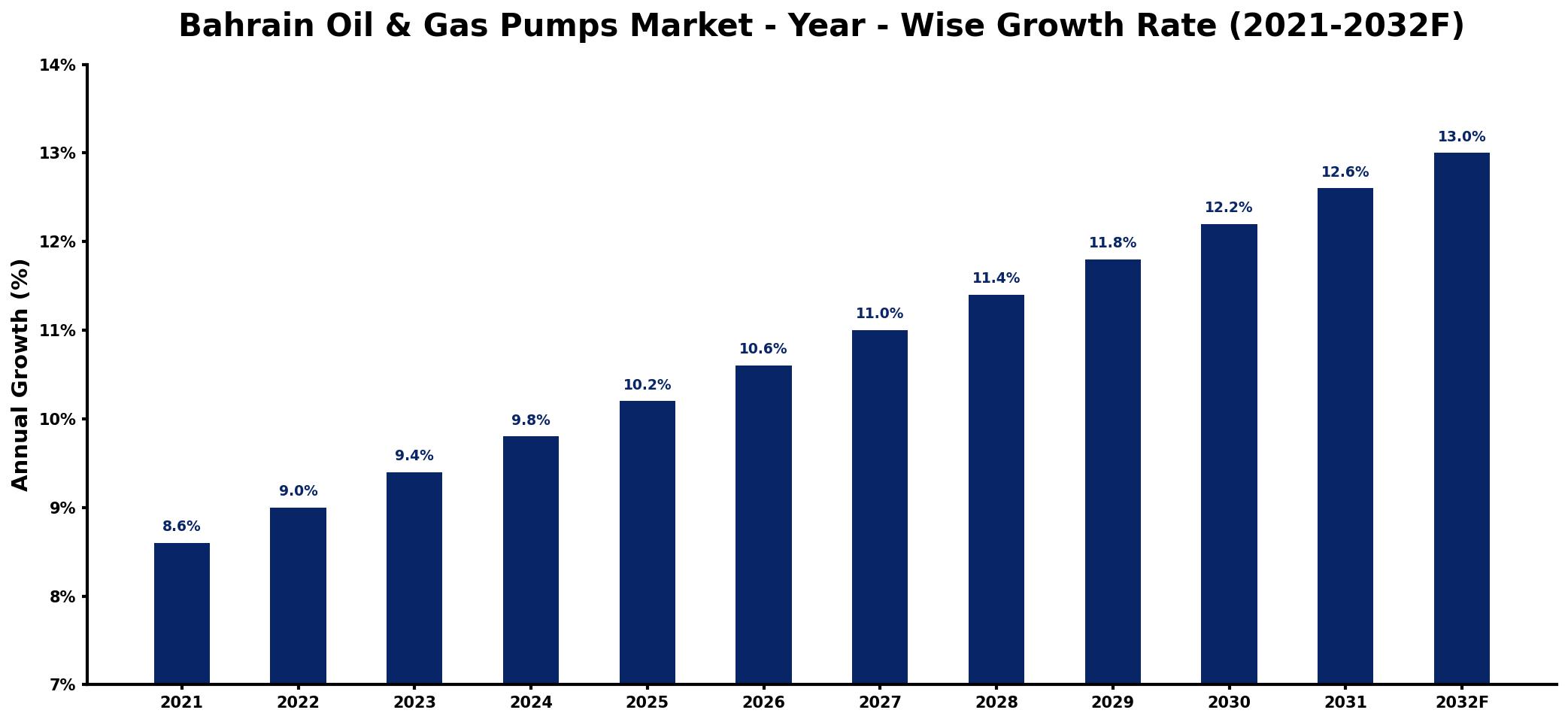
The table below presents the year‑wise growth rates along with the key drivers influencing the market
| Year | Growth Rate | Major Drivers |
| 2021 | 8.6% | Increased industrial infrastructure investments |
| 2022 | 9.0% | Rising energy sector demand growth |
| 2023 | 9.4% | Expansion of renewable energy projects |
| 2024 | 9.8% | Boost in regional construction activities |
| 2025 | 10.2% | Technological advancements in energy |
| 2026 | 10.6% | Growing demand for automation solutions |
| 2027 | 11.0% | Investment in energy efficiency initiatives |
| 2028 | 11.4% | Development of new energy policies |
| 2029 | 11.8% | Enhancement of logistics and distribution |
| 2030 | 12.2% | Surge in urbanization and development |
| 2031 | 12.6% | Focus on sustainability and innovation |
| 2032 | 13.0% | Increase in export market opportunities |
Note: Market size estimations and growth projections presented in this report are based on 6Wresearch's proprietary forecasting methodology, utilizing the latest available industry data, government publications, and primary research inputs.
Bahrain Oil & Gas Pumps Market Synopsis
In Bahrain, the demand for pumps that can endure high pressures and extreme temperatures is critical, particularly within the oil extraction sector. This demand is further emphasized by the governments ongoing refinery modernization projects, necessitating reliable pumping solutions that align with stringent operational standards.
Moreover, the emergence of advanced technologies, such as energy-efficient designs and smart pump systems with real-time monitoring capabilities, is redefining market expectations. Such innovations not only improve operational efficiency but also help operators meet environmental regulations while reducing overall operational costs.
- The market is set for robust growth, driven by infrastructure investments and technological advancements.
- High-efficiency pumps tailored for extreme conditions are in increasing demand across various sectors.
- Government support plays a significant role in stimulating market stability and growth.
- Challenges from global oil price volatility and competition remain pivotal considerations for stakeholders.
- Smart technologies and energy-saving solutions are reshaping the competitive landscape of the market.
Despite the growth prospects, the Bahrain Oil & Gas Pumps Market faces notable restraints. The volatility of global oil prices directly influences investment strategies, leading to uncertainty in the sector. Furthermore, the relatively small scale of Bahrain's oil industry compared to its Gulf neighbors limits the overall demand for specialized pumping equipment. Coupled with high import costs for advanced technologies and pressure from established international suppliers, these factors create a challenging environment for local businesses. Additionally, a shortage of skilled technicians to maintain and operate such equipment further complicates the growth trajectory.
Current trends show a marked shift towards the adoption of smart pump technologies. These systems, equipped with sensors that facilitate real-time monitoring and predictive maintenance, allow operators to enhance efficiency and minimize downtime. In tandem, the focus on energy savings is becoming more pronounced, aligning with global environmental initiatives and local regulatory frameworks. Moreover, advances in pump design that cater to the specific challenges of high-pressure and corrosive environments are emerging as key differentiators in the market.
The ongoing development of Bahrain's oil and gas sector presents substantial investment opportunities, particularly in the areas of durable and high-performance pump technologies. With a clear governmental focus on modernizing infrastructure and enhancing operational efficiencies, stakeholders who invest in advanced pumping solutions stand to benefit significantly. Furthermore, the potential for local manufacturing initiatives could mitigate import costs and meet specific market demands, fostering a more resilient market ecosystem.
Bahrains commitment to bolstering its oil and gas sector is evident through various government initiatives and support frameworks. The Bahrain Petroleum Company (Bapco) plays a pivotal role in this ecosystem, driving modernization efforts across refining and infrastructure. Additionally, the National Oil and Gas Authority (NOGA) fosters technological advancements through procurement guidelines that emphasize reliability and efficiency, ensuring that the market remains responsive to both local and international standards.
Looking ahead to the period between 2026 and 2032, the Bahrain Oil & Gas Pumps Market is expected to evolve significantly. Technological innovation will continue to be a key driver, as operators increasingly prioritize solutions that not only enhance efficiency but also align with sustainability goals. As global dynamics shift and local infrastructure needs grow, the market will likely witness increased collaboration between local firms and international suppliers, leading to enhanced competitiveness and improved service delivery.
In recent months, the Bahrain Oil & Gas Pumps Market has seen a flurry of activity focused on technological enhancements and modernization projects. Operators are increasingly integrating smart technologies into their pumping systems, leading to improved operational efficiencies. There is also a growing trend of partnerships between local companies and international suppliers aimed at enhancing the supply chain and reducing dependency on imports. These developments highlight a forward-thinking approach towards building a more resilient and efficient market framework.
- 10 Years of Market Numbers
- Historical Data Starting from 2022 to 2025
- Base Year: 2025
- Forecast Data until 2032
- Key Performance Indicators Impacting the Market
- Major Upcoming Developments and Projects
Key Highlights of the Report:
- Bahrain Oil & Gas Pumps Market Outlook
- Market Size of Bahrain Oil & Gas Pumps Market, 2025
- Forecast of Bahrain Oil & Gas Pumps Market, 2032
- Historical Data and Forecast of Bahrain Oil & Gas Pumps Revenues & Volume for the Period 2022-2032F
- Bahrain Oil & Gas Pumps Market Trend Evolution
- Bahrain Oil & Gas Pumps Market Drivers and Challenges
- Bahrain Oil & Gas Pumps Price Trends
- Bahrain Oil & Gas Pumps Porter's Five Forces
- Bahrain Oil & Gas Pumps Industry Life Cycle
- Historical Data and Forecast of Bahrain Oil & Gas Pumps Market Revenues & Volume By Type for the Period 2022-2032F
- Historical Data and Forecast of Bahrain Oil & Gas Pumps Market Revenues & Volume By Submersible Pumps for the Period 2022-2032F
- Historical Data and Forecast of Bahrain Oil & Gas Pumps Market Revenues & Volume By Non-submersible Pumps for the Period 2022-2032F
- Historical Data and Forecast of Bahrain Oil & Gas Pumps Market Revenues & Volume By Pump Type for the Period 2022-2032F
- Historical Data and Forecast of Bahrain Oil & Gas Pumps Market Revenues & Volume By Centrifugal Pump for the Period 2022-2032F
- Historical Data and Forecast of Bahrain Oil & Gas Pumps Market Revenues & Volume By Positive Displacement Pump for the Period 2022-2032F
- Historical Data and Forecast of Bahrain Oil & Gas Pumps Market Revenues & Volume By Cryogenic Pump for the Period 2022-2032F
- Historical Data and Forecast of Bahrain Oil & Gas Pumps Market Revenues & Volume By Application for the Period 2022-2032F
- Historical Data and Forecast of Bahrain Oil & Gas Pumps Market Revenues & Volume By Upstream for the Period 2022-2032F
- Historical Data and Forecast of Bahrain Oil & Gas Pumps Market Revenues & Volume By Midstream for the Period 2022-2032F
- Historical Data and Forecast of Bahrain Oil & Gas Pumps Market Revenues & Volume By Downstream for the Period 2022-2032F
- Bahrain Oil & Gas Pumps Import Export Trade Statistics
- Market Opportunity Assessment By Type
- Market Opportunity Assessment By Pump Type
- Market Opportunity Assessment By Application
- Bahrain Oil & Gas Pumps Top Companies Market Share
- Bahrain Oil & Gas Pumps Competitive Benchmarking By Technical and Operational Parameters
- Bahrain Oil & Gas Pumps Company Profiles
- Bahrain Oil & Gas Pumps Key Strategic Recommendations






































