Bahrain Processed Vegetables and Fruits Market: Import Trend Analysis
In 2024, Bahrain processed vegetables and fruits market saw a notable increase in imports, driven by growing consumer demand for convenience and healthy food options. This trend reflected a shift towards value-added products in the market.
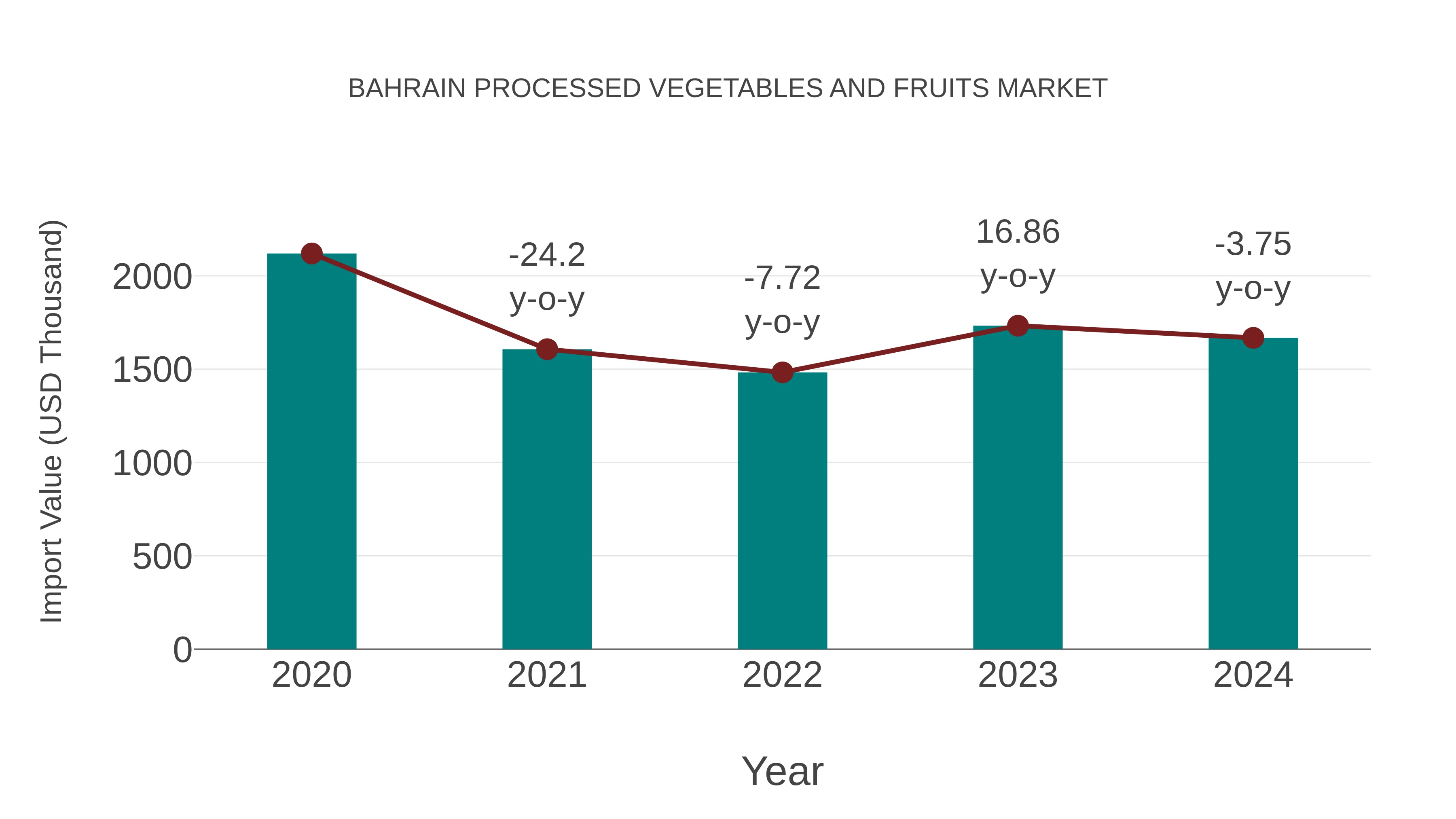
Bahrain Processed Vegetables and Fruits Market Overview
Bahrains processed vegetables and fruits market is driven by urban lifestyles, increased consumption of convenience foods, and limited domestic crop production. Frozen, canned, and vacuum-sealed produce is in high demand among households and the hospitality sector. Imports form the backbone of supply, particularly from India, Egypt, and Europe. With improved cold chain logistics and food preservation technology, quality and shelf life have significantly improved. Rising health awareness and a preference for low-preservative products are shaping consumer preferences. Government food security programs also support the development of this segment by encouraging import diversification and retail expansion.
Trends of the market
The processed vegetables and fruits market in Bahrain is experiencing consistent growth fueled by consumer demand for convenient, healthy food options that fit modern lifestyles. The market includes a wide range of products such as canned, frozen, dried, and ready-to-eat items that cater to households and commercial users. Technological advancements in preservation and packaging help retain nutritional value and extend shelf life. Import reliance remains high, supported by improved cold storage and logistics infrastructure. Increasing health awareness and government food safety initiatives are driving quality improvements. Retailers and foodservice providers are expanding product variety to meet diverse taste preferences. The outlook remains optimistic as demand for processed produce continues to rise.
Challenges of the market
The processed vegetables and fruits market in Bahrain is challenged by logistical complexities involving cold chain management and timely distribution. Heavy reliance on imported raw materials and finished products exposes the market to supply disruptions and price volatility. Regulatory compliance with food safety and quality standards demands ongoing investment in modern processing technologies. Consumer preference often leans towards fresh produce, limiting processed product acceptance. The sector faces competition from international brands with established distribution networks. Seasonal variations impact consistent product availability. Additionally, limited consumer education on the nutritional benefits of processed produce slows market growth.
Investment opportunities in the Market
Bahrain`s dependency on food imports creates a strategic opportunity for processed vegetables and fruits industries. Investors can capitalize on the growing demand for ready-to-eat, frozen, canned, and dehydrated fruits and vegetables driven by urban lifestyles and increased female workforce participation. Establishing food processing units locally can help reduce reliance on imports while also serving regional markets. Investment in cold chain logistics, advanced packaging, and preservative-free processing techniques can offer competitive advantages. With the GCC region focused on food security, Bahrain`s central location makes it a viable hub for food processing and re-export. Marketing strategies can target both retail consumers and institutional buyers like hotels and caterers. Regulatory support for food manufacturing further strengthens the business case. Theres also potential for product innovation aligned with health trends.
Government Policy of the market
Bahrain`s government has established comprehensive policies to regulate the processing of vegetables and fruits. The Ministry of Health mandates that processing facilities adhere to international food safety standards, including HACCP and GMP. Regular inspections ensure compliance with hygiene practices and proper labeling. The government encourages investment in modern processing technologies to improve efficiency and product quality. Support is also provided for local producers to access export markets, enhancing the competitiveness of Bahraini processed fruits and vegetables. These policies aim to ensure food safety, promote local industry, and meet consumer demand for healthy, convenient products.
Key Highlights of the Report:
- Bahrain Processed Vegetables and Fruits Market Outlook
- Market Size of Bahrain Processed Vegetables and Fruits Market, 2025
- Forecast of Bahrain Processed Vegetables and Fruits Market, 2032
- Historical Data and Forecast of Bahrain Processed Vegetables and Fruits Revenues & Volume for the Period 2022 - 2032F
- Bahrain Processed Vegetables and Fruits Market Trend Evolution
- Bahrain Processed Vegetables and Fruits Market Drivers and Challenges
- Bahrain Processed Vegetables and Fruits Price Trends
- Bahrain Processed Vegetables and Fruits Porter's Five Forces
- Bahrain Processed Vegetables and Fruits Industry Life Cycle
- Historical Data and Forecast of Bahrain Processed Vegetables and Fruits Market Revenues & Volume By Operation Type for the Period 2022 - 2032F
- Historical Data and Forecast of Bahrain Processed Vegetables and Fruits Market Revenues & Volume By Automatic for the Period 2022 - 2032F
- Historical Data and Forecast of Bahrain Processed Vegetables and Fruits Market Revenues & Volume By Semi-Automatic for the Period 2022 - 2032F
- Historical Data and Forecast of Bahrain Processed Vegetables and Fruits Market Revenues & Volume By Type for the Period 2022 - 2032F
- Historical Data and Forecast of Bahrain Processed Vegetables and Fruits Market Revenues & Volume By Pre-Processing for the Period 2022 - 2032F
- Historical Data and Forecast of Bahrain Processed Vegetables and Fruits Market Revenues & Volume By Peeling/Inspection/Slicing for the Period 2022 - 2032F
- Historical Data and Forecast of Bahrain Processed Vegetables and Fruits Market Revenues & Volume By Washing & Dewatering for the Period 2022 - 2032F
- Historical Data and Forecast of Bahrain Processed Vegetables and Fruits Market Revenues & Volume By Fillers for the Period 2022 - 2032F
- Historical Data and Forecast of Bahrain Processed Vegetables and Fruits Market Revenues & Volume By Packaging & Handling for the Period 2022 - 2032F
- Historical Data and Forecast of Bahrain Processed Vegetables and Fruits Market Revenues & Volume By Seasoning Systems for the Period 2022 - 2032F
- Historical Data and Forecast of Bahrain Processed Vegetables and Fruits Market Revenues & Volume By Material for the Period 2022 - 2032F
- Historical Data and Forecast of Bahrain Processed Vegetables and Fruits Market Revenues & Volume By Fruits for the Period 2022 - 2032F
- Historical Data and Forecast of Bahrain Processed Vegetables and Fruits Market Revenues & Volume By Vegetables for the Period 2022 - 2032F
- Historical Data and Forecast of Bahrain Processed Vegetables and Fruits Market Revenues & Volume By Product Type for the Period 2022 - 2032F
- Historical Data and Forecast of Bahrain Processed Vegetables and Fruits Market Revenues & Volume By Fresh for the Period 2022 - 2032F
- Historical Data and Forecast of Bahrain Processed Vegetables and Fruits Market Revenues & Volume By Freshly Cut for the Period 2022 - 2032F
- Historical Data and Forecast of Bahrain Processed Vegetables and Fruits Market Revenues & Volume By Canned for the Period 2022 - 2032F
- Historical Data and Forecast of Bahrain Processed Vegetables and Fruits Market Revenues & Volume By Frozen for the Period 2022 - 2032F
- Historical Data and Forecast of Bahrain Processed Vegetables and Fruits Market Revenues & Volume By Dried & dehydrated for the Period 2022 - 2032F
- Historical Data and Forecast of Bahrain Processed Vegetables and Fruits Market Revenues & Volume By Convenience for the Period 2022 - 2032F
- Bahrain Processed Vegetables and Fruits Import Export Trade Statistics
- Market Opportunity Assessment By Operation Type
- Market Opportunity Assessment By Type
- Market Opportunity Assessment By Fillers
- Market Opportunity Assessment By Material
- Market Opportunity Assessment By Product Type
- Bahrain Processed Vegetables and Fruits Top Companies Market Share
- Bahrain Processed Vegetables and Fruits Competitive Benchmarking By Technical and Operational Parameters
- Bahrain Processed Vegetables and Fruits Company Profiles
- Bahrain Processed Vegetables and Fruits Key Strategic Recommendations






































