Bahrain Television Broadcasting Market Size, Share & Growth Rate
The Bahrain Television Broadcasting Market was estimated at USD 940 Million in 2025 and is projected to reach USD 1656 Million by 2032, growing at a CAGR of 8.4% from 2026 to 2032. This growth is fueled by a high television penetration rate, ongoing advancements in broadcasting technology, and the continued demand for diverse content. As digital trends permeate the industry, traditional broadcasters in Bahrain are actively enhancing their capabilities, integrating more HD and UHD offerings to meet evolving audience expectations.
Bahrain Television Broadcasting Market Year-wise Growth Rate and Key Drivers
This graph highlights how the Bahrain Television Broadcasting Market has steadily grown over the years, supported by major growth factors.
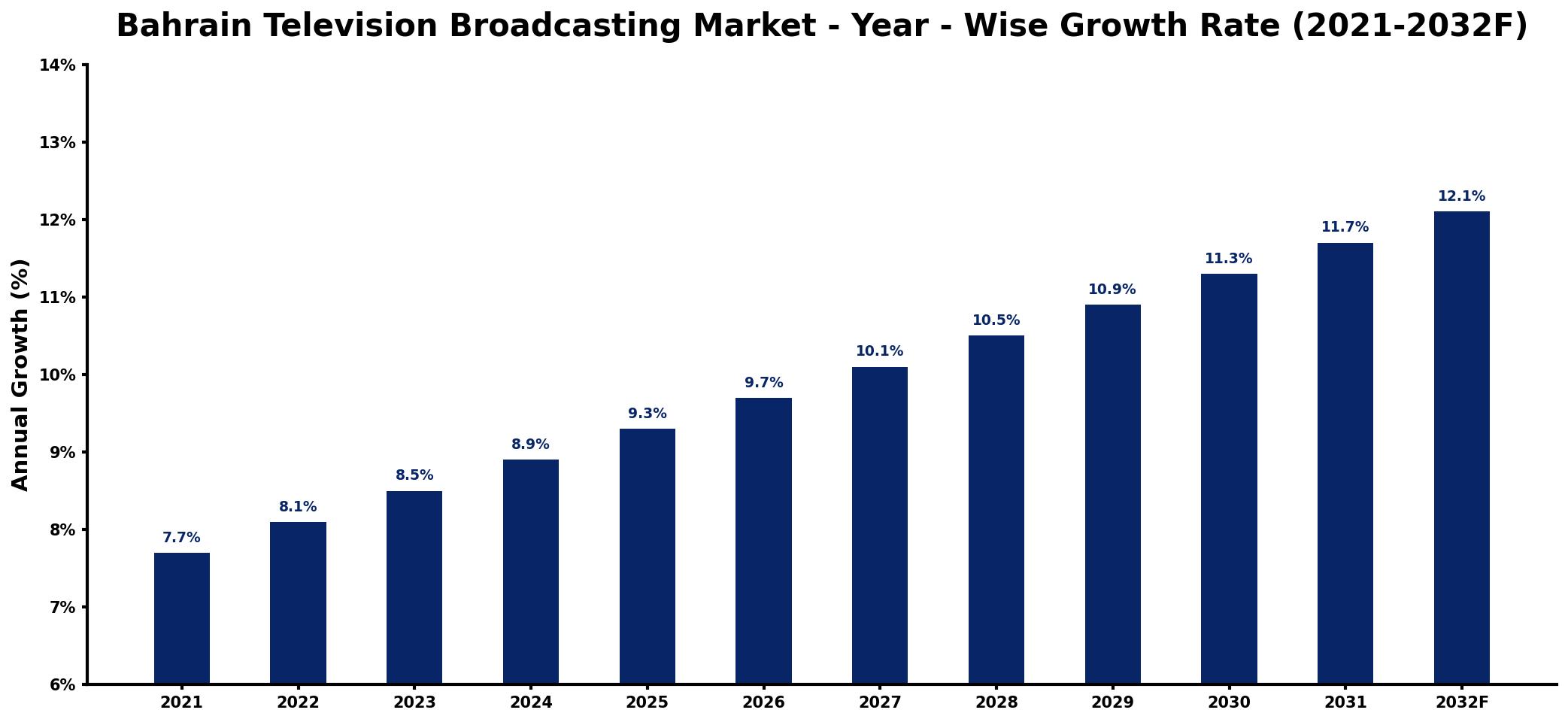
The table below presents the year‑wise growth rates along with the key drivers influencing the market
| Year | Growth Rate | Major Drivers |
| 2021 | 7.7% | Increased digital content consumption |
| 2022 | 8.1% | Expansion of mobile viewing options |
| 2023 | 8.5% | Rise in advertising investments |
| 2024 | 8.9% | Growth in local production capabilities |
| 2025 | 9.3% | Emergence of new streaming platforms |
| 2026 | 9.7% | Higher demand for original programming |
| 2027 | 10.1% | Increased interest in regional content |
| 2028 | 10.5% | strengthening underlying market demand |
| 2029 | 10.9% | Enhanced viewer engagement strategies |
| 2030 | 11.3% | Investment in audience analytics tools |
| 2031 | 11.7% | expanding manufacturing base activity |
| 2032 | 12.1% | Diversification of content delivery channels |
Note: Market size estimations and growth projections presented in this report are based on 6Wresearch's proprietary forecasting methodology, utilizing the latest available industry data, government publications, and primary research inputs.
Bahrain Television Broadcasting Market Synopsis
Bahrain's television broadcasting market is characterized by a unique blend of local and international channels, creating a rich tapestry of viewing options for its diverse populace. The resilience of traditional TV broadcasting, particularly in news and cultural programming, remains strong, despite the competitive pressure from digital platforms.
Investment in new technologies is essential, as broadcasters strive to create interactive and on-demand content that appeals to younger demographics. This need for digital transformation presents both challenges and opportunities, as players navigate the shifting landscape of viewer preferences.
Bahrain Television Broadcasting Market Key Takeaways
- Strong market growth driven by technological advancements in broadcasting.
- High demand for HD and UHD content reshapes viewer expectations.
- Local content production is being prioritized to enhance cultural relevance.
- Increased competition from streaming services pressures traditional broadcasters.
- Investment opportunities exist in IPTV and localized content creation.
Evaluation of Restraints in Bahrain Television Broadcasting Market
The Bahrain Television Broadcasting Market is encountering significant obstacles, primarily from the rapid ascent of streaming services which appeal to a tech-savvy audience. Advertisers are redirecting budgets towards digital platforms, creating revenue pressures for conventional broadcasters. Furthermore, the high costs associated with content production and licensing pose challenges, particularly for smaller players, limiting their capacity to compete effectively in this evolving landscape.
Bahrain Television Broadcasting Market Trends
Emerging trends in the Bahrain Television Broadcasting Market include a notable shift towards digital streaming and on-demand content, as viewers increasingly seek personalized viewing experiences. The integration of artificial intelligence and machine learning technologies is becoming more prevalent, enabling broadcasters to refine content recommendations and enhance viewer engagement. Additionally, the expansion of mobile viewing platforms is reshaping how audiences consume media.
Bahrain Television Broadcasting Market Opportunities
The transition towards digital content presents ample investment opportunities within the Bahrain Television Broadcasting Market. Key areas for growth include IPTV services and video-on-demand platforms, which can cater to both domestic preferences and regional audiences. Moreover, localized content creation aimed at preserving Bahrain's cultural identity can foster viewer loyalty and attract government support, further driving market expansion.
Government Initiatives in the Bahrain Television Broadcasting Market
The Ministry of Information Affairs plays a pivotal role in regulating Bahrain's television broadcasting landscape. Current government policies focus on promoting the production of local content to maintain cultural identity while allowing foreign channels to enrich the viewing experience. Initiatives aimed at transitioning from analog to digital broadcasting are in progress, enhancing transmission quality and expanding channel availability for viewers.
Future Insights of the Bahrain Television Broadcasting Market
Looking ahead to 2026-2032, the Bahrain Television Broadcasting Market is poised for substantial transformation as digital technologies continue to redefine the viewer experience. Emphasizing high-quality content delivery, broadcasters will increasingly invest in upgrading infrastructure and exploring new formats. With audience preferences shifting, the industry is likely to witness greater collaboration between traditional broadcasters and digital platforms, ensuring sustained engagement across diverse demographics.
Bahrain Television Broadcasting Market Latest Developments (2025 - 2026)
Recent developments in Bahrain's television broadcasting sector highlight an increased focus on enhancing content quality and accessibility. Broadcasters are actively expanding their digital offerings, integrating advanced technologies to provide viewers with a seamless experience. Noteworthy initiatives include efforts to boost local programming and initiatives to strengthen partnerships with digital streaming services, thereby broadening the content landscape available to Bahraini audiences.
Bahrain Television Broadcasting Market - Key Attractiveness of the Report
- 10 Years of Market Numbers
- Historical Data Starting from 2022 to 2025
- Base Year: 2025
- Forecast Data until 2032
- Key Performance Indicators Impacting the Market
- Major Upcoming Developments and Projects
Key Highlights of the Report:
- Bahrain Television Broadcasting Market Outlook
- Market Size of Bahrain Television Broadcasting Market, 2025
- Forecast of Bahrain Television Broadcasting Market, 2032
- Historical Data and Forecast of Bahrain Television Broadcasting Revenues & Volume for the Period 2022-2032F
- Bahrain Television Broadcasting Market Trend Evolution
- Bahrain Television Broadcasting Market Drivers and Challenges
- Bahrain Television Broadcasting Price Trends
- Bahrain Television Broadcasting Porter's Five Forces
- Bahrain Television Broadcasting Industry Life Cycle
- Historical Data and Forecast of Bahrain Television Broadcasting Market Revenues & Volume By Type for the Period 2022-2032F
- Historical Data and Forecast of Bahrain Television Broadcasting Market Revenues & Volume By Television Station for the Period 2022-2032F
- Historical Data and Forecast of Bahrain Television Broadcasting Market Revenues & Volume By Television Network for the Period 2022-2032F
- Historical Data and Forecast of Bahrain Television Broadcasting Market Revenues & Volume By Broadcaster Type for the Period 2022-2032F
- Historical Data and Forecast of Bahrain Television Broadcasting Market Revenues & Volume By Public for the Period 2022-2032F
- Historical Data and Forecast of Bahrain Television Broadcasting Market Revenues & Volume By Commercial for the Period 2022-2032F
- Historical Data and Forecast of Bahrain Television Broadcasting Market Revenues & Volume By Revenue Source for the Period 2022-2032F
- Historical Data and Forecast of Bahrain Television Broadcasting Market Revenues & Volume By Subscription-based for the Period 2022-2032F
- Historical Data and Forecast of Bahrain Television Broadcasting Market Revenues & Volume By Advertisement-based for the Period 2022-2032F
- Bahrain Television Broadcasting Import Export Trade Statistics
- Market Opportunity Assessment By Type
- Market Opportunity Assessment By Broadcaster Type
- Market Opportunity Assessment By Revenue Source
- Bahrain Television Broadcasting Top Companies Market Share
- Bahrain Television Broadcasting Competitive Benchmarking By Technical and Operational Parameters
- Bahrain Television Broadcasting Company Profiles
- Bahrain Television Broadcasting Key Strategic Recommendations






































