Bahrain Toggle Clamps Market Size, Share & Growth Rate
The Bahrain Toggle Clamps Market was estimated at USD 1273 Million in 2025 and is projected to reach USD 2158 Million by 2032, growing at a CAGR of 7.8% from 2026 to 2032. This robust growth trajectory is primarily driven by the increasing demands of the manufacturing and industrial sectors in Bahrain, where toggle clamps play a crucial role in ensuring precision during processes such as machining and assembly. Furthermore, the expansion of small and medium-sized enterprises and advancements in clamping technology are enhancing the performance and durability of these essential tools.
Bahrain Toggle Clamps Market Year-wise Growth Rate and Key Drivers
This graph highlights how the Bahrain Toggle Clamps Market has steadily grown over the years, supported by major growth factors.
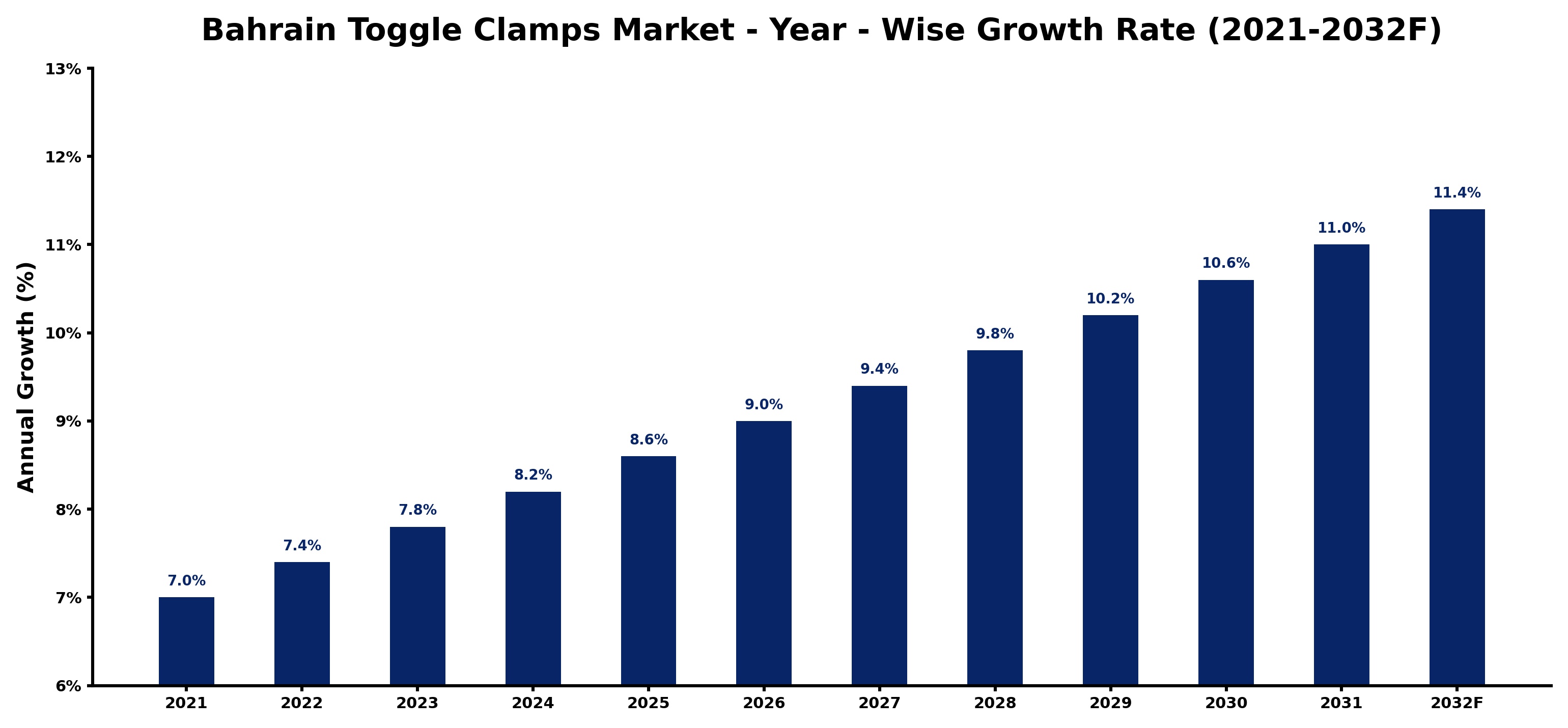
The table below presents the year‑wise growth rates along with the key drivers influencing the market
| Year | Growth Rate | Major Drivers |
| 2021 | 7.0% | Rising electricity demand across industries |
| 2022 | 7.4% | Government infrastructure modernization initiatives |
| 2023 | 7.8% | Rising electricity demand across industries |
| 2024 | 8.2% | Expansion of transportation and logistics networks |
| 2025 | 8.6% | Expansion of manufacturing activities |
| 2026 | 9.0% | Government infrastructure modernization initiatives |
| 2027 | 9.4% | Increasing adoption of advanced technologies |
| 2028 | 9.8% | Increasing industrial automation investments |
| 2029 | 10.2% | Expansion of commercial construction activities |
| 2030 | 10.6% | Rising electricity demand across industries |
| 2031 | 11.0% | Increasing adoption of advanced technologies |
| 2032 | 11.4% | Increasing smart city development projects |
Note - Market size estimations and growth projections presented in this report are based on 6Wresearch’s advanced forecasting approach, validated with industry datasets as of June 2026.
Bahrain Toggle Clamps Market Synopsis
The most significant force shaping the Bahrain Toggle Clamps Market today is the rapid advancement in industrial automation. As sectors like automotive and aerospace embrace modern manufacturing techniques, the reliance on reliable clamping solutions is becoming more pronounced. This shift is compelling manufacturers to invest in high-quality toggle clamps that promise efficiency and durability.
In addition to automation, the growth of small and medium-sized manufacturing enterprises is a pivotal factor for market demand. These businesses are eager to adopt innovative clamping solutions to enhance their operational capabilities, presenting a unique opportunity for suppliers of toggle clamps to cater to a burgeoning customer base.
Bahrain Toggle Clamps Market Key Takeaways
- Significant growth anticipated with a projected market size increase from USD 1273 Million to USD 2158 Million by 2032.
- Rapid advancements in industrial automation are driving demand for reliable clamping solutions.
- The rise of small and medium-sized enterprises in Bahrain is expanding the market potential for toggle clamps.
- Technological improvements in clamping products are enhancing performance and user-friendliness.
- Investment in high-quality toggle clamps is crucial for manufacturers aiming to remain competitive in an evolving market.
Evaluation of Restraints in Bahrain Toggle Clamps Market
While the Bahrain Toggle Clamps Market shows promising growth, several factors could hinder its progress. The availability of automated clamping systems presents significant competition, as these solutions often offer superior efficiency and precision. Furthermore, economic fluctuations can affect manufacturing activities, leading to variable demand for industrial equipment, including toggle clamps. Lastly, imported low-cost clamps pose a challenge to premium product sales, as budget-conscious manufacturers may opt for cheaper alternatives, impacting market value.
Bahrain Toggle Clamps Market Trends
Current trends in the Bahrain Toggle Clamps Market indicate a shift toward enhanced durability and ease of use in clamping solutions. As manufacturers seek to streamline processes, innovations such as lightweight materials and ergonomic designs are gaining traction. Additionally, there is a growing preference for automated solutions, leading to increased investment in technology that integrates advanced features into traditional toggle clamps.
Bahrain Toggle Clamps Market Opportunities
The expansion of Bahrain's industrial and construction sectors presents abundant investment opportunities for toggle clamp suppliers. Companies can benefit by forming strategic partnerships with local manufacturers and workshops engaged in heavy-duty fabrication processes. By focusing on the development and supply of high-quality clamps tailored to specific industrial applications, businesses can position themselves advantageously in this evolving landscape.
Government Initiatives in the Bahrain Toggle Clamps Market
Government policies in Bahrain are fostering growth in the manufacturing sector, thereby enhancing the demand for toggle clamps. Initiatives aimed at industrial diversification are encouraging investments in manufacturing technologies, while import regulations ensure that all industrial tools meet strict quality and safety standards. These efforts collectively contribute to a supportive environment for the toggle clamps market, further stimulating demand.
Future Insights of the Bahrain Toggle Clamps Market
Looking ahead to 2026-2032, the Bahrain Toggle Clamps Market is poised for substantial growth. As industrial automation continues to evolve, the demand for sophisticated clamping solutions will likely increase. Moreover, the ongoing expansion of the manufacturing sector will create additional opportunities for high-quality toggle clamps, ensuring that suppliers and manufacturers can capitalize on technological advancements and evolving market needs.
Bahrain Toggle Clamps Market Latest Developments (May 2025 - June 2026)
Recent developments in the Bahrain Toggle Clamps Market indicate a strategic push towards enhancing product offerings. Industry stakeholders are increasingly focusing on integrating innovative technologies that boost efficiency and precision in clamping solutions. Additionally, there is a noticeable trend of partnerships forming between local manufacturers and technology providers, aimed at elevating product quality and expanding market reach. This collaboration is expected to drive competitiveness and innovation in the coming years.
Bahrain Toggle Clamps Market - Key Attractiveness of the Report
- 10 Years of Market Numbers
- Historical Data Starting from 2022 to 2025
- Base Year: 2025
- Forecast Data until 2032
- Key Performance Indicators Impacting the Market
- Major Upcoming Developments and Projects
Key Highlights of the Report:
- Bahrain Toggle Clamps Market Outlook
- Market Size of Bahrain Toggle Clamps Market, 2025
- Forecast of Bahrain Toggle Clamps Market, 2032
- Historical Data and Forecast of Bahrain Toggle Clamps Revenues & Volume for the Period 2022-2032F
- Bahrain Toggle Clamps Market Trend Evolution
- Bahrain Toggle Clamps Market Drivers and Challenges
- Bahrain Toggle Clamps Price Trends
- Bahrain Toggle Clamps Porter's Five Forces
- Bahrain Toggle Clamps Industry Life Cycle
- Historical Data and Forecast of Bahrain Toggle Clamps Market Revenues & Volume By Product Type for the Period 2022-2032F
- Historical Data and Forecast of Bahrain Toggle Clamps Market Revenues & Volume By Horizontal Toggle Clamps for the Period 2022-2032F
- Historical Data and Forecast of Bahrain Toggle Clamps Market Revenues & Volume By Vertical Toggle Clamps for the Period 2022-2032F
- Historical Data and Forecast of Bahrain Toggle Clamps Market Revenues & Volume By Application for the Period 2022-2032F
- Historical Data and Forecast of Bahrain Toggle Clamps Market Revenues & Volume By Assembly Technology for the Period 2022-2032F
- Historical Data and Forecast of Bahrain Toggle Clamps Market Revenues & Volume By Clamping Technology for the Period 2022-2032F
- Historical Data and Forecast of Bahrain Toggle Clamps Market Revenues & Volume By Tool Construction for the Period 2022-2032F
- Historical Data and Forecast of Bahrain Toggle Clamps Market Revenues & Volume By Fixture Construction for the Period 2022-2032F
- Bahrain Toggle Clamps Import Export Trade Statistics
- Market Opportunity Assessment By Product Type
- Market Opportunity Assessment By Application
- Bahrain Toggle Clamps Top Companies Market Share
- Bahrain Toggle Clamps Competitive Benchmarking By Technical and Operational Parameters
- Bahrain Toggle Clamps Company Profiles
- Bahrain Toggle Clamps Key Strategic Recommendations






































