Bahrain Tractor Market Size, Share & Growth Rate
The Bahrain Tractor Market was estimated at USD 848 Million in 2025 and is projected to reach USD 1586 Million by 2032, growing at a CAGR of 9.4% from 2026 to 2032. This promising growth trajectory is driven by government initiatives aimed at enhancing agricultural productivity and sustainability, as well as a rising interest in modern farming practices. With a focus on compact tractors that meet local needs, the market is adapting to technological advancements and changing agricultural methods.
Bahrain Tractor Market Year-wise Growth Rate and Key Drivers
This graph highlights how the Bahrain Tractor Market has steadily grown over the years, supported by major growth factors.
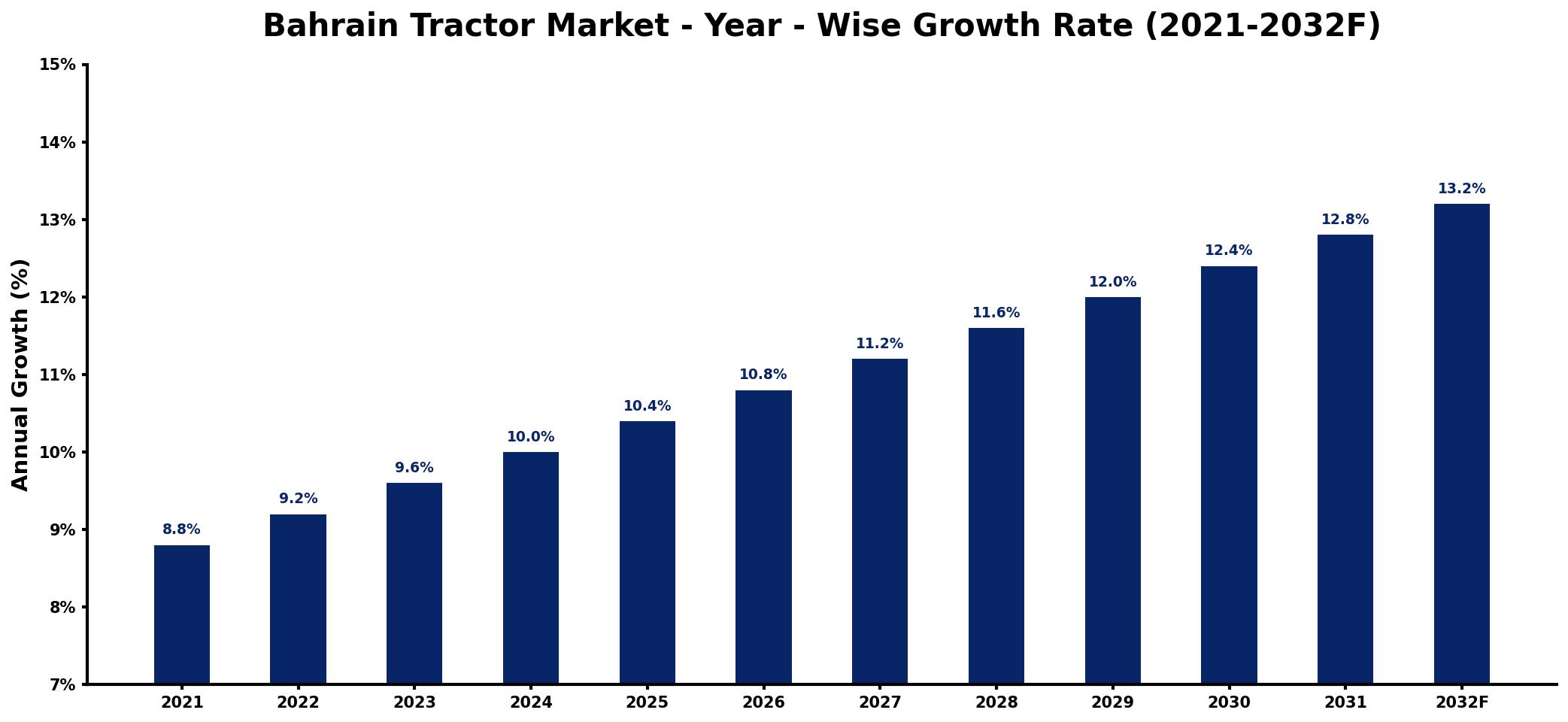
The table below presents the year‑wise growth rates along with the key drivers influencing the market
| Year | Growth Rate | Major Drivers |
| 2021 | 8.8% | increased agricultural investment trends |
| 2022 | 9.2% | rising demand for mechanization |
| 2023 | 9.6% | expansion of rural infrastructure projects |
| 2024 | 10.0% | growing precision farming adoption |
| 2025 | 10.4% | enhanced financing options availability |
| 2026 | 10.8% | influx of foreign agricultural technologies |
| 2027 | 11.2% | increased focus on sustainability practices |
| 2028 | 11.6% | growing interest in export markets |
| 2029 | 12.0% | development of local manufacturing capabilities |
| 2030 | 12.4% | improved raw material availability |
| 2031 | 12.8% | increased government support initiatives |
| 2032 | 13.2% | growing trend of cooperative farming |
Note: Market size estimations and growth projections presented in this report are based on 6Wresearch's proprietary forecasting methodology, utilizing the latest available industry data, government publications, and primary research inputs.
Bahrain Tractor Market Synopsis
In Bahrain, the tractor market plays a crucial role in supporting farming operations, particularly in rural and semi-urban areas where limited arable land necessitates the use of efficient, compact machinery. Multi-purpose tractors are gaining traction not only for agricultural tasks but also for landscaping and municipal maintenance, highlighting their versatility in this unique market environment.
Government support significantly influences demand, with initiatives focused on sustainable agriculture encouraging farmers to invest in modern equipment. However, the market faces challenges regarding spare parts availability and maintenance expertise, impacting brand loyalty and service satisfaction among end-users.
Bahrain Tractor Market Key Takeaways
- Demand for compact and multi-purpose tractors is rising, driven by government agricultural initiatives.
- The tractor market is primarily import-driven, with key suppliers from India, Japan, and the U.S.
- Government subsidies aim to enhance mechanization and improve farming productivity.
- Maintenance services and spare parts availability significantly influence buyer preferences.
- Investment opportunities exist in leasing models and tailored tractor solutions for Bahrain's terrain.
Evaluation of Restraints in Bahrain Tractor Market
The Bahrain Tractor Market is constrained by limited agricultural land, which curtails the scale of farming operations and consequently reduces the demand for high-capacity tractors. Most farms are small and regionally concentrated, making them less likely to invest in advanced, high-tech machinery. Additionally, while imports dominate the market, the scarcity of spare parts and limited local expertise in maintaining newer models create barriers for sustainable growth. Farmers awareness of the benefits of modern mechanization is also low, leading to sporadic growth that often hinges on fluctuating government policies rather than consistent market demand.
Bahrain Tractor Market Trends
Emerging trends in the Bahrain Tractor Market include the growing preference for energy-efficient and environmentally friendly models, aligning with global sustainability efforts. Technological integration in farming practices, such as precision agriculture, is increasingly being adopted. Furthermore, the use of tractors in landscaping and non-agricultural applications is expanding, allowing for a broader market appeal. These trends indicate a shift towards multifunctional equipment that meets diverse operational needs.
Bahrain Tractor Market Opportunities
Genuine growth opportunities in the Bahrain Tractor Market lie in developing compact tractors specifically designed for the country's unique agricultural landscape and operational requirements. Investors can capitalize on the increasing demand for flexible leasing options and government-related supply contracts that cater to local farmers. Additionally, enhancing after-sales service infrastructure to address maintenance and repair concerns presents a lucrative avenue for market entrants seeking to establish a foothold in this niche segment.
Government Initiatives in the Bahrain Tractor Market
The Bahraini government plays an active role in fostering the tractor market through various agricultural policies aimed at increasing food security and mechanization. Subsidies and financial assistance programs are available for farmers purchasing tractors and related equipment. Moreover, import regulations are streamlined to facilitate the entry of energy-efficient models into the market. The government also invests in technical training programs to enhance farmers skills in operating and maintaining modern machinery, thereby boosting agricultural productivity and sustainability.
Future Insights of the Bahrain Tractor Market
Looking ahead to 2026-2032, the Bahrain Tractor Market is poised for sustained growth driven by ongoing government support and increased awareness of modern farming benefits. The expansion of agricultural practices, coupled with land development projects, is expected to further fuel demand for versatile and efficient tractor models. As more farmers adopt mechanization, the market will likely witness a transition towards technologically advanced solutions that enhance productivity and operational efficiency.
Bahrain Tractor Market Latest Developments (2025 - 2026)
Recent developments in the Bahrain Tractor Market indicate a positive shift towards collaborative efforts between local farmers and international manufacturers. Increased focus on sustainable farming practices has sparked interest in modern, eco-friendly tractors. Moreover, training programs initiated by the government are enhancing skill levels among farmers, allowing for better utilization of advanced machinery. These initiatives are contributing to a gradual improvement in the market's overall landscape.
Bahrain Tractor Market - Key Attractiveness of the Report
- 10 Years of Market Numbers
- Historical Data Starting from 2022 to 2025
- Base Year: 2025
- Forecast Data until 2032
- Key Performance Indicators Impacting the Market
- Major Upcoming Developments and Projects
Key Highlights of the Report:
- Bahrain Tractor Market Outlook
- Market Size of Bahrain Tractor Market, 2025
- Forecast of Bahrain Tractor Market, 2032
- Historical Data and Forecast of Bahrain Tractor Revenues & Volume for the Period 2022-2032F
- Bahrain Tractor Market Trend Evolution
- Bahrain Tractor Market Drivers and Challenges
- Bahrain Tractor Price Trends
- Bahrain Tractor Porter's Five Forces
- Bahrain Tractor Industry Life Cycle
- Historical Data and Forecast of Bahrain Tractor Market Revenues & Volume By Power Output for the Period 2022-2032F
- Historical Data and Forecast of Bahrain Tractor Market Revenues & Volume By Less Than 30 HP for the Period 2022-2032F
- Historical Data and Forecast of Bahrain Tractor Market Revenues & Volume By 30-50 HP for the Period 2022-2032F
- Historical Data and Forecast of Bahrain Tractor Market Revenues & Volume By 51-100 HP for the Period 2022-2032F
- Historical Data and Forecast of Bahrain Tractor Market Revenues & Volume By More Than 100 HP for the Period 2022-2032F
- Historical Data and Forecast of Bahrain Tractor Market Revenues & Volume By Drive Type for the Period 2022-2032F
- Historical Data and Forecast of Bahrain Tractor Market Revenues & Volume By 2 Wheel Drive for the Period 2022-2032F
- Historical Data and Forecast of Bahrain Tractor Market Revenues & Volume By 4 Wheel Drive for the Period 2022-2032F
- Historical Data and Forecast of Bahrain Tractor Market Revenues & Volume By Application for the Period 2022-2032F
- Historical Data and Forecast of Bahrain Tractor Market Revenues & Volume By Agriculture for the Period 2022-2032F
- Bahrain Tractor Import Export Trade Statistics
- Market Opportunity Assessment By Power Output
- Market Opportunity Assessment By Drive Type
- Market Opportunity Assessment By Application
- Bahrain Tractor Top Companies Market Share
- Bahrain Tractor Competitive Benchmarking By Technical and Operational Parameters
- Bahrain Tractor Company Profiles
- Bahrain Tractor Key Strategic Recommendations






































