Bahrain Transaction Monitoring Market Size & Growth Rate (2026-2032)
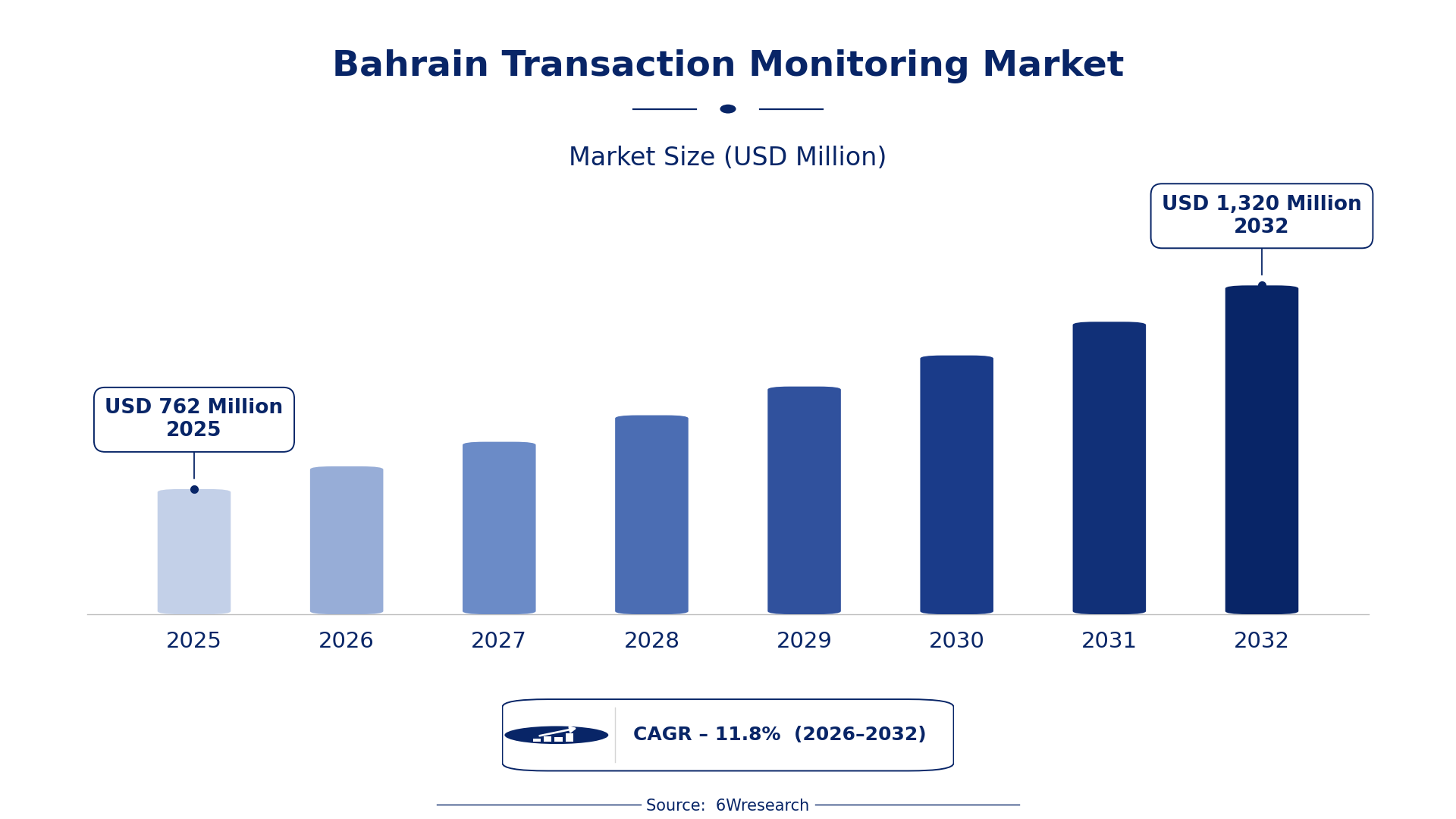
The Bahrain Transaction Monitoring Market was estimated at USD 762 Million in 2025 and is projected to reach USD 1320 Million by 2032, growing at a CAGR of 11.8% from 2026 to 2032.
Bahrain Transaction Monitoring Market Synopsis
Bahrain has become a focal point for financial transaction monitoring, driven by the urgent need for anti-money laundering (AML) initiatives. As the region experiences an increase in cross-border financial activity and digital banking, financial institutions are under pressure to enhance their monitoring systems to ensure compliance and mitigate risks.
The transaction monitoring solutions available in Bahrain analyze data streams and customer behavior to identify potentially fraudulent activities in real-time. With evolving regulatory frameworks and the sophistication of financial crimes, the demand for advanced monitoring systems is increasing significantly across banks and regulatory bodies.
Bahrain Transaction Monitoring Market Year-wise Growth Rate and Key Drivers
This graph illustrates the annual growth rates of the Bahrain Transaction Monitoring Market from 2021 to 2032, highlighting a steady upward trajectory and projected expansion over the forecast period.
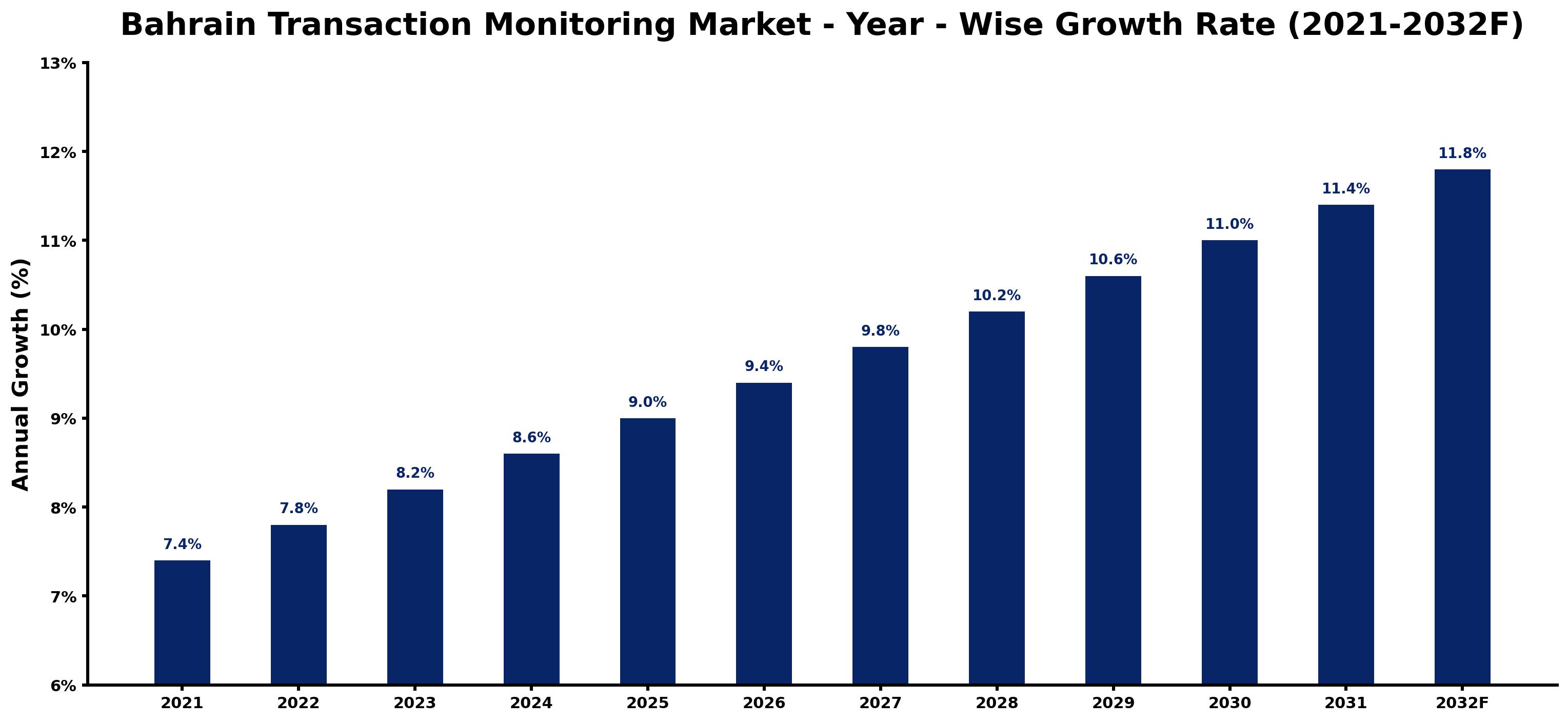
The table below presents the year‑wise growth rates along with the key drivers influencing the market
| Year | Growth Rate | Major Drivers |
| 2021 | 7.4% | Central Bank of Bahrain enforces stricter AML regulations |
| 2022 | 7.8% | Growth in fintech driving demand for compliance technologies |
| 2023 | 8.2% | Increased investments in anti-money laundering solutions |
| 2024 | 8.6% | Enhanced digital banking services require robust transaction monitoring |
| 2025 | 9.0% | Government initiatives to combat financial crimes intensify |
| 2026 | 9.4% | Rising awareness of cybersecurity threats among businesses |
| 2027 | 9.8% | Global standards adoption prompts local compliance upgrades |
| 2028 | 10.2% | Bahrain's economic diversification increase financial sector scrutiny |
| 2029 | 10.6% | Higher foreign investments necessitate advanced risk management tools |
| 2030 | 11.0% | Regulatory technology partnerships expand in local market |
| 2031 | 11.4% | Local banks adopt innovative reporting technologies for compliance |
| 2032 | 11.8% | Evolving financial landscape demands sophisticated monitoring systems |
Note: Market size estimations and growth projections presented in this report are based on 6Wresearch's proprietary forecasting methodology, utilizing the latest available industry data, government publications, and primary research inputs.
Bahrain Transaction Monitoring Market Key Takeaways
Below are some of the specific key takeaways from the market, including:
- There is a growing emphasis on compliance due to stricter AML regulations, driving demand for transaction monitoring solutions.
- Advancements in AI and machine learning technologies are transforming how financial institutions detect and manage risks.
- The increasing trend of globalization and digital banking has heightened the need for effective monitoring solutions.
- Financial institutions face challenges in reducing false positives while complying with regulatory requirements.
- Government policies are evolving to reinforce the framework for transaction monitoring and AML efforts.
Evaluation of Restraints in Bahrain Transaction Monitoring Market
Despite its growth, the Bahrain Transaction Monitoring Market grapples with significant restraints. Chief among these is the increasing sophistication of financial crimes. As criminals adopt more advanced tactics, existing monitoring systems struggle to keep pace. This challenge is compounded by regulatory demands for accuracy, where financial institutions must balance thoroughness with speed.
Additionally, compliance teams often face the burden of managing an influx of false positives, creating inefficiencies that can undermine the effectiveness of monitoring strategies. These challenges can result in resource constraints, where institutions may hesitate to invest further in transaction monitoring solutions amidst rising operational pressures.
Bahrain Transaction Monitoring Market Trends
Current trends in the Bahrain Transaction Monitoring Market indicate a shift towards integration of AI and machine learning for improved accuracy in detecting suspicious activities. Financial institutions are increasingly adopting real-time analytics capabilities to respond swiftly to identified anomalies.
There is also a growing recognition of the importance of data-sharing initiatives among various financial entities and regulatory authorities. This collaborative approach enhances collective intelligence and strengthens the overall transaction monitoring framework in Bahrain.
Bahrain Transaction Monitoring Market Opportunities
The Bahrain Transaction Monitoring Market presents various growth opportunities for both new entrants and established players. Institutions that focus on developing advanced analytics platforms are well-positioned to capture market share. There is also a rising demand for customizable monitoring solutions tailored to the unique challenges of different sectors.
Public-private partnerships aimed at enhancing digital infrastructure for transaction monitoring systems are another promising avenue. These collaborations could yield innovative solutions while aligning with government priorities to combat financial crime.
Government Initiatives in the Bahrain Transaction Monitoring Market
Bahrain's government is actively shaping the Transaction Monitoring Market through a series of initiatives aimed at combating financial crime. With a regulatory focus on enhancing anti-money laundering measures, these policies play a crucial role in encouraging financial institutions to adopt advanced monitoring solutions.
- A recently completed initiative involved the implementation of a national framework for financial crime prevention, which mandates improved compliance measures across banking institutions.
- Currently underway is an extensive training program for compliance officers, aimed at bolstering skills related to transaction monitoring and regulatory reporting.
- A planned upcoming regulatory review is expected to introduce stricter guidelines for transaction monitoring systems, ensuring that institutions enhance their operational frameworks.
- Information-sharing agreements between regulatory authorities are being established to promote collaborative efforts in identifying and mitigating financial crime.
- Capacity-building programs for regulatory bodies are scheduled to commence in the next quarter, focusing on enhancing analytical capabilities for transaction monitoring.
Future Insights of the Bahrain Transaction Monitoring Market
Looking ahead to 2026-2032, the Bahrain Transaction Monitoring Market is likely to experience accelerated growth fueled by ongoing advancements in technology. The integration of blockchain and AI in transaction monitoring systems could revolutionize the accuracy and efficiency of detecting suspicious activities. As regulatory requirements continue to evolve, financial institutions will increasingly invest in innovative solutions that not only ensure compliance but also enhance customer trust.
Bahrain Transaction Monitoring Market Latest Developments
In recent months, the Bahrain Transaction Monitoring Market has seen notable developments as institutions prioritize upgrading their monitoring capabilities. With growing regulatory scrutiny, financial institutions are under pressure to invest in more effective solutions to combat financial crime.
- A major technology vendor launched a new AI-driven transaction monitoring solution in early 2025, designed to minimize false positives and enhance detection accuracy.
- Ongoing collaboration between banks and tech firms is focused on developing integrated platforms that leverage big data analytics to bolster fraud detection efforts.
- A public-private partnership aimed at improving information sharing practices is expected to roll out in mid-2026, facilitating better data exchange among financial institutions.
- By late 2025, a financial institution completed a comprehensive upgrade of its transaction monitoring system, integrating machine learning algorithms for enhanced risk assessment.
- In Q1 2026, a new regulatory initiative is anticipated that will mandate compliance with updated transaction monitoring standards, pushing institutions to adapt swiftly.
Bahrain Transaction Monitoring Market - Key Attractiveness of the Report
- 10 Years of Market Numbers
- Historical Data Starting from 2022 to 2025
- Base Year: 2025
- Forecast Data until 2032
- Key Performance Indicators Impacting the Market
- Major Upcoming Developments and Projects
Key Highlights of the Report:
- Bahrain Transaction Monitoring Market Outlook
- Market Size of Bahrain Transaction Monitoring Market, 2025
- Forecast of Bahrain Transaction Monitoring Market, 2032
- Historical Data and Forecast of Bahrain Transaction Monitoring Revenues & Volume for the Period 2022-2032F
- Bahrain Transaction Monitoring Market Trend Evolution
- Bahrain Transaction Monitoring Market Drivers and Challenges
- Bahrain Transaction Monitoring Price Trends
- Bahrain Transaction Monitoring Porter's Five Forces
- Bahrain Transaction Monitoring Industry Life Cycle
- Historical Data and Forecast of Bahrain Transaction Monitoring Market Revenues & Volume By Application Area for the Period 2022-2032F
- Historical Data and Forecast of Bahrain Transaction Monitoring Market Revenues & Volume By AML for the Period 2022-2032F
- Historical Data and Forecast of Bahrain Transaction Monitoring Market Revenues & Volume By FDP for the Period 2022-2032F
- Historical Data and Forecast of Bahrain Transaction Monitoring Market Revenues & Volume By Compliance Management for the Period 2022-2032F
- Historical Data and Forecast of Bahrain Transaction Monitoring Market Revenues & Volume By Customer Identity Management for the Period 2022-2032F
- Historical Data and Forecast of Bahrain Transaction Monitoring Market Revenues & Volume By Component for the Period 2022-2032F
- Historical Data and Forecast of Bahrain Transaction Monitoring Market Revenues & Volume By Solution for the Period 2022-2032F
- Historical Data and Forecast of Bahrain Transaction Monitoring Market Revenues & Volume By Services for the Period 2022-2032F
- Historical Data and Forecast of Bahrain Transaction Monitoring Market Revenues & Volume By Function for the Period 2022-2032F
- Historical Data and Forecast of Bahrain Transaction Monitoring Market Revenues & Volume By Case Management for the Period 2022-2032F
- Historical Data and Forecast of Bahrain Transaction Monitoring Market Revenues & Volume By KYC/Customer Onboarding for the Period 2022-2032F
- Historical Data and Forecast of Bahrain Transaction Monitoring Market Revenues & Volume By Dashboard and Reporting for the Period 2022-2032F
- Historical Data and Forecast of Bahrain Transaction Monitoring Market Revenues & Volume By Watch List Screening for the Period 2022-2032F
- Historical Data and Forecast of Bahrain Transaction Monitoring Market Revenues & Volume By Deployment Mode for the Period 2022-2032F
- Historical Data and Forecast of Bahrain Transaction Monitoring Market Revenues & Volume By On-Premises for the Period 2022-2032F
- Historical Data and Forecast of Bahrain Transaction Monitoring Market Revenues & Volume By Cloud for the Period 2022-2032F
- Historical Data and Forecast of Bahrain Transaction Monitoring Market Revenues & Volume By Organization Size for the Period 2022-2032F
- Historical Data and Forecast of Bahrain Transaction Monitoring Market Revenues & Volume By SMEs for the Period 2022-2032F
- Historical Data and Forecast of Bahrain Transaction Monitoring Market Revenues & Volume By Large Enterprises for the Period 2022-2032F
- Historical Data and Forecast of Bahrain Transaction Monitoring Market Revenues & Volume By Vertical for the Period 2022-2032F
- Historical Data and Forecast of Bahrain Transaction Monitoring Market Revenues & Volume By Banking, Financial Services, and Insurance for the Period 2022-2032F
- Historical Data and Forecast of Bahrain Transaction Monitoring Market Revenues & Volume By Government and Defense for the Period 2022-2032F
- Historical Data and Forecast of Bahrain Transaction Monitoring Market Revenues & Volume By IT and Telecom for the Period 2022-2032F
- Historical Data and Forecast of Bahrain Transaction Monitoring Market Revenues & Volume By Retail for the Period 2022-2032F
- Historical Data and Forecast of Bahrain Transaction Monitoring Market Revenues & Volume By Healthcare for the Period 2022-2032F
- Historical Data and Forecast of Bahrain Transaction Monitoring Market Revenues & Volume By Energy and Utilities for the Period 2022-2032F
- Historical Data and Forecast of Bahrain Transaction Monitoring Market Revenues & Volume By Manufacturing for the Period 2022-2032F
- Historical Data and Forecast of Bahrain Transaction Monitoring Market Revenues & Volume By Others for the Period 2022-2032F
- Bahrain Transaction Monitoring Import Export Trade Statistics
- Market Opportunity Assessment By Application Area
- Market Opportunity Assessment By Component
- Market Opportunity Assessment By Function
- Market Opportunity Assessment By Deployment Mode
- Market Opportunity Assessment By Organization Size
- Market Opportunity Assessment By Vertical
- Bahrain Transaction Monitoring Top Companies Market Share
- Bahrain Transaction Monitoring Competitive Benchmarking By Technical and Operational Parameters
- Bahrain Transaction Monitoring Company Profiles
- Bahrain Transaction Monitoring Key Strategic Recommendations






































