Bahrain Tripod Jack For Civil Aircraft Market Size, Share & Growth Rate
The Bahrain Tripod Jack For Civil Aircraft Market was estimated at USD 724 Million in 2025 and is projected to reach USD 1248 Million by 2032, growing at a CAGR of 8.1% from 2026 to 2032. This upward trajectory is fueled by Bahrain's expanding aviation sector, characterized by increased air travel and the enhancement of airport infrastructure. As the demand for efficient maintenance and repair solutions rises, the need for robust and innovative tripod jacks is set to intensify.
Bahrain Tripod Jack For Civil Aircraft Market Year-wise Growth Rate and Key Drivers
This graph highlights how the Bahrain Tripod Jack For Civil Aircraft Market has steadily grown over the years, supported by major growth factors.
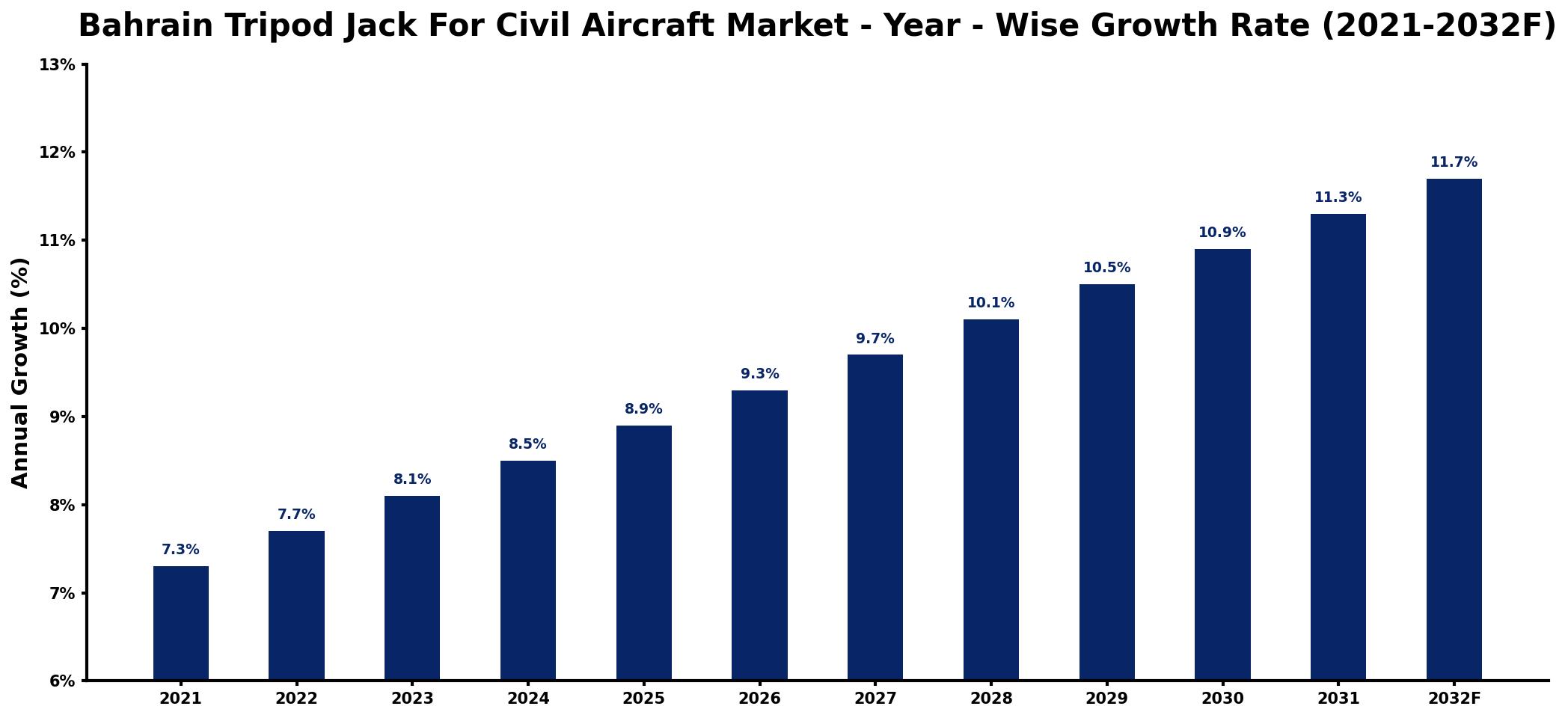
The table below presents the year‑wise growth rates along with the key drivers influencing the market
| Year | Growth Rate | Major Drivers |
| 2021 | 7.3% | Rising infrastructure development projects |
| 2022 | 7.7% | Increased airline operational efficiency |
| 2023 | 8.1% | Growing demand for maintenance services |
| 2024 | 8.5% | Expansion of regional aviation market |
| 2025 | 8.9% | Technological advancements in equipment |
| 2026 | 9.3% | Higher investments in safety standards |
| 2027 | 9.7% | Surge in air travel demand |
| 2028 | 10.1% | Strengthening of logistics networks |
| 2029 | 10.5% | Emergence of new airline operators |
| 2030 | 10.9% | Enhanced regulatory compliance requirements |
| 2031 | 11.3% | Growing focus on sustainability practices |
| 2032 | 11.7% | Increased collaboration among stakeholders |
Note: Market size estimations and growth projections presented in this report are based on 6Wresearch's proprietary forecasting methodology, utilizing the latest available industry data, government publications, and primary research inputs.
Bahrain Tripod Jack For Civil Aircraft Market Synopsis
The tripod jack market for civil aircraft in Bahrain is gaining momentum as the nation prioritizes its aviation capabilities. With the government's commitment to developing modern maintenance facilities, these jacks play a vital role in ensuring aircraft safety and operational efficiency. The emphasis on reliability and advanced design continues to shape the product landscape.
Current market dynamics reflect a growing appetite for quality ground support equipment. As airlines and maintenance, repair, and overhaul (MRO) businesses operate in a competitive environment, the adoption of lightweight, durable tripod jacks becomes essential. The trends towards safety, operational efficiency, and regulatory compliance further drive this market.
Bahrain Tripod Jack For Civil Aircraft Market Key Takeaways
- The market is on a growth trajectory due to the rising demand for reliable ground support equipment.
- Investment in the aviation sector and related infrastructure is a significant driver of market expansion.
- New product development focuses on lightweight and easy-to-operate tripod jacks to meet industry standards.
- Government policies promote safety and compliance, enhancing market attractiveness.
- The market faces competition from refurbished equipment, influencing new product sales.
Evaluation of Restraints in Bahrain Tripod Jack For Civil Aircraft Market
Despite the growth potential, the Bahrain Tripod Jack market faces distinct challenges that may inhibit its full trajectory. A major limiting factor is the scale of the aviation industry itself, which remains relatively small compared to global standards. Additionally, the costs associated with manufacturing and maintaining high-quality equipment can deter investment. Furthermore, fluctuations in air travel demand can lead to tighter maintenance budgets, impacting purchasing decisions significantly. The presence of refurbished jacks from international suppliers also introduces price competition, further complicating the new product sales landscape.
Bahrain Tripod Jack For Civil Aircraft Market Trends
Recent trends indicate a shift towards advanced materials and technology in tripod jack manufacturing. Emphasis on lightweight designs not only enhances maneuverability but also supports fuel efficiency in the broader context of aviation operations. Additionally, the growing focus on automation and smart technologies is paving the way for more sophisticated equipment that can offer improved safety features and operational efficiency. As the market evolves, manufacturers are increasingly incorporating feedback from end-users to align product offerings with real-world needs.
Bahrain Tripod Jack For Civil Aircraft Market Opportunities
With Bahrains aviation sector on the rise, significant investment opportunities are emerging for businesses focused on manufacturing or distributing tripod jacks. The increasing need for high-quality maintenance equipment presents a clear opening for innovative solutions that cater to safety and efficiency standards. Additionally, as the government invests in infrastructure, collaborations with MRO service providers can lead to long-term partnerships, further solidifying market presence. The pursuit of sustainable practices in aviation maintenance may also drive the demand for eco-friendly jacking systems.
Government Initiatives in the Bahrain Tripod Jack For Civil Aircraft Market
The Bahraini government is actively encouraging the development of its aviation maintenance capabilities through various policies and programs. By promoting investments in modern ground support equipment, the government seeks to ensure compliance with international aviation safety standards. Initiatives focused on infrastructure development not only enhance the operational landscape but also foster an environment conducive to growth in the tripod jack market. Regulations are strictly enforced to ensure that all equipment meets necessary safety and quality benchmarks, further solidifying market integrity.
Future Insights of the Bahrain Tripod Jack For Civil Aircraft Market
Looking ahead to 2026-2032, the Bahrain Tripod Jack market is poised for significant evolution. With the anticipated growth in air travel, the demand for effective maintenance solutions will continue to rise, positioning tripod jacks as critical components in this ecosystem. As technology advances, the incorporation of smart features and enhanced safety measures will be paramount. The market will likely see increased collaboration between manufacturers and MRO service providers, creating tailored solutions that meet emerging challenges and drive efficiency in aircraft servicing.
Bahrain Tripod Jack For Civil Aircraft Market Latest Developments (2025 - 2026)
Recent developments in the Bahrain Tripod Jack market indicate a growing focus on innovation and compliance with international safety standards. Manufacturers are increasingly adopting advanced technologies and materials to enhance product functionality and reduce weight. The trend towards automation is also gaining traction, with several companies exploring smart jacking systems that offer real-time monitoring and control features. As market dynamics shift, stakeholders are engaging in partnerships aimed at improving operational efficiencies and ensuring compliance with regulatory requirements.
Bahrain Tripod Jack For Civil Aircraft Market - Key Attractiveness of the Report
- 10 Years of Market Numbers
- Historical Data Starting from 2022 to 2025
- Base Year: 2025
- Forecast Data until 2032
- Key Performance Indicators Impacting the Market
- Major Upcoming Developments and Projects
Key Highlights of the Report:
- Bahrain Tripod Jack For Civil Aircraft Market Outlook
- Market Size of Bahrain Tripod Jack For Civil Aircraft Market, 2025
- Forecast of Bahrain Tripod Jack For Civil Aircraft Market, 2032
- Historical Data and Forecast of Bahrain Tripod Jack For Civil Aircraft Revenues & Volume for the Period 2022-2032F
- Bahrain Tripod Jack For Civil Aircraft Market Trend Evolution
- Bahrain Tripod Jack For Civil Aircraft Market Drivers and Challenges
- Bahrain Tripod Jack For Civil Aircraft Price Trends
- Bahrain Tripod Jack For Civil Aircraft Porter's Five Forces
- Bahrain Tripod Jack For Civil Aircraft Industry Life Cycle
- Historical Data and Forecast of Bahrain Tripod Jack For Civil Aircraft Market Revenues & Volume By Product for the Period 2022-2032F
- Historical Data and Forecast of Bahrain Tripod Jack For Civil Aircraft Market Revenues & Volume By Single Stage for the Period 2022-2032F
- Historical Data and Forecast of Bahrain Tripod Jack For Civil Aircraft Market Revenues & Volume By Multi Stage for the Period 2022-2032F
- Historical Data and Forecast of Bahrain Tripod Jack For Civil Aircraft Market Revenues & Volume By Application for the Period 2022-2032F
- Historical Data and Forecast of Bahrain Tripod Jack For Civil Aircraft Market Revenues & Volume By Jetliners for the Period 2022-2032F
- Historical Data and Forecast of Bahrain Tripod Jack For Civil Aircraft Market Revenues & Volume By Business Jet for the Period 2022-2032F
- Historical Data and Forecast of Bahrain Tripod Jack For Civil Aircraft Market Revenues & Volume By Regional Aircraft for the Period 2022-2032F
- Historical Data and Forecast of Bahrain Tripod Jack For Civil Aircraft Market Revenues & Volume By Commericial Jetliner for the Period 2022-2032F
- Bahrain Tripod Jack For Civil Aircraft Import Export Trade Statistics
- Market Opportunity Assessment By Product
- Market Opportunity Assessment By Application
- Bahrain Tripod Jack For Civil Aircraft Top Companies Market Share
- Bahrain Tripod Jack For Civil Aircraft Competitive Benchmarking By Technical and Operational Parameters
- Bahrain Tripod Jack For Civil Aircraft Company Profiles
- Bahrain Tripod Jack For Civil Aircraft Key Strategic Recommendations






































