Bahrain Virtualization Security Market Size & Growth Rate (2026-2032)
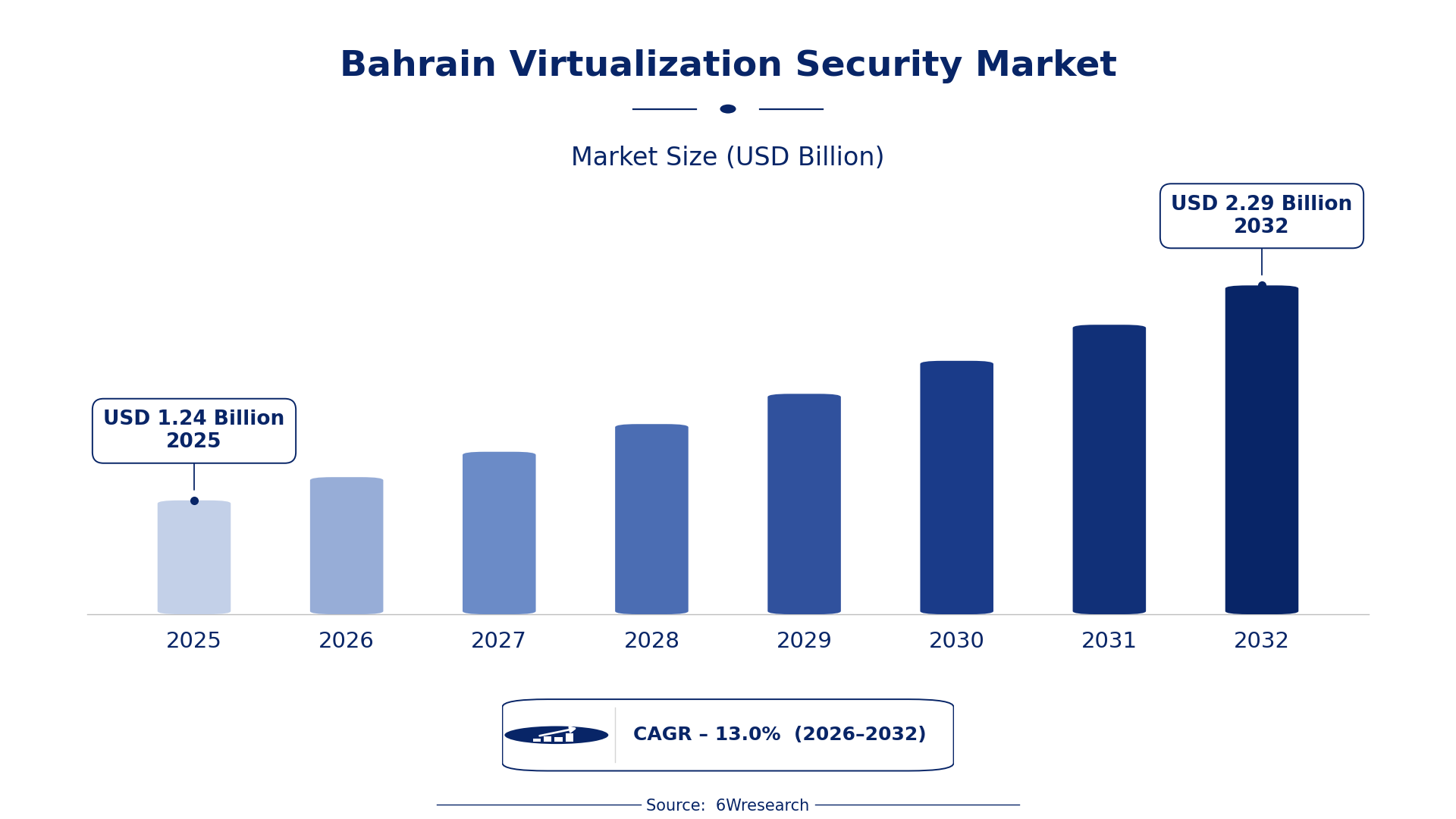
The Bahrain Virtualization Security Market was estimated at USD 1236 Million in 2025 and is projected to reach USD 2286 Million by 2032, growing at a CAGR of 13.0% from 2026 to 2032.
Bahrain Virtualization Security Market Synopsis
The Bahrain Virtualization Security Market is witnessing notable traction as organizations increasingly turn to virtualization technologies to optimize their IT infrastructure. This shift brings the pressing need for security solutions tailored to protect virtual environments from a myriad of cyber threats, emphasizing the importance of safeguarding sensitive data.
Growing incidents of data breaches and stringent compliance regulations are compelling businesses in Bahrain to invest heavily in virtualization security solutions. As cloud computing and hybrid IT architectures gain traction, the focus on securing virtual environments will remain critical, ensuring that organizations can confidently expand their digital footprint.
Bahrain Virtualization Security Market Year-wise Growth Rate and Key Drivers
This graph illustrates the annual growth rates of the Bahrain Virtualization Security Market from 2021 to 2032, highlighting a steady upward trajectory and projected expansion over the forecast period.
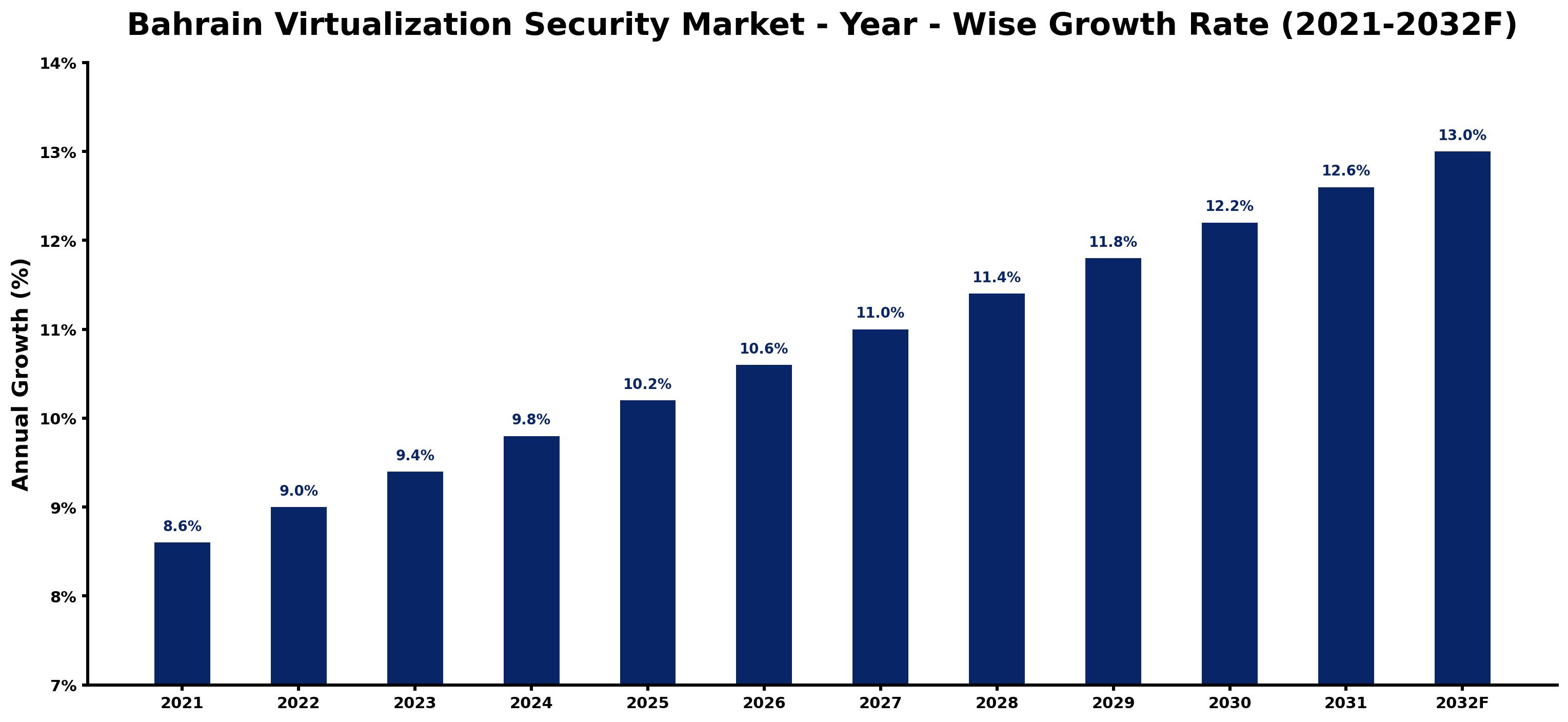
The table below presents the year‑wise growth rates along with the key drivers influencing the market
| Year | Growth Rate | Major Drivers |
| 2021 | 8.6% | Bahrain economic recovery enhances cybersecurity investments. |
| 2022 | 9.0% | Government's cybersecurity strategy boosts virtualization security needs. |
| 2023 | 9.4% | Increased homeworking drives demand for virtual security solutions. |
| 2024 | 9.8% | Bahrain Fintech Bay promotes secure virtual environments. |
| 2025 | 10.2% | Telecom Regulatory Authority mandates enhanced digital protections. |
| 2026 | 10.6% | Rising e-commerce in Bahrain increases virtualization security requirements. |
| 2027 | 11.0% | National cybersecurity framework strengthens demand for virtualization security. |
| 2028 | 11.4% | Government incentives for tech startups enhance security investments. |
| 2029 | 11.8% | Growth in IoT devices necessitates advanced security solutions. |
| 2030 | 12.2% | Local banks enhance security for online transactions. |
| 2031 | 12.6% | Education sector digitization increases need for secure environments. |
| 2032 | 13.0% | Bahrain's global fintech trade positions for robust security frameworks. |
Note: Market size estimations and growth projections presented in this report are based on 6Wresearch's proprietary forecasting methodology, utilizing the latest available industry data, government publications, and primary research inputs.
Bahrain Virtualization Security Market Key Takeaways
Below are some of the specific key takeaways from the market, including:
- The market's growth is largely driven by the increasing adoption of virtualization technologies across sectors.
- Heightened awareness of cyber threats is pushing organizations to prioritize virtualization security measures.
- Government policies are reinforcing the need for compliance and risk management related to virtualization technologies.
- Emerging technologies such as AI and machine learning are enhancing the effectiveness of virtualization security solutions.
- Continued investment in cloud computing and hybrid models is set to expand the virtualization security landscape.
Evaluation of Restraints in Bahrain Virtualization Security Market
Despite the promising growth trajectory, the Bahrain virtualization security market faces several real challenges. Hypervisor vulnerabilities remain a critical concern, as attacks targeting these areas can compromise entire virtual infrastructures. Additionally, ensuring data protection during transit and at rest is complex, especially with increasingly sophisticated cyber threats. Compliance with industry regulations adds another layer of difficulty for IT professionals, as they work to ensure that virtualization environments are secure and compliant. As these challenges persist, they complicate security strategies and highlight the necessity for ongoing investment in advanced security solutions.
Bahrain Virtualization Security Market Trends
Key trends are shaping the Bahrain virtualization security market, with a significant emphasis on integrated security solutions that encompass threat detection, response, and compliance. The rise in hybrid IT architectures is pushing organizations to adopt comprehensive security frameworks that provide visibility and control over their virtualized environments. on top of that, the growing implementation of machine learning and AI technologies within security tools is enhancing threat detection capabilities, allowing organizations to respond more effectively to potential vulnerabilities.
Bahrain Virtualization Security Market Opportunities
Genuine opportunities abound within the Bahrain virtualization security market, particularly as businesses expand their digital infrastructures. Investments in advanced threat intelligence platforms and encryption techniques are likely to yield significant returns, with organizations prioritizing security that offers both resilience and scalability. Additionally, the increasing adoption of cloud services positions virtualization security as a fundamental pillar of cybersecurity strategies, providing a fertile ground for innovation and growth.
Government Initiatives in the Bahrain Virtualization Security Market
Bahrain's government is actively shaping the virtualization security market through a series of policies aimed at enhancing cybersecurity and data protection frameworks. By prioritizing regulations that mandate the use of security solutions, the government is fostering a culture of compliance that aligns with global best practices. This commitment is vital for organizations as they seek to safeguard their virtualized environments against emerging threats.
- A recently completed initiative focused on establishing a national cybersecurity strategy aimed at bolstering the resilience of virtualized infrastructures across sectors.
- Currently ongoing is a government-led training program designed to enhance cybersecurity skills among IT professionals, with an emphasis on virtualization security.
- A planned public-private partnership expected to enhance the cybersecurity framework by 2027, focusing on integrating advanced virtualization security measures into national infrastructure.
- The introduction of regulations mandating the use of encryption for sensitive data within virtualized environments, set to roll out in early 2026.
- Support for educational institutions to incorporate cybersecurity education into their curricula, particularly focusing on virtualization security methodologies.
Future Insights of the Bahrain Virtualization Security Market
Looking ahead, the Bahrain virtualization security market is expected to evolve alongside advancements in technology and increasing cyber threats. The incorporation of artificial intelligence and machine learning in security solutions will likely transform threat detection capabilities, while the expansion of cloud services will continue to drive investments in virtualization security. As organizations prioritize digital transformation, the focus on secure virtual environments will be critical in maintaining operational integrity and customer trust.
Bahrain Virtualization Security Market Latest Developments
Recent activity in the Bahrain virtualization security market has been marked by substantial innovations and strategic initiatives aimed at enhancing security frameworks. As organizations face growing cyber threats, the focus has shifted toward implementing advanced security measures that can effectively protect virtualized environments.
- A new cloud-based security solution was launched in mid-2025, targeting enterprises with robust virtualization environments and offering comprehensive threat detection.
- An initiative focusing on improving hypervisor security standards commenced in early 2025 and is currently undergoing industry consultation.
- A major technology vendor announced a partnership in late 2025 to develop cutting-edge security tools aimed at enhancing the resilience of virtualized infrastructures.
- An upcoming project expected to start in Q3 2026 aims to integrate AI-driven analytics into existing security frameworks across governmental agencies.
- A training initiative was initiated in 2024 to bolster the skill set of IT professionals concerning virtualization security best practices, with ongoing sessions scheduled throughout 2026.
Bahrain Virtualization Security Market - Key Attractiveness of the Report
- 10 Years of Market Numbers
- Historical Data Starting from 2022 to 2025
- Base Year: 2025
- Forecast Data until 2032
- Key Performance Indicators Impacting the Market
- Major Upcoming Developments and Projects
Key Highlights of the Report:
- Bahrain Virtualization Security Market Outlook
- Market Size of Bahrain Virtualization Security Market, 2025
- Forecast of Bahrain Virtualization Security Market, 2032
- Historical Data and Forecast of Bahrain Virtualization Security Revenues & Volume for the Period 2022-2032F
- Bahrain Virtualization Security Market Trend Evolution
- Bahrain Virtualization Security Market Drivers and Challenges
- Bahrain Virtualization Security Price Trends
- Bahrain Virtualization Security Porter's Five Forces
- Bahrain Virtualization Security Industry Life Cycle
- Historical Data and Forecast of Bahrain Virtualization Security Market Revenues & Volume By Component for the Period 2022-2032F
- Historical Data and Forecast of Bahrain Virtualization Security Market Revenues & Volume By Solution (Virtual Infrastructure & Lifecycle Protection) for the Period 2022-2032F
- Historical Data and Forecast of Bahrain Virtualization Security Market Revenues & Volume By Services (Professional & Managed) for the Period 2022-2032F
- Historical Data and Forecast of Bahrain Virtualization Security Market Revenues & Volume By Organization Size for the Period 2022-2032F
- Historical Data and Forecast of Bahrain Virtualization Security Market Revenues & Volume By SMEs for the Period 2022-2032F
- Historical Data and Forecast of Bahrain Virtualization Security Market Revenues & Volume By Large Enterprises for the Period 2022-2032F
- Historical Data and Forecast of Bahrain Virtualization Security Market Revenues & Volume By End User for the Period 2022-2032F
- Historical Data and Forecast of Bahrain Virtualization Security Market Revenues & Volume By Service Providers for the Period 2022-2032F
- Historical Data and Forecast of Bahrain Virtualization Security Market Revenues & Volume By Enterprises for the Period 2022-2032F
- Historical Data and Forecast of Bahrain Virtualization Security Market Revenues & Volume By Deployment for the Period 2022-2032F
- Historical Data and Forecast of Bahrain Virtualization Security Market Revenues & Volume By On-premises for the Period 2022-2032F
- Historical Data and Forecast of Bahrain Virtualization Security Market Revenues & Volume By Cloud for the Period 2022-2032F
- Bahrain Virtualization Security Import Export Trade Statistics
- Market Opportunity Assessment By Component
- Market Opportunity Assessment By Organization Size
- Market Opportunity Assessment By End User
- Market Opportunity Assessment By Deployment
- Bahrain Virtualization Security Top Companies Market Share
- Bahrain Virtualization Security Competitive Benchmarking By Technical and Operational Parameters
- Bahrain Virtualization Security Company Profiles
- Bahrain Virtualization Security Key Strategic Recommendations






































