Bangladesh Crystal Lighting Market Summary
The bangladesh crystal lighting market was estimated at USD 393 Million in 2025 and is projected to reach USD 520 Million by 2032, growing at a CAGR of 4.6% from 2026 to 2032.
Bangladesh Crystal Lighting Market Year-wise Growth Rate and Key Drivers
This graph highlights how the Bangladesh Crystal Lighting Market has steadily grown over the past five years, supported by major growth factors.
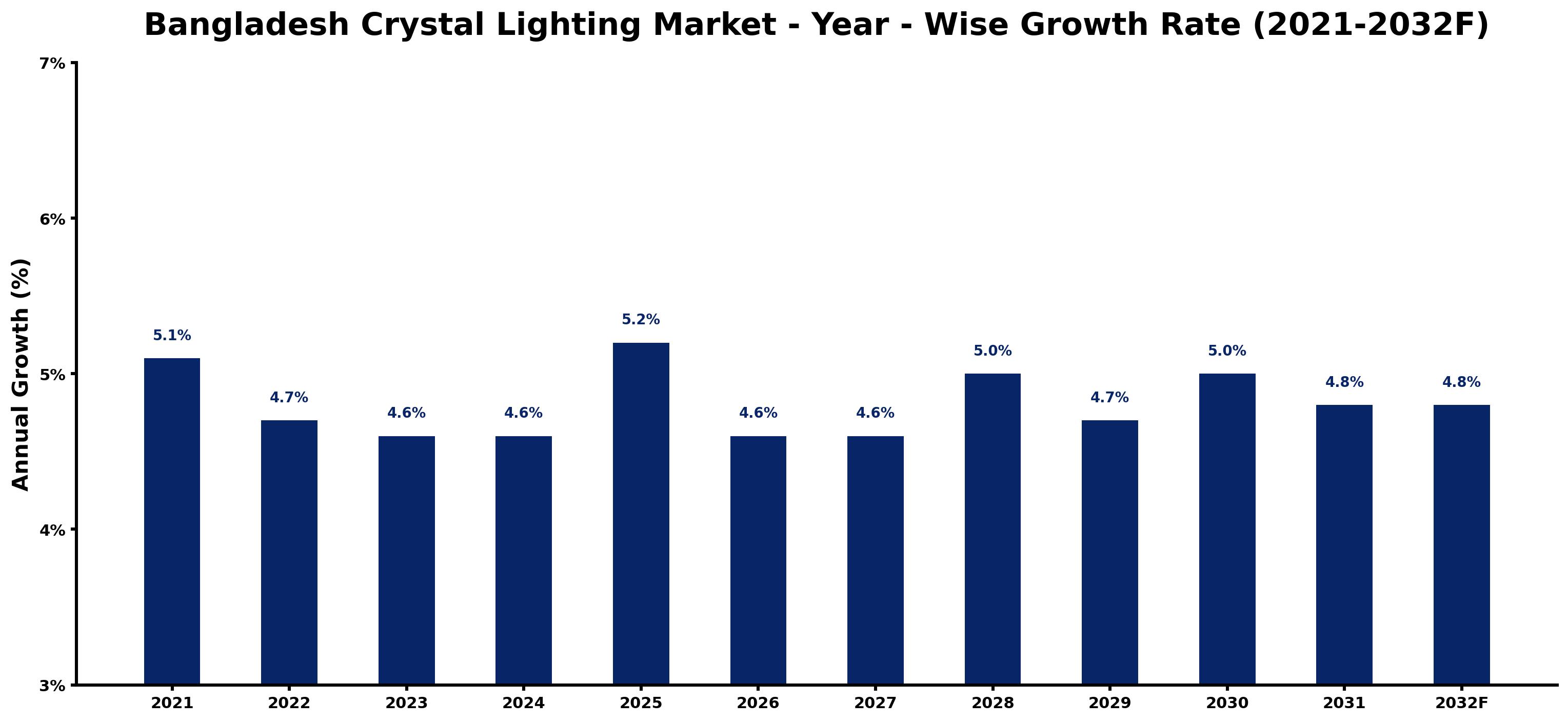
The table below presents the year wise growth rates along with the key drivers influencing the market
| Year | Growth Rate | Major Drivers |
| 2021 | 5.1% | Increased urbanization led to heightened demand for energy-efficient lighting solutions. |
| 2022 | 4.7% | Local manufacturers expanded product lines, enhancing competition and affordability in the market. |
| 2023 | 4.6% | Homeowners began investing in decorative lighting, reflecting personal style and modern aesthetics. |
| 2024 | 4.6% | Post-lockdown retail projects gained momentum, driving demand for commercial lighting solutions. |
| 2025 | 5.2% | Expansion of the real estate sector created new opportunities for integrated lighting designs. |
| 2026 | 4.6% | Economic recovery post-pandemic fostered consumer spending on home improvement and upgrades. |
| 2027 | 4.6% | Rising awareness of sustainable practices pushed eco-friendly lighting innovations into the spotlight. |
| 2028 | 5.0% | Technological advancements in smart lighting systems attracted tech-savvy consumers and businesses alike. |
| 2029 | 4.7% | Collaborations between local artisans and manufacturers brought unique designs to the market. |
| 2030 | 5.0% | Public projects focused on urban beautification initiated increased demand for decorative lighting. |
| 2031 | 4.8% | Diverse product offerings catered to various cultural and aesthetic preferences across the nation. |
| 2032 | 4.8% | Investment in renewable energy sources encouraged a shift towards energy-efficient lighting solutions. |
Note - Market size estimations and growth projections presented in this report are based on 6Wresearch's advanced forecasting approach, validated with industry datasets as of June 2026.
Bangladesh Crystal Lighting Market Synopsis
The Bangladesh Crystal Lighting Market is projected to reach 4.6% and witness significant growth during the forecast period (2026-2032). This growth is expected to be driven by several factors, including an increasing demand for energy-efficient lighting solutions, heightened awareness regarding cost savings, and rapid urbanization across the country. Additionally, the upward trend in disposable income levels among consumers, coupled with evolving lifestyle preferences in both rural and urban demographics, plays a crucial role in the market's expansion.
Bangladesh Crystal Lighting Market Growth Drivers
The Bangladesh Crystal Lighting Market is experiencing robust growth due to multiple intrinsic and extrinsic factors. Firstly, the emphasis on energy efficiency is shaping consumer preferences, with many seeking products that significantly reduce energy consumption while maintaining aesthetic appeal. Secondly, increased awareness of the long-term cost savings associated with such lighting solutions has encouraged consumers to make informed purchasing decisions. Thirdly, rapid urbanization has escalated the demand for modern lighting solutions in newly developed urban areas as well as in rural upgrades.
As disposable incomes rise, households are more willing to invest in higher-quality lighting products. This trend is further supported by changing lifestyles, where both urban and rural populations prioritize aesthetics and functionality in their living spaces. Furthermore, government programs like Green Building Certification Programs (GBC) have positively influenced the market by promoting eco-friendly lighting technologies, thus expanding the reach of manufacturers in the region.
Bangladesh Crystal Lighting Market Challenges and Restraints
Despite the promising trajectory, the Bangladesh Crystal Lighting Market faces several challenges that could impede its growth. A significant concern is the high installation costs associated with crystal lighting products, which may deter price-sensitive consumers. This financial barrier can limit market penetration, especially in low-income demographics.
Another challenge is the limited consumer awareness regarding the advantages of crystal lighting over traditional options. In rural areas, where access to information is often constrained, the adoption rate for modern lighting technologies may lag. Moreover, the lack of skilled workforce for installation and maintenance of sophisticated lighting systems can further complicate market growth.
Additionally, potential fluctuations in the global supply chain may affect the availability of raw materials necessary for manufacturing crystal lighting fixtures. This could lead to increased costs and project delays, thereby dampening market confidence.
Bangladesh Crystal Lighting Market Investment Opportunities
The Bangladesh Crystal Lighting Market presents several investment opportunities that stakeholders can capitalize on. The growing trend towards sustainable living has opened avenues for manufacturers to innovate and cater to eco-conscious consumers. Investing in research and development to create energy-efficient, affordable crystal lighting solutions can yield significant returns.
Infrastructure development projects, propelled by urban expansion, offer promising opportunities for lighting manufacturers. As cities grow, demand for comprehensive lighting solutions that enhance public spaces becomes crucial. Additionally, the integration of smart technology in lighting systems can attract tech-savvy consumers and provide differentiation in a competitive market.
Strategically positioned partnerships with government initiatives can also provide a platform for growth. By aligning with energy efficiency programs, manufacturers can benefit from incentives while paving the way for broader market acceptance.
Bangladesh Crystal Lighting Market Government Investment and Initiatives
Government initiatives play a pivotal role in shaping the trajectory of the Bangladesh Crystal Lighting Market. Through policies aimed at promoting energy efficiency and sustainable practices, the government has initiated several programs that encourage the adoption of modern lighting technologies. The Green Building Certification Programs (GBC) are particularly noteworthy, as they incentivize construction projects to incorporate eco-friendly lighting solutions.
In addition to certification programs, public spending on infrastructure development, especially in urban areas, creates a conducive environment for the growth of the lighting market. Initiatives aimed at enhancing public infrastructure often include provisions for modern lighting systems, which directly benefits crystal lighting manufacturers.
Furthermore, the government has been working on regulations that promote the use of energy-efficient appliances, which can bolster the demand for crystal lighting solutions. These regulations not only align with global sustainability goals but also underscore the government's commitment to improving the overall quality of life for its citizens.
Bangladesh Crystal Lighting Market Latest Developments (May 2025 - June 2026)
The Bangladesh Crystal Lighting Market has witnessed several noteworthy developments from May 2025 to June 2026. The focus on sustainable lighting solutions has accelerated research and development efforts aimed at creating energy-efficient products that cater to the growing demands of consumers. Manufacturers are increasingly investing in innovative designs that blend aesthetics with functionality, responding to changing consumer preferences.
Additionally, the government has continued to bolster support for energy efficiency initiatives, promoting awareness and fostering partnerships with various entities to encourage greater adoption of crystal lighting technologies. Public seminars and campaigns aimed at educating consumers about the benefits of crystal lighting have been implemented, resulting in increased interest and potential sales growth.
Moreover, collaborations between private firms and governmental bodies have emerged, focusing on enhancing urban lighting infrastructure. Projects aimed at revitalizing public spaces have increasingly included crystal lighting solutions, showcasing their potential to improve urban aesthetics while contributing to energy savings.
Bangladesh Crystal Lighting Market - Key Attractiveness of the Report
- 10 Years of Market Numbers
- Historical Data Starting from 2022 to 2025
- Base Year: 2025
- Forecast Data until 2032
- Key Performance Indicators Impacting the Market
- Major Upcoming Developments and Projects
Key Highlights of the Report:
- Bangladesh Crystal Lighting Market Outlook
- Market Size of Bangladesh Crystal Lighting Market, 2025
- Forecast of Bangladesh Crystal Lighting Market, 2032F
- Historical Data and Forecast of Bangladesh Crystal Lighting Revenues & Volume for the Period 2022-2032F
- Bangladesh Crystal Lighting Market Trend Evolution
- Bangladesh Crystal Lighting Market Drivers and Challenges
- Bangladesh Crystal Lighting Price Trends
- Bangladesh Crystal Lighting Porter's Five Forces
- Bangladesh Crystal Lighting Industry Life Cycle
- Historical Data and Forecast of Bangladesh Crystal Lighting Market Revenues & Volume By Product Type for the Period 2022-2032F
- Historical Data and Forecast of Bangladesh Crystal Lighting Market Revenues & Volume By Ceiling Crystal Lights for the Period 2022-2032F
- Historical Data and Forecast of Bangladesh Crystal Lighting Market Revenues & Volume By Crystal Chandeliers for the Period 2022-2032F
- Historical Data and Forecast of Bangladesh Crystal Lighting Market Revenues & Volume By Others for the Period 2022-2032F
- Historical Data and Forecast of Bangladesh Crystal Lighting Market Revenues & Volume By Applications for the Period 2022-2032F
- Historical Data and Forecast of Bangladesh Crystal Lighting Market Revenues & Volume By Commercial for the Period 2022-2032F
- Historical Data and Forecast of Bangladesh Crystal Lighting Market Revenues & Volume By Designer for the Period 2022-2032F
- Historical Data and Forecast of Bangladesh Crystal Lighting Market Revenues & Volume By Superior Residential for the Period 2022-2032F
- Bangladesh Crystal Lighting Import Export Trade Statistics
- Market Opportunity Assessment By Product Type
- Market Opportunity Assessment By Applications
- Bangladesh Crystal Lighting Top Companies Market Share
- Bangladesh Crystal Lighting Competitive Benchmarking By Technical and Operational Parameters
- Bangladesh Crystal Lighting Company Profiles
- Bangladesh Crystal Lighting Key Strategic Recommendations






































