Bangladesh Energy Efficient Lighting Market Size, Share & Growth Rate
The Bangladesh Energy Efficient Lighting Market was estimated at USD 330 Million in 2025 and is projected to reach USD 462 Million by 2032, growing at a CAGR of 4.9% from 2026 to 2032. This upward trajectory is fueled by robust government initiatives aimed at energy conservation, along with a rapidly growing preference for LED lighting solutions across various sectors. Increased consumer awareness regarding the environmental and economic benefits of energy-efficient lighting is further bolstering market dynamics.
Bangladesh Energy Efficient Lighting Market Year-wise Growth Rate and Key Drivers
This graph highlights how the Bangladesh Energy Efficient Lighting Market has steadily grown over the years, supported by major growth factors.
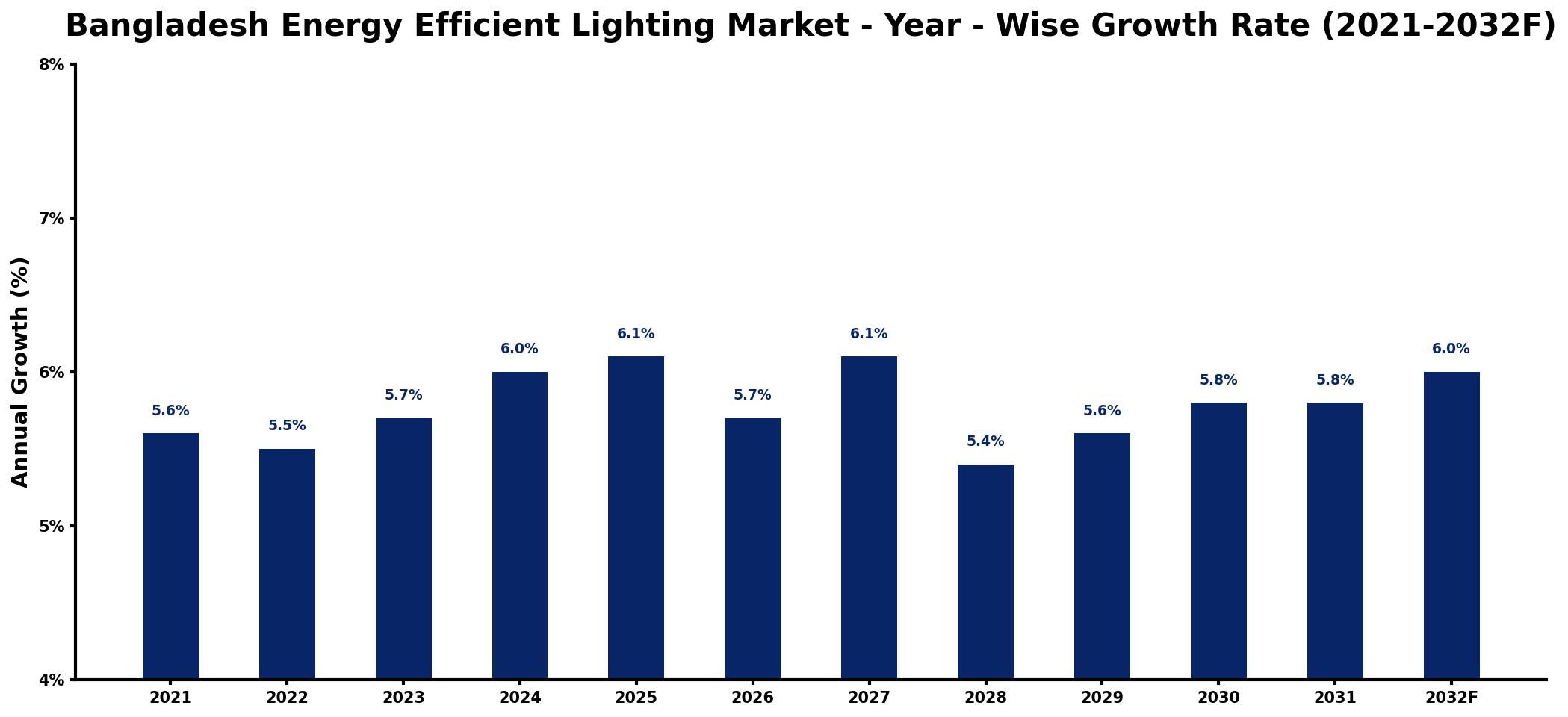
The table below presents the year‑wise growth rates along with the key drivers influencing the market
| Year | Growth Rate | Major Drivers |
| 2021 | 5.6% | Rising consumer awareness initiatives |
| 2022 | 5.5% | Government subsidies for renewable technologies |
| 2023 | 5.7% | Increased urban population growth |
| 2024 | 6.0% | Expansion of green building projects |
| 2025 | 6.1% | Technological advancements in alternatives |
| 2026 | 5.7% | Strengthening of sustainability regulations |
| 2027 | 6.1% | Growing international investment influx |
| 2028 | 5.4% | Emergence of eco-friendly startups |
| 2029 | 5.6% | Rising demand for smart solutions |
| 2030 | 5.8% | rising procurement volume requirements |
| 2031 | 5.8% | Focus on corporate social responsibility |
| 2032 | 6.0% | Development of innovative financing models |
Note: Market size estimations and growth projections presented in this report are based on 6Wresearch's proprietary forecasting methodology, utilizing the latest available industry data, government publications, and primary research inputs.
Bangladesh Energy Efficient Lighting Market Synopsis
The Bangladesh Energy Efficient Lighting Market has recently gained momentum, transitioning from traditional incandescent and CFL bulbs to modern LED lighting solutions. This shift aligns with broader trends in sustainability and energy efficiency, driven by both consumer demand and regulatory frameworks.
Looking forward, the market is set to expand significantly as the government continues to implement policies encouraging the adoption of energy-efficient technologies. Innovations in smart lighting and IoT integration are expected to further revolutionize the sector, catering to an increasingly tech-savvy consumer base.
Bangladesh Energy Efficient Lighting Market Key Takeaways
- The market is rapidly shifting towards LED lighting due to its energy-saving capabilities.
- Government initiatives play a crucial role in promoting energy-efficient lighting solutions.
- Rising awareness of environmental sustainability is driving consumer preference for energy-efficient products.
- Investment opportunities are emerging in manufacturing, distribution, and installation of energy-efficient lighting systems.
- Smart lighting and IoT integration are shaping future trends in the market.
Evaluation of Restraints in Bangladesh Energy Efficient Lighting Market
Despite the encouraging growth, several factors act as restraints in the Bangladesh Energy Efficient Lighting Market. One notable issue is the limited awareness among consumers about the advantages of energy-efficient lighting, often resulting in a continued reliance on traditional lighting options. Additionally, the high initial investment for LED technology can deter both consumers and businesses in a price-sensitive market. There is also a pressing need for improved distribution channels to ensure the availability of quality products, which currently poses a challenge to widespread adoption.
Bangladesh Energy Efficient Lighting Market Trends
A notable trend in the Bangladesh Energy Efficient Lighting Market is the significant migration towards LED technology due to its longevity and energy efficiency. As urbanization increases, there is a corresponding demand for smart lighting systems integrated with IoT solutions, making lighting management more efficient. Additionally, manufacturers are focusing on innovative designs to enhance the aesthetic appeal and functionality of lighting products, aligning with consumer preferences for both form and function.
Bangladesh Energy Efficient Lighting Market Opportunities
The Bangladesh Energy Efficient Lighting Market offers lucrative investment opportunities as the country prioritizes energy conservation. Investors can capitalize on the growing demand for LED lighting in residential, commercial, and industrial sectors. Furthermore, there is potential in providing energy audit services and collaborating with governmental bodies on energy efficiency initiatives. The ongoing transition towards sustainability presents a fertile ground for innovations in energy-efficient lighting technologies.
Government Initiatives in the Bangladesh Energy Efficient Lighting Market
The Bangladeshi government has been proactive in promoting energy-efficient lighting solutions through various policies and initiatives. The Energy Efficiency and Conservation Act of 2013, alongside the National Energy Efficiency and Conservation Policy of 2009, establishes a regulatory framework aimed at encouraging the use of energy-efficient products. Programs like the Efficient Lighting Initiative aim to distribute compact fluorescent lamps (CFLs) at subsidized rates, further fostering the transition to energy-efficient technologies in households and businesses.
Future Insights of the Bangladesh Energy Efficient Lighting Market
Looking ahead to 2026-2032, the Bangladesh Energy Efficient Lighting Market is poised for substantial growth. Factors such as increasing consumer awareness, urbanization, and continuous government support for sustainable practices will likely drive market dynamics. The anticipated growth in demand for advanced lighting technologies, including smart and integrated systems, signifies a shift in consumer expectations towards energy efficiency and innovation in lighting solutions.
Bangladesh Energy Efficient Lighting Market Latest Developments (2025 - 2026)
In recent months, the Bangladesh Energy Efficient Lighting Market has witnessed a surge in product launches focusing on innovative LED and smart lighting solutions. Various stakeholders, including manufacturers and distributors, have ramped up their efforts to enhance product availability and market penetration. Additionally, governmental awareness campaigns have intensified, aiming to educate consumers on the benefits of energy-efficient lighting, thereby facilitating a more informed market landscape.
Bangladesh Energy Efficient Lighting Market - Key Attractiveness of the Report
- 10 Years of Market Numbers
- Historical Data Starting from 2022 to 2025
- Base Year: 2025
- Forecast Data until 2032
- Key Performance Indicators Impacting the Market
- Major Upcoming Developments and Projects
Key Highlights of the Report:
- Bangladesh Energy Efficient Lighting Market Outlook
- Market Size of Bangladesh Energy Efficient Lighting Market, 2025
- Forecast of Bangladesh Energy Efficient Lighting Market, 2032
- Historical Data and Forecast of Bangladesh Energy Efficient Lighting Revenues & Volume for the Period 2022-2032F
- Bangladesh Energy Efficient Lighting Market Trend Evolution
- Bangladesh Energy Efficient Lighting Market Drivers and Challenges
- Bangladesh Energy Efficient Lighting Price Trends
- Bangladesh Energy Efficient Lighting Porter's Five Forces
- Bangladesh Energy Efficient Lighting Industry Life Cycle
- Historical Data and Forecast of Bangladesh Energy Efficient Lighting Market Revenues & Volume By Product Type for the Period 2022-2032F
- Historical Data and Forecast of Bangladesh Energy Efficient Lighting Market Revenues & Volume By Incandescent Lamp for the Period 2022-2032F
- Historical Data and Forecast of Bangladesh Energy Efficient Lighting Market Revenues & Volume By Light Emitting Diode for the Period 2022-2032F
- Historical Data and Forecast of Bangladesh Energy Efficient Lighting Market Revenues & Volume By Arc Lamp for the Period 2022-2032F
- Historical Data and Forecast of Bangladesh Energy Efficient Lighting Market Revenues & Volume By Gas Discharge Lamps for the Period 2022-2032F
- Historical Data and Forecast of Bangladesh Energy Efficient Lighting Market Revenues & Volume By Application for the Period 2022-2032F
- Historical Data and Forecast of Bangladesh Energy Efficient Lighting Market Revenues & Volume By Commercial for the Period 2022-2032F
- Historical Data and Forecast of Bangladesh Energy Efficient Lighting Market Revenues & Volume By Residential for the Period 2022-2032F
- Historical Data and Forecast of Bangladesh Energy Efficient Lighting Market Revenues & Volume By Government for the Period 2022-2032F
- Historical Data and Forecast of Bangladesh Energy Efficient Lighting Market Revenues & Volume By Correlated Color Temperature for the Period 2022-2032F
- Historical Data and Forecast of Bangladesh Energy Efficient Lighting Market Revenues & Volume By 2700K-3000K for the Period 2022-2032F
- Historical Data and Forecast of Bangladesh Energy Efficient Lighting Market Revenues & Volume By 3500K??4000K for the Period 2022-2032F
- Historical Data and Forecast of Bangladesh Energy Efficient Lighting Market Revenues & Volume By 4000K-5000K for the Period 2022-2032F
- Historical Data and Forecast of Bangladesh Energy Efficient Lighting Market Revenues & Volume By 5000K-6500K for the Period 2022-2032F
- Historical Data and Forecast of Bangladesh Energy Efficient Lighting Market Revenues & Volume By More Than 6500K for the Period 2022-2032F
- Bangladesh Energy Efficient Lighting Import Export Trade Statistics
- Market Opportunity Assessment By Product Type
- Market Opportunity Assessment By Application
- Market Opportunity Assessment By Correlated Color Temperature
- Bangladesh Energy Efficient Lighting Top Companies Market Share
- Bangladesh Energy Efficient Lighting Competitive Benchmarking By Technical and Operational Parameters
- Bangladesh Energy Efficient Lighting Company Profiles
- Bangladesh Energy Efficient Lighting Key Strategic Recommendations






































