Bangladesh Industrial Machinery Market Size, Share & Growth Rate
The Bangladesh Industrial Machinery Market was estimated at USD 92 Million in 2025 and is projected to reach USD 100 Million by 2032, growing at a CAGR of 1.2% from 2026 to 2032. This gradual yet steady growth is underpinned by increasing investments in manufacturing and infrastructure development. As Bangladesh aims to bolster its industrial output, the need for advanced machinery to enhance production efficiency and facilitate technological adoption becomes increasingly critical.
Bangladesh Industrial Machinery Market Year-wise Growth Rate and Key Drivers
This graph highlights how the Bangladesh Industrial Machinery Market has steadily grown over the years, supported by major growth factors.
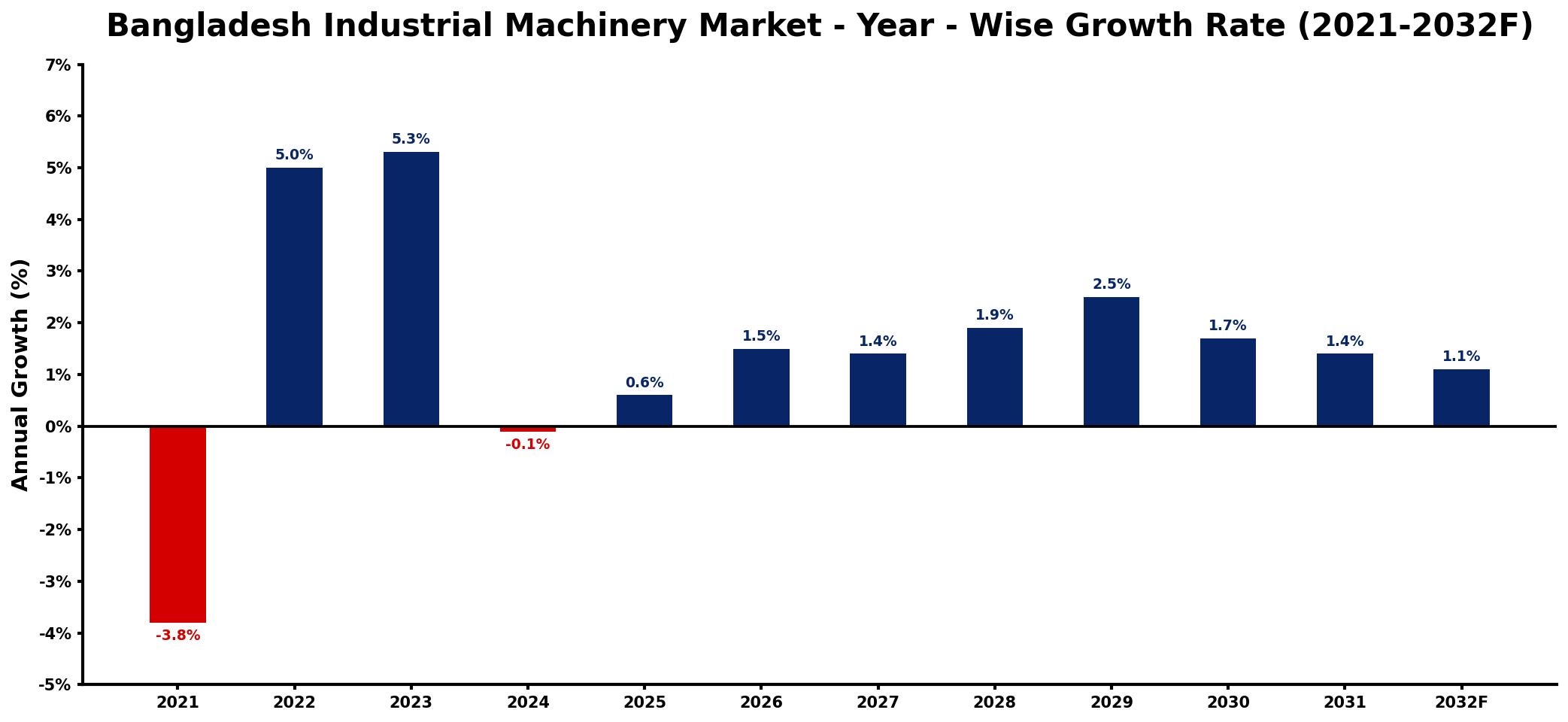
The table below presents the year‑wise growth rates along with the key drivers influencing the market
| Year | Growth Rate | Major Drivers |
| 2021 | -3.8% | decrease in manufacturing investments |
| 2022 | 5.0% | rise in construction activities |
| 2023 | 5.3% | expansion of energy sector |
| 2024 | -0.1% | drop in export orders |
| 2025 | 0.6% | growth in agricultural technology |
| 2026 | 1.5% | increase in infrastructure projects |
| 2027 | 1.4% | development of renewable energy |
| 2028 | 1.9% | surge in urbanization trends |
| 2029 | 2.5% | increased domestic production output |
| 2030 | 1.7% | growing emerging market penetration |
| 2031 | 1.4% | enhanced product quality standards |
| 2032 | 1.1% | rising procurement volume requirements |
Note: Market size estimations and growth projections presented in this report are based on 6Wresearch's proprietary forecasting methodology, utilizing the latest available industry data, government publications, and primary research inputs.
Bangladesh Industrial Machinery Market Synopsis
In recent years, the Bangladesh Industrial Machinery Market has witnessed promising momentum, driven by a surge in manufacturing activities. However, this trend is coupled with evolving demands for higher efficiency and customized solutions, which are shaping the industry's future trajectory. As businesses adopt more automated processes and advanced machinery, the market is poised for transformation.
Looking ahead, the market presents a complex landscape where traditional practices are interwoven with innovative technologies. This intersection creates both challenges and opportunities, particularly as suppliers strive to meet quality standards while enhancing customization capabilities to remain competitive.
Bangladesh Industrial Machinery Market Key Takeaways
- The market is on a path of slow but steady growth, driven by manufacturing and infrastructure investments.
- Government policies are actively promoting the industrial machinery sector through various incentives and reforms.
- Customization and technology adoption are key focus areas for suppliers in the competitive landscape.
- While the market grapples with challenges related to equipment reliability, opportunities for innovation abound.
- Emerging trends indicate a shift towards automation and advanced production processes within industries.
Evaluation of Restraints in Bangladesh Industrial Machinery Market
Despite its potential, the Bangladesh Industrial Machinery Market faces significant restraints that may inhibit its progress. Equipment reliability remains a pressing concern, as does the need for enhanced production efficiency. Suppliers must navigate the complexities of technology adoption while ensuring their offerings align with stringent quality standards. Additionally, the demand for customization can strain operational capabilities, adding further pressure to maintain a competitive edge in an evolving market.
Bangladesh Industrial Machinery Market Trends
Current trends reveal a marked shift towards automation, with industries increasingly recognizing the benefits of industrial robots and advanced machinery. This trend is complemented by the growing emphasis on sustainability, prompting manufacturers to seek energy-efficient solutions that not only enhance productivity but also reduce environmental impact. Furthermore, the integration of smart technologies is transforming traditional manufacturing processes into intelligent systems capable of real-time data analysis and operational optimization.
Bangladesh Industrial Machinery Market Opportunities
The landscape for growth and investment in the Bangladesh Industrial Machinery Market is vibrant, particularly in sectors such as manufacturing and logistics. As local industries expand their operations, there is a significant opportunity for suppliers to provide specialized machinery tailored to specific production processes. Additionally, collaborations with international firms for technology transfer can enhance local capabilities, opening avenues for innovation and increased market share. The ongoing push for infrastructure development also presents a lucrative platform for machinery suppliers.
Government Initiatives in the Bangladesh Industrial Machinery Market
The Bangladeshi government is actively engaged in promoting the industrial machinery sector through a combination of incentives and policy reforms. Initiatives aimed at attracting foreign investment, alongside infrastructure development programs, serve to bolster the industry's competitiveness. Export promotion initiatives and technology transfer programs are also pivotal in fostering innovation and enhancing the overall capacity of local manufacturers, facilitating their entry into the global market.
Future Insights of the Bangladesh Industrial Machinery Market
Looking toward 2026-2032, the Bangladesh Industrial Machinery Market is anticipated to evolve significantly, with advancements in automation and technology at the forefront. As industries increasingly adopt intelligent systems, the demand for state-of-the-art machinery will rise. Moreover, the government's commitment to enhancing infrastructure and promoting the manufacturing sector will likely provide a conducive environment for sustained growth, positioning Bangladesh as a potential hub for industrial machinery in South Asia.
Bangladesh Industrial Machinery Market Latest Developments (2025 - 2026)
In recent months, the industrial machinery sector in Bangladesh has seen a renewed focus on sustainable manufacturing practices, with several initiatives aimed at integrating energy-efficient technologies into existing processes. Additionally, there has been a notable increase in partnerships between local manufacturers and global technology firms, facilitating knowledge transfer and innovation. These developments underscore the ongoing commitment to modernizing the industry while aligning with international standards.
Bangladesh Industrial Machinery Market - Key Attractiveness of the Report
- 10 Years of Market Numbers
- Historical Data Starting from 2022 to 2025
- Base Year: 2025
- Forecast Data until 2032
- Key Performance Indicators Impacting the Market
- Major Upcoming Developments and Projects
Key Highlights of the Report:
- Bangladesh Industrial Machinery Market Outlook
- Market Size of Bangladesh Industrial Machinery Market, 2025
- Forecast of Bangladesh Industrial Machinery Market, 2032
- Historical Data and Forecast of Bangladesh Industrial Machinery Revenues & Volume for the Period 2022-2032F
- Bangladesh Industrial Machinery Market Trend Evolution
- Bangladesh Industrial Machinery Market Drivers and Challenges
- Bangladesh Industrial Machinery Price Trends
- Bangladesh Industrial Machinery Porter's Five Forces
- Bangladesh Industrial Machinery Industry Life Cycle
- Historical Data and Forecast of Bangladesh Industrial Machinery Market Revenues & Volume By Application for the Period 2022-2032F
- Historical Data and Forecast of Bangladesh Industrial Machinery Market Revenues & Volume By Agriculture for the Period 2022-2032F
- Historical Data and Forecast of Bangladesh Industrial Machinery Market Revenues & Volume By Construction for the Period 2022-2032F
- Historical Data and Forecast of Bangladesh Industrial Machinery Market Revenues & Volume By Packaging for the Period 2022-2032F
- Historical Data and Forecast of Bangladesh Industrial Machinery Market Revenues & Volume By Food Processing for the Period 2022-2032F
- Historical Data and Forecast of Bangladesh Industrial Machinery Market Revenues & Volume By Mining for the Period 2022-2032F
- Historical Data and Forecast of Bangladesh Industrial Machinery Market Revenues & Volume By Semiconductor Manufacturing for the Period 2022-2032F
- Bangladesh Industrial Machinery Import Export Trade Statistics
- Market Opportunity Assessment By Application
- Bangladesh Industrial Machinery Top Companies Market Share
- Bangladesh Industrial Machinery Competitive Benchmarking By Technical and Operational Parameters
- Bangladesh Industrial Machinery Company Profiles
- Bangladesh Industrial Machinery Key Strategic Recommendations






































