Bangladesh Natural Extracts Market Size, Share & Growth Rate
The Bangladesh Natural Extracts Market was estimated at USD 275 Million in 2025 and is projected to reach USD 364 Million by 2032, growing at a CAGR of 4.1% from 2026 to 2032. This growth trajectory is largely fueled by the rising consumer awareness regarding the health benefits of natural ingredients, which is leading to increased demand across the food, beverage, cosmetics, and pharmaceutical industries. Additionally, the growing trend toward sustainability and organic products is pushing companies to innovate and seek reliable sources of natural extracts.
Bangladesh Natural Extracts Market Year-wise Growth Rate and Key Drivers
This graph highlights how the Bangladesh Natural Extracts Market has steadily grown over the years, supported by major growth factors.
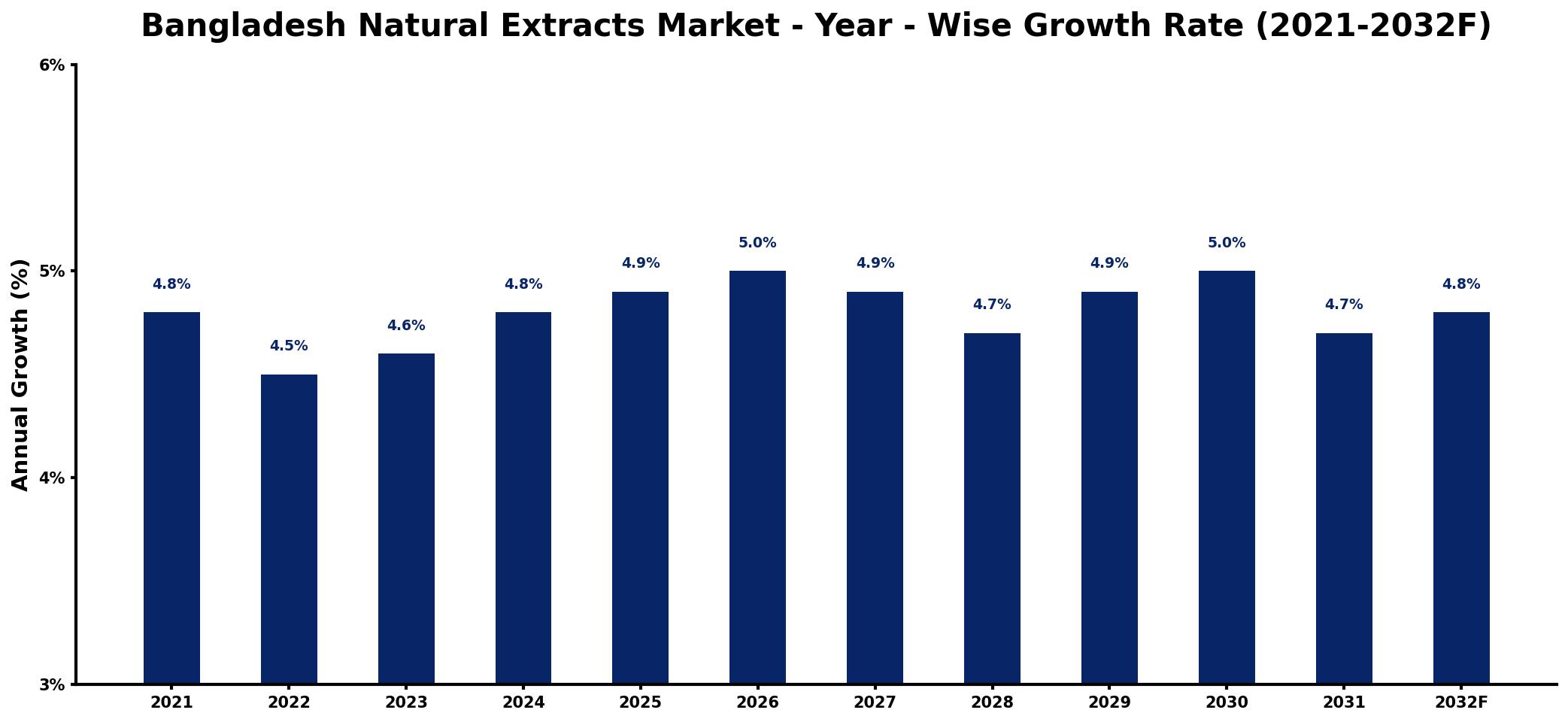
The table below presents the year‑wise growth rates along with the key drivers influencing the market
| Year | Growth Rate | Major Drivers |
| 2021 | 4.8% | Increased consumer health consciousness |
| 2022 | 4.5% | Rising demand for organic products |
| 2023 | 4.6% | Expansion of wellness industries |
| 2024 | 4.8% | Growing popularity of herbal remedies |
| 2025 | 4.9% | Investment in sustainable agriculture |
| 2026 | 5.0% | Emerging trends in clean labeling |
| 2027 | 4.9% | Surge in online retail platforms |
| 2028 | 4.7% | Heightened focus on environmental sustainability |
| 2029 | 4.9% | Advancements in extraction technologies |
| 2030 | 5.0% | Diversification of product offerings |
| 2031 | 4.7% | Strengthening of export markets |
| 2032 | 4.8% | Collaboration with health professionals |
Note: Market size estimations and growth projections presented in this report are based on 6Wresearch's proprietary forecasting methodology, utilizing the latest available industry data, government publications, and primary research inputs.
Bangladesh Natural Extracts Market Synopsis
In Bangladesh, there is a burgeoning demand for natural extracts, particularly those derived from indigenous plants and herbs. Local farmers are increasingly being engaged by manufacturers, ensuring a more stable supply chain and promoting sustainable agricultural practices. As consumers lean toward products that are clean-label and organic, the market for natural extracts is poised for robust expansion.
The market is characterized by a diversity of applications, from herbal supplements to personal care items. Consumer preference for safer, eco-friendly options is reshaping product offerings, with companies actively investing in research and development to enhance their portfolios. This strategic alignment with market trends further solidifies the prospects for the natural extracts sector in Bangladesh.
Bangladesh Natural Extracts Market Key Takeaways
- The market is driven by an increasing consumer shift towards natural and organic products.
- Local sourcing and partnerships are enhancing supply chain stability and sustainability.
- The government is actively promoting sustainable agricultural practices that support the industry.
- Innovation in product formulation is crucial for meeting rising consumer expectations.
- Investment opportunities abound in herbal extracts, essential oils, and plant-based ingredients.
Evaluation of Restraints in Bangladesh Natural Extracts Market
Despite the encouraging growth, the Bangladesh Natural Extracts Market faces several critical limitations. Variability in quality remains a significant concern, largely due to inconsistent climatic conditions and diverse agricultural practices. The lack of standardized regulations hampers product credibility and market confidence. Additionally, the infrastructure for processing and storage is underdeveloped, contributing to inefficiencies in the supply chain. Addressing these challenges will necessitate concerted efforts in technology investment and improved quality assurance mechanisms.
Bangladesh Natural Extracts Market Trends
Current trends reveal a pronounced rise in the demand for herbal and ayurvedic products, with consumers increasingly aware of their health benefits. The food and beverage sector is embracing natural extracts for their functional properties, leading to a surge in innovative product development. Moreover, cosmetics and personal care items enriched with natural ingredients are gaining traction as consumers opt for safer, more eco-conscious choices. This trend aligns well with the global shift towards holistic wellness, reinforcing the importance of natural extracts in consumer lifestyles.
Bangladesh Natural Extracts Market Opportunities
The Bangladesh Natural Extracts Market offers numerous investment opportunities, primarily driven by the countrys rich biodiversity and growing consumer demand for organic products. Key areas to explore include herbal extracts and essential oils tailored for the pharmaceutical and personal care sectors. By developing innovative solutions and establishing solid partnerships with local farmers, investors can tap into the expanding domestic and export markets, thus unlocking significant potential for profitability.
Government Initiatives in the Bangladesh Natural Extracts Market
The Bangladeshi government has enacted various policies aimed at fostering growth within the natural extracts sector. These initiatives encompass incentives for sustainable harvesting and processing practices, as well as support for research and development efforts. By enhancing awareness of the benefits of natural extracts among consumers and promoting their use across various industries, the government is working to create a robust and sustainable market environment.
Future Insights of the Bangladesh Natural Extracts Market
Looking forward to 2026-2032, the Bangladesh Natural Extracts Market is poised for steady growth driven by a persistent consumer preference for natural products. As awareness of the health benefits of these extracts expands, demand is expected to rise in diverse sectors, including food, cosmetics, and pharmaceuticals. Furthermore, government efforts to promote sustainable agriculture, alongside innovations in extraction technologies and product diversification, will significantly shape the future landscape of this promising market.
Bangladesh Natural Extracts Market Latest Developments (2025 - 2026)
Recent industry developments indicate a clear shift toward enhanced quality assurance practices, with several initiatives aimed at standardizing natural extract products. There is also a growing focus on research collaborations between academia and industry to uncover new applications for natural extracts. Furthermore, consumer education campaigns are being launched to increase awareness about the benefits of natural extracts, aiding in driving market penetration.
Bangladesh Natural Extracts Market - Key Attractiveness of the Report
- 10 Years of Market Numbers
- Historical Data Starting from 2022 to 2025
- Base Year: 2025
- Forecast Data until 2032
- Key Performance Indicators Impacting the Market
- Major Upcoming Developments and Projects
Key Highlights of the Report:
- Bangladesh Natural Extracts Market Outlook
- Market Size of Bangladesh Natural Extracts Market, 2025
- Forecast of Bangladesh Natural Extracts Market, 2032
- Historical Data and Forecast of Bangladesh Natural Extracts Revenues & Volume for the Period 2022-2032F
- Bangladesh Natural Extracts Market Trend Evolution
- Bangladesh Natural Extracts Market Drivers and Challenges
- Bangladesh Natural Extracts Price Trends
- Bangladesh Natural Extracts Porter's Five Forces
- Bangladesh Natural Extracts Industry Life Cycle
- Historical Data and Forecast of Bangladesh Natural Extracts Market Revenues & Volume By Product for the Period 2022-2032F
- Historical Data and Forecast of Bangladesh Natural Extracts Market Revenues & Volume By Essential Oils for the Period 2022-2032F
- Historical Data and Forecast of Bangladesh Natural Extracts Market Revenues & Volume By Oleoresins for the Period 2022-2032F
- Historical Data and Forecast of Bangladesh Natural Extracts Market Revenues & Volume By Herbal Extracts for the Period 2022-2032F
- Historical Data and Forecast of Bangladesh Natural Extracts Market Revenues & Volume By Natural Colors for the Period 2022-2032F
- Historical Data and Forecast of Bangladesh Natural Extracts Market Revenues & Volume By Dried Crops for the Period 2022-2032F
- Historical Data and Forecast of Bangladesh Natural Extracts Market Revenues & Volume By Application for the Period 2022-2032F
- Historical Data and Forecast of Bangladesh Natural Extracts Market Revenues & Volume By Personal Care & Cosmetics for the Period 2022-2032F
- Historical Data and Forecast of Bangladesh Natural Extracts Market Revenues & Volume By Food & Beverage for the Period 2022-2032F
- Historical Data and Forecast of Bangladesh Natural Extracts Market Revenues & Volume By Animal Feed for the Period 2022-2032F
- Historical Data and Forecast of Bangladesh Natural Extracts Market Revenues & Volume By Pharmaceuticals for the Period 2022-2032F
- Historical Data and Forecast of Bangladesh Natural Extracts Market Revenues & Volume By Nutraceuticals for the Period 2022-2032F
- Historical Data and Forecast of Bangladesh Natural Extracts Market Revenues & Volume By Others for the Period 2022-2032F
- Bangladesh Natural Extracts Import Export Trade Statistics
- Market Opportunity Assessment By Product
- Market Opportunity Assessment By Application
- Bangladesh Natural Extracts Top Companies Market Share
- Bangladesh Natural Extracts Competitive Benchmarking By Technical and Operational Parameters
- Bangladesh Natural Extracts Company Profiles
- Bangladesh Natural Extracts Key Strategic Recommendations






































