Bangladesh Passive Fire Protection Market Size, Share & Growth Rate
The Bangladesh Passive Fire Protection Market was estimated at USD 486 Million in 2025 and is projected to reach USD 658 Million by 2032, growing at a CAGR of 4.4% from 2026 to 2032. This growth trajectory is spurred by the increasing urbanization and a robust infrastructure development agenda that emphasizes fire safety. Enhanced regulatory frameworks and heightened awareness of fire protection in construction further contribute to this upward momentum, promising a dynamic landscape for investment.
Bangladesh Passive Fire Protection Market Year-wise Growth Rate and Key Drivers
This graph highlights how the Bangladesh Passive Fire Protection Market has steadily grown over the years, supported by major growth factors.
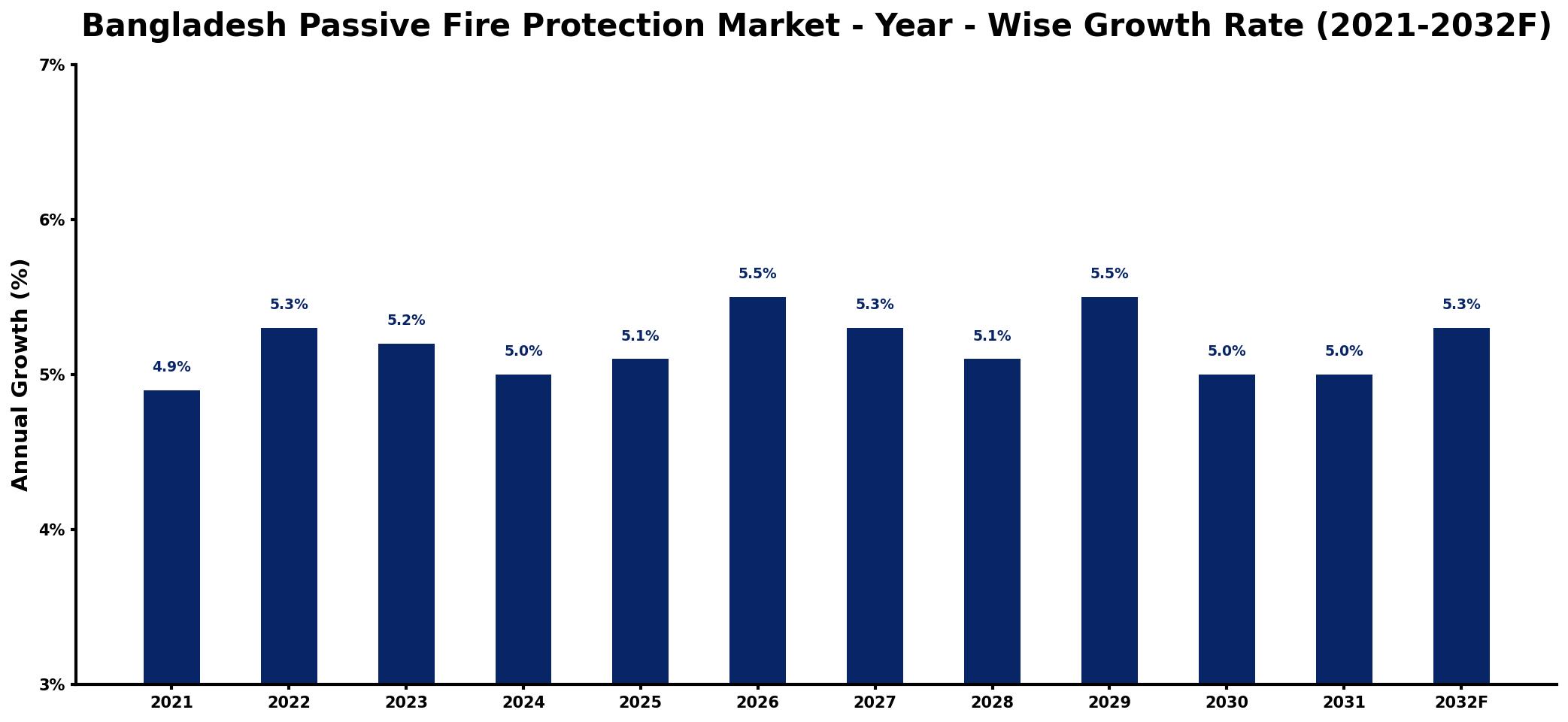
The table below presents the year‑wise growth rates along with the key drivers influencing the market
| Year | Growth Rate | Major Drivers |
| 2021 | 4.9% | Rising construction sector investments |
| 2022 | 5.3% | Growing awareness of safety regulations |
| 2023 | 5.2% | Increase in commercial property developments |
| 2024 | 5.0% | Expansion of infrastructure projects |
| 2025 | 5.1% | Surge in urbanization trends |
| 2026 | 5.5% | Heightened demand for residential buildings |
| 2027 | 5.3% | Strengthening industrial safety standards |
| 2028 | 5.1% | Increased focus on sustainability initiatives |
| 2029 | 5.5% | Growth in real estate investments |
| 2030 | 5.0% | Emerging markets driving demand |
| 2031 | 5.0% | Technological advancements in safety |
| 2032 | 5.3% | Rising government safety initiatives |
Note: Market size estimations and growth projections presented in this report are based on 6Wresearch's proprietary forecasting methodology, utilizing the latest available industry data, government publications, and primary research inputs.
Bangladesh Passive Fire Protection Market Synopsis
The Bangladesh Passive Fire Protection market has gained significant momentum in recent years, reflecting a societal shift toward prioritizing safety in construction. As urban areas expand and infrastructure projects proliferate, the demand for fire safety solutions is also escalating.
In this evolving market, key players are pivoting towards innovative product development and strategic partnerships. With a comprehensive approach to passive fire protection—including fire-resistant doors, walls, and coatings—stakeholders are poised to harness opportunities that align with the growing recognition of fire safetys importance.
Bangladesh Passive Fire Protection Market Key Takeaways
- Robust growth is projected driven by regulatory enforcement and urbanization.
- Innovative materials and advanced technologies are gaining traction among consumers.
- Awareness campaigns are crucial for educating stakeholders on fire safety importance.
- Investment opportunities exist in coatings, sealants, and training services.
- Infrastructure enhancements will catalyze demand across various sectors.
Evaluation of Restraints in Bangladesh Passive Fire Protection Market
Despite the promising landscape, the Bangladesh Passive Fire Protection Market faces significant barriers. A general lack of awareness among various stakeholders, including developers and regulatory bodies, often leads to inadequate adherence to established fire safety standards. This results in the use of subpar materials and practices in construction projects. The limited availability of high-quality fire-resistant materials and a shortage of skilled professionals trained in fire protection techniques further compound these challenges, inhibiting the overall potential of the market.
Bangladesh Passive Fire Protection Market Trends
The market is observing a notable trend towards the adoption of advanced fire protection technologies, including innovative fire-retardant materials designed to enhance safety. Moreover, the implementation of stringent building codes is driving developers to comply with regulations, necessitating the incorporation of passive fire protection solutions in new projects. This evolution not only caters to immediate safety needs but also addresses long-term sustainability goals as the industry seeks to minimize risks associated with fire hazards.
Bangladesh Passive Fire Protection Market Opportunities
The market presents a plethora of investment opportunities, particularly in the realms of fire-resistant coatings, sealants, and barriers. As urbanization continues to surge, the demand for passive fire protection systems across residential, commercial, and industrial sectors is expected to rise dramatically. Collaborations with local manufacturers and distributors or entering into joint ventures can enhance market access for innovative fire protection products. Additionally, providing training and consultancy services on compliance and regulations will offer lucrative avenues for growth.
Government Initiatives in the Bangladesh Passive Fire Protection Market
The government of Bangladesh has established comprehensive building codes aimed at enhancing fire safety in the construction sector. The Bangladesh National Building Code (BNBC) lays down essential requirements for fire-resistant materials and systems, emphasizing the importance of passive fire protection measures. These policies are designed to safeguard both occupants and assets, reinforcing the imperative for compliance across all new construction and renovation projects. This proactive stance by the government fosters a conducive environment for the market's growth.
Future Insights of the Bangladesh Passive Fire Protection Market
Looking ahead to 2026-2032, the Bangladesh Passive Fire Protection Market is set for continued expansion. Growing awareness surrounding fire safety, coupled with stricter enforcement of building regulations, will undoubtedly stimulate market demand. The construction industry's ongoing growth, especially in urban centers, necessitates a robust focus on fire safety solutions. Innovations in product development and technology are likely to enhance offerings, ensuring that passive fire protection solutions meet the evolving demands of this burgeoning market.
Bangladesh Passive Fire Protection Market Latest Developments (2025 - 2026)
Recent developments in the Bangladesh Passive Fire Protection Market indicate a shift towards sustainability, with manufacturers exploring eco-friendly fire-resistant materials. Industry stakeholders are increasingly engaging in partnerships to enhance distribution networks and streamline supply chains. Furthermore, educational initiatives aimed at increasing awareness of fire safety regulations are being implemented, thereby fostering a culture of compliance within the construction community.
Bangladesh Passive Fire Protection Market - Key Attractiveness of the Report
- 10 Years of Market Numbers
- Historical Data Starting from 2022 to 2025
- Base Year: 2025
- Forecast Data until 2032
- Key Performance Indicators Impacting the Market
- Major Upcoming Developments and Projects
Key Highlights of the Report:
- Bangladesh Passive Fire Protection Market Outlook
- Market Size of Bangladesh Passive Fire Protection Market, 2025
- Forecast of Bangladesh Passive Fire Protection Market, 2032
- Historical Data and Forecast of Bangladesh Passive Fire Protection Revenues & Volume for the Period 2022-2032F
- Bangladesh Passive Fire Protection Market Trend Evolution
- Bangladesh Passive Fire Protection Market Drivers and Challenges
- Bangladesh Passive Fire Protection Price Trends
- Bangladesh Passive Fire Protection Porter's Five Forces
- Bangladesh Passive Fire Protection Industry Life Cycle
- Historical Data and Forecast of Bangladesh Passive Fire Protection Market Revenues & Volume By Product for the Period 2022-2032F
- Historical Data and Forecast of Bangladesh Passive Fire Protection Market Revenues & Volume By Cementitious Materials for the Period 2022-2032F
- Historical Data and Forecast of Bangladesh Passive Fire Protection Market Revenues & Volume By Intumescent Coatings for the Period 2022-2032F
- Historical Data and Forecast of Bangladesh Passive Fire Protection Market Revenues & Volume By Fireproofing Cladding for the Period 2022-2032F
- Historical Data and Forecast of Bangladesh Passive Fire Protection Market Revenues & Volume By Others for the Period 2022-2032F
- Historical Data and Forecast of Bangladesh Passive Fire Protection Market Revenues & Volume By Application for the Period 2022-2032F
- Historical Data and Forecast of Bangladesh Passive Fire Protection Market Revenues & Volume By Oil & Gas for the Period 2022-2032F
- Historical Data and Forecast of Bangladesh Passive Fire Protection Market Revenues & Volume By Construction for the Period 2022-2032F
- Historical Data and Forecast of Bangladesh Passive Fire Protection Market Revenues & Volume By Industrial for the Period 2022-2032F
- Historical Data and Forecast of Bangladesh Passive Fire Protection Market Revenues & Volume By Warehousing for the Period 2022-2032F
- Historical Data and Forecast of Bangladesh Passive Fire Protection Market Revenues & Volume By Others for the Period 2022-2032F
- Bangladesh Passive Fire Protection Import Export Trade Statistics
- Market Opportunity Assessment By Product
- Market Opportunity Assessment By Application
- Bangladesh Passive Fire Protection Top Companies Market Share
- Bangladesh Passive Fire Protection Competitive Benchmarking By Technical and Operational Parameters
- Bangladesh Passive Fire Protection Company Profiles
- Bangladesh Passive Fire Protection Key Strategic Recommendations






































