Bangladesh Propane Market Size, Share & Growth Rate
The Bangladesh Propane Market was estimated at USD 325 Million in 2025 and is projected to reach USD 444 Million by 2032, growing at a CAGR of 4.6% from 2026 to 2032. This growth trajectory is primarily driven by the rising demand for cleaner energy alternatives and the push towards energy diversification in the country. The widespread application of propane in heating, cooking, and industrial processes is further amplifying its adoption across various sectors.
Bangladesh Propane Market Year-wise Growth Rate and Key Drivers
This graph highlights how the Bangladesh Propane Market has steadily grown over the years, supported by major growth factors.
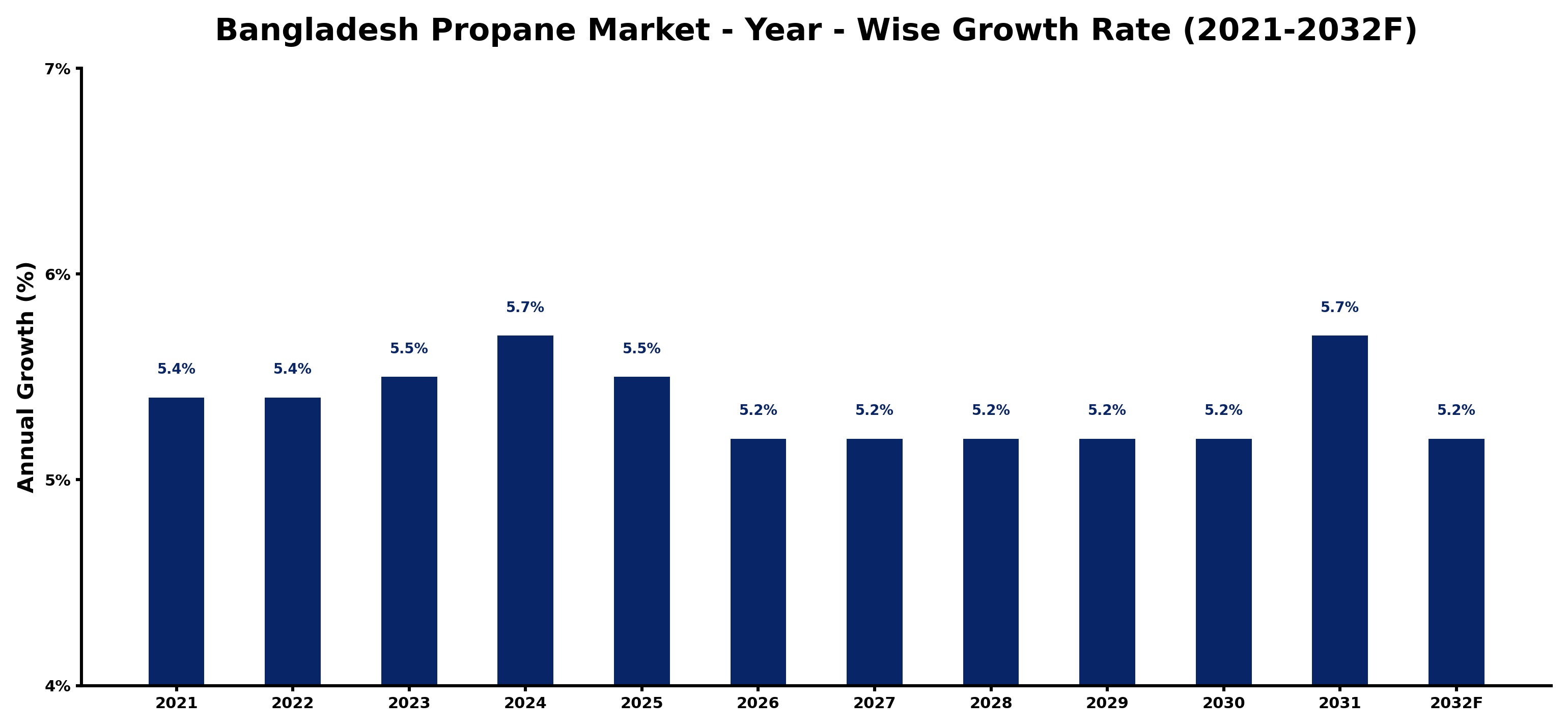
The table below presents the year‑wise growth rates along with the key drivers influencing the market
| Year | Growth Rate | Major Drivers |
| 2021 | 5.4% | Advanced propane processing technology boosts production efficiency across facilities |
| 2022 | 5.4% | Domestic propane extraction projects drive investments in processing facilities |
| 2023 | 5.5% | Domestic propane distribution network expansion boosts delivery efficiency nationwide |
| 2024 | 5.7% | Higher pipeline infrastructure investments boost propane distribution capacity utilization |
| 2025 | 5.5% | New LPG terminal development boosts propane distribution capacity across regions |
| 2026 | 5.2% | Increased garment production drives demand for industrial propane supply |
| 2027 | 5.2% | Propane demand surged with new manufacturing facility investments |
| 2028 | 5.2% | Increased investment in propane infrastructure boosted local manufacturing capacities |
| 2029 | 5.2% | Technology integration in bottling facilities streamlined propane distribution processes |
| 2030 | 5.2% | Domestic pipeline upgrades boost propane distribution efficiency across regions |
| 2031 | 5.7% | New petrochemical facilities boost local propane supply chain efficiency |
| 2032 | 5.2% | Export driven petrochemical investments boost local propane distribution networks |
Note - Market size estimations and growth projections presented in this report are based on 6Wresearch's advanced forecasting approach, validated with industry datasets as of June 2026.
Bangladesh Propane Market Synopsis
Recently, the Bangladesh Propane Market has experienced significant momentum, buoyed by increased awareness of environmental sustainability and the need for energy diversification. However, as the market evolves, it faces the necessity to enhance supply chain efficiencies and consumer education to sustain this growth trajectory.
Looking ahead, the market is poised for robust expansion. The government's focus on rural electrification and the promotion of propane as a clean energy alternative will likely fortify its role in the national energy landscape. The interplay of market forces and regulatory frameworks will shape its future direction.
Bangladesh Propane Market Key Takeaways
- The market is witnessing a steady shift towards cleaner energy sources, with propane emerging as a viable alternative to traditional fuels.
- Government initiatives aimed at promoting safety standards and infrastructure investment are instrumental in facilitating market growth.
- Rural electrification projects are significantly increasing the demand for propane in remote areas.
- Emerging technologies in propane distribution are enhancing efficiency and reliability within the supply chain.
- There is a pressing need for consumer education to improve awareness regarding the benefits of propane usage.
Evaluation of Restraints in Bangladesh Propane Market
Despite its potential, the Bangladesh Propane Market contends with several restraints that hinder optimal growth. Supply chain logistics pose a significant challenge, as ensuring a consistent and safe supply of propane can be difficult in rural and less-developed areas. Regulatory compliance demands meticulous attention, impacting operational efficiency and safety standards. Furthermore, price volatility in the global propane market adds an element of unpredictability for stakeholders, requiring strategic adaptability to navigate these challenges effectively.
Bangladesh Propane Market Trends
The demand for propane is shaped by several current and emerging trends. An increasing emphasis on environmental sustainability is spurring interest in propane as a cleaner-burning fuel. Additionally, technological advancements in storage and distribution are enabling more efficient use of propane, making it an increasingly attractive option for various applications. Innovations in safety protocols are also fostering consumer confidence, thereby driving adoption rates across residential and commercial sectors.
Bangladesh Propane Market Opportunities
Significant growth and investment opportunities are emerging in the Bangladesh Propane Market, particularly in rural electrification projects and infrastructure development. As the government prioritizes access to clean energy, propane's role in off-grid solutions is becoming increasingly prominent. Additionally, fostering partnerships for technology transfer and distribution efficiency will unlock further potential in meeting rising consumer demand and enhancing overall market viability.
Government Initiatives in the Bangladesh Propane Market
The Bangladeshi government is actively implementing policies to regulate and support the propane market. These initiatives focus on ensuring safe handling and storage of propane while promoting competition among suppliers to stabilize pricing. Additionally, policies aimed at minimizing environmental impacts related to emissions are encouraging the transition towards cleaner fuel alternatives. Investment in infrastructure for propane distribution and storage is also prioritized to support this strategic shift in energy utilization.
Future Insights of the Bangladesh Propane Market
Looking forward to the period from 2026 to 2032, the Bangladesh Propane Market is expected to experience significant evolution. The combination of increasing energy demand and a governmental push towards cleaner fuels is set to transform propane into a cornerstone of the nation's energy strategy. Consumer acceptance, coupled with infrastructural advancements, will likely determine the pace and extent of market development, as stakeholders adapt to the changing landscape.
Bangladesh Propane Market Latest Developments (May 2025 - June 2026)
Recent developments in the Bangladesh Propane Market highlight a trend towards enhanced infrastructure and distribution systems. Stakeholders are exploring innovative technologies to improve supply chain reliability and efficiency. Furthermore, educational campaigns aimed at promoting the benefits and safe usage of propane are gaining traction, aiming to increase consumer adoption. The regulatory environment is also evolving, with new guidelines introduced to further ensure safety and environmental sustainability in propane usage.
Bangladesh Propane Market - Key Attractiveness of the Report
- 10 Years of Market Numbers
- Historical Data Starting from 2022 to 2025
- Base Year: 2025
- Forecast Data until 2032
- Key Performance Indicators Impacting the Market
- Major Upcoming Developments and Projects
Key Highlights of the Report:
- Bangladesh Propane Market Outlook
- Market Size of Bangladesh Propane Market, 2025
- Forecast of Bangladesh Propane Market, 2032
- Historical Data and Forecast of Bangladesh Propane Revenues & Volume for the Period 2022-2032F
- Bangladesh Propane Market Trend Evolution
- Bangladesh Propane Market Drivers and Challenges
- Bangladesh Propane Price Trends
- Bangladesh Propane Porter's Five Forces
- Bangladesh Propane Industry Life Cycle
- Historical Data and Forecast of Bangladesh Propane Market Revenues & Volume By Applications for the Period 2022-2032F
- Historical Data and Forecast of Bangladesh Propane Market Revenues & Volume By Industrial for the Period 2022-2032F
- Historical Data and Forecast of Bangladesh Propane Market Revenues & Volume By Commercial for the Period 2022-2032F
- Historical Data and Forecast of Bangladesh Propane Market Revenues & Volume By Residential for the Period 2022-2032F
- Historical Data and Forecast of Bangladesh Propane Market Revenues & Volume By Transportation for the Period 2022-2032F
- Historical Data and Forecast of Bangladesh Propane Market Revenues & Volume By Agriculture for the Period 2022-2032F
- Historical Data and Forecast of Bangladesh Propane Market Revenues & Volume By Chemicals and Refineries for the Period 2022-2032F
- Bangladesh Propane Import Export Trade Statistics
- Market Opportunity Assessment By Applications
- Bangladesh Propane Top Companies Market Share
- Bangladesh Propane Competitive Benchmarking By Technical and Operational Parameters
- Bangladesh Propane Company Profiles
- Bangladesh Propane Key Strategic Recommendations






































