Bangladesh Rubber Compound Market Size, Share & Growth Rate
The Bangladesh Rubber Compound Market was estimated at USD 441 Million in 2025 and is projected to reach USD 577 Million by 2032, growing at a CAGR of 3.9% from 2026 to 2032. This growth trajectory is primarily driven by a booming automotive sector and increasing industrial applications. As infrastructure development gains momentum in the country, the demand for high-quality rubber compounds is set to rise, further solidifying the market's upward trend.
Bangladesh Rubber Compound Market Year-wise Growth Rate and Key Drivers
This graph highlights how the Bangladesh Rubber Compound Market has steadily grown over the years, supported by major growth factors.
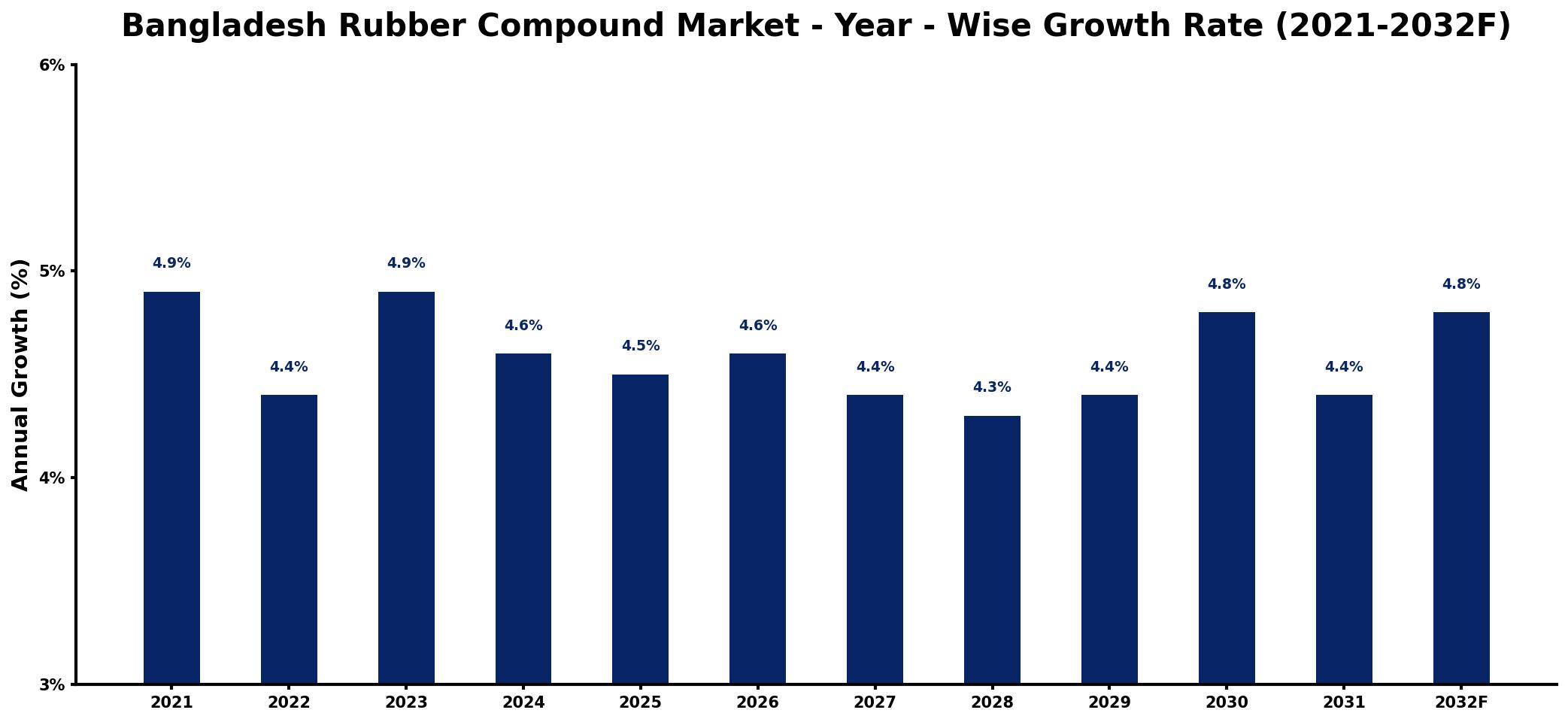
The table below presents the year‑wise growth rates along with the key drivers influencing the market
| Year | Growth Rate | Major Drivers |
| 2021 | 4.9% | Rising automotive production levels |
| 2022 | 4.4% | Increasing construction industry investments |
| 2023 | 4.9% | Growth in consumer electronics demand |
| 2024 | 4.6% | Expansion of infrastructure projects |
| 2025 | 4.5% | Surge in renewable energy initiatives |
| 2026 | 4.6% | Boost in industrial machinery usage |
| 2027 | 4.4% | Higher demand for footwear products |
| 2028 | 4.3% | rising procurement volume requirements |
| 2029 | 4.4% | Increased exports to regional markets |
| 2030 | 4.8% | Advancements in manufacturing technologies |
| 2031 | 4.4% | Rising popularity of electric vehicles |
| 2032 | 4.8% | expanding industrial usage applications |
Note: Market size estimations and growth projections presented in this report are based on 6Wresearch's proprietary forecasting methodology, utilizing the latest available industry data, government publications, and primary research inputs.
Bangladesh Rubber Compound Market Synopsis
The Bangladesh rubber compound market is currently experiencing consistent momentum, fueled by robust demand from automotive and industrial sectors. This positive growth contrasts with the past, as local manufacturers now strive to meet evolving market needs amid increasing foreign investments and government initiatives.
Looking ahead, the market is expected to embrace sustainability, with a noticeable shift toward eco-friendly rubber compounds. As manufacturers innovate and enhance product offerings, the focus on quality and customized solutions will likely become central to maintaining competitiveness in this expanding landscape.
Bangladesh Rubber Compound Market Key Takeaways
- Steady market growth driven by the automotive and industrial sectors.
- Increasing demand for eco-friendly and sustainable rubber compounds.
- Investment opportunities in specialized rubber formulations for various applications.
- Technological advancements enhancing product quality and performance.
- Government initiatives fostering industrial growth and supporting local manufacturers.
Evaluation of Restraints in Bangladesh Rubber Compound Market
Despite positive growth indicators, the Bangladesh rubber compound market faces significant restraints that could hinder its progress. Volatility in raw material prices, particularly for natural and synthetic rubber, poses challenges to maintaining production costs and profit margins for local manufacturers. Additionally, competition from low-cost imported compounds further complicates the landscape, as these imports can undermine the pricing structure of domestic products. Furthermore, the lack of standardized quality control measures results in inconsistencies in product performance, affecting overall market reliability. Addressing these hurdles will be crucial for market participants aiming to strengthen their foothold in the industry.
Bangladesh Rubber Compound Market Trends
Several key trends are shaping the Bangladesh rubber compound market. Firstly, there is a marked increase in demand for sustainable products driven by global environmental awareness and regulatory measures. Concurrently, manufacturers are focusing on specialized compounds tailored for specific industries, particularly automotive and construction, to meet unique customer requirements. Technological advancements are enhancing rubber compounding processes, leading to improved product quality and performance. Additionally, a growing trend towards customization is evident as businesses strive to offer tailor-made solutions to cater to diverse end-user needs.
Bangladesh Rubber Compound Market Opportunities
The Bangladesh rubber compound market presents numerous investment opportunities, especially as demand surges in automotive, construction, and consumer goods sectors. There is a significant potential for developing specialized rubber compounds that cater to specific applications, particularly those that require high-quality and custom formulations. Furthermore, investing in research and development initiatives can pave the way for innovative compounds with enhanced properties such as durability and flexibility. Collaborating with local manufacturers can also streamline the supply chain, increasing production efficiency and profitability in this burgeoning market.
Government Initiatives in the Bangladesh Rubber Compound Market
Government policies play a vital role in shaping the Bangladesh rubber compound market. Various initiatives are in place to support local manufacturers, including financial assistance and tax incentives to promote industrial growth. The government is also focusing on infrastructure development to enhance the operational capabilities of the rubber industry. Moreover, regulations aimed at ensuring quality standards and environmental sustainability contribute to maintaining product integrity while minimizing environmental impacts. Overall, these initiatives foster a conducive environment for market growth and innovation.
Future Insights of the Bangladesh Rubber Compound Market
Looking forward to the period from 2026 to 2032, the outlook for the Bangladesh rubber compound market is highly optimistic. The anticipated rise in demand across various sectors, coupled with increased investments in infrastructure and industrial production, will likely drive market expansion. Sustainability and technological innovations will be at the forefront, with manufacturers increasingly focusing on eco-friendly solutions and high-performance compounds. As government initiatives continue to support local production, the market is poised for a vibrant growth phase that presents numerous opportunities for stakeholders.
Bangladesh Rubber Compound Market Latest Developments (2025 - 2026)
In the recent months, the Bangladesh rubber compound market has seen significant developments aligned with the global shift towards sustainability. Manufacturers are increasingly adopting eco-friendly practices and sourcing materials that comply with international environmental standards. Additionally, there has been a surge in collaborative efforts between local firms and international companies, aiming to enhance product quality and expand market reach. The focus on research and development has also intensified, with various players investing in new technologies to develop specialized rubber compounds tailored for diverse applications.
Bangladesh Rubber Compound Market - Key Attractiveness of the Report
- 10 Years of Market Numbers
- Historical Data Starting from 2022 to 2025
- Base Year: 2025
- Forecast Data until 2032
- Key Performance Indicators Impacting the Market
- Major Upcoming Developments and Projects
Key Highlights of the Report:
- Bangladesh Rubber Compound Market Outlook
- Market Size of Bangladesh Rubber Compound Market, 2025
- Forecast of Bangladesh Rubber Compound Market, 2032
- Historical Data and Forecast of Bangladesh Rubber Compound Revenues & Volume for the Period 2022-2032F
- Bangladesh Rubber Compound Market Trend Evolution
- Bangladesh Rubber Compound Market Drivers and Challenges
- Bangladesh Rubber Compound Price Trends
- Bangladesh Rubber Compound Porter's Five Forces
- Bangladesh Rubber Compound Industry Life Cycle
- Historical Data and Forecast of Bangladesh Rubber Compound Market Revenues & Volume By Rubber Type for the Period 2022-2032F
- Historical Data and Forecast of Bangladesh Rubber Compound Market Revenues & Volume By Silicone Rubber for the Period 2022-2032F
- Historical Data and Forecast of Bangladesh Rubber Compound Market Revenues & Volume By Fluoro Rubber for the Period 2022-2032F
- Historical Data and Forecast of Bangladesh Rubber Compound Market Revenues & Volume By Butyronitrile Rubber for the Period 2022-2032F
- Historical Data and Forecast of Bangladesh Rubber Compound Market Revenues & Volume By EPDM Rubber for the Period 2022-2032F
- Historical Data and Forecast of Bangladesh Rubber Compound Market Revenues & Volume By Chloroprene Rubber for the Period 2022-2032F
- Historical Data and Forecast of Bangladesh Rubber Compound Market Revenues & Volume By Others for the Period 2022-2032F
- Historical Data and Forecast of Bangladesh Rubber Compound Market Revenues & Volume By End-User for the Period 2022-2032F
- Historical Data and Forecast of Bangladesh Rubber Compound Market Revenues & Volume By Tires for the Period 2022-2032F
- Historical Data and Forecast of Bangladesh Rubber Compound Market Revenues & Volume By Hose & Belting for the Period 2022-2032F
- Historical Data and Forecast of Bangladesh Rubber Compound Market Revenues & Volume By Roofing & Geo Membranes for the Period 2022-2032F
- Historical Data and Forecast of Bangladesh Rubber Compound Market Revenues & Volume By Footwear for the Period 2022-2032F
- Historical Data and Forecast of Bangladesh Rubber Compound Market Revenues & Volume By Wire & Cable Insulation for the Period 2022-2032F
- Historical Data and Forecast of Bangladesh Rubber Compound Market Revenues & Volume By Others for the Period 2022-2032F
- Bangladesh Rubber Compound Import Export Trade Statistics
- Market Opportunity Assessment By Rubber Type
- Market Opportunity Assessment By End-User
- Bangladesh Rubber Compound Top Companies Market Share
- Bangladesh Rubber Compound Competitive Benchmarking By Technical and Operational Parameters
- Bangladesh Rubber Compound Company Profiles
- Bangladesh Rubber Compound Key Strategic Recommendations






































