Bangladesh Steel Market Size Growth Rate
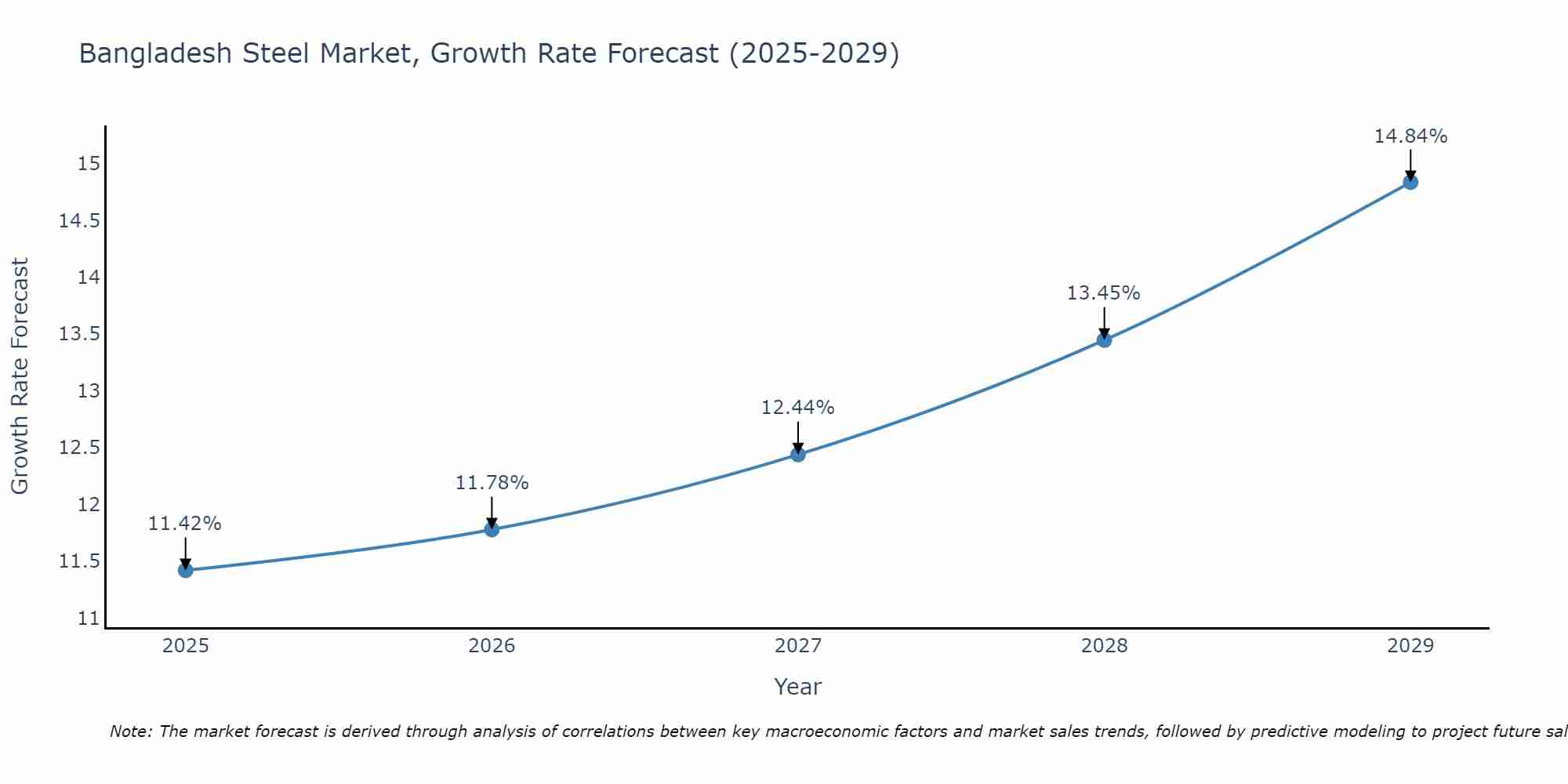
The Bangladesh Steel Market is likely to experience consistent growth rate gains over the period 2025 to 2029. Commencing at 11.42% in 2025, growth builds up to 14.84% by 2029.
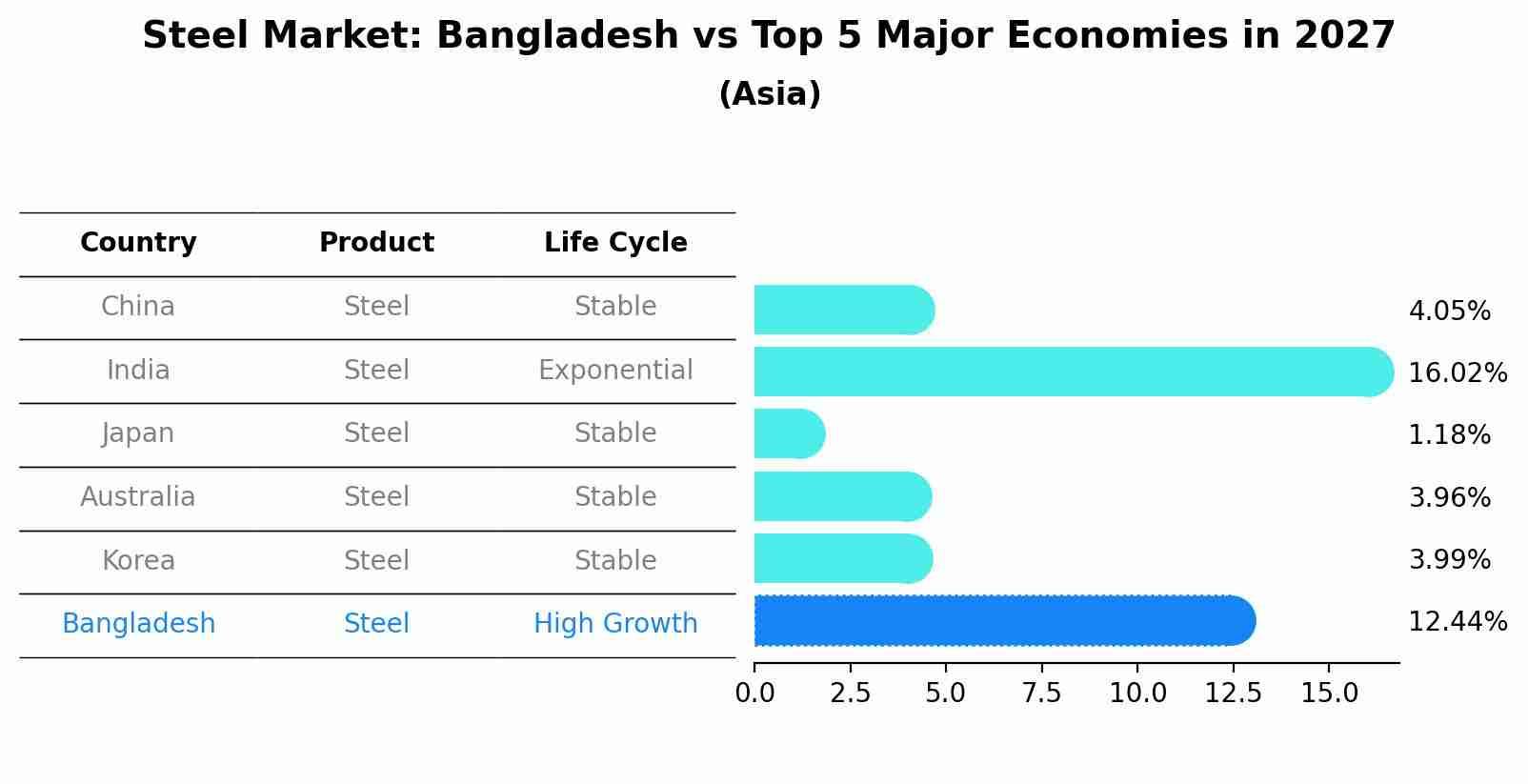
Steel Market: Bangladesh vs Top 5 Major Economies in 2027 (Asia)
The Steel market in Bangladesh is projected to grow at a high growth rate of 12.44% by 2027, highlighting the country's increasing focus on advanced technologies within the Asia region, where China holds the dominant position, followed closely by India, Japan, Australia and South Korea, shaping overall regional demand.
Bangladesh Steel Market Highlights
| Report Name | Bangladesh Steel Market |
| Forecast period | 2025-2029 |
| CAGR | 14.84% |
| Growing Sector | Automotive |
Topics Covered in the Bangladesh Steel Market Report
The Bangladesh Steel Market report thoroughly covers the market by Types, by Product Types and by Applications. The market report provides an unbiased and detailed analysis of the ongoing market trends, opportunities/high growth areas, and market drivers which would help the stakeholders to devise and align their market strategies according to the current and future market dynamics.
Bangladesh Steel Market Synopsis
Bangladesh Steel Market stands as a backbone of the country’s industrial and construction growth. As huge demand derive from real estate, infrastructure, and manufacturing, the sector is becoming more organized and competitive. Also, leading local producers and integrated plants are strengthening domestic supply, while ongoing modernization is shaping the market into a more competitive and sustainable industry.
Bangladesh Steel Market is expected to grow at the robust CAGR of 14.84% during the forecast period 2025-2029. The growth of steel market is driven by the several factors such as rapid urbanization, rising disposable incomes, and government-led infrastructure projects such as bridges, highways, and power plants. Developing real estate sector is fuelling the strong demand for long steel products, particularly rebar used in construction. Apart from this, the industrial activities, combined with increasing investments in manufacturing and automotive sectors, is also contributing in the consumption of steel. Further, steel plants are modernized with advanced technology that is enhancing the efficiency of products and quality.
Despite robust demand, the sector faces several challenges such as heavy dependence on imported raw materials like scrap and billets, exposing it to global price volatility. Major issue are the high energy costs and frequent power shortages, which affect the production efficiency and raise operational expenses. Environmental compliance requirements add further pressure on producers, especially smaller mills. Moreover, infrastructure bottlenecks in logistics and port facilities hinder smooth supply chain operations, limits the potential of Bangladesh Steel Market Growth.
Bangladesh Steel Market Trends
Bangladesh steel market is seeing rapid growth with notable trends which include the increasing urbanization, industrial expansion, and large-scale infrastructure projects. Also, the demand for long steel products, particularly rebar, is rising as construction activities intensify. The shift toward modern steel plants with energy-efficient technologies is also noticeable. Further, investment is increased in high-quality flat steel products supports diversification.
Investment Opportunities in the Bangladesh Steel Market
Due to expanding local steel production, significant opportunities are generating in the Bangladesh Steel Market, also helping to reduce the reliance on imported raw materials. Investments can be done in energy-efficient furnaces, recycling plants, and port-based steel mills can enhance competitiveness. Further, the demand from the construction and automotive industries offers avenues for product innovation. Further, partnerships with foreign investors can also bring advanced technology and capital inflows.
Leading Players of the Bangladesh Steel Market
Bangladesh Steel Market is dominated by several leading players which include BSRM, Abul Khair Steel, GPH Ispat, Kabir Steel Re-Rolling Mills (KSRM), and Anwar Ispat. All these companies are doing great work with innovation & expanding distribution networks. BSRM is a market leader who is known for its strong rebar production capacity and wide distribution network, while Abul Khair Steel operates one of the largest integrated steel plants, focusing on both long and flat steel. GPH Ispat is recognized for advanced technology and sustainable practices in steelmaking.
Government Regulations Introduced in the Bangladesh Steel Market
According to Bangladesh Government Data, the Bangladesh Steel Market is operated by regulatory bodies under the Bangladesh National Building Code (BNBC), which mandates safety and quality standards in construction steel. Also, Bangladesh Standards and Testing Institution (STI) regulates certification for steel products. Also, there is Import Policy Order 2021-24 who governs raw material imports, ensuring supply consistency. Further, the Environment Conservation Act 1995 enforces compliance with environmental standards in steel production.
Future Insights of the Bangladesh Steel Market
The future of Bangladesh Steel Industry is expected to be at rise with mega infrastructure projects, such as bridges, highways, and power plants. In the coming years, the growing demand for flat steel in automotive and appliance manufacturing will support the diversification. Further, the adoption of green steel technologies is likely to improve sustainability and attract global investors. Together, all these factors & trends will make the market more self-reliant and competitive on a regional scale.
Top of FormBottom of FormMarket Segmentation Analysis
The report offers a comprehensive study of the subsequent market segments and their leading categories.
Long Steel to Dominate the Market – By Types
According to Parth, Senior Research Analyst, 6Wresearch, long steel is expected to dominate the Bangladesh Steel Market as it is widely used in construction and infrastructure projects such as bridges, roads, and buildings. Flat steel, while smaller in share, is gaining traction in manufacturing and automotive applications.
Structural Steel to Dominate the Market – By Product Type
Structural steel is projected to capture the largest Bangladesh Steel Market Share due to its extensive use in real estate, industrial projects, and large-scale infrastructure. Prestressing steel is also growing steadily, especially in bridges and high-rise construction.
Building & Construction to Dominate the Market – By Applications
Building and construction continues to dominate steel consumption in Bangladesh with urbanization and mega infrastructure projects. Electrical appliances and domestic appliances represent growing demand areas as consumer lifestyles modernize. Mechanical equipment, metal products, and automotive applications also contribute steadily.
Key Attractiveness of the Report
- 10 Years of Market Numbers.
- Historical Data Starting from 2021 to 2024.
- Base Year: 2024
- Forecast Data until 2029.
- Key Performance Indicators Impacting the Market.
- Major Upcoming Developments and Projects.
Key Highlights of the Report:
- Bangladesh Steel Market Outlook
- Market Size of Bangladesh Steel Market, 2024
- Forecast of Bangladesh Steel Market, 2029
- Historical Data and Forecast of Bangladesh Steel Revenues & Volume for the Period 2019-2029
- Bangladesh Steel Market Trend Evolution
- Bangladesh Steel Market Drivers and Challenges
- Bangladesh Steel Price Trends
- Bangladesh Steel Porter's Five Forces
- Bangladesh Steel Industry Life Cycle
- Historical Data and Forecast of Bangladesh Steel Market Revenues & Volume By Types for the Period 2019-2029
- Historical Data and Forecast of Bangladesh Steel Market Revenues & Volume By Flat Steel for the Period 2019-2029
- Historical Data and Forecast of Bangladesh Steel Market Revenues & Volume By Long Steel for the Period 2019-2029
- Historical Data and Forecast of Bangladesh Steel Market Revenues & Volume By Product Type for the Period 2019-2029
- Historical Data and Forecast of Bangladesh Steel Market Revenues & Volume By Structural Steel for the Period 2019-2029
- Historical Data and Forecast of Bangladesh Steel Market Revenues & Volume By Prestressing Steel for the Period 2019-2029
- Historical Data and Forecast of Bangladesh Steel Market Revenues & Volume By Bright Steel for the Period 2019-2029
- Historical Data and Forecast of Bangladesh Steel Market Revenues & Volume By Welding Wire/Rod for the Period 2019-2029
- Historical Data and Forecast of Bangladesh Steel Market Revenues & Volume By Iron Steel Wire for the Period 2019-2029
- Historical Data and Forecast of Bangladesh Steel Market Revenues & Volume By Ropes for the Period 2019-2029
- Historical Data and Forecast of Bangladesh Steel Market Revenues & Volume By Braids for the Period 2019-2029
- Historical Data and Forecast of Bangladesh Steel Market Revenues & Volume By Applications for the Period 2019-2029
- Historical Data and Forecast of Bangladesh Steel Market Revenues & Volume By Building & Construction for the Period 2019-2029
- Historical Data and Forecast of Bangladesh Steel Market Revenues & Volume By Electrical Appliances for the Period 2019-2029
- Historical Data and Forecast of Bangladesh Steel Market Revenues & Volume By Metal Products for the Period 2019-2029
- Historical Data and Forecast of Bangladesh Steel Market Revenues & Volume By Domestic Appliances for the Period 2019-2029
- Historical Data and Forecast of Bangladesh Steel Market Revenues & Volume By Mechanical Equipment for the Period 2019-2029
- Historical Data and Forecast of Bangladesh Steel Market Revenues & Volume By Automotive for the Period 2019-2029
- Historical Data and Forecast of Bangladesh Steel Market Revenues & Volume By Others for the Period 2019-2029
- Bangladesh Steel Import Export Trade Statistics
- Market Opportunity Assessment By Types
- Market Opportunity Assessment By Product Type
- Market Opportunity Assessment By Applications
- Bangladesh Steel Top Companies Market Share
- Bangladesh Steel Competitive Benchmarking By Technical and Operational Parameters
- Bangladesh Steel Company Profiles
- Bangladesh Steel Key Strategic Recommendations
Market Covered
The report offers a comprehensive study of the subsequent market segments:
By Types
- Flat Steel
- Long Steel
By Product Type
- Structural Steel
- Prestressing Steel
- Bright Steel
- Welding Wire/Rod
- Iron Steel Wire
- Ropes
- Braids
By Applications
- Building & Construction
- Electrical Appliances
- Metal Products
- Domestic Appliances
- Mechanical Equipment
- Automotive
- Others






































