Bangladesh Thermal Paper Market Size, Share & Growth Rate
The Bangladesh Thermal Paper Market was estimated at USD 192 Million in 2025 and is projected to reach USD 253 Million by 2032, growing at a CAGR of 4.0% from 2026 to 2032. This trajectory is primarily driven by the increasing adoption of point-of-sale (POS) systems across various sectors, including retail and healthcare. Additionally, the growing trend towards e-commerce and the demand for efficient printing solutions contribute significantly to this market's promising outlook.
Bangladesh Thermal Paper Market Year-wise Growth Rate and Key Drivers
This graph highlights how the Bangladesh Thermal Paper Market has steadily grown over the years, supported by major growth factors.
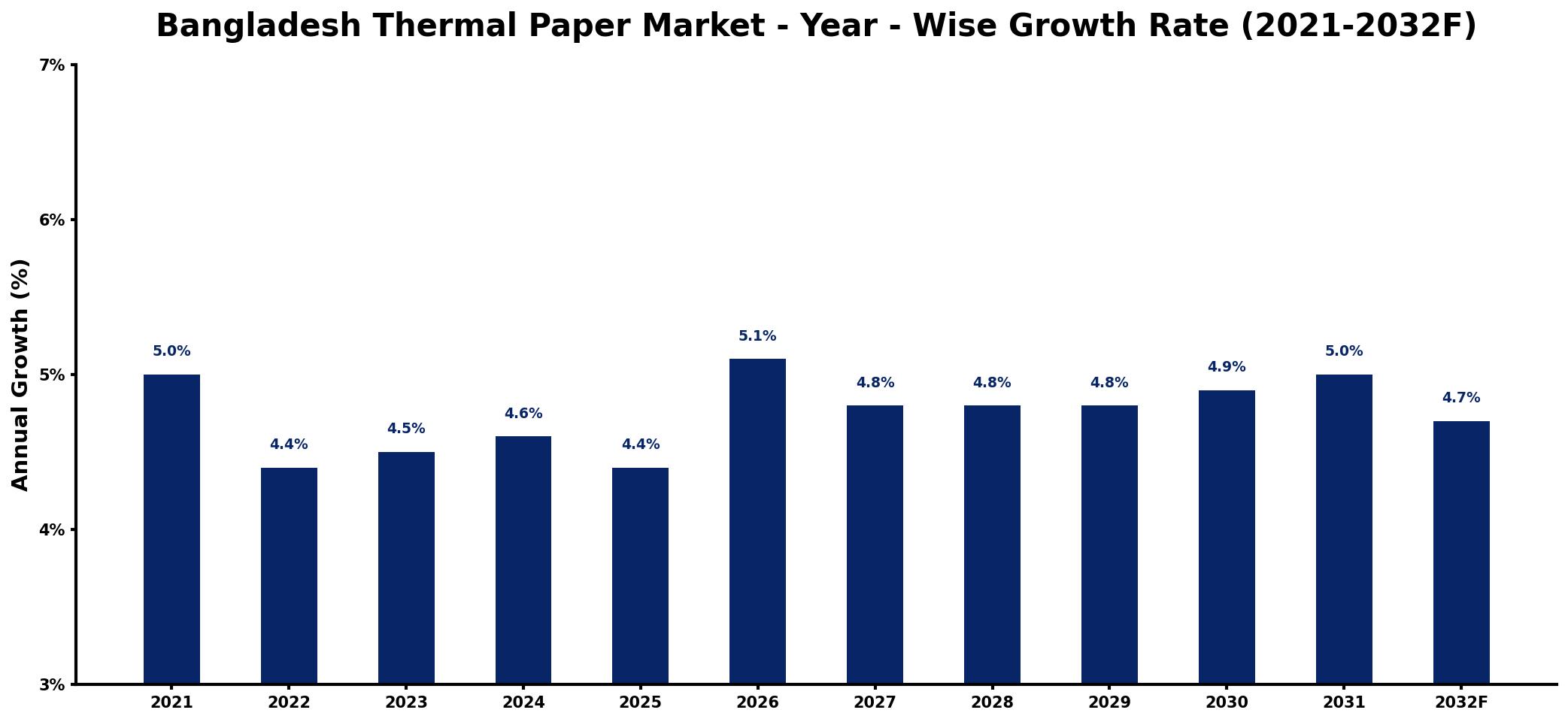
The table below presents the year‑wise growth rates along with the key drivers influencing the market
| Year | Growth Rate | Major Drivers |
| 2021 | 5.0% | Rising retail sector transactions |
| 2022 | 4.4% | Increased adoption of POS systems |
| 2023 | 4.5% | Growth in logistics and delivery |
| 2024 | 4.6% | Expansion of food service industry |
| 2025 | 4.4% | Surge in e-commerce activities |
| 2026 | 5.1% | Investments in healthcare facilities |
| 2027 | 4.8% | Development of smart city initiatives |
| 2028 | 4.8% | improved processing technologies adoption |
| 2029 | 4.8% | Increase in advertising expenditures |
| 2030 | 4.9% | Rising demand for event tickets |
| 2031 | 5.0% | increased overall sector activity |
| 2032 | 4.7% | rising procurement volume requirements |
Note: Market size estimations and growth projections presented in this report are based on 6Wresearch's proprietary forecasting methodology, utilizing the latest available industry data, government publications, and primary research inputs.
Bangladesh Thermal Paper Market Synopsis
The demand for thermal paper in Bangladesh is witnessing a notable surge, particularly for applications such as POS receipts, shipping labels, and ticketing solutions. This growth is supported by an expanding retail landscape and an evolving logistics sector, which require reliable and effective printing options.
Moreover, the ongoing digital transformation initiatives within the country are bolstering the use of thermal printing technology. As businesses and consumers alike gravitate toward more efficient and eco-friendly solutions, the market is evolving to meet these emerging needs.
Bangladesh Thermal Paper Market Key Takeaways
- The market is benefiting from a robust growth trajectory due to the digital transformation in retail and logistics.
- Eco-friendly thermal paper options are gaining traction as consumers become more environmentally conscious.
- Government initiatives are supporting the transition to digital transactions, which boosts thermal paper demand.
- Technological advancements in printing quality and durability are driving product innovation in the sector.
- Investments in manufacturing capabilities present substantial opportunities for growth and expansion.
Evaluation of Restraints in Bangladesh Thermal Paper Market
Despite its growth, the Bangladesh Thermal Paper Market faces several hurdles that could temper its progress. One significant challenge is price sensitivity among consumers and businesses, leading them to seek more economical alternatives. Additionally, the competitive landscape includes rising digital solutions that offer paperless transaction methods, which could divert demand from traditional thermal paper applications. Environmental sustainability concerns related to chemical content in thermal paper, such as BPA, pose another restraint, prompting a demand for greener alternatives. Addressing these challenges will require market players to innovate while balancing cost-effectiveness and environmental responsibility.
Bangladesh Thermal Paper Market Trends
The thermal paper market in Bangladesh is currently witnessing pivotal trends that shape its future. The accelerated adoption of POS systems across retail, healthcare, and hospitality sectors is notably increasing the demand for thermal paper products. Furthermore, the burgeoning e-commerce sector is resulting in a higher need for shipping labels and transaction receipts. Environmental considerations are steering consumers towards sustainable thermal paper options, pushing manufacturers to innovate and adapt their products. Overall, these trends indicate a dynamic shift towards modernized practices in the industry.
Bangladesh Thermal Paper Market Opportunities
Investment opportunities in the Bangladesh Thermal Paper Market are considerable, fueled by the increasing demand across key sectors such as retail, banking, and healthcare. The growth of digital processes supported by government initiatives presents an attractive landscape for investors looking to capitalize on manufacturing and distribution capabilities. Furthermore, the rising emphasis on sustainable production methods opens avenues for innovation and differentiation, allowing businesses to stand out in a competitive market. As the sector continues to evolve, seizing these opportunities could yield significant returns.
Government Initiatives in the Bangladesh Thermal Paper Market
The Bangladeshi government is actively promoting policies aimed at enhancing sustainability and quality within the thermal paper market. Regulations are being implemented to encourage the development and utilization of eco-friendly thermal paper alternatives, reducing the environmental impact of traditional products. These policies not only support local manufacturers through various incentives but also aim to enhance consumer protection by ensuring quality standards in thermal paper production. The government's commitment to fostering a competitive and responsible market is evident in these initiatives.
Future Insights of the Bangladesh Thermal Paper Market
Looking ahead to 2026-2032, the Bangladesh Thermal Paper Market is set to continue its upward trajectory, driven by the ongoing modernization of retail and financial sectors. The increasing efficiency demands in printing solutions, coupled with the rise of e-commerce activities, will sustain market growth. Additionally, manufacturers' focus on sustainable practices and eco-friendly product development will play a crucial role in shaping the future landscape. As the market adapts to these evolving trends, stakeholders can anticipate a vibrant and expanding environment for thermal paper solutions.
Bangladesh Thermal Paper Market Latest Developments (2025 - 2026)
Recent developments in the Bangladesh Thermal Paper Market indicate a strong push towards innovation, particularly in the production of eco-friendly thermal paper products. Companies are actively exploring advanced manufacturing techniques that not only enhance product quality but also address environmental concerns. Additionally, the growing emphasis on digitalization in various sectors has led to increased partnerships between technology providers and thermal paper manufacturers, fostering a more integrated approach to meeting market demands.
Bangladesh Thermal Paper Market - Key Attractiveness of the Report
- 10 Years of Market Numbers
- Historical Data Starting from 2022 to 2025
- Base Year: 2025
- Forecast Data until 2032
- Key Performance Indicators Impacting the Market
- Major Upcoming Developments and Projects
Key Highlights of the Report:
- Bangladesh Thermal Paper Market Outlook
- Market Size of Bangladesh Thermal Paper Market, 2025
- Forecast of Bangladesh Thermal Paper Market, 2032
- Historical Data and Forecast of Bangladesh Thermal Paper Revenues & Volume for the Period 2022-2032F
- Bangladesh Thermal Paper Market Trend Evolution
- Bangladesh Thermal Paper Market Drivers and Challenges
- Bangladesh Thermal Paper Price Trends
- Bangladesh Thermal Paper Porter's Five Forces
- Bangladesh Thermal Paper Industry Life Cycle
- Historical Data and Forecast of Bangladesh Thermal Paper Market Revenues & Volume By Application for the Period 2022-2032F
- Historical Data and Forecast of Bangladesh Thermal Paper Market Revenues & Volume By Point of Sale (PoS) for the Period 2022-2032F
- Historical Data and Forecast of Bangladesh Thermal Paper Market Revenues & Volume By Tags & Labels for the Period 2022-2032F
- Historical Data and Forecast of Bangladesh Thermal Paper Market Revenues & Volume By Lottery & Gaming for the Period 2022-2032F
- Historical Data and Forecast of Bangladesh Thermal Paper Market Revenues & Volume By Others for the Period 2022-2032F
- Bangladesh Thermal Paper Import Export Trade Statistics
- Market Opportunity Assessment By Application
- Bangladesh Thermal Paper Top Companies Market Share
- Bangladesh Thermal Paper Competitive Benchmarking By Technical and Operational Parameters
- Bangladesh Thermal Paper Company Profiles
- Bangladesh Thermal Paper Key Strategic Recommendations






































