Bangladesh Virtualization Security Market Size & Growth Rate (2026-2032)
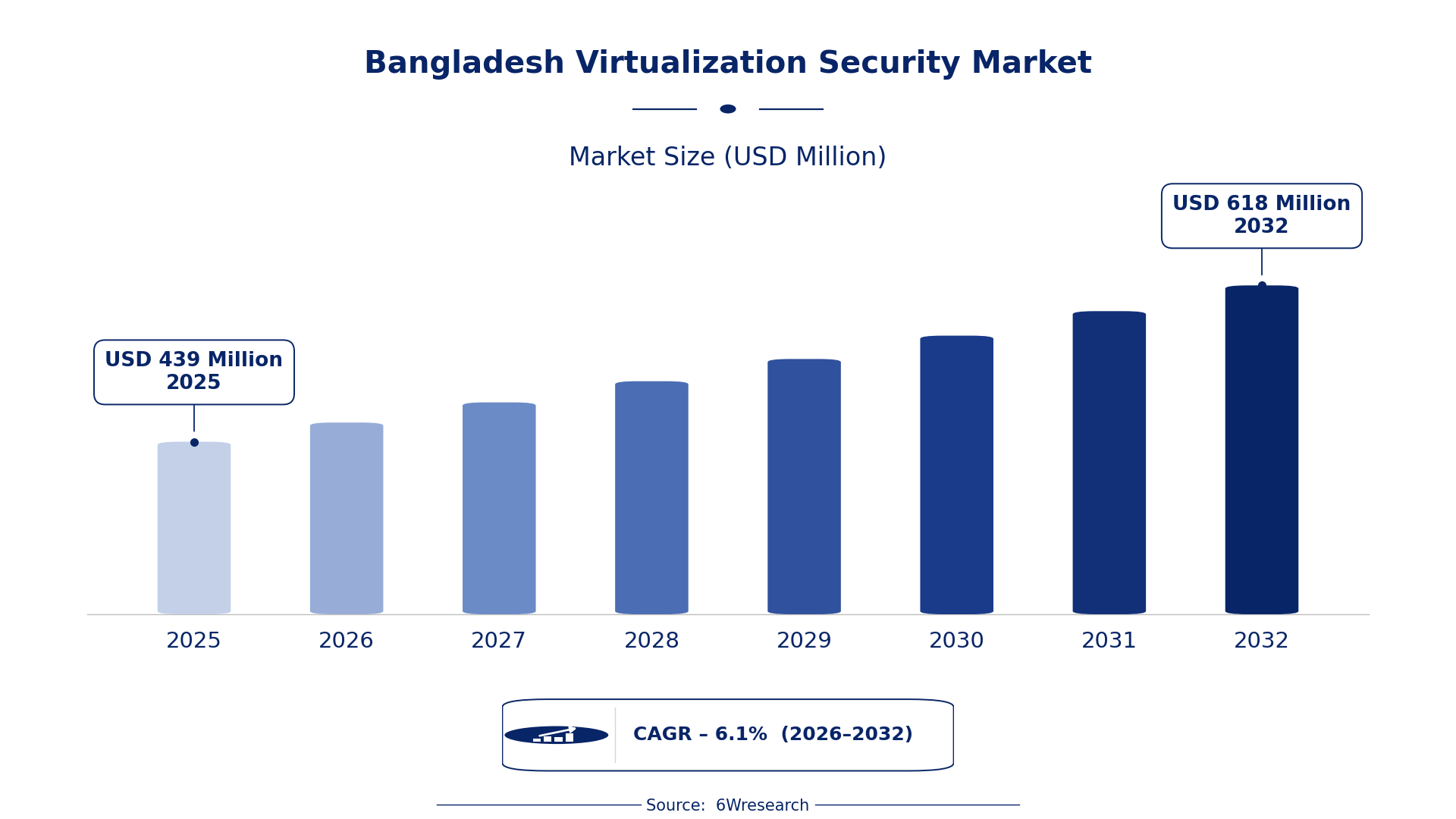
The Bangladesh Virtualization Security Market was estimated at USD 439 Million in 2025 and is projected to reach USD 618 Million by 2032, growing at a CAGR of 6.1% from 2026 to 2032.
Bangladesh Virtualization Security Market Synopsis
The Bangladesh Virtualization Security Market is entering a phase of pronounced growth, driven by a notable increase in data breaches and evolving regulatory requirements. As businesses embrace virtualization technologies, the urgency for stringent security solutions becomes critical.
Organizations are realizing that virtualization, while advantageous for operational efficiency, introduces a range of vulnerabilities. Consequently, the demand for virtualization security solutions is rising sharply, as companies seek to protect their digital assets and ensure compliance with emerging standards.
Bangladesh Virtualization Security Market Year-wise Growth Rate and Key Drivers
This graph illustrates the annual growth rates of the Bangladesh Virtualization Security Market from 2021 to 2032, highlighting a steady upward trajectory and projected expansion over the forecast period.
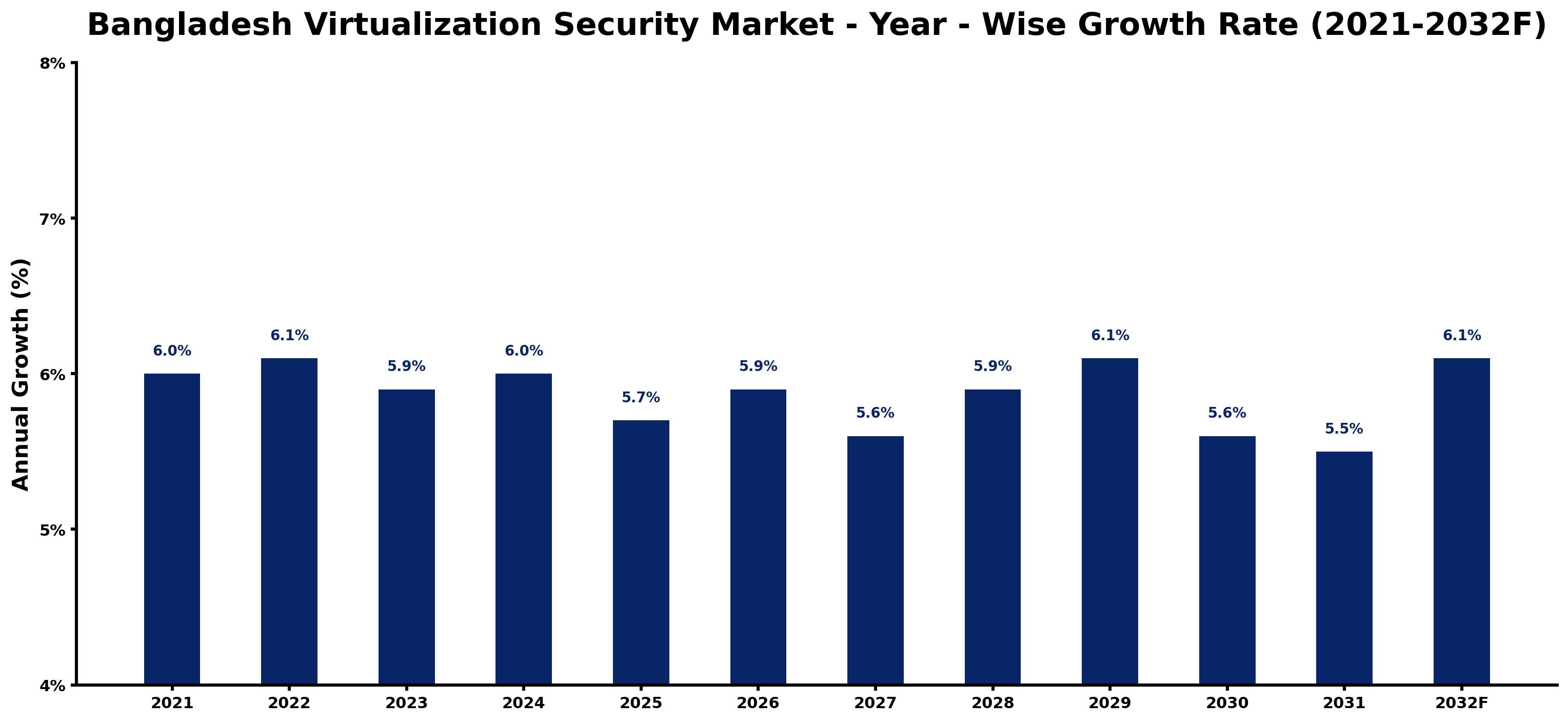
The table below presents the year‑wise growth rates along with the key drivers influencing the market
| Year | Growth Rate | Major Drivers |
| 2021 | 6.0% | Government boosts cybersecurity initiatives through Digital Bangladesh policy. |
| 2022 | 6.1% | Increased cyber threats drive demand for advanced virtualization security. |
| 2023 | 5.9% | Growing awareness of data protection regulations among businesses. |
| 2024 | 6.0% | Rise in remote work demands enhanced virtualization security solutions. |
| 2025 | 5.7% | Local tech firms invest in secure cloud infrastructure. |
| 2026 | 5.9% | Regulatory push for data localization enhances security services demand. |
| 2027 | 5.6% | Emerging startups require robust security for digital transformation. |
| 2028 | 5.9% | Bangladesh Bank mandates stronger security for financial institutions. |
| 2029 | 6.1% | Increased digital transactions promote virtualization security solutions. |
| 2030 | 5.6% | Enhanced internet access expands the cybersecurity market landscape. |
| 2031 | 5.5% | Government support for startups fuels virtualization security innovation. |
| 2032 | 6.1% | Industry partnerships strengthen cybersecurity measures across sectors. |
Note: Market size estimations and growth projections presented in this report are based on 6Wresearch's proprietary forecasting methodology, utilizing the latest available industry data, government publications, and primary research inputs.
Bangladesh Virtualization Security Market Key Takeaways
Below are some of the specific key takeaways from the market, including:
- The market is increasingly influenced by rising cyber threats and the critical need for effective data protection measures.
- Organizations are prioritizing investments in security solutions that address hypervisor vulnerabilities and virtual machine sprawl.
- The ongoing skills shortage in cybersecurity professionals is impacting the adoption of effective virtualization security measures.
- Government policies are beginning to foster a more favorable environment for virtualization security adoption.
- There is a growing recognition of the importance of collaboration among stakeholders to enhance security frameworks.
Evaluation of Restraints in Bangladesh Virtualization Security Market
Several obstacles impede the progress of the Bangladesh Virtualization Security Market. Foremost is the shortage of skilled cybersecurity professionals, which restricts organizations' ability to implement and manage advanced security measures effectively. Smaller enterprises, often operating under tight budget constraints, struggle to allocate adequate resources toward cybersecurity initiatives. Additionally, the intricacy of managing security across diverse virtualized environments adds another layer of complexity, leading to potential oversights and vulnerabilities that can be exploited by malicious actors.
Bangladesh Virtualization Security Market Trends
A shift towards cloud-based virtualization security solutions is currently underway, as organizations seek scalable options that reduce on-premises management burdens. Companies are increasingly adopting multi-layered security strategies that integrate threat detection, encryption, and access controls to combat the growing threat landscape.
In addition, there’s a notable trend towards automation in security protocols, enabling organizations to respond swiftly to potential threats without human intervention. The emphasis on regulatory compliance is also shaping security investments, as businesses prepare for more stringent data protection laws.
Bangladesh Virtualization Security Market Opportunities
Significant growth opportunities exist in the Bangladesh Virtualization Security Market, particularly as organizations continue to expand their digital infrastructure. Investment in advanced security solutions that address specific virtualization challenges presents a lucrative prospect for vendors. Additionally, the rising number of public-private partnerships aimed at enhancing cybersecurity infrastructure can provide a framework for developing tailored security solutions.
With government support in promoting cybersecurity awareness, businesses that align with these initiatives may benefit from increased funding and resources, presenting a strategic avenue for growth.
Government Initiatives in the Bangladesh Virtualization Security Market
The Bangladeshi government is actively engaged in fostering a secure virtualized environment through various initiatives aimed at enhancing cybersecurity. By establishing comprehensive regulatory frameworks and promoting industry collaboration, policymakers are setting the stage for a more secure digital landscape. This commitment underscores the importance of public policy in strengthening the nation's defenses against cyber threats.
- A national cybersecurity awareness campaign launched in 2025 focused on educating organizations about virtualization security best practices.
- Currently underway is an initiative to develop a centralized framework that mandates cybersecurity compliance for businesses adopting virtualization technologies.
- Upcoming plans include a public-private partnership aimed at expanding cybersecurity training programs for professionals in the virtualization sector, expected to roll out by 2027.
- The government is currently drafting regulations that will require annual security audits for enterprises utilizing virtualization, set for implementation in 2026.
Future Insights of the Bangladesh Virtualization Security Market
Looking ahead to 2026-2032, the Bangladesh Virtualization Security Market will likely experience accelerated growth driven by heightened awareness of cybersecurity threats. As organizations continue to embrace virtualization, the demand for specialized security solutions tailored to this environment will grow. The convergence of emerging technologies such as artificial intelligence and machine learning with virtualization security will further enhance protection measures, providing a sophisticated approach to threat detection and response.
Bangladesh Virtualization Security Market Latest Developments
In the past year, the Bangladesh Virtualization Security Market has seen a flurry of activity as organizations increasingly prioritize cybersecurity. This momentum reflects a growing recognition of the risks posed by cyber threats in a virtualized context. Companies are seeking to enhance their security postures through innovative solutions tailored to their needs.
- A major technology vendor launched a comprehensive virtualization security solution in Q2 2025 that integrates advanced threat detection capabilities.
- A regional operator is currently implementing a multi-tier security framework for its virtualized infrastructure, which began in early 2025 and remains ongoing.
- By mid-2026, a significant new initiative is expected to begin, aimed at providing cybersecurity training for SMEs focusing on virtualization security practices.
- A collaboration between government agencies and industry stakeholders was formed in late 2025 to develop best practices for secure virtualization management.
Bangladesh Virtualization Security Market - Key Attractiveness of the Report
- 10 Years of Market Numbers
- Historical Data Starting from 2022 to 2025
- Base Year: 2025
- Forecast Data until 2032
- Key Performance Indicators Impacting the Market
- Major Upcoming Developments and Projects
Key Highlights of the Report:
- Bangladesh Virtualization Security Market Outlook
- Market Size of Bangladesh Virtualization Security Market, 2025
- Forecast of Bangladesh Virtualization Security Market, 2032
- Historical Data and Forecast of Bangladesh Virtualization Security Revenues & Volume for the Period 2022-2032F
- Bangladesh Virtualization Security Market Trend Evolution
- Bangladesh Virtualization Security Market Drivers and Challenges
- Bangladesh Virtualization Security Price Trends
- Bangladesh Virtualization Security Porter's Five Forces
- Bangladesh Virtualization Security Industry Life Cycle
- Historical Data and Forecast of Bangladesh Virtualization Security Market Revenues & Volume By Component for the Period 2022-2032F
- Historical Data and Forecast of Bangladesh Virtualization Security Market Revenues & Volume By Solution (Virtual Infrastructure & Lifecycle Protection) for the Period 2022-2032F
- Historical Data and Forecast of Bangladesh Virtualization Security Market Revenues & Volume By Services (Professional & Managed) for the Period 2022-2032F
- Historical Data and Forecast of Bangladesh Virtualization Security Market Revenues & Volume By Organization Size for the Period 2022-2032F
- Historical Data and Forecast of Bangladesh Virtualization Security Market Revenues & Volume By SMEs for the Period 2022-2032F
- Historical Data and Forecast of Bangladesh Virtualization Security Market Revenues & Volume By Large Enterprises for the Period 2022-2032F
- Historical Data and Forecast of Bangladesh Virtualization Security Market Revenues & Volume By End User for the Period 2022-2032F
- Historical Data and Forecast of Bangladesh Virtualization Security Market Revenues & Volume By Service Providers for the Period 2022-2032F
- Historical Data and Forecast of Bangladesh Virtualization Security Market Revenues & Volume By Enterprises for the Period 2022-2032F
- Historical Data and Forecast of Bangladesh Virtualization Security Market Revenues & Volume By Deployment for the Period 2022-2032F
- Historical Data and Forecast of Bangladesh Virtualization Security Market Revenues & Volume By On-premises for the Period 2022-2032F
- Historical Data and Forecast of Bangladesh Virtualization Security Market Revenues & Volume By Cloud for the Period 2022-2032F
- Bangladesh Virtualization Security Import Export Trade Statistics
- Market Opportunity Assessment By Component
- Market Opportunity Assessment By Organization Size
- Market Opportunity Assessment By End User
- Market Opportunity Assessment By Deployment
- Bangladesh Virtualization Security Top Companies Market Share
- Bangladesh Virtualization Security Competitive Benchmarking By Technical and Operational Parameters
- Bangladesh Virtualization Security Company Profiles
- Bangladesh Virtualization Security Key Strategic Recommendations






































