Bangladesh Water Treatment Market Summary
The bangladesh water treatment market was estimated at USD 787 Million in 2025 and is projected to reach USD 1138 Million by 2032, growing at a CAGR of 6.3% from 2026 to 2032.
Bangladesh Water Treatment Market Year-wise Growth Rate and Key Drivers
This graph highlights how the Bangladesh Water Treatment Market has steadily grown over the past five years, supported by major growth factors.
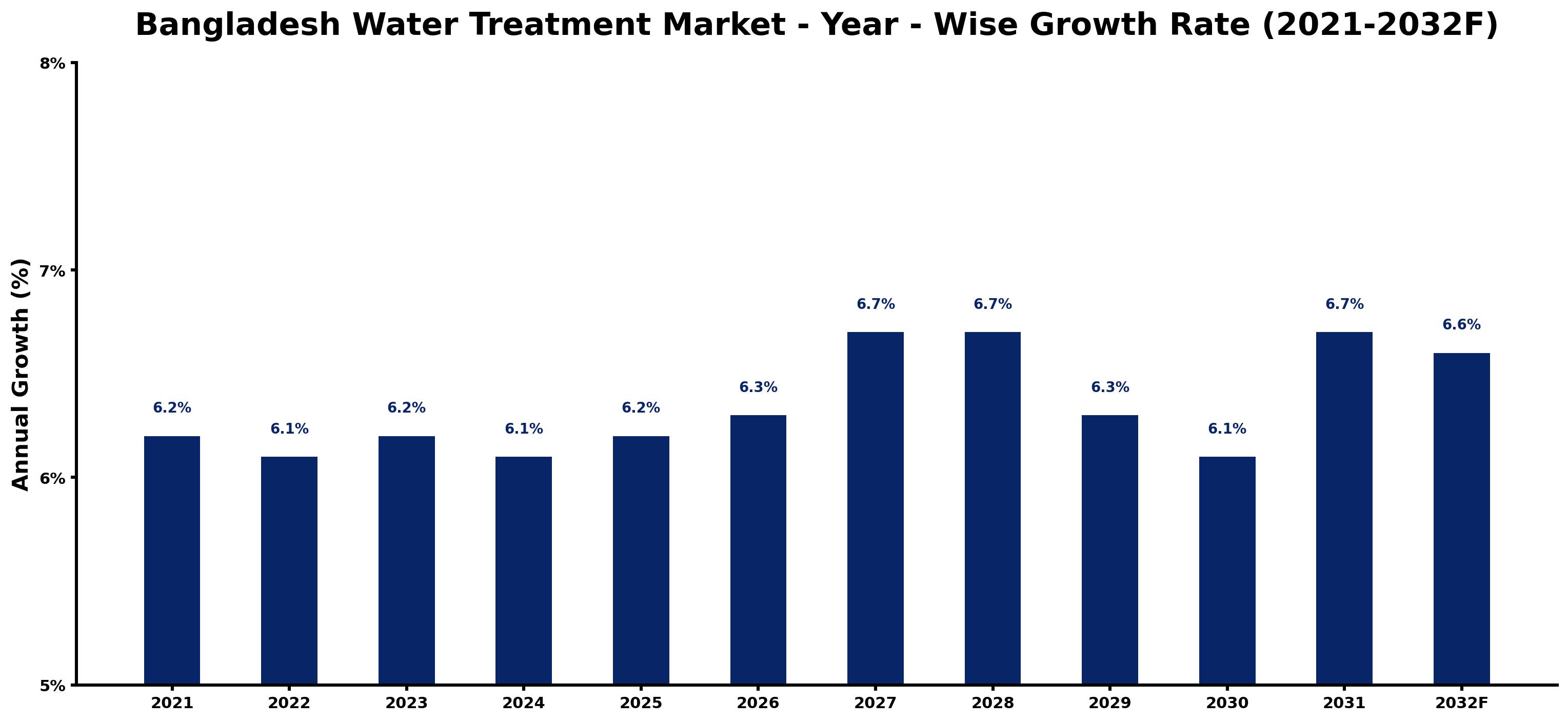
The table below presents the year wise growth rates along with the key drivers influencing the market
| Year | Growth Rate | Major Drivers |
| 2021 | 6.2% | Water pollution concerns catalyze public awareness and investment in treatment solutions. |
| 2022 | 6.1% | Rural infrastructure projects expand, necessitating efficient water treatment technologies for communities. |
| 2023 | 6.2% | Urbanization trends increase water demand, placing pressure on existing treatment facilities. |
| 2024 | 6.1% | International partnerships foster technology transfer, enhancing local water treatment capabilities effectively. |
| 2025 | 6.2% | Private sector investments rise as businesses recognize the value of clean water access. |
| 2026 | 6.3% | Public health campaigns emphasize the importance of safe water, improving consumer education significantly. |
| 2027 | 6.7% | Emerging local startups innovate solutions, disrupting traditional water treatment methods impressively. |
| 2028 | 6.7% | Climate change effects escalate, altering water availability and motivating adaptive treatment strategies. |
| 2029 | 6.3% | Technological advancements lower operational costs, making water treatment accessible for more industries. |
| 2030 | 6.1% | Increased focus on sustainability prompts demand for eco-friendly water treatment practices. |
| 2031 | 6.7% | Integration of IoT technologies enhances monitoring, ensuring efficient water treatment system management. |
| 2032 | 6.6% | Cross-sector collaborations emerge, streamlining resources for comprehensive water management solutions. |
Note - Market size estimations and growth projections presented in this report are based on 6Wresearch's advanced forecasting approach, validated with industry datasets as of June 2026.
Bangladesh Water Treatment Market Synopsis
The Bangladesh Water Treatment Market is projected to reach 6.3% and witness significant growth during the forecast period (2026-2032). This growth is primarily driven by increasing concerns surrounding water quality and pollution, which have escalated due to rapid urbanization and industrialization. The urgent need for advanced water treatment technologies has prompted municipalities, industries, and households to invest in systems that ensure the purity of water for essential purposes, including drinking, irrigation, and various industrial processes.
Bangladesh Water Treatment Market Growth Drivers
Several factors are contributing to the robust growth of the Bangladesh Water Treatment Market. The escalating contamination of water sources is a major catalyst, necessitating the implementation of effective water treatment solutions. In addition, the heightened public awareness of the critical importance of clean water for health and environmental sustainability is propelling market demand. Other significant drivers include:
- The rising incidence of waterborne diseases has prompted both government and private sectors to prioritize water treatment initiatives.
- Government regulations aimed at controlling industrial wastewater discharge are increasing investments in water treatment technologies.
- There is a growing emphasis on environmental sustainability, urging industries to adopt cleaner production techniques and efficient waste management.
- Public health campaigns focused on educating communities about safe water practices are fostering demand for water treatment systems.
- The increasing availability of advanced treatment technologies is making it feasible for more stakeholders to adopt effective solutions.
Bangladesh Water Treatment Market Challenges and Restraints
Despite its growth prospects, the Bangladesh Water Treatment Market faces several challenges that could hinder its development. One of the primary issues is the limited infrastructure that hampers the efficient distribution and treatment of water. Additionally, regulatory hurdles associated with compliance can create obstacles for both local and international players in the field. Key challenges include:
- A lack of sufficient investment in infrastructure development is limiting access to advanced water treatment facilities.
- Technological complexities often deter smaller players from entering the market or expanding their operations.
- Regulatory compliance may pose significant barriers for industries, especially smaller enterprises grappling with limited resources.
- Public awareness of the need for regular maintenance and upgrades of water treatment systems remains insufficient.
- Competition from low-cost, less effective alternatives could undermine the market for conventional treatment technologies.
Bangladesh Water Treatment Market Government Investment and Initiatives
The government of Bangladesh has recognized the urgent need to address water quality challenges and has implemented a range of initiatives to enhance water treatment capabilities. These initiatives include policies focused on improving regulatory frameworks, investing in existing water treatment facilities, and promoting public-private partnerships.
Key government actions encompass:
- Development of comprehensive regulations aimed at safeguarding water quality and managing wastewater effectively.
- Financial incentives aimed at encouraging local enterprises to invest in state-of-the-art water treatment technologies.
- Upgrading existing infrastructure to enhance the efficiency and reach of water treatment services.
- Collaborative efforts with NGOs and private sectors to ensure community engagement in water conservation initiatives.
- Promotion of water conservation education programs aimed at increasing public awareness of sustainable water use practices.
Bangladesh Water Treatment Market Latest Developments (May 2025 - June 2026)
Recent developments in the Bangladesh Water Treatment Market from May 2025 to June 2026 have indicated a positive trajectory, reflecting increased investments and technological advancements in water treatment solutions. The government and private sectors have ramped up efforts to develop and implement more effective treatment methodologies.
Some notable industry trends include:
- The introduction of innovative water treatment technologies aimed at reducing operational costs and improving efficiency.
- Enhanced collaboration between public and private sectors to tackle water quality challenges more effectively.
- Increased investments in research and development for sustainable water treatment solutions.
- Growing participation from international suppliers looking to penetrate the Bangladesh market with advanced treatment systems.
- Strengthened regulatory frameworks to ensure compliance and safety in water treatment practices across various sectors.
Bangladesh Water Treatment Market - Key Attractiveness of the Report
- 10 Years of Market Numbers
- Historical Data Starting from 2022 to 2025
- Base Year: 2025
- Forecast Data until 2032
- Key Performance Indicators Impacting the Market
- Major Upcoming Developments and Projects
Key Highlights of the Report:
- Bangladesh Water Treatment Market Outlook
- Market Size of Bangladesh Water Treatment Market, 2025
- Forecast of Bangladesh Water Treatment Market, 2032
- Historical Data and Forecast of Bangladesh Water Treatment Revenues & Volume for the Period 2022-2032F
- Bangladesh Water Treatment Market Trend Evolution
- Bangladesh Water Treatment Market Drivers and Challenges
- Bangladesh Water Treatment Price Trends
- Bangladesh Water Treatment Porter's Five Forces
- Bangladesh Water Treatment Industry Life Cycle
- Historical Data and Forecast of Bangladesh Water Treatment Market Revenues & Volume By Types for the Period 2022-2032F
- Historical Data and Forecast of Bangladesh Water Treatment Market Revenues & Volume By Distillation? for the Period 2022-2032F
- Historical Data and Forecast of Bangladesh Water Treatment Market Revenues & Volume By Filtration? for the Period 2022-2032F
- Historical Data and Forecast of Bangladesh Water Treatment Market Revenues & Volume By Disinfection for the Period 2022-2032F
- Historical Data and Forecast of Bangladesh Water Treatment Market Revenues & Volume By Reverse Osmosis for the Period 2022-2032F
- Historical Data and Forecast of Bangladesh Water Treatment Market Revenues & Volume By Applications for the Period 2022-2032F
- Historical Data and Forecast of Bangladesh Water Treatment Market Revenues & Volume By Residential? for the Period 2022-2032F
- Historical Data and Forecast of Bangladesh Water Treatment Market Revenues & Volume By Non-Residential? for the Period 2022-2032F
- Historical Data and Forecast of Bangladesh Water Treatment Market Revenues & Volume By Installations for the Period 2022-2032F
- Historical Data and Forecast of Bangladesh Water Treatment Market Revenues & Volume By Point Of Use for the Period 2022-2032F
- Historical Data and Forecast of Bangladesh Water Treatment Market Revenues & Volume By Point Of Entry for the Period 2022-2032F
- Bangladesh Water Treatment Import Export Trade Statistics
- Market Opportunity Assessment By Types
- Market Opportunity Assessment By Applications
- Market Opportunity Assessment By Installations
- Bangladesh Water Treatment Top Companies Market Share
- Bangladesh Water Treatment Competitive Benchmarking By Technical and Operational Parameters
- Bangladesh Water Treatment Company Profiles
- Bangladesh Water Treatment Key Strategic Recommendations






































