Belgium Coal Market Top 5 Importing Countries and Market Competition (HHI) Analysis
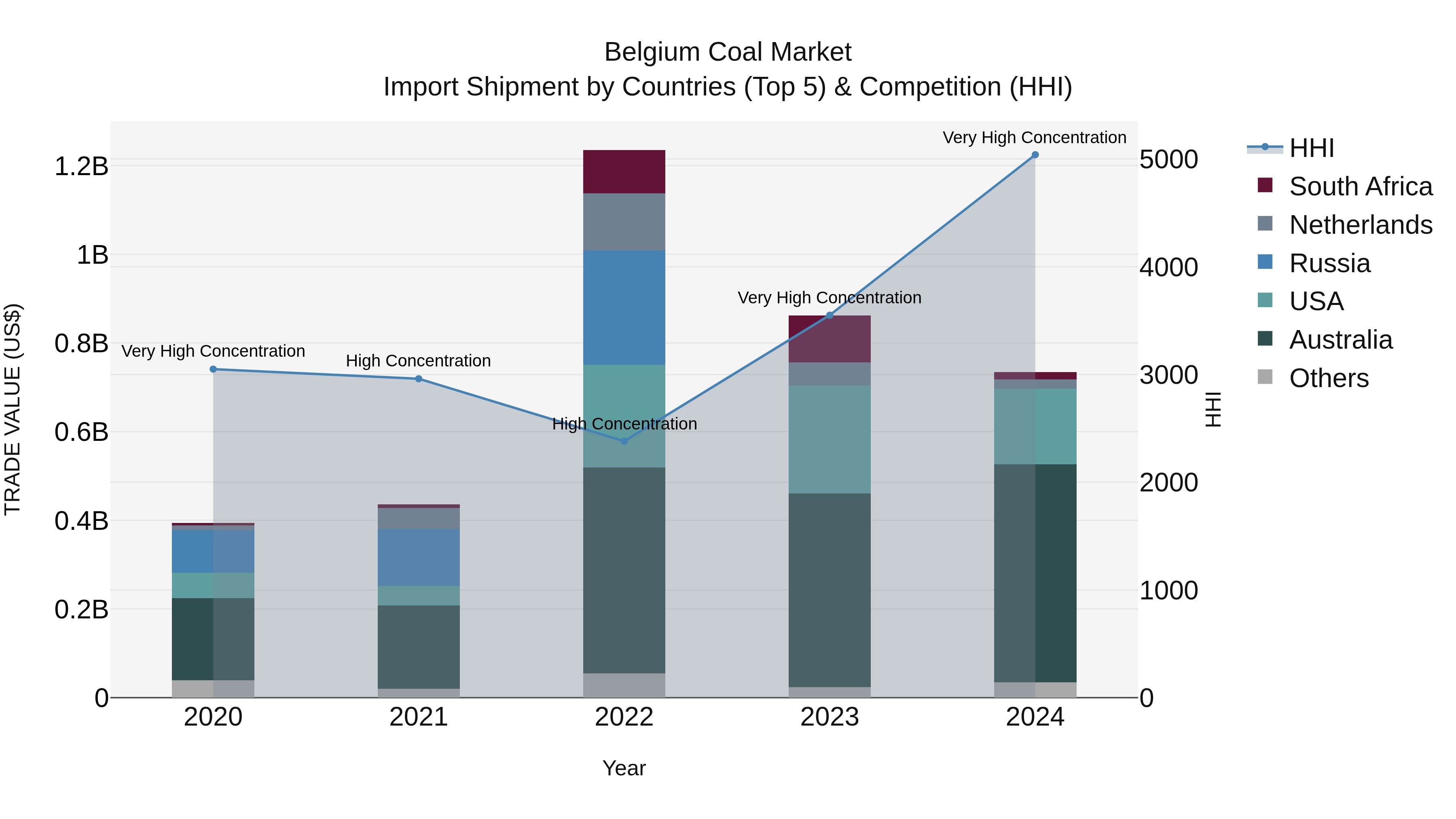
Belgium`s coal import market in 2024 continued to be dominated by key exporting countries such as Australia, USA, Netherlands, South Africa, and Germany. The high Herfindahl-Hirschman Index (HHI) indicates a concentrated market, potentially leading to pricing power for suppliers. Despite a strong compound annual growth rate (CAGR) of 16.87% from 2020 to 2024, there was a notable decline in growth rate of -14.81% from 2023 to 2024. This shift could be influenced by various factors including economic conditions, environmental policies, and global market dynamics impacting coal trade.
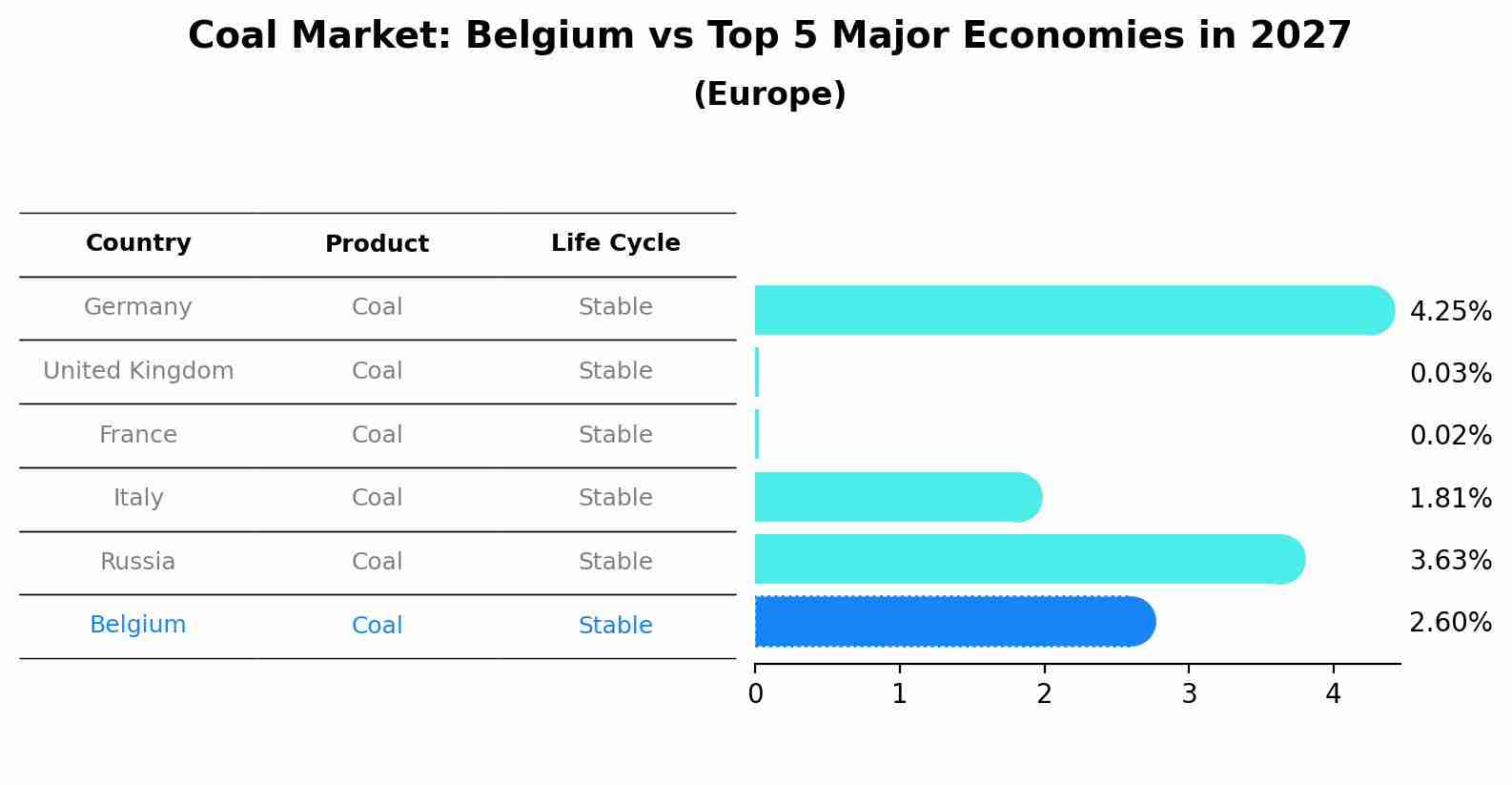
Coal Market: Belgium vs Top 5 Major Economies in 2027 (Europe)
The Coal market in Belgium is projected to grow at a stable growth rate of 2.60% by 2027, within the Europe region led by Germany, along with other countries like United Kingdom, France, Italy and Russia, collectively shaping a dynamic and evolving market environment driven by innovation and increasing adoption of emerging technologies.
Belgium Coal Market Overview
Belgiums coal market is characterized by a decline in domestic coal production and consumption, driven by the European Unions commitment to reducing greenhouse gas emissions and transitioning to cleaner energy sources. The country is focusing on alternative energy sources, which impacts the coal market. However, coal still plays a role in Belgiums energy mix, particularly in industries and regions where transitioning away from coal is gradual.
Drivers of the market
The Belgium coal market is driven by the continued demand for coal in energy production and various industrial processes. Despite the global shift towards renewable energy sources, coal remains a critical component in Belgium`s energy mix due to its reliability and affordability. The presence of established coal-fired power plants and industries that rely on coal for production, such as steel manufacturing, also sustains market demand. Additionally, geopolitical factors and international trade agreements influence the dynamics of coal imports and exports, impacting the market.
Challenges of the market
The coal market in Belgium is significantly affected by environmental policies and the transition to renewable energy sources. As Belgium aims to reduce carbon emissions and increase the share of renewables in its energy mix, the demand for coal is declining. Additionally, fluctuations in global coal prices and geopolitical tensions can impact supply and pricing stability. The market must navigate these challenges while adapting to evolving energy policies and market dynamics.
Government Policy of the market
Belgium`s coal market is shaped by national and European Union-wide environmental policies that aim to reduce coal dependency and greenhouse gas emissions. The Belgian government has committed to transitioning away from coal to meet its climate targets, including phasing out coal-fired power plants and investing in renewable energy sources. These policies are part of Belgium`s broader strategy to achieve sustainability and energy security. The transition impacts the coal market by reducing domestic demand and influencing coal import and export dynamics.
Key Highlights of the Report:
- Belgium Coal Market Outlook
- Market Size of Belgium Coal Market, 2024
- Forecast of Belgium Coal Market, 2031
- Historical Data and Forecast of Belgium Coal Revenues & Volume for the Period 2021-2031
- Belgium Coal Market Trend Evolution
- Belgium Coal Market Drivers and Challenges
- Belgium Coal Price Trends
- Belgium Coal Porter`s Five Forces
- Belgium Coal Industry Life Cycle
- Historical Data and Forecast of Belgium Coal Market Revenues & Volume By Types for the Period 2021-2031
- Historical Data and Forecast of Belgium Coal Market Revenues & Volume By Bituminous Coal for the Period 2021-2031
- Historical Data and Forecast of Belgium Coal Market Revenues & Volume By Sub-Bituminous Coal for the Period 2021-2031
- Historical Data and Forecast of Belgium Coal Market Revenues & Volume By Anthracite for the Period 2021-2031
- Historical Data and Forecast of Belgium Coal Market Revenues & Volume By Lignite for the Period 2021-2031
- Historical Data and Forecast of Belgium Coal Market Revenues & Volume By End-Users for the Period 2021-2031
- Historical Data and Forecast of Belgium Coal Market Revenues & Volume By Electricity for the Period 2021-2031
- Historical Data and Forecast of Belgium Coal Market Revenues & Volume By Steel for the Period 2021-2031
- Historical Data and Forecast of Belgium Coal Market Revenues & Volume By Cement for the Period 2021-2031
- Historical Data and Forecast of Belgium Coal Market Revenues & Volume By Others for the Period 2021-2031
- Belgium Coal Import Export Trade Statistics
- Market Opportunity Assessment By Types
- Market Opportunity Assessment By End-Users
- Belgium Coal Top Companies Market Share
- Belgium Coal Competitive Benchmarking By Technical and Operational Parameters
- Belgium Coal Company Profiles
- Belgium Coal Key Strategic Recommendations






































