Botswana Fuel Oil Market Year-wise Growth Rate (2021-2031F)
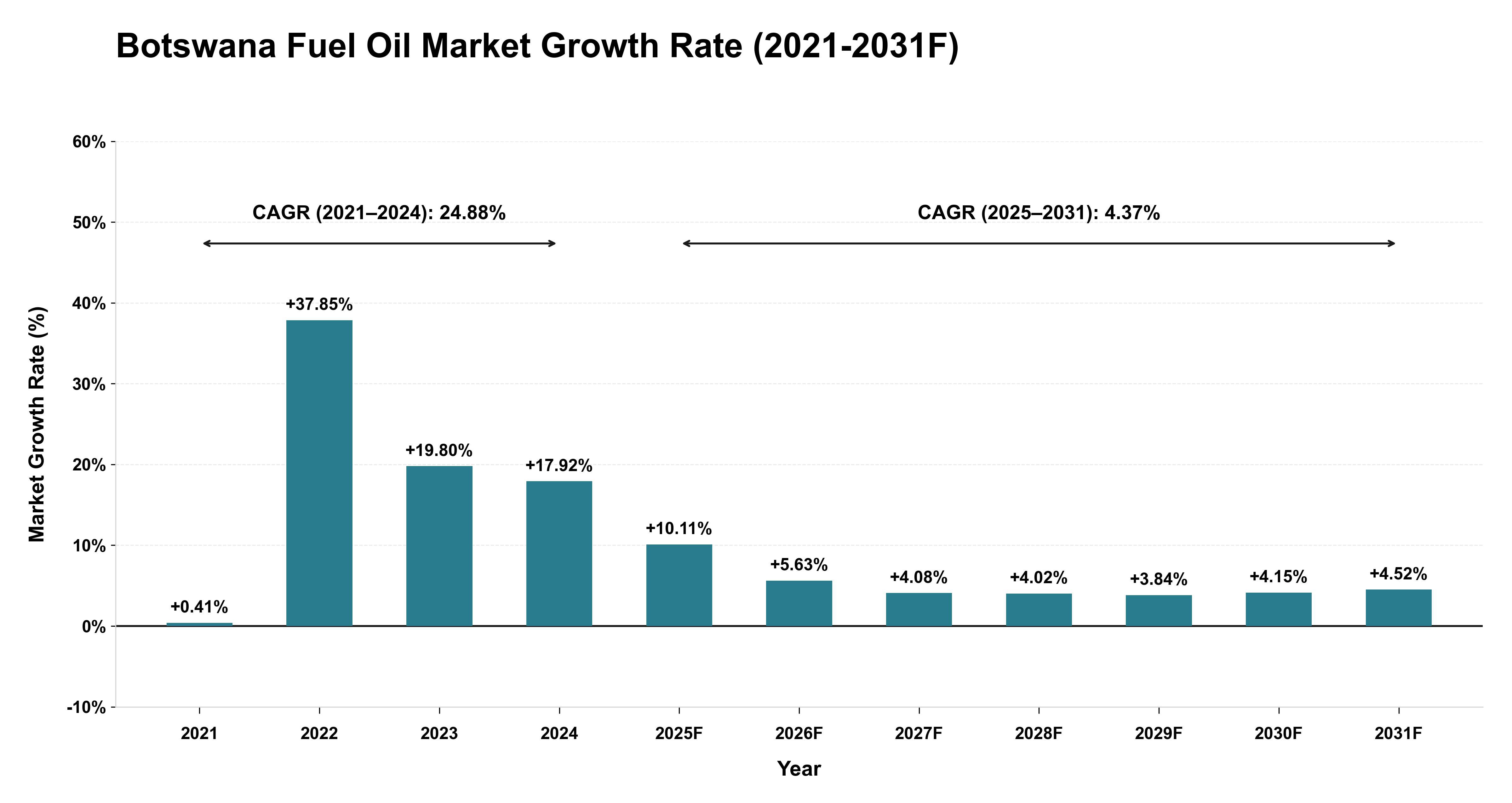
The Botswana Fuel Oil Market experienced a remarkable historical growth trajectory from 2021 to 2024, with a sharp acceleration in 2022 at 37.85%, driven by increasing industrial demand and infrastructure projects. This was followed by robust growth in 2023 and 2024 at 19.80% and 17.92% respectively, reflecting sustained economic expansion and rising consumption patterns. However, the forecast period from 2025 to 2031 anticipates a gradual deceleration in growth rates, aligning with a more stable economy and matured demand dynamics. The expected CAGR of 4.37% signals a shift towards steadier market conditions, influenced by regulatory changes promoting energy efficiency and sustainable practices in the fuel sector. Despite the slowdown, the market remains resilient, adapting to evolving industry standards and technological advancements for long-term sustainability.
Botswana Fuel Oil Market Overview
Botswana`s fuel oil market is expanding due to the country`s increasing energy demands and industrial activities. The market is driven by the need for reliable fuel sources for power generation, manufacturing processes, and transportation.
Drivers of the market
The Botswana fuel oil market benefits from the demand for fuel oil in heating and energy applications. Fuel oil is used in residential, commercial, and industrial settings for heating and power generation. The rise in industrial activities, construction projects, and the need for reliable energy sources drive market growth.
Challenges of the market
The Botswana Fuel Oil market is constrained by fluctuating global oil prices and competition from alternative energy sources. Additionally, the market faces challenges related to limited local refining capacity and high transportation costs.
Government Policy of the market
Botswanas policy on the fuel oil market centers on regulating the production, distribution, and use of fuel oil to ensure environmental and safety standards. The government may offer incentives for the development and adoption of cleaner and more efficient fuel oil technologies.
Key Highlights of the Report:
- Botswana Fuel Oil Market Outlook
- Market Size of Botswana Fuel Oil Market, 2024
- Forecast of Botswana Fuel Oil Market, 2031
- Historical Data and Forecast of Botswana Fuel Oil Revenues & Volume for the Period 2021-2031
- Botswana Fuel Oil Market Trend Evolution
- Botswana Fuel Oil Market Drivers and Challenges
- Botswana Fuel Oil Price Trends
- Botswana Fuel Oil Porter`s Five Forces
- Botswana Fuel Oil Industry Life Cycle
- Historical Data and Forecast of Botswana Fuel Oil Market Revenues & Volume By Application for the Period 2021-2031
- Historical Data and Forecast of Botswana Fuel Oil Market Revenues & Volume By Marine for the Period 2021-2031
- Historical Data and Forecast of Botswana Fuel Oil Market Revenues & Volume By Industrial for the Period 2021-2031
- Historical Data and Forecast of Botswana Fuel Oil Market Revenues & Volume By Others for the Period 2021-2031
- Botswana Fuel Oil Import Export Trade Statistics
- Market Opportunity Assessment By Application
- Botswana Fuel Oil Top Companies Market Share
- Botswana Fuel Oil Competitive Benchmarking By Technical and Operational Parameters
- Botswana Fuel Oil Company Profiles
- Botswana Fuel Oil Key Strategic Recommendations






































