Brazil Activated Carbon Market Top 5 Importing Countries and Market Competition (HHI) Analysis
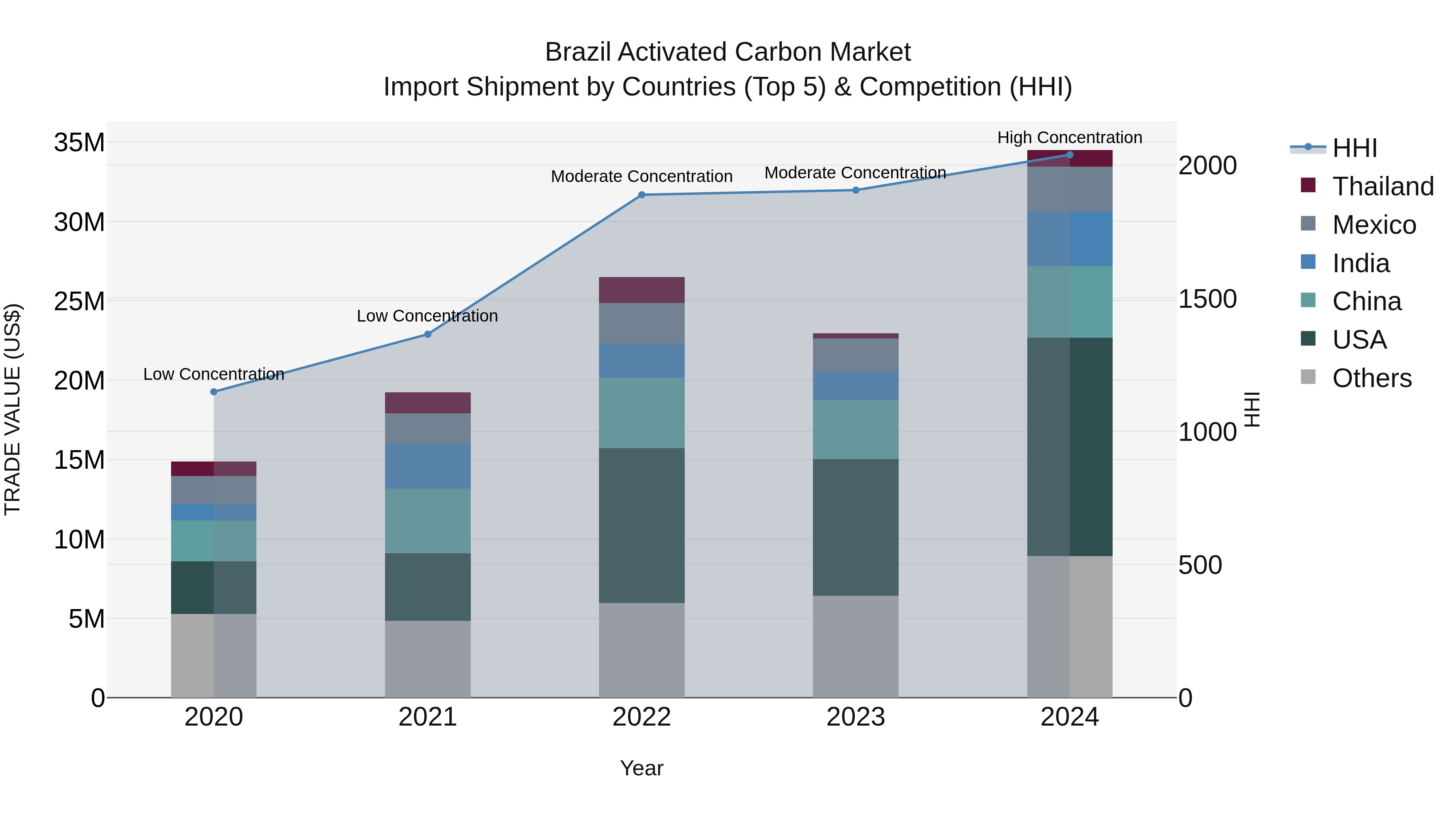
Brazil`s activated carbon import market experienced significant growth in 2024, with top exporting countries including the USA, China, India, Mexico, and Sri Lanka. The market concentration, as measured by the Herfindahl-Hirschman Index (HHI), increased from moderate to high in just one year, reflecting a more competitive landscape. The compound annual growth rate (CAGR) from 2020 to 2024 stood at an impressive 23.39%, with a remarkable growth rate of 50.32% from 2023 to 2024, indicating a rapidly expanding market with strong potential for further development.
Brazil Activated Carbon Market Overview
The Brazil Activated Carbon Market involves the production, distribution, and utilization of activated carbon, a porous material with high surface area and adsorption capacity, used in various applications such as water purification, air filtration, industrial processing, and environmental remediation. Activated carbon is utilized for removing contaminants, odors, and impurities from liquids and gases in industries such as water treatment, food and beverage, pharmaceuticals, and automotive. Market dynamics are influenced by factors such as environmental regulations, water and air quality concerns, industrial pollution control, and technological innovations in activated carbon production and applications.
Drivers of the market
The activated carbon market in Brazil experiences growth driven by water treatment and air purification applications. Activated carbon, with its high surface area and adsorption properties, is used to remove contaminants, odors, and impurities from water and air streams. With increasing concerns about water pollution, industrial emissions, and indoor air quality, the demand for activated carbon products rises in Brazil. Factors such as environmental regulations, municipal water treatment projects, and industrial pollution control contribute to the growth of the activated carbon market.
Challenges of the market
Challenges in Brazil activated carbon market include raw material availability, production costs, and environmental regulations. Market players may encounter challenges related to carbon activation methods, quality control standards, and product customization. Additionally, there are challenges associated with market saturation, pricing pressures, and competition from alternative adsorbent materials impacting the demand for activated carbon in water treatment, air purification, and industrial applications.
Government Policy of the market
Brazil government policies impact the activated carbon market through regulations on environmental protection, water treatment, and air pollution control. These policies aim to promote the use of activated carbon as a versatile adsorbent material for removing pollutants, contaminants, and impurities from water, air, and industrial effluents. Additionally, there are initiatives to regulate the production, importation, and distribution of activated carbon to comply with Brazil regulations and standards. Moreover, regulatory frameworks may govern the certification, disposal, and recycling of activated carbon products to ensure environmental sustainability and public health protection.
Key Highlights of the Report:
- Brazil Activated Carbon Market Outlook
- Market Size of Brazil Activated Carbon Market, 2024
- Forecast of Brazil Activated Carbon Market, 2031
- Historical Data and Forecast of Brazil Activated Carbon Revenues & Volume for the Period 2018 - 2031
- Brazil Activated Carbon Market Trend Evolution
- Brazil Activated Carbon Market Drivers and Challenges
- Brazil Activated Carbon Price Trends
- Brazil Activated Carbon Porter's Five Forces
- Brazil Activated Carbon Industry Life Cycle
- Historical Data and Forecast of Brazil Activated Carbon Market Revenues & Volume By Product for the Period 2018 - 2031
- Historical Data and Forecast of Brazil Activated Carbon Market Revenues & Volume By Powdered for the Period 2018 - 2031
- Historical Data and Forecast of Brazil Activated Carbon Market Revenues & Volume By Granular for the Period 2018 - 2031
- Historical Data and Forecast of Brazil Activated Carbon Market Revenues & Volume By Others for the Period 2018 - 2031
- Historical Data and Forecast of Brazil Activated Carbon Market Revenues & Volume By Application for the Period 2018 - 2031
- Historical Data and Forecast of Brazil Activated Carbon Market Revenues & Volume By Liquid Phase for the Period 2018 - 2031
- Historical Data and Forecast of Brazil Activated Carbon Market Revenues & Volume By Gas Phase for the Period 2018 - 2031
- Historical Data and Forecast of Brazil Activated Carbon Market Revenues & Volume By End-use for the Period 2018 - 2031
- Historical Data and Forecast of Brazil Activated Carbon Market Revenues & Volume By Water Treatment for the Period 2018 - 2031
- Historical Data and Forecast of Brazil Activated Carbon Market Revenues & Volume By Food & Beverage Processing for the Period 2018 - 2031
- Historical Data and Forecast of Brazil Activated Carbon Market Revenues & Volume By Pharmaceutical & Medical for the Period 2018 - 2031
- Historical Data and Forecast of Brazil Activated Carbon Market Revenues & Volume By Automotive for the Period 2018 - 2031
- Historical Data and Forecast of Brazil Activated Carbon Market Revenues & Volume By Air Purification for the Period 2018 - 2031
- Historical Data and Forecast of Brazil Activated Carbon Market Revenues & Volume By Others for the Period 2018 - 2031
- Brazil Activated Carbon Import Export Trade Statistics
- Market Opportunity Assessment By Product
- Market Opportunity Assessment By Application
- Market Opportunity Assessment By End-use
- Brazil Activated Carbon Top Companies Market Share
- Brazil Activated Carbon Competitive Benchmarking By Technical and Operational Parameters
- Brazil Activated Carbon Company Profiles
- Brazil Activated Carbon Key Strategic Recommendations






































