Brazil Anti Reflective Glass Market Size, Share & Growth Rate
The Brazil Anti Reflective Glass Market was estimated at USD 323 Million in 2025 and is projected to reach USD 386 Million by 2032, growing at a CAGR of 2.6% from 2026 to 2032. This growth trajectory is largely attributed to the increasing demand for high-quality glass in construction and urban infrastructure, as well as the burgeoning consumer electronics sector. As Brazil invests in modernizing its urban landscapes and enhancing energy efficiency, anti-reflective glass is becoming a vital component of these developments.
Brazil Anti Reflective Glass Market Year-wise Growth Rate and Key Drivers
This graph highlights how the Brazil Anti Reflective Glass Market has steadily grown over the years, supported by major growth factors.
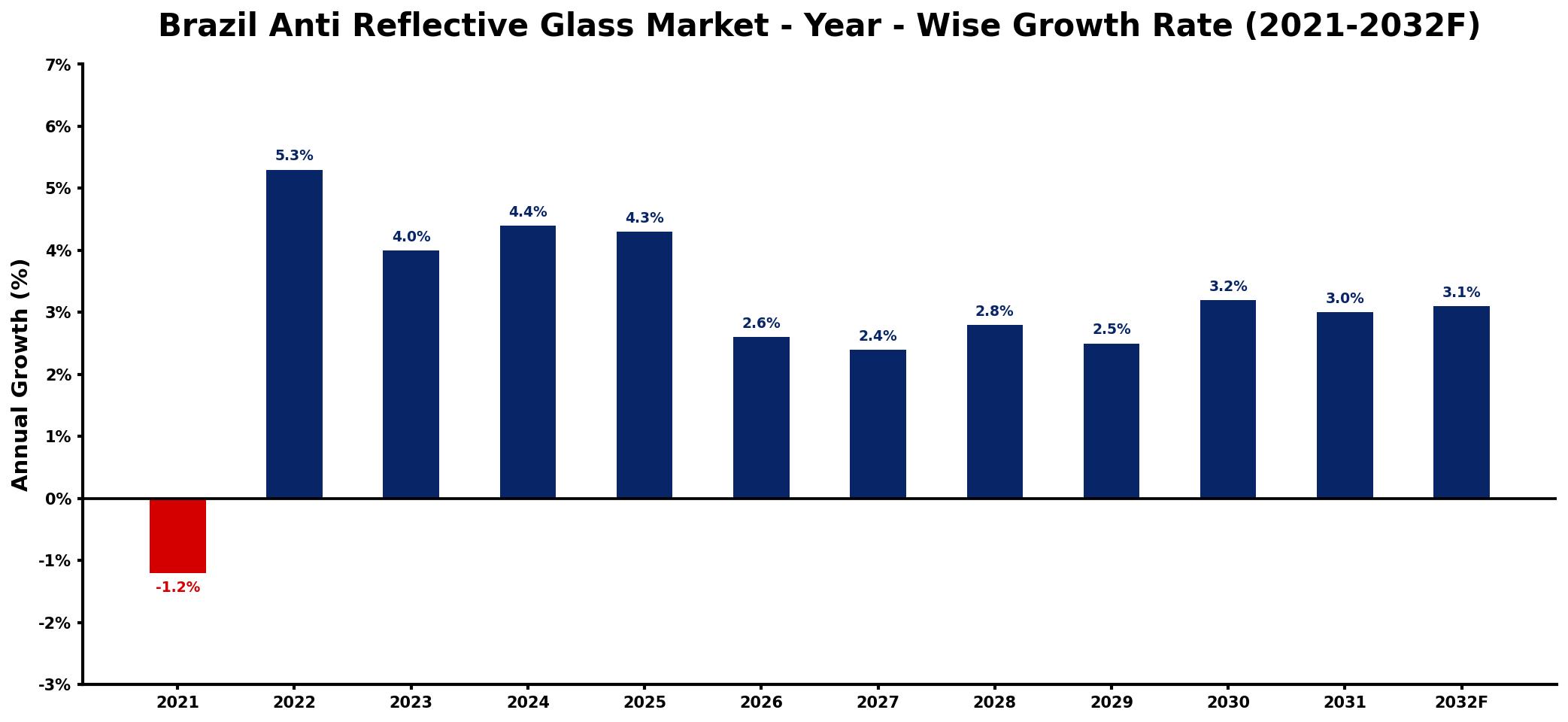
The table below presents the year‑wise growth rates along with the key drivers influencing the market
| Year | Growth Rate | Major Drivers |
| 2021 | -1.2% | slowing construction project completions |
| 2022 | 5.3% | increased demand from automotive sector |
| 2023 | 4.0% | growth in renewable energy investments |
| 2024 | 4.4% | expansion of residential building projects |
| 2025 | 4.3% | rising consumer electronics production |
| 2026 | 2.6% | surge in infrastructure development initiatives |
| 2027 | 2.4% | increased focus on energy efficiency |
| 2028 | 2.8% | increased capital investment inflows |
| 2029 | 2.5% | increased domestic production output |
| 2030 | 3.2% | rising interest in smart technologies |
| 2031 | 3.0% | strengthening international trade flows |
| 2032 | 3.1% | growing downstream application demand |
Note: Market size estimations and growth projections presented in this report are based on 6Wresearch's proprietary forecasting methodology, utilizing the latest available industry data, government publications, and primary research inputs.
Brazil Anti Reflective Glass Market Synopsis
The Brazilian anti-reflective glass market is witnessing significant momentum, driven by an evolving construction landscape and a strong push towards incorporating advanced materials in buildings. This shift is complemented by growing consumer preferences for electronics with enhanced visual clarity, reinforcing the market's positive outlook.
As more urban centers expand and the automotive industry flourishes, the demand for anti-reflective glass is increasingly pivotal. In addition to enhancing aesthetic appeal, these glass products contribute to energy efficiency, making them a preferred choice for both residential and commercial applications.
Brazil Anti Reflective Glass Market Key Takeaways
- The market is experiencing steady growth owing to rising urbanization and infrastructure projects.
- Consumer electronics and the automotive sector are significant demand drivers for anti-reflective glass.
- Innovation and differentiation are crucial for manufacturers to thrive amid competition from alternative materials.
- Regulatory measures in Brazil focus on ensuring product quality and consumer safety.
- Investment in energy-efficient solutions is propelling the adoption of anti-reflective glass in various applications.
Evaluation of Restraints in Brazil Anti Reflective Glass Market
Despite its advantages, the Brazilian anti-reflective glass market grapples with several restraints. Rapid technological advancements present challenges, as manufacturers must constantly innovate to maintain a competitive edge. Additionally, the presence of alternative solutions, such as cost-effective coatings and films, can dilute the market share for traditional anti-reflective glass. These factors necessitate a strategic approach for players in the market to not only sustain but also grow their presence amidst a competitive landscape.
Brazil Anti Reflective Glass Market Trends
The increasing integration of smart technologies in construction and automotive sectors is paving the way for innovative anti-reflective glass applications. Trends indicate a shift towards multifunctional glass that not only minimizes glare but also incorporates features like heat resistance and self-cleaning properties. Sustainability and energy efficiency are becoming central themes, leading to heightened demand for products that enhance environmental performance.
Brazil Anti Reflective Glass Market Opportunities
Opportunities abound in the Brazilian anti-reflective glass market, particularly in sectors such as green building and smart technology integration. As regulations increasingly favor sustainable practices, manufacturers can seize the chance to develop advanced glass products that meet these emerging standards. Furthermore, collaboration with technology companies to create smart glass solutions could open new avenues for growth.
Government Initiatives in the Brazil Anti Reflective Glass Market
The Brazilian government has established regulatory frameworks aimed at promoting product performance standards in the anti-reflective glass market. Policies are designed to enhance consumer protection while ensuring that products meet high standards for optical clarity and durability. Public spending is increasingly focused on infrastructure projects that favor energy-efficient materials, creating an environment conducive to the growth of the anti-reflective glass segment.
Future Insights of the Brazil Anti Reflective Glass Market
Looking ahead to 2026-2032, the Brazil Anti Reflective Glass Market is poised for continued growth, buoyed by ongoing urbanization and technological advancements. As consumer preferences evolve toward high-quality, energy-efficient materials, the market is expected to adapt and innovate accordingly. Manufacturers who align with sustainability goals and leverage new technologies will likely emerge as leaders in this dynamic market landscape.
Brazil Anti Reflective Glass Market Latest Developments (2025 - 2026)
Recent developments in the Brazilian anti-reflective glass market indicate a proactive approach toward technological integration and sustainability. Key industry stakeholders are increasingly focusing on research and development to enhance product offerings, emphasizing energy efficiency and user comfort. The ongoing investments in urban infrastructure and smart cities are driving the demand for innovative glass solutions.
Brazil Anti Reflective Glass Market - Key Attractiveness of the Report
- 10 Years of Market Numbers
- Historical Data Starting from 2022 to 2025
- Base Year: 2025
- Forecast Data until 2032
- Key Performance Indicators Impacting the Market
- Major Upcoming Developments and Projects
Key Highlights of the Report:
- Brazil Anti Reflective Glass Market Outlook
- Market Size of Brazil Anti Reflective Glass Market, 2025
- Forecast of Brazil Anti Reflective Glass Market, 2032
- Historical Data and Forecast of Brazil Anti Reflective Glass Revenues & Volume for the Period 2022-2032F
- Brazil Anti Reflective Glass Market Trend Evolution
- Brazil Anti Reflective Glass Market Drivers and Challenges
- Brazil Anti Reflective Glass Price Trends
- Brazil Anti Reflective Glass Porter's Five Forces
- Brazil Anti Reflective Glass Industry Life Cycle
- Historical Data and Forecast of Brazil Anti Reflective Glass Market Revenues & Volume By Type for the Period 2022-2032F
- Historical Data and Forecast of Brazil Anti Reflective Glass Market Revenues & Volume By Double Layers for the Period 2022-2032F
- Historical Data and Forecast of Brazil Anti Reflective Glass Market Revenues & Volume By Four Layers for the Period 2022-2032F
- Historical Data and Forecast of Brazil Anti Reflective Glass Market Revenues & Volume By Others for the Period 2022-2032F
- Historical Data and Forecast of Brazil Anti Reflective Glass Market Revenues & Volume By Application for the Period 2022-2032F
- Historical Data and Forecast of Brazil Anti Reflective Glass Market Revenues & Volume By Architectural Windows for the Period 2022-2032F
- Historical Data and Forecast of Brazil Anti Reflective Glass Market Revenues & Volume By Instrumentation Windows for the Period 2022-2032F
- Historical Data and Forecast of Brazil Anti Reflective Glass Market Revenues & Volume By Electronic Displays for the Period 2022-2032F
- Historical Data and Forecast of Brazil Anti Reflective Glass Market Revenues & Volume By Picture Framing Glass for the Period 2022-2032F
- Historical Data and Forecast of Brazil Anti Reflective Glass Market Revenues & Volume By Showcase Glass for the Period 2022-2032F
- Historical Data and Forecast of Brazil Anti Reflective Glass Market Revenues & Volume By Cold Storage Displays for the Period 2022-2032F
- Historical Data and Forecast of Brazil Anti Reflective Glass Market Revenues & Volume By Lamps Glass for the Period 2022-2032F
- Historical Data and Forecast of Brazil Anti Reflective Glass Market Revenues & Volume By Others for the Period 2022-2032F
- Brazil Anti Reflective Glass Import Export Trade Statistics
- Market Opportunity Assessment By Type
- Market Opportunity Assessment By Application
- Brazil Anti Reflective Glass Top Companies Market Share
- Brazil Anti Reflective Glass Competitive Benchmarking By Technical and Operational Parameters
- Brazil Anti Reflective Glass Company Profiles
- Brazil Anti Reflective Glass Key Strategic Recommendations






































