Argentina Anti Reflective Glass Market Size, Share & Growth Rate
The Argentina Anti Reflective Glass Market was estimated at USD 1001 Million in 2025 and is projected to reach USD 1451 Million by 2032, growing at a CAGR of 5.4% from 2026 to 2032. This growth trajectory is primarily driven by the heightened demand for energy-efficient building materials in the construction sector, alongside the automotive industrys increasing preference for anti-reflective glass for its aesthetic and safety benefits. Furthermore, the shift toward renewable energy sources, particularly in solar panel applications, further solidifies the market's potential.
Argentina Anti Reflective Glass Market Year-wise Growth Rate and Key Drivers
This graph highlights how the Argentina Anti Reflective Glass Market has steadily grown over the years, supported by major growth factors.
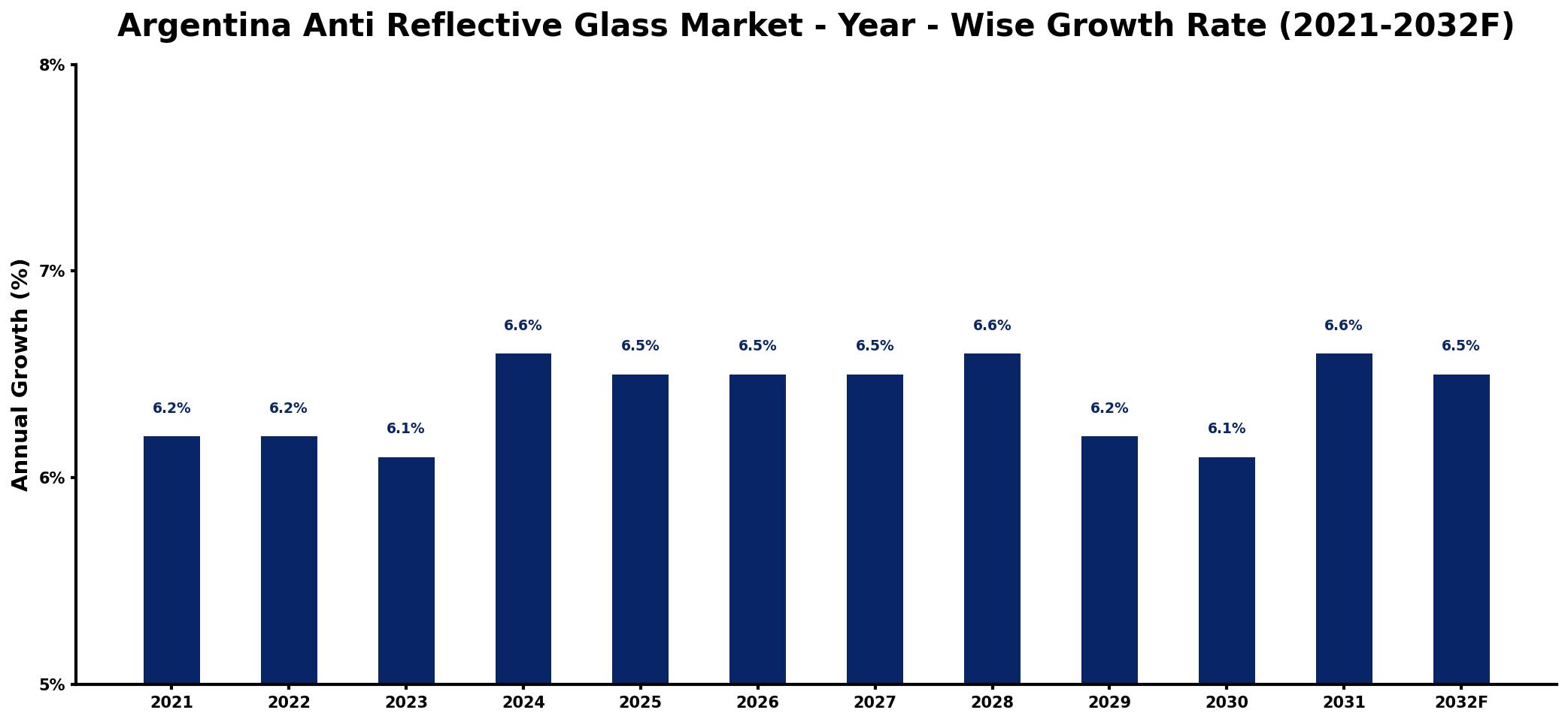
The table below presents the year‑wise growth rates along with the key drivers influencing the market
| Year | Growth Rate | Major Drivers |
| 2021 | 6.2% | Rising demand in automotive sector |
| 2022 | 6.2% | Growth in renewable energy projects |
| 2023 | 6.1% | Increasing consumer electronics production |
| 2024 | 6.6% | Expansion in construction activities |
| 2025 | 6.5% | Technological advancements in manufacturing |
| 2026 | 6.5% | Surge in architectural innovations |
| 2027 | 6.5% | Higher investments in infrastructure |
| 2028 | 6.6% | Growth of smart home technology |
| 2029 | 6.2% | Increase in export opportunities |
| 2030 | 6.1% | Demand from healthcare equipment |
| 2031 | 6.6% | Boom in outdoor recreational products |
| 2032 | 6.5% | Rising focus on energy efficiency |
Note: Market size estimations and growth projections presented in this report are based on 6Wresearch's proprietary forecasting methodology, utilizing the latest available industry data, government publications, and primary research inputs.
Argentina Anti Reflective Glass Market Synopsis
The most significant force currently shaping the Argentina Anti Reflective Glass Market is the robust growth within the construction sector. With sustainable building practices gaining traction, the demand for anti-reflective glass is surging, as it not only enhances aesthetic appeal but also contributes to energy efficiency and reduced glare.
Simultaneously, the automotive industry's increasing adoption of anti-reflective glass is contributing to market dynamics. This glass not only improves driver visibility but also aligns with the broader trend of integrating energy-efficient materials across various applications, creating a fertile ground for market expansion.
Argentina Anti Reflective Glass Market Key Takeaways
- The market is driven by the construction sectors shift towards sustainable materials.
- Automotive applications are seeing increased utilization of anti-reflective glass for safety and aesthetics.
- Rising awareness about UV protection and energy efficiency enhances the glass's popularity.
- Technological advancements are leading to innovative products with superior performance.
- Government policies are increasingly favoring the use of energy-efficient building materials.
Evaluation of Restraints in Argentina Anti Reflective Glass Market
While the Argentina Anti Reflective Glass Market exhibits promising growth, it faces several constraints. Intense competition among domestic and international manufacturers heightens the pressure on pricing and innovation. Additionally, fluctuating raw material prices can impede profitability, while economic instability may affect consumer purchasing power and project investments. Regulatory hurdles, particularly regarding import restrictions, also pose challenges for market participants striving to expand their operations in Argentina.
Argentina Anti Reflective Glass Market Trends
Current trends indicate a marked preference for energy-efficient and sustainable building materials across the Argentine construction landscape. This trend is driving the adoption of anti-reflective glass, as it mitigates glare and enhances architectural aesthetics. Furthermore, manufacturers are focusing on developing cutting-edge technologies that improve the performance characteristics of anti-reflective glass, thus responding to growing consumer demands for high-quality solutions.
Argentina Anti Reflective Glass Market Opportunities
The Argentina Anti Reflective Glass Market presents numerous investment opportunities, particularly in light of the ongoing expansion of the construction sector. The demand for high-quality anti-reflective glass in both commercial and residential settings is set to rise, offering lucrative prospects for investors. Moreover, strategic partnerships with construction firms and architects can lead to innovative applications of anti-reflective glass, further driving market growth.
Government Initiatives in the Argentina Anti Reflective Glass Market
The Argentine government is actively promoting the use of energy-efficient materials in construction, including anti-reflective glass. Various regulations and incentives have been implemented to encourage the integration of sustainable building practices. Tax incentives, building codes prioritizing energy-efficient designs, and subsidies for projects incorporating anti-reflective glass are some of the key policies shaping the market landscape. These initiatives are crucial for fostering an environment conducive to growth in the anti-reflective glass sector.
Future Insights of the Argentina Anti Reflective Glass Market
Looking ahead to 2026-2032, the Argentina Anti Reflective Glass Market is poised for continued growth. Factors such as increasing consumer awareness about the benefits of anti-reflective glass—including enhanced light transmission and UV protection—will likely bolster demand across various sectors. Additionally, as technological advancements yield innovative products with better performance, the market will expand further. However, potential economic fluctuations and raw material price volatility will require stakeholders to remain agile in their strategic approaches.
Argentina Anti Reflective Glass Market Latest Developments (2025 - 2026)
Recent developments in the Argentina Anti Reflective Glass Market reflect a trend toward greater innovation and product diversification. Manufacturers are increasingly investing in research and development to enhance the performance features of anti-reflective glass, aligning with the market's sustainability goals. This includes the introduction of new coatings and processing techniques aimed at improving durability and energy efficiency, which are anticipated to resonate well with evolving consumer preferences.
Argentina Anti Reflective Glass Market - Key Attractiveness of the Report
- 10 Years of Market Numbers
- Historical Data Starting from 2022 to 2025
- Base Year: 2025
- Forecast Data until 2032
- Key Performance Indicators Impacting the Market
- Major Upcoming Developments and Projects
Key Highlights of the Report:
- Argentina Anti Reflective Glass Market Outlook
- Market Size of Argentina Anti Reflective Glass Market, 2025
- Forecast of Argentina Anti Reflective Glass Market, 2032
- Historical Data and Forecast of Argentina Anti Reflective Glass Revenues & Volume for the Period 2022-2032F
- Argentina Anti Reflective Glass Market Trend Evolution
- Argentina Anti Reflective Glass Market Drivers and Challenges
- Argentina Anti Reflective Glass Price Trends
- Argentina Anti Reflective Glass Porter's Five Forces
- Argentina Anti Reflective Glass Industry Life Cycle
- Historical Data and Forecast of Argentina Anti Reflective Glass Market Revenues & Volume By Type for the Period 2022-2032F
- Historical Data and Forecast of Argentina Anti Reflective Glass Market Revenues & Volume By Double Layers for the Period 2022-2032F
- Historical Data and Forecast of Argentina Anti Reflective Glass Market Revenues & Volume By Four Layers for the Period 2022-2032F
- Historical Data and Forecast of Argentina Anti Reflective Glass Market Revenues & Volume By Others for the Period 2022-2032F
- Historical Data and Forecast of Argentina Anti Reflective Glass Market Revenues & Volume By Application for the Period 2022-2032F
- Historical Data and Forecast of Argentina Anti Reflective Glass Market Revenues & Volume By Architectural Windows for the Period 2022-2032F
- Historical Data and Forecast of Argentina Anti Reflective Glass Market Revenues & Volume By Instrumentation Windows for the Period 2022-2032F
- Historical Data and Forecast of Argentina Anti Reflective Glass Market Revenues & Volume By Electronic Displays for the Period 2022-2032F
- Historical Data and Forecast of Argentina Anti Reflective Glass Market Revenues & Volume By Picture Framing Glass for the Period 2022-2032F
- Historical Data and Forecast of Argentina Anti Reflective Glass Market Revenues & Volume By Showcase Glass for the Period 2022-2032F
- Historical Data and Forecast of Argentina Anti Reflective Glass Market Revenues & Volume By Cold Storage Displays for the Period 2022-2032F
- Historical Data and Forecast of Argentina Anti Reflective Glass Market Revenues & Volume By Lamps Glass for the Period 2022-2032F
- Historical Data and Forecast of Argentina Anti Reflective Glass Market Revenues & Volume By Others for the Period 2022-2032F
- Argentina Anti Reflective Glass Import Export Trade Statistics
- Market Opportunity Assessment By Type
- Market Opportunity Assessment By Application
- Argentina Anti Reflective Glass Top Companies Market Share
- Argentina Anti Reflective Glass Competitive Benchmarking By Technical and Operational Parameters
- Argentina Anti Reflective Glass Company Profiles
- Argentina Anti Reflective Glass Key Strategic Recommendations






































