Brazil API Management Market Size & Growth Rate (2026-2032)
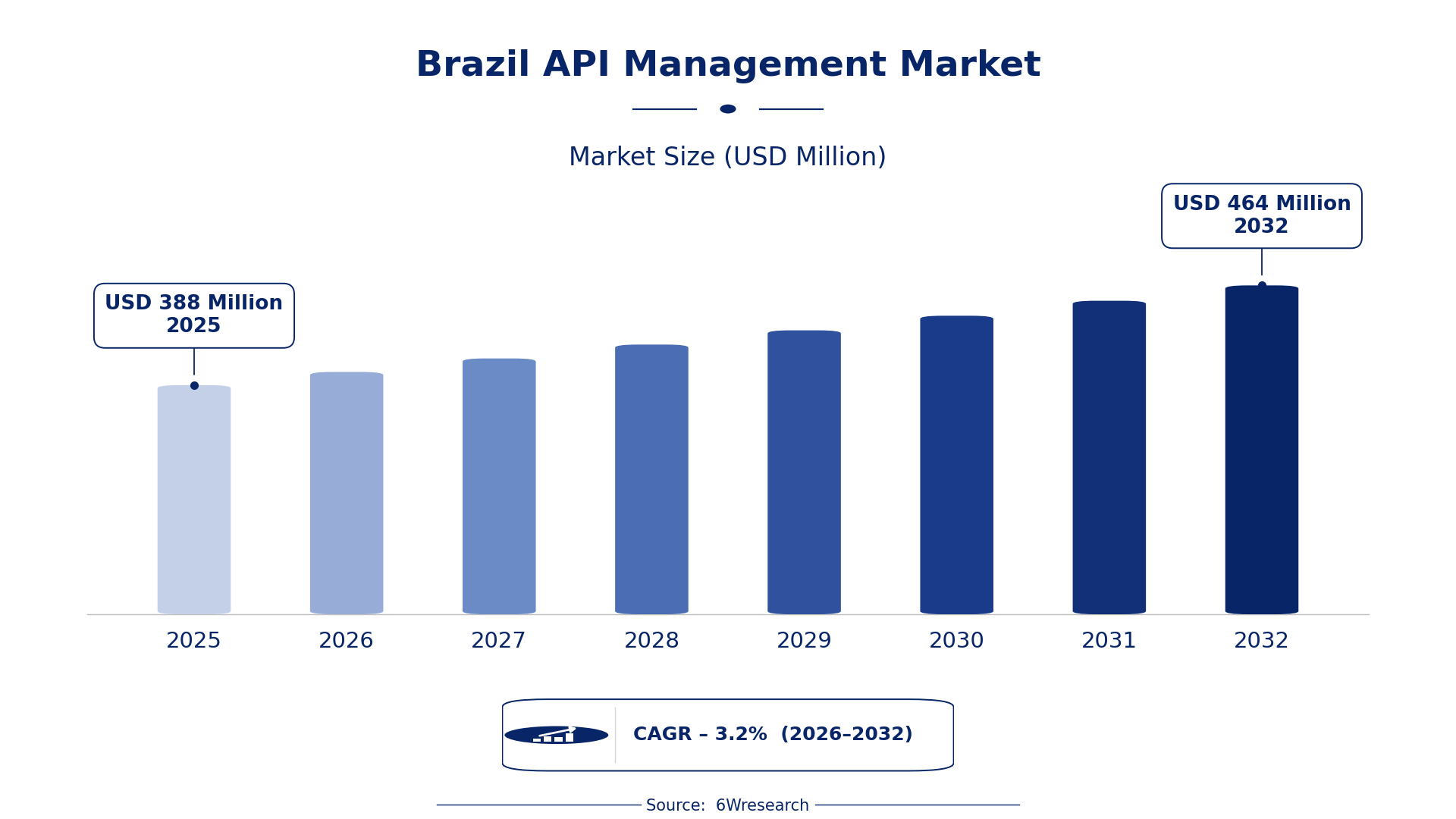
The Brazil API Management Market was estimated at USD 388 Million in 2025 and is projected to reach USD 464 Million by 2032, growing at a CAGR of 3.2% from 2026 to 2032.
Brazil API Management Market Synopsis
In Brazil, the demand for API management solutions is rapidly increasing as organizations across various sectors embrace digital transformation. The surge in cloud computing adoption and the need for enhanced interconnectivity among applications are driving businesses to invest in robust API management platforms.
The Brazilian market is characterized by a diverse array of API management offerings that cater to specific industry requirements. As companies strive to streamline operations and improve customer engagement, the competition among service providers is intensifying, resulting in innovative solutions tailored to meet localized demands.
Brazil API Management Market Year-wise Growth Rate and Key Drivers
This graph illustrates the annual growth rates of the Brazil API Management Market from 2021 to 2032, highlighting a steady upward trajectory and projected expansion over the forecast period.
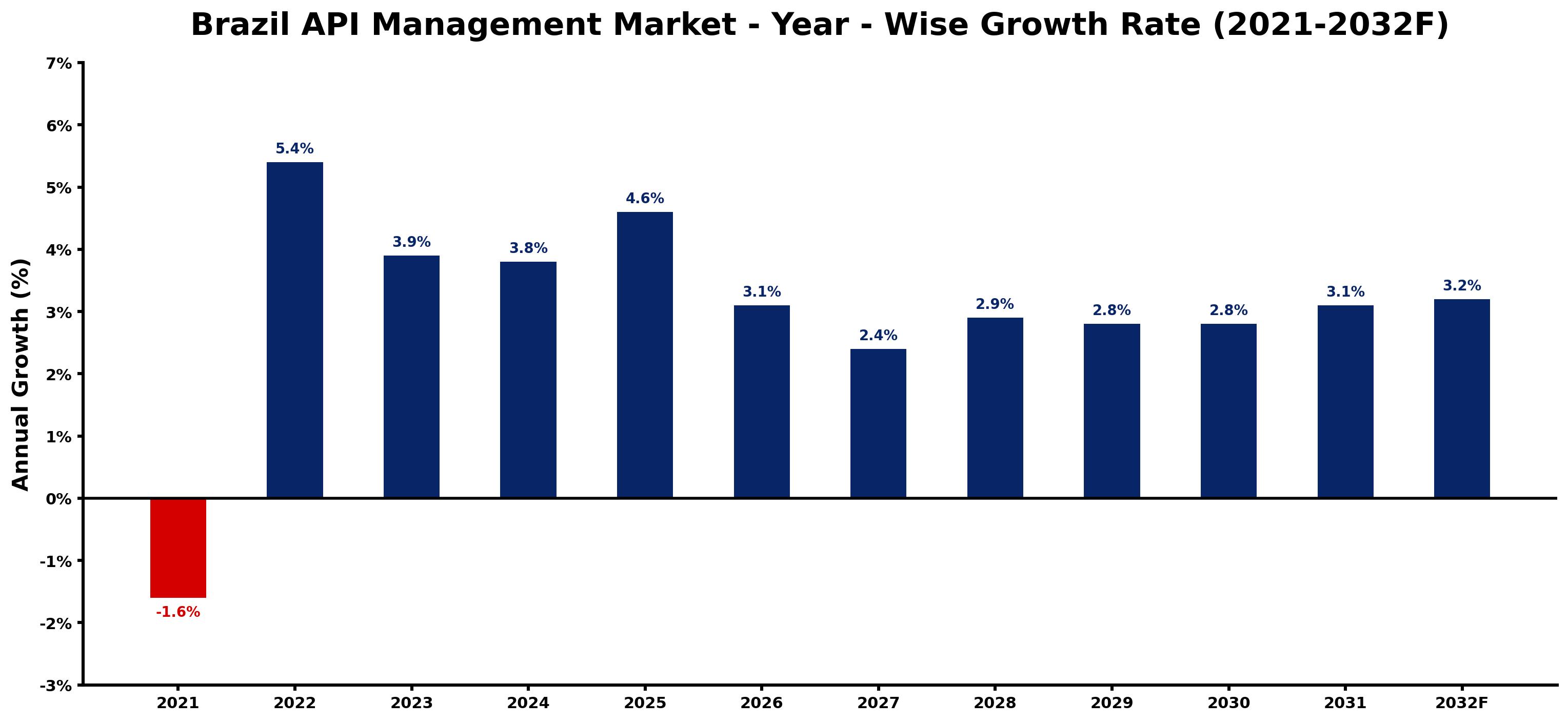
The table below presents the year‑wise growth rates along with the key drivers influencing the market
| Year | Growth Rate | Major Drivers |
| 2021 | -1.6% | LGPD compliance costs hindered API investment efforts. |
| 2022 | 5.4% | Government's Digital Transformation Plan accelerating API integration. |
| 2023 | 3.9% | Increased adoption of cloud solutions by Brazilian enterprises. |
| 2024 | 3.8% | Growing e-commerce sector requiring robust API frameworks. |
| 2025 | 4.6% | Enhanced cybersecurity regulations fostering API security measures. |
| 2026 | 3.1% | Local startups innovating with APIs for financial solutions. |
| 2027 | 2.4% | Rising mobile app development fueling API utilization. |
| 2028 | 2.9% | Telecom regulations promoting interoperability through API standards. |
| 2029 | 2.8% | Increased demand for data analytics driving API investments. |
| 2030 | 2.8% | Continued support from BNDES for digital innovation initiatives. |
| 2031 | 3.1% | Emergence of IoT applications needing efficient API access. |
| 2032 | 3.2% | Local enterprises embracing microservices architecture through APIs. |
Note: Market size estimations and growth projections presented in this report are based on 6Wresearch's proprietary forecasting methodology, utilizing the latest available industry data, government publications, and primary research inputs.
Brazil API Management Market Key Takeaways
Below are some of the specific key takeaways from the market, including:
- Strong growth trajectory driven by the digital transformation initiatives of Brazilian businesses.
- Increasing emphasis on cloud computing and application integration as key factors propelling market demand.
- Growing number of local and international players contributing to a competitive API management environment.
- Rising concerns over data security and privacy influencing API management strategies and solutions.
- Government policies actively fostering a digital ecosystem that supports API management adoption.
Evaluation of Restraints in Brazil API Management Market
Despite the positive growth outlook, several challenges are hindering the expansion of the Brazil API Management Market. Chief among these is the complexity associated with integrating diverse applications and ensuring consistent security across platforms. Data privacy regulations are becoming increasingly stringent, prompting companies to invest heavily in compliance measures. The lack of standardized API protocols adds another layer of difficulty, as organizations struggle to manage a myriad of APIs effectively. These hurdles create a landscape where companies must prioritize not only technology adoption but also robust security frameworks.
Brazil API Management Market Trends
A noticeable trend in the Brazil API Management Market is the shift towards more user-friendly and accessible platforms. Companies are increasingly seeking solutions that simplify the integration process, enabling faster deployment and reduced operational overhead. on top of that, the rise of microservices architecture is compelling organizations to adopt API management tools that facilitate the creation and management of numerous small, interconnected services.
Another trend is the growing focus on API analytics and performance monitoring. Businesses are recognizing the importance of real-time data to optimize API usage and drive better decision-making. This emphasis on analytics capabilities is pushing service providers to enhance their offerings to include advanced tracking and reporting functionalities.
Brazil API Management Market Opportunities
The Brazilian API Management Market presents significant opportunities for growth, particularly in sectors such as finance, healthcare, and retail. As companies in these industries strive to enhance customer experiences and streamline operations, there is a clear demand for tailored API solutions. Startups and established firms alike can capitalize on this trend by developing specialized platforms that address unique industry challenges.
on top of that, the increasing adoption of the Internet of Things (IoT) is creating a fertile ground for API management innovations. Businesses seeking to connect a multitude of devices will require efficient API frameworks that can handle vast amounts of data while ensuring security and compliance. This presents a lucrative avenue for investment and development.
Government Initiatives in the Brazil API Management Market
Government policy is playing an instrumental role in shaping the Brazil API Management Market. With a clear focus on advancing the digital economy, public-sector initiatives are encouraging businesses to adopt API management solutions that enhance operational efficiency. The regulatory framework is gradually becoming more conducive to innovation, promoting a collaborative environment for tech development.
- A national digital infrastructure upgrade programme now in its rollout phase aims to improve internet access and connectivity across urban and rural areas.
- A regulatory framework introduced in 2025 mandates transparency in data handling practices for companies operating APIs, enhancing consumer trust.
- A planned public-private initiative expected to expand telecom infrastructure access by 2028 will facilitate better API integration capabilities for businesses.
- Recent government-backed workshops are being conducted to educate businesses on API management best practices and compliance with new regulations.
Future Insights of the Brazil API Management Market
Looking forward to 2026-2032, the Brazil API Management Market is set to evolve significantly as businesses increasingly prioritize digital solutions. The demand for agile, responsive API management systems will likely intensify, driven by the need for improved customer experiences and operational efficiency. With the anticipated rise of emerging technologies such as artificial intelligence and machine learning, API management solutions will need to adapt, offering advanced functionalities that support these innovations.
Brazil API Management Market Latest Developments
Recent activity in the Brazil API Management Market reveals a strong inclination towards innovation and integration. Over the past year, businesses have been actively pursuing partnerships and technology enhancements to bolster their API capabilities.
- A major technology vendor launched a new API management platform in early 2025, aimed at improving scalability and user experience for enterprises.
- An initiative that began in mid-2025 and remains underway is focused on integrating AI-driven analytics into API management solutions, enhancing performance tracking.
- A partnership between local firms is currently ongoing, aimed at developing a comprehensive API marketplace to facilitate easier access to diverse services.
- A rollout expected to begin in the second half of 2026 will introduce a new regulatory compliance framework for API data security, enhancing market trust.
Brazil API Management Market - Key Attractiveness of the Report
- 10 Years of Market Numbers
- Historical Data Starting from 2022 to 2025
- Base Year: 2025
- Forecast Data until 2032
- Key Performance Indicators Impacting the Market
- Major Upcoming Developments and Projects
Key Highlights of the Report:
- Brazil API Management Market Outlook
- Market Size of Brazil API Management Market, 2025
- Forecast of Brazil API Management Market, 2032
- Historical Data and Forecast of Brazil API Management Revenues & Volume for the Period 2022-2032F
- Brazil API Management Market Trend Evolution
- Brazil API Management Market Drivers and Challenges
- Brazil API Management Price Trends
- Brazil API Management Porter's Five Forces
- Brazil API Management Industry Life Cycle
- Historical Data and Forecast of Brazil API Management Market Revenues & Volume By Component for the Period 2022-2032F
- Historical Data and Forecast of Brazil API Management Market Revenues & Volume By Solutions for the Period 2022-2032F
- Historical Data and Forecast of Brazil API Management Market Revenues & Volume By Services for the Period 2022-2032F
- Historical Data and Forecast of Brazil API Management Market Revenues & Volume By Organization Size for the Period 2022-2032F
- Historical Data and Forecast of Brazil API Management Market Revenues & Volume By Large Enterprise for the Period 2022-2032F
- Historical Data and Forecast of Brazil API Management Market Revenues & Volume By Small & Medium Enterprise for the Period 2022-2032F
- Historical Data and Forecast of Brazil API Management Market Revenues & Volume By Deployment Type for the Period 2022-2032F
- Historical Data and Forecast of Brazil API Management Market Revenues & Volume By On-premises for the Period 2022-2032F
- Historical Data and Forecast of Brazil API Management Market Revenues & Volume By Cloud for the Period 2022-2032F
- Historical Data and Forecast of Brazil API Management Market Revenues & Volume By Vertical for the Period 2022-2032F
- Historical Data and Forecast of Brazil API Management Market Revenues & Volume By BFSI for the Period 2022-2032F
- Historical Data and Forecast of Brazil API Management Market Revenues & Volume By Healthcare for the Period 2022-2032F
- Historical Data and Forecast of Brazil API Management Market Revenues & Volume By Government for the Period 2022-2032F
- Historical Data and Forecast of Brazil API Management Market Revenues & Volume By Energy & Utilities for the Period 2022-2032F
- Historical Data and Forecast of Brazil API Management Market Revenues & Volume By Manufacturing for the Period 2022-2032F
- Historical Data and Forecast of Brazil API Management Market Revenues & Volume By Retail & Consumer Goods for the Period 2022-2032F
- Historical Data and Forecast of Brazil API Management Market Revenues & Volume By Telecom & IT for the Period 2022-2032F
- Historical Data and Forecast of Brazil API Management Market Revenues & Volume By Others for the Period 2022-2032F
- Brazil API Management Import Export Trade Statistics
- Market Opportunity Assessment By Component
- Market Opportunity Assessment By Organization Size
- Market Opportunity Assessment By Deployment Type
- Market Opportunity Assessment By Vertical
- Brazil API Management Top Companies Market Share
- Brazil API Management Competitive Benchmarking By Technical and Operational Parameters
- Brazil API Management Company Profiles
- Brazil API Management Key Strategic Recommendations






































