Brazil Applicant Tracking System Market Size & Growth Rate (2026-2032)
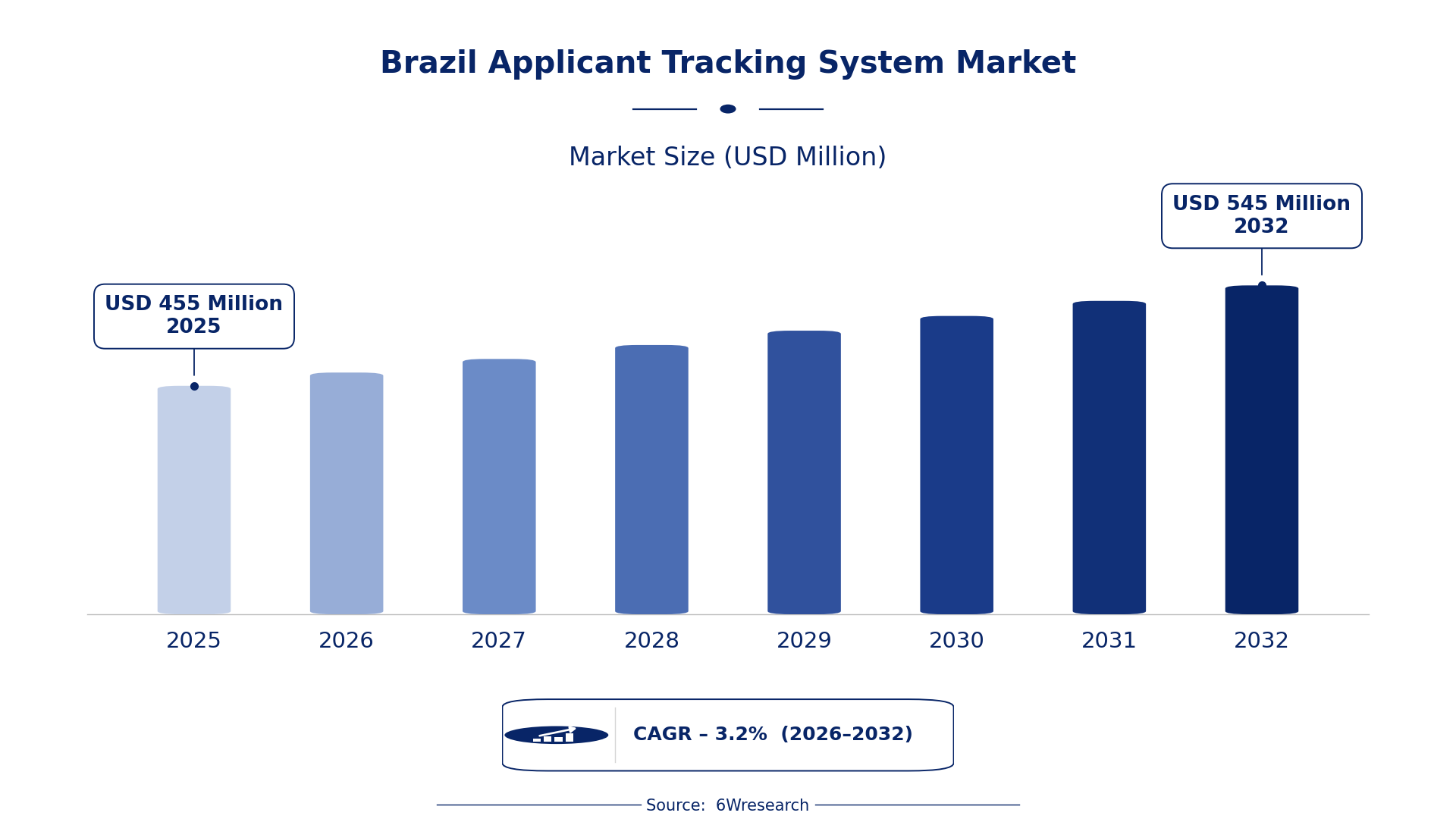
The Brazil Applicant Tracking System Market was estimated at USD 455 Million in 2025 and is projected to reach USD 545 Million by 2032, growing at a CAGR of 3.2% from 2026 to 2032.
Brazil Applicant Tracking System Market Synopsis
In Brazil, the rapid integration of AI-driven features is reshaping the Applicant Tracking System (ATS) Market. Companies increasingly prioritize automation, seeking to improve recruitment workflows and enhance candidate experiences, which underscores the urgency of optimizing hiring processes.
As competition for skilled talent heightens, businesses are turning to ATS solutions to streamline hiring. The ability to efficiently screen candidates and leverage data for informed decisions is becoming a cornerstone of effective HR strategies in the Brazilian market.
Brazil Applicant Tracking System Market Year-wise Growth Rate and Key Drivers
This graph illustrates the annual growth rates of the Brazil Applicant Tracking System Market from 2021 to 2032, highlighting a steady upward trajectory and projected expansion over the forecast period.
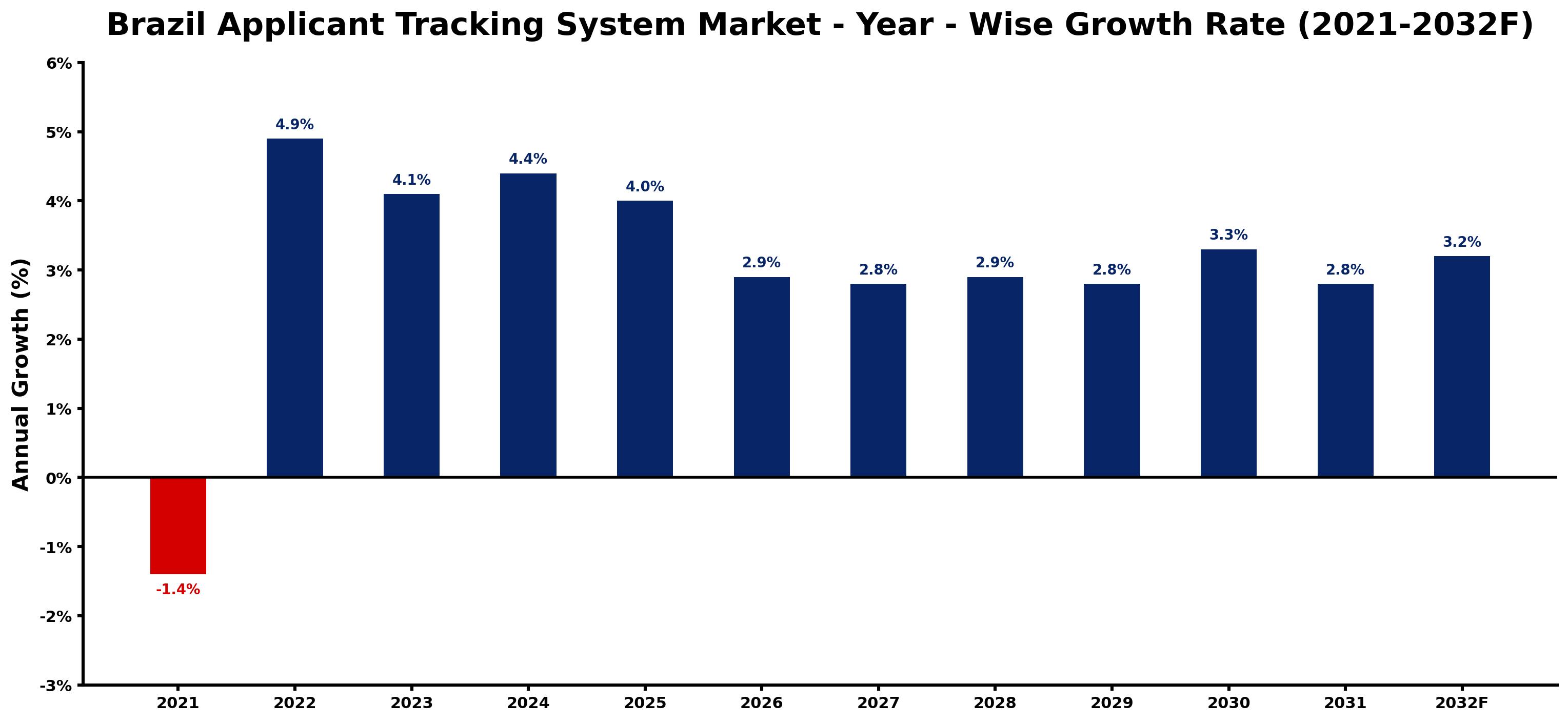
The table below presents the year‑wise growth rates along with the key drivers influencing the market
| Year | Growth Rate | Major Drivers |
| 2021 | -1.4% | Surge in local competition from homegrown ATS providers. |
| 2022 | 4.9% | Increased remote work requiring efficient recruitment solutions |
| 2023 | 4.1% | Emergence of tech startups boosting hiring competition |
| 2024 | 4.4% | Government incentives for digitizing HR processes |
| 2025 | 4.0% | Growth in mid-sized companies investing in HR technology |
| 2026 | 2.9% | Surge in labor market activity post-pandemic recovery |
| 2027 | 2.8% | Rise in demand for specialized recruitment services |
| 2028 | 2.9% | Improved internet access in rural areas facilitating hiring |
| 2029 | 2.8% | Increased focus on diversity hiring initiatives among firms |
| 2030 | 3.3% | Higher adoption of AI in recruitment workflows |
| 2031 | 2.8% | Growing interest in employer branding strategies |
| 2032 | 3.2% | Strengthened collaboration between universities and industries |
Note: Market size estimations and growth projections presented in this report are based on 6Wresearch's proprietary forecasting methodology, utilizing the latest available industry data, government publications, and primary research inputs.
Brazil Applicant Tracking System Market Key Takeaways
Below are some of the specific key takeaways from the market, including:
- AI-driven candidate screening is revolutionizing hiring efficiency.
- Companies are increasingly adopting ATS solutions to enhance talent acquisition processes.
- The market is characterized by a growing demand for automation in recruitment workflows.
- Data-driven decision-making is becoming a critical component of HR strategies.
- Challenges in system integration and compliance persist for many organizations.
Evaluation of Restraints in Brazil Applicant Tracking System Market
Despite robust growth, the Brazil Applicant Tracking System market faces several restraints. Customization remains a significant hurdle, as many ATS solutions struggle to meet the unique needs of diverse industries. Integrating these systems with existing HR platforms can also be problematic, often leading to inefficiencies. Additionally, companies must navigate local labor regulations, which can complicate compliance efforts. Resistance to change from HR teams can further impede user adoption, making it essential for vendors to address these challenges head-on.
Brazil Applicant Tracking System Market Trends
The demand for AI-enhanced ATS solutions is on the rise, as organizations seek to improve candidate screening and streamline workflows. Mobile-optimized applications are becoming standard, allowing candidates to apply through various devices, thus increasing engagement. on top of that, there's a growing emphasis on diversity and inclusion, prompting ATS providers to develop features that support unbiased hiring practices. This focus on inclusivity is reshaping how companies approach recruitment, aligning with broader societal expectations.
Brazil Applicant Tracking System Market Opportunities
The Brazil ATS market presents numerous growth opportunities, particularly for vendors that can offer highly customizable solutions tailored to specific sectors. There is a rising demand for analytics-driven insights that can enhance recruitment strategies, making advanced reporting features a valuable asset. Additionally, as remote work continues to gain traction, ATS solutions that facilitate virtual hiring processes stand to capture a larger share of the market. Exploring partnerships with educational institutions for talent pipelines also represents a strategic opportunity for growth.
Government Initiatives in the Brazil Applicant Tracking System Market
The Brazilian government is actively supporting the development of the Applicant Tracking System market by focusing on enhancing employment opportunities and workforce capabilities. Recent initiatives aimed at digital transformation in recruitment processes are crucial for aligning public sector employment strategies with private sector needs. These policies not only promote technological adoption but also aim to improve overall employment rates and workforce quality.
- A national workforce development program launched in early 2025 focuses on improving digital skills among job seekers.
- A current initiative involves updating labor regulations to facilitate the integration of technology in recruitment processes.
- Upcoming plans include a public-private partnership aimed at creating a digital job portal, expected to enhance access to ATS solutions.
- A recently completed initiative focused on streamlining compliance processes for ATS vendors, encouraging broader adoption.
- Current government training workshops are underway to educate HR professionals on using ATS technology effectively.
Future Insights of the Brazil Applicant Tracking System Market
Looking ahead to 2026-2032, the Brazil Applicant Tracking System market is expected to continue its upward trajectory. Increasing reliance on technology for recruitment will drive further innovation in ATS solutions. Companies will increasingly demand features that facilitate agile hiring processes and enhance candidate engagement. As employers place a premium on data-driven decision-making, ATS providers that can deliver actionable insights will be positioned for success. on top of that, the ongoing evolution of labor regulations will necessitate adaptable ATS systems capable of ensuring compliance while maximizing recruitment efficiency.
Brazil Applicant Tracking System Market Latest Developments
In the last 12-14 months, the Brazil Applicant Tracking System market has witnessed significant activity, with companies emphasizing technological advancements to improve recruitment processes. As organizations strive for enhanced efficiency, they are increasingly investing in ATS solutions that incorporate cutting-edge features tailored to local demands.
- A leading technology vendor launched an AI-enhanced ATS solution in Q1 2025, improving candidate matching accuracy significantly.
- Currently underway, a collaboration between multiple HR tech firms aims to develop a standardized ATS framework for small and medium enterprises.
- A planned rollout of a mobile-friendly ATS platform is expected to begin in mid-2026, addressing the growing demand for mobile recruitment solutions.
- A regional operator introduced a comprehensive training program for HR professionals on ATS implementation, starting in early 2025 and continuing through 2026.
- A major vendor recently completed a system upgrade to enhance compliance features, finalized by late 2025.
Brazil Applicant Tracking System Market - Key Attractiveness of the Report
- 10 Years of Market Numbers
- Historical Data Starting from 2022 to 2025
- Base Year: 2025
- Forecast Data until 2032
- Key Performance Indicators Impacting the Market
- Major Upcoming Developments and Projects
Key Highlights of the Report:
- Brazil Applicant Tracking System Market Outlook
- Market Size of Brazil Applicant Tracking System Market, 2025
- Forecast of Brazil Applicant Tracking System Market, 2032
- Historical Data and Forecast of Brazil Applicant Tracking System Revenues & Volume for the Period 2022-2032F
- Brazil Applicant Tracking System Market Trend Evolution
- Brazil Applicant Tracking System Market Drivers and Challenges
- Brazil Applicant Tracking System Price Trends
- Brazil Applicant Tracking System Porter's Five Forces
- Brazil Applicant Tracking System Industry Life Cycle
- Historical Data and Forecast of Brazil Applicant Tracking System Market Revenues & Volume By Component for the Period 2022-2032F
- Historical Data and Forecast of Brazil Applicant Tracking System Market Revenues & Volume By Software for the Period 2022-2032F
- Historical Data and Forecast of Brazil Applicant Tracking System Market Revenues & Volume By Services for the Period 2022-2032F
- Historical Data and Forecast of Brazil Applicant Tracking System Market Revenues & Volume By Organization Size for the Period 2022-2032F
- Historical Data and Forecast of Brazil Applicant Tracking System Market Revenues & Volume By SMEs for the Period 2022-2032F
- Historical Data and Forecast of Brazil Applicant Tracking System Market Revenues & Volume By Large Enterprises for the Period 2022-2032F
- Historical Data and Forecast of Brazil Applicant Tracking System Market Revenues & Volume By Deployment Mode for the Period 2022-2032F
- Historical Data and Forecast of Brazil Applicant Tracking System Market Revenues & Volume By On-Premises for the Period 2022-2032F
- Historical Data and Forecast of Brazil Applicant Tracking System Market Revenues & Volume By Cloud for the Period 2022-2032F
- Historical Data and Forecast of Brazil Applicant Tracking System Market Revenues & Volume By Vertical for the Period 2022-2032F
- Historical Data and Forecast of Brazil Applicant Tracking System Market Revenues & Volume By BFSI for the Period 2022-2032F
- Historical Data and Forecast of Brazil Applicant Tracking System Market Revenues & Volume By Government for the Period 2022-2032F
- Historical Data and Forecast of Brazil Applicant Tracking System Market Revenues & Volume By Manufacturing for the Period 2022-2032F
- Historical Data and Forecast of Brazil Applicant Tracking System Market Revenues & Volume By Telecom and IT for the Period 2022-2032F
- Historical Data and Forecast of Brazil Applicant Tracking System Market Revenues & Volume By Consumer Goods and Retail for the Period 2022-2032F
- Historical Data and Forecast of Brazil Applicant Tracking System Market Revenues & Volume By Healthcare and Lifesciencs for the Period 2022-2032F
- Historical Data and Forecast of Brazil Applicant Tracking System Market Revenues & Volume By Energy and Utilities for the Period 2022-2032F
- Historical Data and Forecast of Brazil Applicant Tracking System Market Revenues & Volume By Transportation and Logistics for the Period 2022-2032F
- Brazil Applicant Tracking System Import Export Trade Statistics
- Market Opportunity Assessment By Component
- Market Opportunity Assessment By Organization Size
- Market Opportunity Assessment By Deployment Mode
- Market Opportunity Assessment By Vertical
- Brazil Applicant Tracking System Top Companies Market Share
- Brazil Applicant Tracking System Competitive Benchmarking By Technical and Operational Parameters
- Brazil Applicant Tracking System Company Profiles
- Brazil Applicant Tracking System Key Strategic Recommendations






































