Brazil Artificial Organs Market Size, Share & Growth Rate
The Brazil Artificial Organs Market was estimated at USD 174 Million in 2025 and is projected to reach USD 209 Million by 2032, growing at a CAGR of 2.7% from 2026 to 2032. This growth trajectory is primarily driven by the aging population and the increasing incidence of organ failure, which necessitate viable alternatives to traditional transplant methods. Additionally, advancements in medical technology and government support for healthcare infrastructure play pivotal roles in expanding market opportunities.
Brazil Artificial Organs Market Year-wise Growth Rate and Key Drivers
This graph highlights how the Brazil Artificial Organs Market has steadily grown over the years, supported by major growth factors.
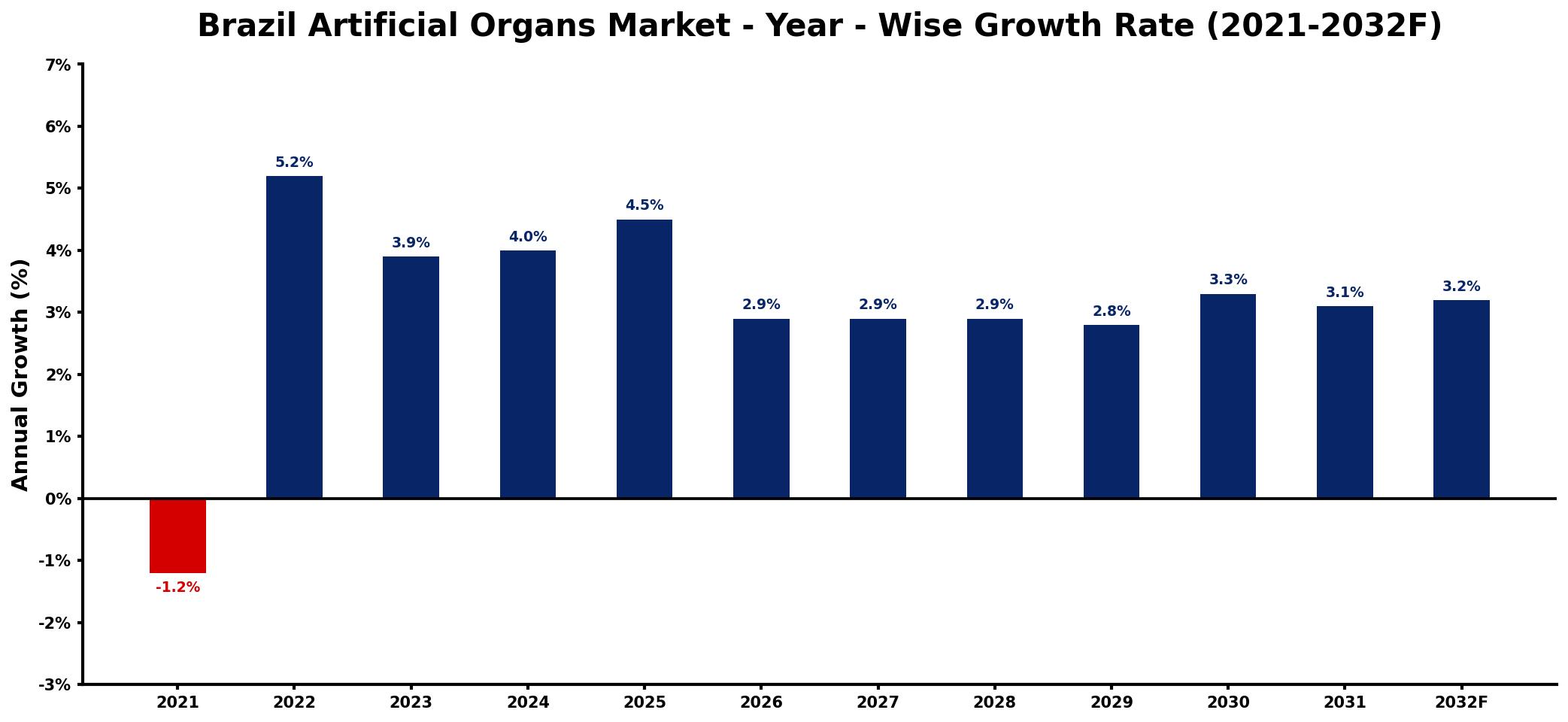
The table below presents the year‑wise growth rates along with the key drivers influencing the market
| Year | Growth Rate | Major Drivers |
| 2021 | -1.2% | decrease in healthcare investments |
| 2022 | 5.2% | rise in transplant technology adoption |
| 2023 | 3.9% | expansion of healthcare infrastructure |
| 2024 | 4.0% | increased demand for innovative solutions |
| 2025 | 4.5% | growth in patient population needs |
| 2026 | 2.9% | surge in research funding allocations |
| 2027 | 2.9% | enhanced regulatory approval processes |
| 2028 | 2.9% | growing commercial sector adoption |
| 2029 | 2.8% | advancements in medical technology integration |
| 2030 | 3.3% | increased public health awareness campaigns |
| 2031 | 3.1% | improved processing technologies adoption |
| 2032 | 3.2% | growing focus on personalized medicine |
Note: Market size estimations and growth projections presented in this report are based on 6Wresearch's proprietary forecasting methodology, utilizing the latest available industry data, government publications, and primary research inputs.
Brazil Artificial Organs Market Synopsis
In recent years, the Brazil Artificial Organs market has gained momentum, fueled by technological breakthroughs and an urgent need for organ replacements. However, as the market evolves, challenges such as ethical concerns and regulatory compliance loom large, affecting long-term growth prospects.
Looking ahead, the market is likely to experience both competition and collaboration among stakeholders. Companies will need to align their strategies with patient safety standards and regulatory requirements to secure their positions in this dynamic landscape.
Brazil Artificial Organs Market Key Takeaways
- The market is increasingly characterized by technological innovations in biomaterials and tissue engineering.
- Government policies are crucial for fostering research and development in artificial organ technologies.
- The demand for artificial organs is anticipated to rise sharply due to the aging demographic and growing organ failure rates.
- Ethical considerations and regulatory hurdles remain significant factors influencing market growth.
- Collaboration between healthcare providers and technology firms is essential for advancing artificial organ applications.
Evaluation of Restraints in Brazil Artificial Organs Market
Despite the promising outlook, the Brazil Artificial Organs market is confronted with considerable restraints. High development costs and lengthy regulatory approval processes can hinder the pace at which innovations are brought to market. Furthermore, public skepticism about the safety and efficacy of artificial organs presents another barrier to widespread acceptance. Companies must navigate these complexities while ensuring adherence to stringent safety regulations, requiring both time and resources.
Brazil Artificial Organs Market Trends
Key trends shaping the Brazil Artificial Organs market include the shift towards minimally invasive surgical techniques and personalized medicine. The integration of artificial intelligence in diagnostics and treatment planning is also emerging, making it possible to tailor organ substitutes to individual patient needs. These advancements are likely to enhance patient outcomes and contribute to the overall growth of the market.
Brazil Artificial Organs Market Opportunities
The market is poised for significant growth opportunities, particularly in the realm of regenerative medicine and advanced tissue engineering. As research continues to push the boundaries of what artificial organs can achieve, investment in these areas could yield lucrative returns. Additionally, partnerships between academic institutions and private enterprises may spur innovation, making artificial organs more accessible to Brazilian patients.
Government Initiatives in the Brazil Artificial Organs Market
Brazilian government initiatives aimed at improving healthcare access and standards directly impact the artificial organs market. Programs focused on healthcare infrastructure development and funding for medical research encourage investment in artificial organ technologies. Regulatory frameworks are evolving, reflecting a commitment to not only improving patient outcomes but also ensuring that ethical guidelines are respected throughout the industry.
Future Insights of the Brazil Artificial Organs Market
The future of the Brazil Artificial Organs market between 2026 and 2032 looks promising, with sustained growth expected as technological innovations continue to unfold. As demographic shifts lead to an increase in chronic diseases, the urgency for effective artificial organ solutions will only intensify. Stakeholders must remain agile, adapting to evolving regulatory landscapes while prioritizing patient-centric approaches to capitalize on emerging opportunities.
Brazil Artificial Organs Market Latest Developments (2025 - 2026)
Recently, the Brazil Artificial Organs market has witnessed significant advancements in the development of biocompatible materials, which are essential for enhancing the longevity and functionality of artificial organs. Additionally, collaborations between research institutions and healthcare providers have intensified, leading to innovative product designs aimed at improving patient outcomes. Regulatory agencies are also working to streamline approval processes, facilitating quicker access to new technologies.
Brazil Artificial Organs Market - Key Attractiveness of the Report
- 10 Years of Market Numbers
- Historical Data Starting from 2022 to 2025
- Base Year: 2025
- Forecast Data until 2032
- Key Performance Indicators Impacting the Market
- Major Upcoming Developments and Projects
Key Highlights of the Report:
- Brazil Artificial Organs Market Outlook
- Market Size of Brazil Artificial Organs Market, 2025
- Forecast of Brazil Artificial Organs Market, 2032
- Historical Data and Forecast of Brazil Artificial Organs Revenues & Volume for the Period 2022-2032F
- Brazil Artificial Organs Market Trend Evolution
- Brazil Artificial Organs Market Drivers and Challenges
- Brazil Artificial Organs Price Trends
- Brazil Artificial Organs Porter's Five Forces
- Brazil Artificial Organs Industry Life Cycle
- Historical Data and Forecast of Brazil Artificial Organs Market Revenues & Volume By Product Type for the Period 2022-2032F
- Historical Data and Forecast of Brazil Artificial Organs Market Revenues & Volume By Artificial Kidney for the Period 2022-2032F
- Historical Data and Forecast of Brazil Artificial Organs Market Revenues & Volume By Artificial Heart for the Period 2022-2032F
- Historical Data and Forecast of Brazil Artificial Organs Market Revenues & Volume By Artificial Pancreas for the Period 2022-2032F
- Historical Data and Forecast of Brazil Artificial Organs Market Revenues & Volume By Cochlear Implants for the Period 2022-2032F
- Historical Data and Forecast of Brazil Artificial Organs Market Revenues & Volume By Others for the Period 2022-2032F
- Brazil Artificial Organs Import Export Trade Statistics
- Market Opportunity Assessment By Product Type
- Brazil Artificial Organs Top Companies Market Share
- Brazil Artificial Organs Competitive Benchmarking By Technical and Operational Parameters
- Brazil Artificial Organs Company Profiles
- Brazil Artificial Organs Key Strategic Recommendations






































