Brazil Cloud POS Market Size & Growth Rate (2026-2032)
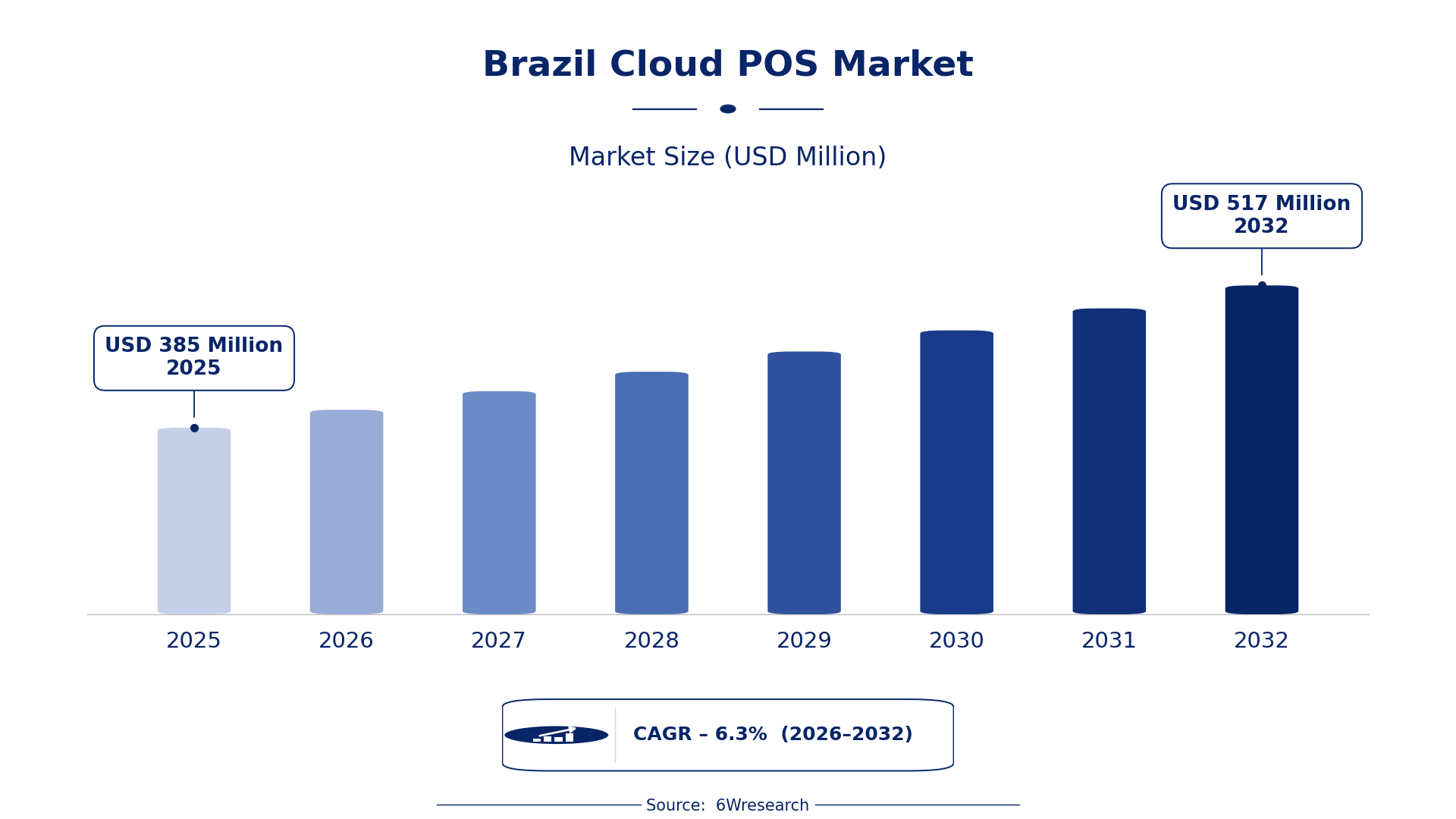
The Brazil Cloud POS Market was estimated at USD 385 Million in 2025 and is projected to reach USD 517 Million by 2032, growing at a CAGR of 6.3% from 2026 to 2032.
Brazil Cloud POS Market Synopsis
Brazil's retail sector is undergoing a transformation, with many businesses shifting from traditional point-of-sale systems to cloud-based solutions. This transition is fueled by the demand for integrated systems that enhance efficiency and customer engagement.
As consumer behavior evolves, retailers are increasingly adopting cloud POS systems that offer real-time analytics and mobility. This trend reflects a broader movement towards omnichannel strategies, enabling businesses to meet customers' needs across various platforms.
Brazil Cloud POS Market Year-wise Growth Rate and Key Drivers
This graph illustrates the annual growth rates of the Brazil Cloud POS Market from 2021 to 2032, highlighting a steady upward trajectory and projected expansion over the forecast period.
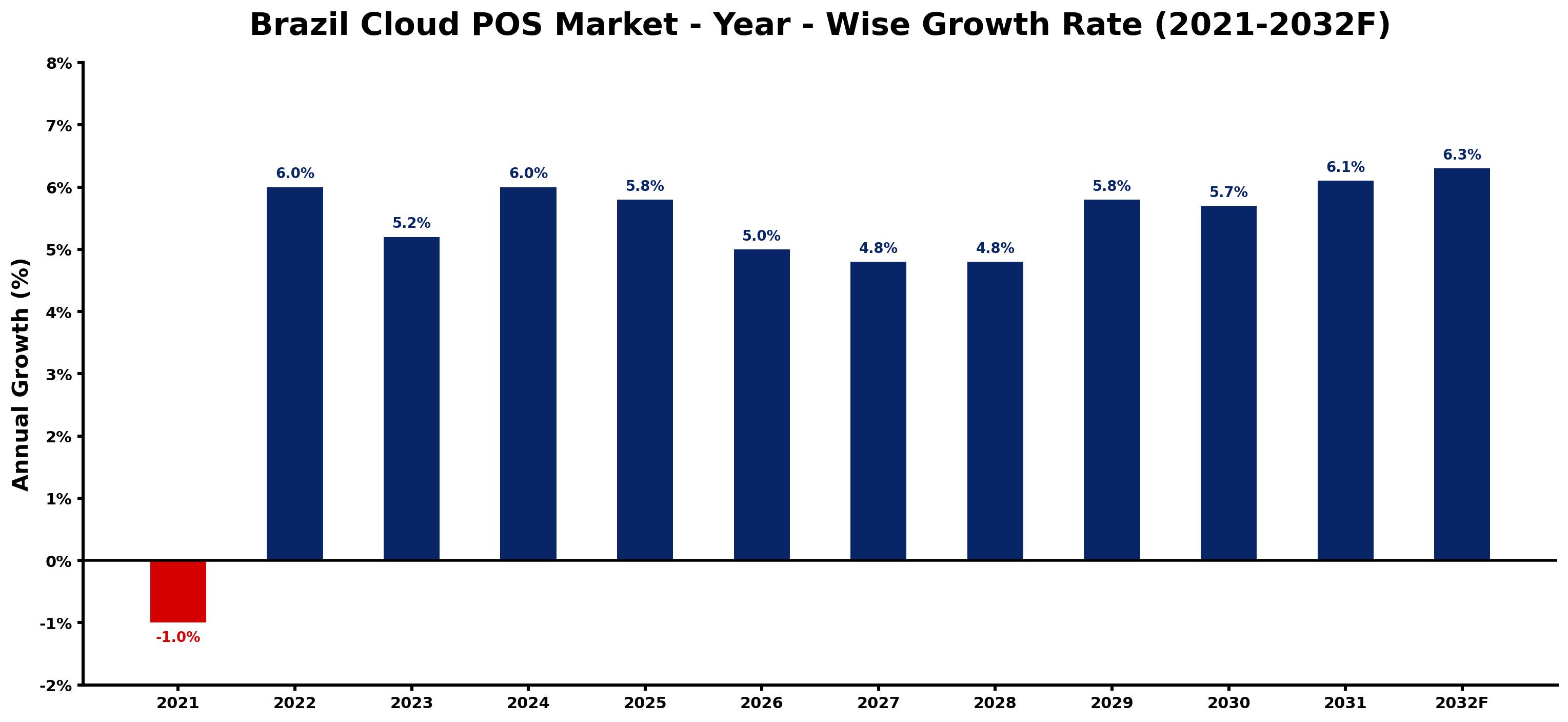
The table below presents the year‑wise growth rates along with the key drivers influencing the market
| Year | Growth Rate | Major Drivers |
| 2021 | -1.0% | High taxation on digital transactions by Receita Federal |
| 2022 | 6.0% | Increased adoption of e-commerce among Brazilian retailers. |
| 2023 | 5.2% | Advent of new digital payment regulations boosting POS solutions. |
| 2024 | 6.0% | Surge in mobile payment apps driving cloud POS usage. |
| 2025 | 5.8% | Local startups enhancing cloud service offerings for retailers. |
| 2026 | 5.0% | Rise of Brazilian SMEs investing in tech innovations. |
| 2027 | 4.8% | Growth in digital wallets influencing cloud POS demand. |
| 2028 | 4.8% | Implementation of tax incentives for cashless transactions. |
| 2029 | 5.8% | Enhanced internet connectivity enabling cloud-based services expansion. |
| 2030 | 5.7% | Increasing preference for integrated inventory management solutions. |
| 2031 | 6.1% | Government initiative promoting financial literacy and digital payments. |
| 2032 | 6.3% | Launch of nationwide campaigns for cloud POS awareness. |
Note: Market size estimations and growth projections presented in this report are based on 6Wresearch's proprietary forecasting methodology, utilizing the latest available industry data, government publications, and primary research inputs.
Brazil Cloud POS Market Key Takeaways
Below are some of the specific key takeaways from the market, including:
- Retail and hospitality sectors are leading adopters of cloud POS systems.
- Real-time analytics and mobility are key drivers for market growth.
- Integration with e-commerce platforms is becoming essential.
- Government policies are fostering an environment conducive to digital commerce.
- Emerging technologies such as AI are enhancing cloud POS functionalities.
Evaluation of Restraints in Brazil Cloud POS Market
Despite the promising growth, several restraints hinder the full potential of the Brazil Cloud POS market. One significant issue is the challenge of integrating legacy systems with new cloud solutions, which can lead to operational inefficiencies. Additionally, concerns surrounding data security and compliance with evolving regulations create barriers for businesses hesitant to transition to cloud-based systems. These factors necessitate ongoing efforts from providers to build trust and demonstrate the reliability of their solutions.
Brazil Cloud POS Market Trends
Several trends are shaping the Brazil Cloud POS market. A notable shift towards contactless payments is gaining traction, driven by consumer preference for convenience and safety. Businesses are also prioritizing customer relationship management features within cloud POS systems, aiming to personalize shopping experiences. on top of that, the integration of artificial intelligence is becoming increasingly relevant, allowing businesses to glean insights from data and optimize their operations.
Brazil Cloud POS Market Opportunities
The Brazil Cloud POS market presents various opportunities for growth and investment. Companies that can develop solutions tailored to small and medium-sized enterprises (SMEs) stand to benefit significantly, as this segment is increasingly seeking cost-effective and flexible options. on top of that, the rise of e-commerce and online sales channels creates a pressing need for integrated cloud POS solutions that can manage both in-store and online transactions seamlessly.
Government Initiatives in the Brazil Cloud POS Market
Government policies are actively shaping the Brazil Cloud POS market by promoting digital commerce and enhancing the retail industry's infrastructure. The regulatory framework aims to support digital payment systems while safeguarding consumer data, creating a favorable environment for cloud POS adoption.
- A recently completed initiative aimed to streamline digital payment regulations, enhancing consumer trust in online transactions.
- Current ongoing efforts focus on improving e-commerce infrastructure, making it easier for businesses to adopt cloud solutions.
- A planned public-private partnership is expected to invest in digital literacy programs, helping businesses transition to cloud technologies by 2027.
- New consumer data protection laws are being introduced, ensuring compliance as businesses adopt cloud POS systems.
- Policies encouraging technological innovation in retail are being developed to boost the digital economy.
Future Insights of the Brazil Cloud POS Market
Looking ahead to 2026-2032, the Brazil Cloud POS market is expected to evolve rapidly, driven by technological advancements and shifting consumer preferences. The integration of AI and machine learning into POS systems will likely offer enhanced functionalities, improving operational efficiency for businesses. Additionally, the continued emphasis on omnichannel retailing will encourage more companies to adopt cloud solutions that can seamlessly connect various sales channels.
Brazil Cloud POS Market Latest Developments
In the past year, the Brazil Cloud POS market has experienced notable activity, with businesses increasingly recognizing the value of transitioning to cloud solutions. This trend has sparked various developments aimed at enhancing service offerings and operational capabilities.
- A major technology vendor launched a comprehensive cloud POS solution in early 2025, focusing on integration with popular e-commerce platforms.
- An initiative that began in mid-2025 aims to upgrade existing POS systems across several retail chains, enhancing their capabilities with cloud functionalities.
- A rollout expected to begin in the second half of 2026 will introduce AI-driven analytics features across various cloud POS platforms.
- A partnership between regional providers was established to develop a suite of mobile POS solutions, with initial tests set to commence by late 2025.
- A service upgrade was completed in early 2025, enabling existing cloud POS users to access enhanced reporting and customer management tools.
Brazil Cloud POS Market - Key Attractiveness of the Report
- 10 Years of Market Numbers
- Historical Data Starting from 2022 to 2025
- Base Year: 2025
- Forecast Data until 2032
- Key Performance Indicators Impacting the Market
- Major Upcoming Developments and Projects
Key Highlights of the Report:
- Brazil Cloud POS Market Outlook
- Market Size of Brazil Cloud POS Market, 2025
- Forecast of Brazil Cloud POS Market, 2032
- Historical Data and Forecast of Brazil Cloud POS Revenues & Volume for the Period 2022-2032F
- Brazil Cloud POS Market Trend Evolution
- Brazil Cloud POS Market Drivers and Challenges
- Brazil Cloud POS Price Trends
- Brazil Cloud POS Porter's Five Forces
- Brazil Cloud POS Industry Life Cycle
- Historical Data and Forecast of Brazil Cloud POS Market Revenues & Volume By Application Areas for the Period 2022-2032F
- Historical Data and Forecast of Brazil Cloud POS Market Revenues & Volume By Retail and Consumer Goods for the Period 2022-2032F
- Historical Data and Forecast of Brazil Cloud POS Market Revenues & Volume By Travel and Hospitality for the Period 2022-2032F
- Historical Data and Forecast of Brazil Cloud POS Market Revenues & Volume By Media and Entertainment for the Period 2022-2032F
- Historical Data and Forecast of Brazil Cloud POS Market Revenues & Volume By Transport and Logistics for the Period 2022-2032F
- Historical Data and Forecast of Brazil Cloud POS Market Revenues & Volume By Healthcare for the Period 2022-2032F
- Historical Data and Forecast of Brazil Cloud POS Market Revenues & Volume By Component for the Period 2022-2032F
- Historical Data and Forecast of Brazil Cloud POS Market Revenues & Volume By Solution for the Period 2022-2032F
- Historical Data and Forecast of Brazil Cloud POS Market Revenues & Volume By Services for the Period 2022-2032F
- Historical Data and Forecast of Brazil Cloud POS Market Revenues & Volume By Service for the Period 2022-2032F
- Historical Data and Forecast of Brazil Cloud POS Market Revenues & Volume By Training, Consulting, and Integration for the Period 2022-2032F
- Historical Data and Forecast of Brazil Cloud POS Market Revenues & Volume By Support and Maintenance for the Period 2022-2032F
- Historical Data and Forecast of Brazil Cloud POS Market Revenues & Volume By Organization Size for the Period 2022-2032F
- Historical Data and Forecast of Brazil Cloud POS Market Revenues & Volume By SMEs for the Period 2022-2032F
- Historical Data and Forecast of Brazil Cloud POS Market Revenues & Volume By Large Enterprises for the Period 2022-2032F
- Brazil Cloud POS Import Export Trade Statistics
- Market Opportunity Assessment By Application Areas
- Market Opportunity Assessment By Component
- Market Opportunity Assessment By Service
- Market Opportunity Assessment By Organization Size
- Brazil Cloud POS Top Companies Market Share
- Brazil Cloud POS Competitive Benchmarking By Technical and Operational Parameters
- Brazil Cloud POS Company Profiles
- Brazil Cloud POS Key Strategic Recommendations






































