Mexico Cloud POS Market Size & Growth Rate (2026-2032)
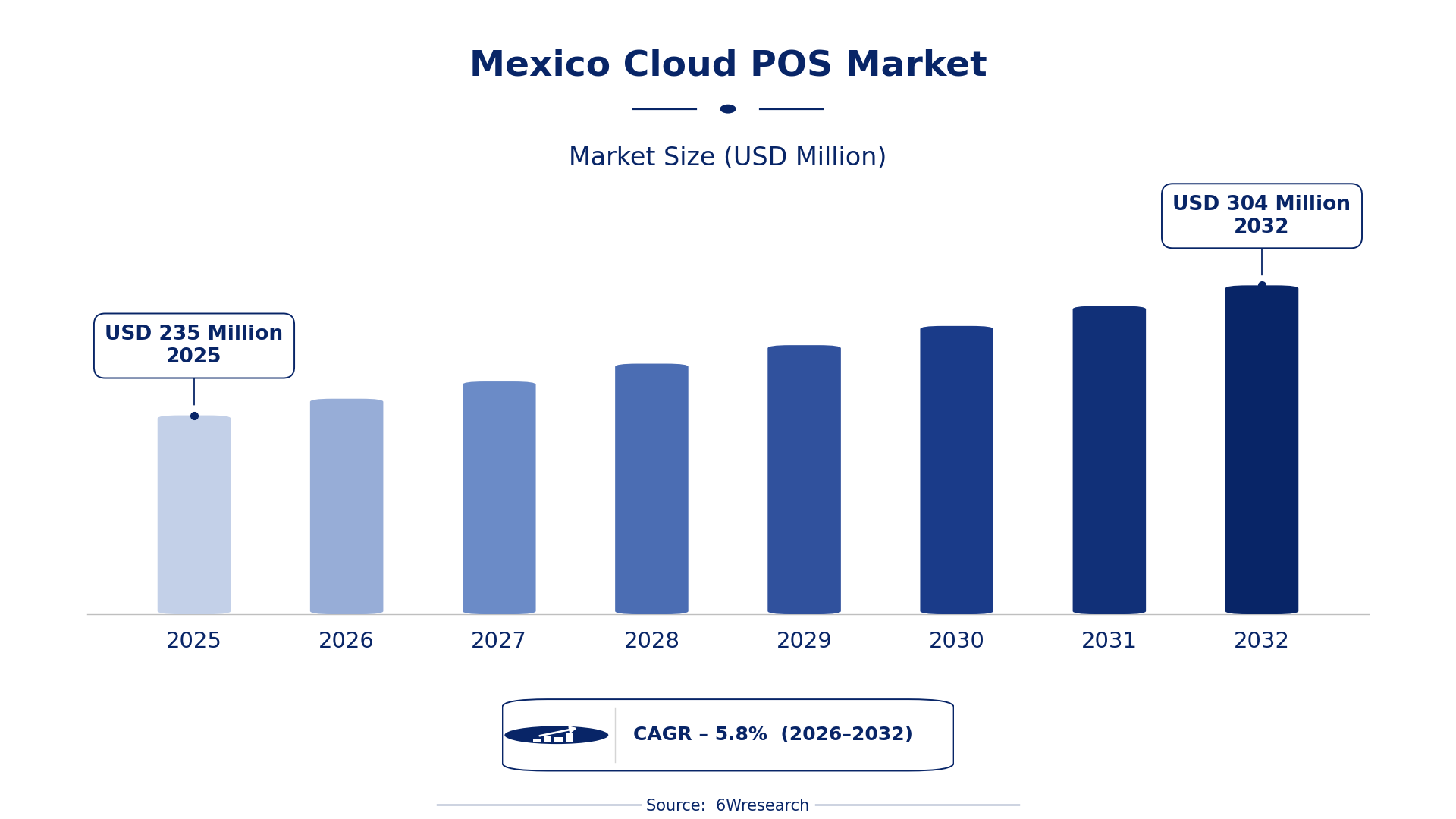
The Mexico Cloud POS Market was estimated at USD 235 Million in 2025 and is projected to reach USD 304 Million by 2032, growing at a CAGR of 5.8% from 2026 to 2032.
Mexico Cloud POS Market Synopsis
The demand for cloud point-of-sale (POS) systems in Mexico is witnessing a surge, particularly within the retail and hospitality sectors. Businesses are increasingly recognizing the advantages of cloud-based solutions, which facilitate transaction processing, inventory management, and sales analysis from any internet-connected device. This shift is not merely a trend but a critical move towards operational efficiency.
As retailers and hospitality providers modernize, they prioritize flexibility and scalability. This market's growth is largely attributed to the integration of omnichannel strategies that enhance customer experiences. The ability to access real-time analytics and mobility features has become essential, driving the adoption of cloud POS systems across various business types.
Mexico Cloud POS Market Year-wise Growth Rate and Key Drivers
This graph illustrates the annual growth rates of the Mexico Cloud POS Market from 2021 to 2032, highlighting a steady upward trajectory and projected expansion over the forecast period.
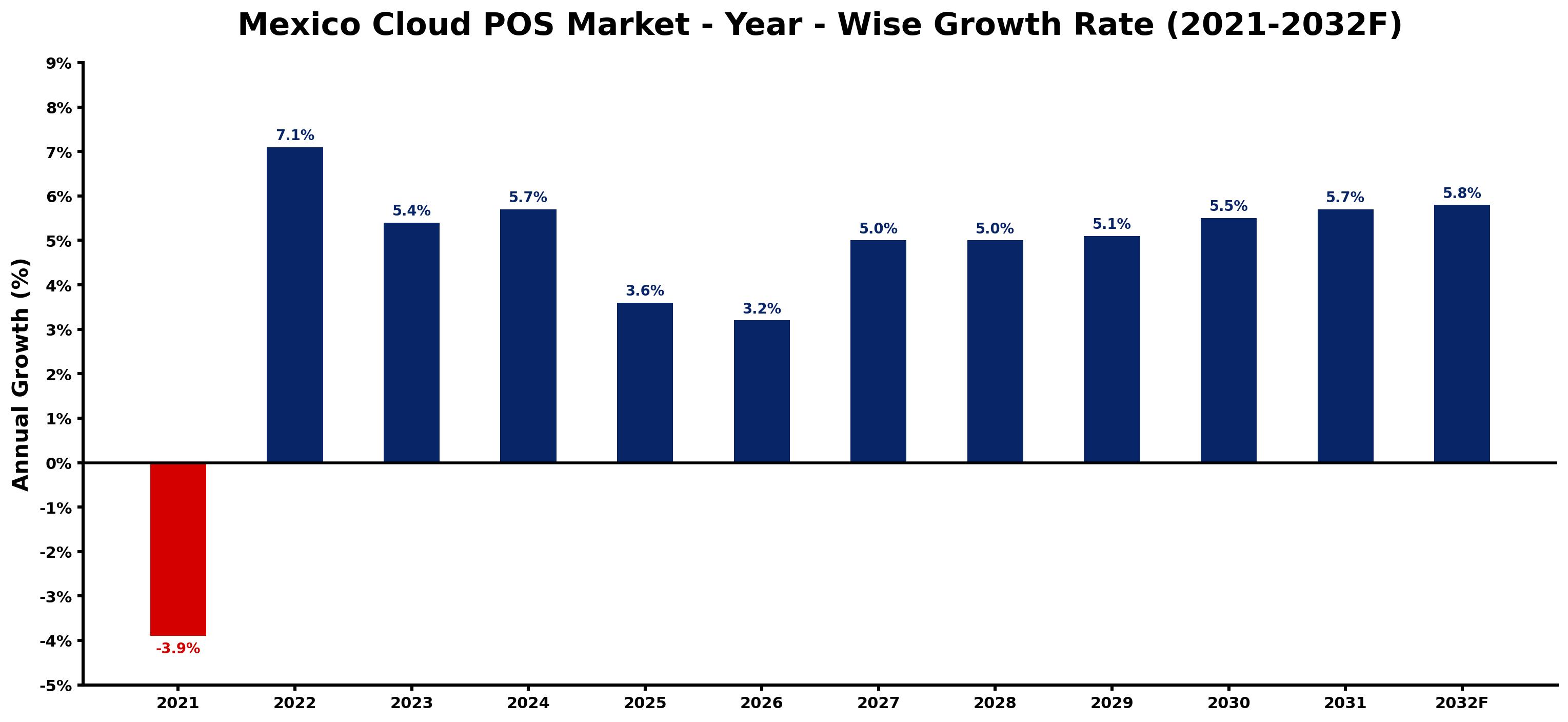
The table below presents the year‑wise growth rates along with the key drivers influencing the market
| Year | Growth Rate | Major Drivers |
| 2021 | -3.9% | Supply chain bottlenecks from US-Mexico trade tensions |
| 2022 | 7.1% | Government supports digital payment transformation initiatives. |
| 2023 | 5.4% | Increased smartphone penetration fuels cloud technology adoption. |
| 2024 | 5.7% | Retail sector modernization drives demand for agile payment solutions. |
| 2025 | 3.6% | Rising e-commerce activities enhance cloud POS necessity. |
| 2026 | 3.2% | Consumer preference shifts towards contactless payment methods. |
| 2027 | 5.0% | Local startups innovate tailored cloud POS solutions. |
| 2028 | 5.0% | Small business digitalization driven by government incentives. |
| 2029 | 5.1% | Improved internet connectivity supports cloud solutions deployment. |
| 2030 | 5.5% | Growing fintech ecosystem motivates cloud POS integrations. |
| 2031 | 5.7% | Higher consumer spending bolsters retail cloud service adoption. |
| 2032 | 5.8% | Strengthened regulations on digital transactions enhance compliance needs. |
Note: Market size estimations and growth projections presented in this report are based on 6Wresearch's proprietary forecasting methodology, utilizing the latest available industry data, government publications, and primary research inputs.
Mexico Cloud POS Market Key Takeaways
Below are some of the specific key takeaways from the market, including:
- The retail sector is the primary driver for cloud POS adoption, reflecting a shift towards integrated, digital solutions.
- Hospitality businesses are increasingly leveraging cloud POS systems to streamline service and improve customer satisfaction.
- Security and connectivity challenges remain significant barriers to widespread adoption of cloud-based systems.
- Government regulations are evolving to enhance the reliability and security of cloud POS transactions.
- Training and support for staff transitioning to cloud systems are critical for successful implementation.
Evaluation of Restraints in Mexico Cloud POS Market
Connectivity issues present a formidable challenge for the Mexico Cloud POS market. Many regions still grapple with unreliable internet access, which can severely disrupt operations for businesses relying on cloud technology. on top of that, as these systems handle sensitive payment information, they become attractive targets for cybercriminals, necessitating stringent security measures. User adoption is another hurdle, as businesses transitioning from traditional POS systems often require extensive training and support to ensure their staff can effectively utilize new technologies. Addressing these restraints is vital for the market to reach its full potential.
Mexico Cloud POS Market Trends
The trend towards omnichannel retailing is reshaping the demand for cloud POS systems in Mexico. Businesses are increasingly looking for solutions that integrate online and offline transactions, enabling a smoother customer experience. Additionally, the rise of mobile payment options is prompting cloud POS providers to enhance their platforms with features that support mobile transactions. Environmental sustainability is also gaining traction, with companies seeking energy-efficient solutions that minimize their carbon footprint.
Mexico Cloud POS Market Opportunities
Investment opportunities in the Mexico Cloud POS market are abundant, particularly as businesses continue to digitize their operations. The growing emphasis on customer experience opens avenues for cloud POS providers to innovate and offer tailored solutions. on top of that, as more businesses recognize the need for robust security measures, there is an opportunity for companies specializing in cybersecurity to collaborate with cloud POS providers. The anticipated growth of e-commerce in Mexico also presents a fertile ground for expanding cloud POS functionalities.
Government Initiatives in the Mexico Cloud POS Market
Government policies are significantly influencing the cloud POS market in Mexico, focusing on enhancing transaction efficiency, security, and reliability. These regulations are crucial for safeguarding consumer data and ensuring compliance among businesses operating in the retail and hospitality sectors. As the government pushes for digital transformation, adherence to these policies will be essential for market players aiming to thrive in this evolving environment.
- A regulatory framework introduced in early 2025 mandating enhanced data encryption for cloud POS systems.
- A national digital infrastructure upgrade program currently underway aims to improve internet connectivity in underserved areas.
- Recent policy initiatives emphasize transparency in payment processing, with compliance checks becoming more stringent.
- Ongoing training programs for businesses to comply with new cloud POS regulations and enhance operational efficiencies.
- A planned public-private initiative expected to launch by 2027, targeting the expansion of secure payment processing technologies.
Future Insights of the Mexico Cloud POS Market
Looking ahead, the Mexico Cloud POS market is set to experience transformative growth driven by technological advancements and changing consumer behaviors. As businesses increasingly adopt digital solutions, the integration of artificial intelligence and machine learning into POS systems will become more common, enabling deeper insights into customer preferences and purchasing patterns. The focus on security will also intensify, with ongoing developments in cybersecurity measures becoming a priority for providers. By 2032, we expect to see a more interconnected ecosystem where cloud POS solutions play a central role in the retail and hospitality sectors.
Mexico Cloud POS Market Latest Developments
In the past year, the Mexico Cloud POS market has witnessed a flurry of activity, reflecting its dynamic nature. Companies are increasingly investing in technology enhancements and partnerships to stay competitive. The focus on security and user experience is evident, with many providers rolling out updates and new features to address emerging customer needs.
- A major technology vendor launched an enhanced cloud POS solution in early 2025, featuring advanced analytics and improved user interface capabilities.
- Ongoing collaborations between cloud POS providers and cybersecurity firms aim to bolster security measures across platforms.
- A leading regional operator is currently expanding its cloud POS service offerings to include mobile payment solutions, enhancing customer convenience.
- By mid-2026, a new initiative focused on integrating artificial intelligence into cloud POS systems is expected to commence.
- A pilot program for improved internet connectivity in rural areas launched in late 2025 to support cloud POS adoption in underserved regions.
Mexico Cloud POS Market - Key Attractiveness of the Report
- 10 Years of Market Numbers
- Historical Data Starting from 2022 to 2025
- Base Year: 2025
- Forecast Data until 2032
- Key Performance Indicators Impacting the Market
- Major Upcoming Developments and Projects
Key Highlights of the Report:
- Mexico Cloud POS Market Outlook
- Market Size of Mexico Cloud POS Market, 2025
- Forecast of Mexico Cloud POS Market, 2032
- Historical Data and Forecast of Mexico Cloud POS Revenues & Volume for the Period 2022-2032F
- Mexico Cloud POS Market Trend Evolution
- Mexico Cloud POS Market Drivers and Challenges
- Mexico Cloud POS Price Trends
- Mexico Cloud POS Porter's Five Forces
- Mexico Cloud POS Industry Life Cycle
- Historical Data and Forecast of Mexico Cloud POS Market Revenues & Volume By Application Areas for the Period 2022-2032F
- Historical Data and Forecast of Mexico Cloud POS Market Revenues & Volume By Retail and Consumer Goods for the Period 2022-2032F
- Historical Data and Forecast of Mexico Cloud POS Market Revenues & Volume By Travel and Hospitality for the Period 2022-2032F
- Historical Data and Forecast of Mexico Cloud POS Market Revenues & Volume By Media and Entertainment for the Period 2022-2032F
- Historical Data and Forecast of Mexico Cloud POS Market Revenues & Volume By Transport and Logistics for the Period 2022-2032F
- Historical Data and Forecast of Mexico Cloud POS Market Revenues & Volume By Healthcare for the Period 2022-2032F
- Historical Data and Forecast of Mexico Cloud POS Market Revenues & Volume By Component for the Period 2022-2032F
- Historical Data and Forecast of Mexico Cloud POS Market Revenues & Volume By Solution for the Period 2022-2032F
- Historical Data and Forecast of Mexico Cloud POS Market Revenues & Volume By Services for the Period 2022-2032F
- Historical Data and Forecast of Mexico Cloud POS Market Revenues & Volume By Service for the Period 2022-2032F
- Historical Data and Forecast of Mexico Cloud POS Market Revenues & Volume By Training, Consulting, and Integration for the Period 2022-2032F
- Historical Data and Forecast of Mexico Cloud POS Market Revenues & Volume By Support and Maintenance for the Period 2022-2032F
- Historical Data and Forecast of Mexico Cloud POS Market Revenues & Volume By Organization Size for the Period 2022-2032F
- Historical Data and Forecast of Mexico Cloud POS Market Revenues & Volume By SMEs for the Period 2022-2032F
- Historical Data and Forecast of Mexico Cloud POS Market Revenues & Volume By Large Enterprises for the Period 2022-2032F
- Mexico Cloud POS Import Export Trade Statistics
- Market Opportunity Assessment By Application Areas
- Market Opportunity Assessment By Component
- Market Opportunity Assessment By Service
- Market Opportunity Assessment By Organization Size
- Mexico Cloud POS Top Companies Market Share
- Mexico Cloud POS Competitive Benchmarking By Technical and Operational Parameters
- Mexico Cloud POS Company Profiles
- Mexico Cloud POS Key Strategic Recommendations






































