Brazil Conveyors System Market Summary
The brazil conveyors system market was estimated at USD 236 Million in 2025 and is projected to reach USD 281 Million by 2032, growing at a CAGR of 2.8% from 2026 to 2032.
Brazil Conveyors System Market Year-wise Growth Rate and Key Drivers
This graph highlights how the Brazil Conveyors System Market has steadily grown over the past five years, supported by major growth factors.
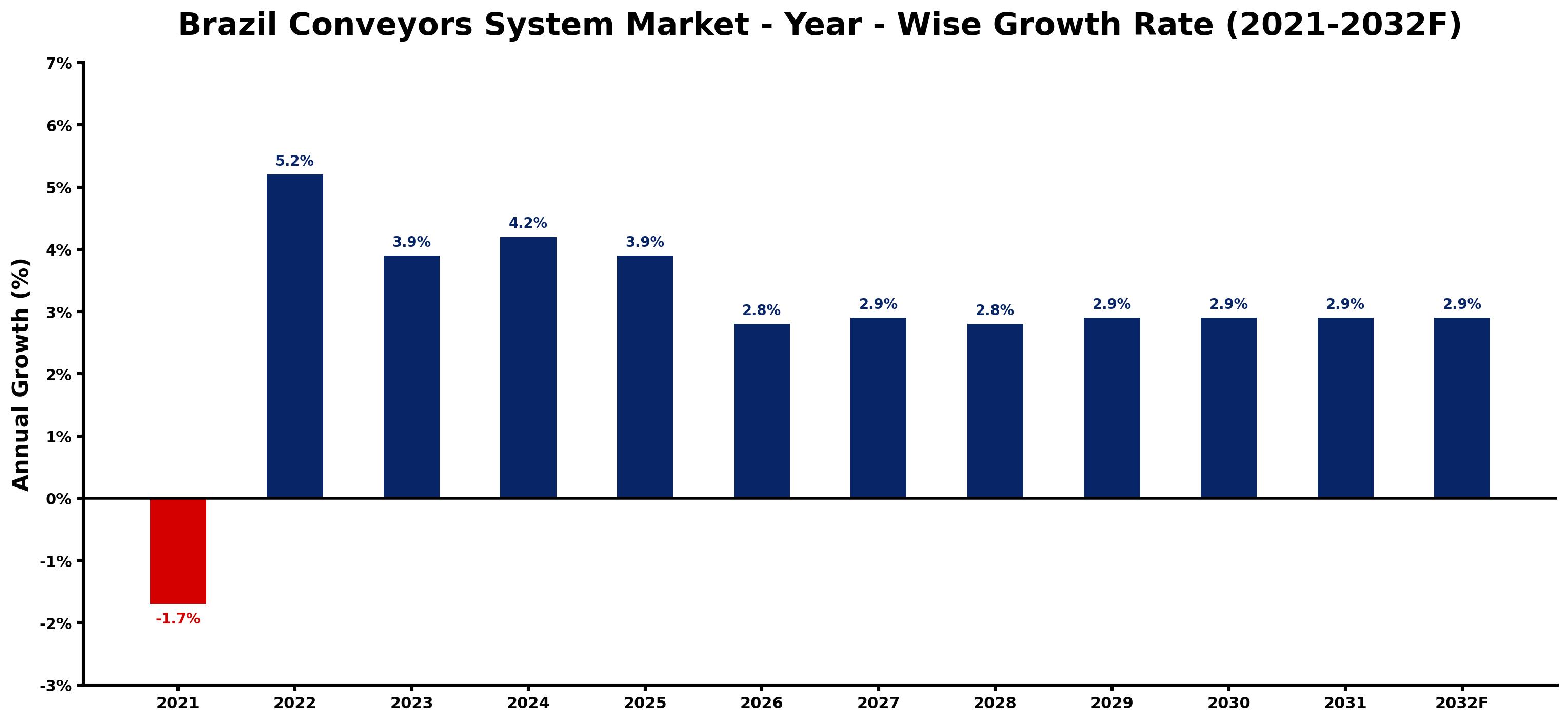
The table below presents the year wise growth rates along with the key drivers influencing the market
| Year | Growth Rate | Major Drivers |
| 2021 | -1.7% | Supply chain disruptions hindered manufacturing efficiency, leading to delayed project completions in the conveyor system sector. |
| 2022 | 5.2% | Manufacturers increasingly focus on efficiency, enhancing conveyor system integrations. |
| 2023 | 3.9% | Emerging technologies create opportunities for more flexible conveyor solutions. |
| 2024 | 4.2% | Sustainability initiatives prompt demand for eco-friendly conveyor systems. |
| 2025 | 3.9% | Brazil's logistics sector evolves, necessitating advanced material handling equipment. |
| 2026 | 2.8% | Local production capabilities expand, reducing reliance on imported conveyor systems. |
| 2027 | 2.9% | Infrastructure projects accelerate, driving growth in conveyor system installations. |
| 2028 | 2.8% | Increased urbanization leads to higher demand for automated warehousing solutions. |
| 2029 | 2.9% | E-commerce boom influences conveyor system design for optimized fulfillment. |
| 2030 | 2.9% | Investments in smart factories highlight the importance of integrated conveyor systems. |
| 2031 | 2.9% | The agriculture sector adopts conveyor systems for improved processing efficiency. |
| 2032 | 2.9% | Digital transformation trends push for advanced conveyor technology integration. |
Note - Market size estimations and growth projections presented in this report are based on 6Wresearch's advanced forecasting approach, validated with industry datasets as of June 2026.
Brazil Conveyors System Market Synopsis
The Brazil Conveyors System Market is projected to reach 2.8% and witness significant growth during the forecast period (2026-2032). This market is essential for improving efficiency in various sectors, including manufacturing, logistics, and warehousing. Conveyor systems streamline material handling processes, enabling companies to optimize their operations while reducing labor costs. The increasing emphasis on automation and the evolution of supply chain management strategies are key factors contributing to the expansion of the conveyors system market in Brazil.
Brazil Conveyors System Market Growth Drivers
The growth of the Brazil Conveyors System Market is driven by several pivotal factors that underscore its significance in the industrial landscape. One of the primary drivers is the rapid industrialization occurring across the nation, which is elevating the demand for efficient material handling solutions. The following elements illustrate the critical drivers fueling market growth:
- Increasing investments in the industrial sector are encouraging businesses to adopt conveyor systems for improved efficiency in production lines.
- The growing e-commerce sector in Brazil necessitates the need for robust logistics systems, thereby enhancing the demand for conveyor solutions that facilitate swift material movement.
- Advancements in technology, particularly the integration of IoT and AI, are propelling the development of smart conveyors, enhancing operational efficiency and safety.
- The push for sustainable practices in manufacturing is creating a need for energy-efficient conveyor systems that reduce environmental impact while maintaining productivity.
- Government initiatives aimed at boosting automation in various industries further drive the adoption of conveyor systems across sectors.
Brazil Conveyors System Market Challenges and Restraints
Despite its growth, the Brazil Conveyors System Market faces several challenges that can impede its progress. These challenges must be addressed effectively to ensure sustained market development. Key challenges include:
- The high initial investment costs associated with conveyor system implementation can deter smaller businesses from upgrading their material handling capabilities.
- Economic fluctuations and uncertainty can impact the trajectory of industrial projects, leading to postponed or canceled investments in conveyor systems.
- The diverse requirements of different industries mean that adaptability and customization of conveyor solutions are essential, which can complicate development processes.
- Maintaining compatibility with existing infrastructure is critical; however, outdated systems may necessitate significant modifications and additional costs.
- The fast-paced evolution of automation technologies demands continuous investment in innovation, presenting a challenge for companies striving to stay competitive.
Brazil Conveyors System Market Government Investment and Initiatives
Government policies play a crucial role in shaping the Brazil Conveyors System Market by facilitating infrastructure development and promoting automation across industries. Recent initiatives reflect the government's commitment to enhancing efficiency and safety in material handling. Key aspects of government involvement include:
- Investment in infrastructure projects, including transportation and logistics networks, to support the integration of advanced conveyor systems.
- Regulatory frameworks aimed at improving occupational safety and minimizing environmental impacts, driving industries to adopt modern conveyor technologies.
- Incentives provided for companies investing in automation and smart technology solutions, fostering innovation in the conveyors sector.
- Support for manufacturing sectors through funding programs that encourage the modernization of equipment and processes, including conveyor systems.
- Development plans emphasizing the importance of efficient supply chains, which have resulted in a significant push toward automated material handling solutions.
Brazil Conveyors System Market Latest Developments (May 2025 - June 2026)
Recent developments in the Brazil Conveyors System Market indicate a robust shift towards automation and smart technologies. Companies are increasingly investing in conveyor solutions equipped with advanced features such as IoT integration and AI capabilities, enhancing operational efficiency and analytics. The focus on sustainability is also evident, with many businesses seeking energy-efficient conveyor systems that align with environmental goals. Additionally, collaborations between technology providers and industrial companies have emerged, aimed at developing innovative conveyor solutions tailored to specific industry needs, reflecting a dynamic market adapting to modern challenges.
Brazil Conveyors System Market - Key Attractiveness of the Report
- 10 Years of Market Numbers
- Historical Data Starting from 2022 to 2025
- Base Year: 2025
- Forecast Data until 2032
- Key Performance Indicators Impacting the Market
- Major Upcoming Developments and Projects
Key Highlights of the Report:
- Brazil Conveyors System Market Outlook
- Market Size of Brazil Conveyors System Market, 2025
- Forecast of Brazil Conveyors System Market, 2032
- Historical Data and Forecast of Brazil Conveyors System Revenues & Volume for the Period 2022-2032F
- Brazil Conveyors System Market Trend Evolution
- Brazil Conveyors System Market Drivers and Challenges
- Brazil Conveyors System Price Trends
- Brazil Conveyors System Porter's Five Forces
- Brazil Conveyors System Industry Life Cycle
- Historical Data and Forecast of Brazil Conveyors System Market Revenues & Volume By Type for the Period 2022-2032F
- Historical Data and Forecast of Brazil Conveyors System Market Revenues & Volume By Belt for the Period 2022-2032F
- Historical Data and Forecast of Brazil Conveyors System Market Revenues & Volume By Roller for the Period 2022-2032F
- Historical Data and Forecast of Brazil Conveyors System Market Revenues & Volume By Pallet for the Period 2022-2032F
- Historical Data and Forecast of Brazil Conveyors System Market Revenues & Volume By Overhead for the Period 2022-2032F
- Historical Data and Forecast of Brazil Conveyors System Market Revenues & Volume By Floor for the Period 2022-2032F
- Historical Data and Forecast of Brazil Conveyors System Market Revenues & Volume By Crescent for the Period 2022-2032F
- Historical Data and Forecast of Brazil Conveyors System Market Revenues & Volume By Tri-planar for the Period 2022-2032F
- Historical Data and Forecast of Brazil Belt Conveyors System Market Revenues & Volume By Others for the Period 2022-2032F
- Historical Data and Forecast of Brazil Conveyors System Market Revenues & Volume By End-Use Industry for the Period 2022-2032F
- Historical Data and Forecast of Brazil Conveyors System Market Revenues & Volume By Warehouse & Distribution for the Period 2022-2032F
- Historical Data and Forecast of Brazil Conveyors System Market Revenues & Volume By Food & Beverage for the Period 2022-2032F
- Historical Data and Forecast of Brazil Conveyors System Market Revenues & Volume By Automotive for the Period 2022-2032F
- Historical Data and Forecast of Brazil Conveyors System Market Revenues & Volume By Electronics for the Period 2022-2032F
- Historical Data and Forecast of Brazil Conveyors System Market Revenues & Volume By Mining for the Period 2022-2032F
- Historical Data and Forecast of Brazil Conveyors System Market Revenues & Volume By Airport for the Period 2022-2032F
- Brazil Conveyors System Import Export Trade Statistics
- Market Opportunity Assessment By Type
- Market Opportunity Assessment By End-Use Industry
- Brazil Conveyors System Top Companies Market Share
- Brazil Conveyors System Competitive Benchmarking By Technical and Operational Parameters
- Brazil Conveyors System Company Profiles
- Brazil Conveyors System Key Strategic Recommendations






































