Brazil Crushed Stone Mining Market Size, Share & Growth Rate
The Brazil Crushed Stone Mining Market was estimated at USD 316 Million in 2025 and is projected to reach USD 377 Million by 2032, growing at a CAGR of 2.6% from 2026 to 2032. This growth trajectory is driven by substantial investments in infrastructure and a rapid urbanization process across the nation. As cities expand and new construction projects emerge, the demand for crushed stone as a foundational material in various construction activities continues to escalate, solidifying its importance to Brazil's economic fabric.
Brazil Crushed Stone Mining Market Year-wise Growth Rate and Key Drivers
This graph highlights how the Brazil Crushed Stone Mining Market has steadily grown over the years, supported by major growth factors.
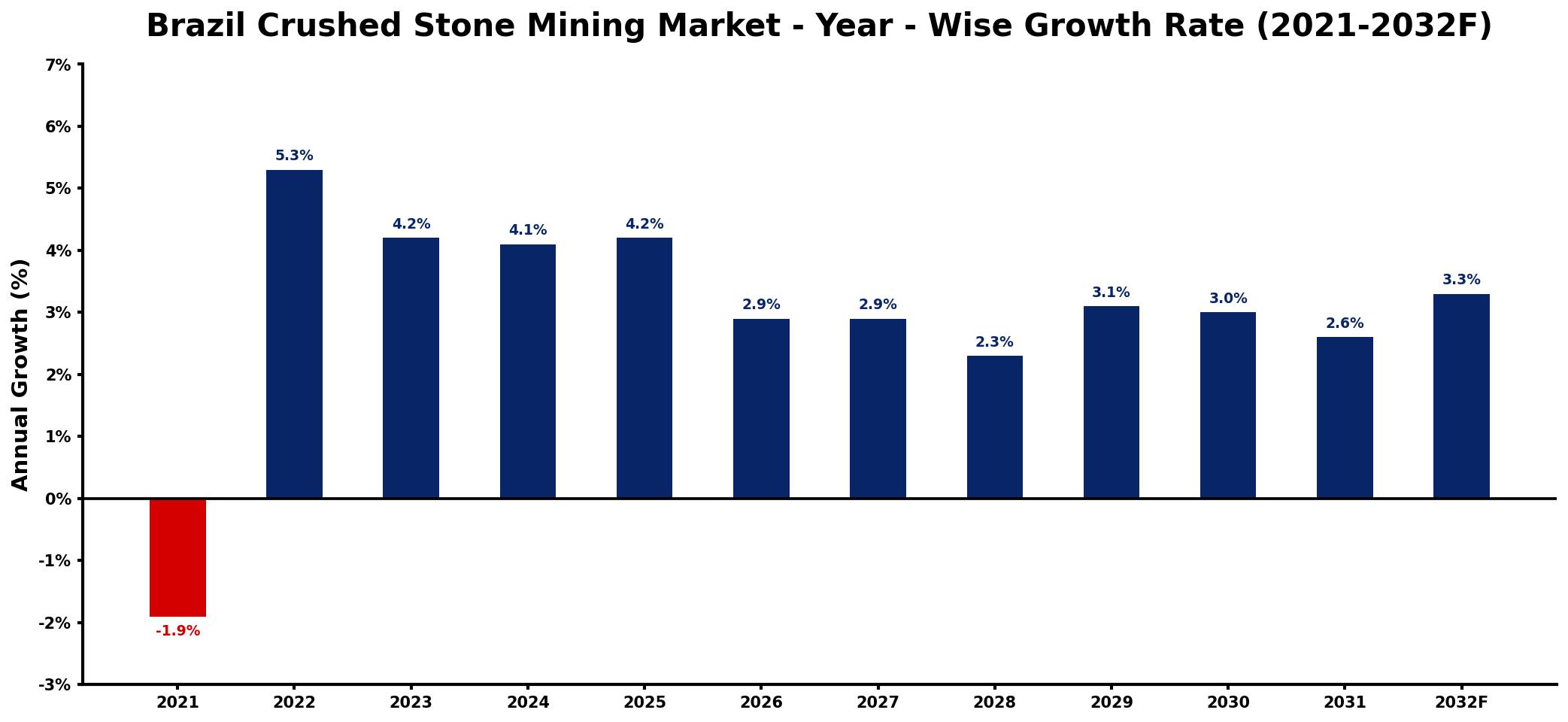
The table below presents the year‑wise growth rates along with the key drivers influencing the market
| Year | Growth Rate | Major Drivers |
| 2021 | -1.9% | decrease in construction activities |
| 2022 | 5.3% | rising infrastructure development projects |
| 2023 | 4.2% | increased demand for aggregates |
| 2024 | 4.1% | expansion of residential construction |
| 2025 | 4.2% | growth in road construction initiatives |
| 2026 | 2.9% | surge in urbanization trends |
| 2027 | 2.9% | enhanced government investment programs |
| 2028 | 2.3% | boost in renewable energy projects |
| 2029 | 3.1% | rising commercial construction demand |
| 2030 | 3.0% | increased public infrastructure investment |
| 2031 | 2.6% | rising procurement volume requirements |
| 2032 | 3.3% | growing commercial sector adoption |
Note: Market size estimations and growth projections presented in this report are based on 6Wresearch's proprietary forecasting methodology, utilizing the latest available industry data, government publications, and primary research inputs.
Brazil Crushed Stone Mining Market Synopsis
The Brazilian crushed stone mining landscape is witnessing significant expansion, fueled by ongoing urban development and major infrastructure initiatives. As the government prioritizes infrastructure upgrades, the construction sector's need for reliable aggregates remains a key catalyst for market growth.
In addition, the country's diverse geography and rich natural resources present unique opportunities for crushed stone production. The strategic positioning of quarries across Brazil enhances supply chain efficiencies, thereby supporting the rising demand from construction firms and public works projects.
Brazil Crushed Stone Mining Market Key Takeaways
- Consistent growth in infrastructure investment and urbanization drives demand for crushed stone.
- Crushed stone serves as a vital component for road construction, concrete production, and landscaping.
- Environmental regulations are shaping operational practices within the industry.
- Sustainable mining practices are becoming increasingly essential for long-term industry viability.
- Growing public and private sector collaborations are fostering innovative construction techniques.
Evaluation of Restraints in Brazil Crushed Stone Mining Market
Despite its promising growth prospects, the Brazil crushed stone mining market faces notable constraints. Environmental regulations are becoming more stringent, demanding compliance that can slow down operations and increase costs. Furthermore, sustainability concerns are compelling companies to adopt greener practices, which while beneficial in the long run, present immediate challenges related to resource allocation and operational adaptation. Balancing productivity with ecological responsibility will be crucial for firms aiming to thrive in this evolving market landscape.
Brazil Crushed Stone Mining Market Trends
Emerging trends in the Brazil crushed stone mining market include a shift towards digitalization and automation in operations. Advanced technologies are being integrated into quarrying processes to enhance efficiency and safety. Moreover, there is a growing emphasis on recycling and repurposing materials within the construction sector, with crushed stone being utilized not only as a primary aggregate but also in innovative applications such as engineered fill and noise barriers. Such trends reflect an industry in transition, striving for both economic performance and ecological sustainability.
Brazil Crushed Stone Mining Market Opportunities
The evolving infrastructure demands in Brazil present significant opportunities for growth within the crushed stone mining sector. With numerous large-scale projects on the horizon, including highways, railroads, and urban redevelopment efforts, the need for reliable supply chains and high-quality materials is paramount. Additionally, investments in green building practices offer potential avenues for new market entrants and established firms looking to innovate their offerings in a rapidly changing construction landscape.
Government Initiatives in the Brazil Crushed Stone Mining Market
The Brazilian government is actively implementing policies aimed at promoting sustainable mining practices and responsible land use. Regulatory frameworks are evolving to include stricter environmental assessments and rehabilitation requirements for mining operations. Public spending on infrastructure, particularly in urban areas, is driving demand for crushed stone, while initiatives to foster public-private partnerships are enhancing collaboration within the industry. These government efforts align with broader economic strategies that emphasize the importance of sustainable development.
Future Insights of the Brazil Crushed Stone Mining Market
Looking ahead to 2026-2032, the Brazil crushed stone mining market is poised for steady growth. The increasing pace of urbanization will drive a sustained demand for crushed stone, particularly in the context of major infrastructure projects planned across the country. As the industry adapts to evolving environmental regulations, companies that embrace innovation and sustainability are likely to gain competitive advantages. Overall, the outlook remains positive, with significant opportunities for players willing to navigate the complexities of the market.
Brazil Crushed Stone Mining Market Latest Developments (2025 - 2026)
Recent developments in the Brazil crushed stone mining sector highlight a continued focus on sustainability and innovation. Companies are increasingly adopting advanced technologies to optimize extraction processes and minimize environmental impacts. Furthermore, collaborative efforts between industry stakeholders and governmental agencies are paving the way for new regulations that emphasize ecological responsibility. These trends suggest an industry poised for transformation as it meets the demands of a growing construction market.
Brazil Crushed Stone Mining Market - Key Attractiveness of the Report
- 10 Years of Market Numbers
- Historical Data Starting from 2022 to 2025
- Base Year: 2025
- Forecast Data until 2032
- Key Performance Indicators Impacting the Market
- Major Upcoming Developments and Projects
Key Highlights of the Report:
- Brazil Crushed Stone Mining Market Outlook
- Market Size of Brazil Crushed Stone Mining Market, 2025
- Forecast of Brazil Crushed Stone Mining Market, 2032
- Historical Data and Forecast of Brazil Crushed Stone Mining Revenues & Volume for the Period 2022-2032F
- Brazil Crushed Stone Mining Market Trend Evolution
- Brazil Crushed Stone Mining Market Drivers and Challenges
- Brazil Crushed Stone Mining Price Trends
- Brazil Crushed Stone Mining Porter's Five Forces
- Brazil Crushed Stone Mining Industry Life Cycle
- Historical Data and Forecast of Brazil Crushed Stone Mining Market Revenues & Volume By Type for the Period 2022-2032F
- Historical Data and Forecast of Brazil Crushed Stone Mining Market Revenues & Volume By Limestone Mining for the Period 2022-2032F
- Historical Data and Forecast of Brazil Crushed Stone Mining Market Revenues & Volume By Granite Mining for the Period 2022-2032F
- Historical Data and Forecast of Brazil Crushed Stone Mining Market Revenues & Volume By Others for the Period 2022-2032F
- Historical Data and Forecast of Brazil Crushed Stone Mining Market Revenues & Volume By Application for the Period 2022-2032F
- Historical Data and Forecast of Brazil Crushed Stone Mining Market Revenues & Volume By Industrial for the Period 2022-2032F
- Historical Data and Forecast of Brazil Crushed Stone Mining Market Revenues & Volume By Manufacture for the Period 2022-2032F
- Historical Data and Forecast of Brazil Crushed Stone Mining Market Revenues & Volume By Construction for the Period 2022-2032F
- Historical Data and Forecast of Brazil Crushed Stone Mining Market Revenues & Volume By Engineering for the Period 2022-2032F
- Historical Data and Forecast of Brazil Crushed Stone Mining Market Revenues & Volume By Others for the Period 2022-2032F
- Brazil Crushed Stone Mining Import Export Trade Statistics
- Market Opportunity Assessment By Type
- Market Opportunity Assessment By Application
- Brazil Crushed Stone Mining Top Companies Market Share
- Brazil Crushed Stone Mining Competitive Benchmarking By Technical and Operational Parameters
- Brazil Crushed Stone Mining Company Profiles
- Brazil Crushed Stone Mining Key Strategic Recommendations






































