Brazil Digital Signature Market Size & Growth Rate (2026-2032)
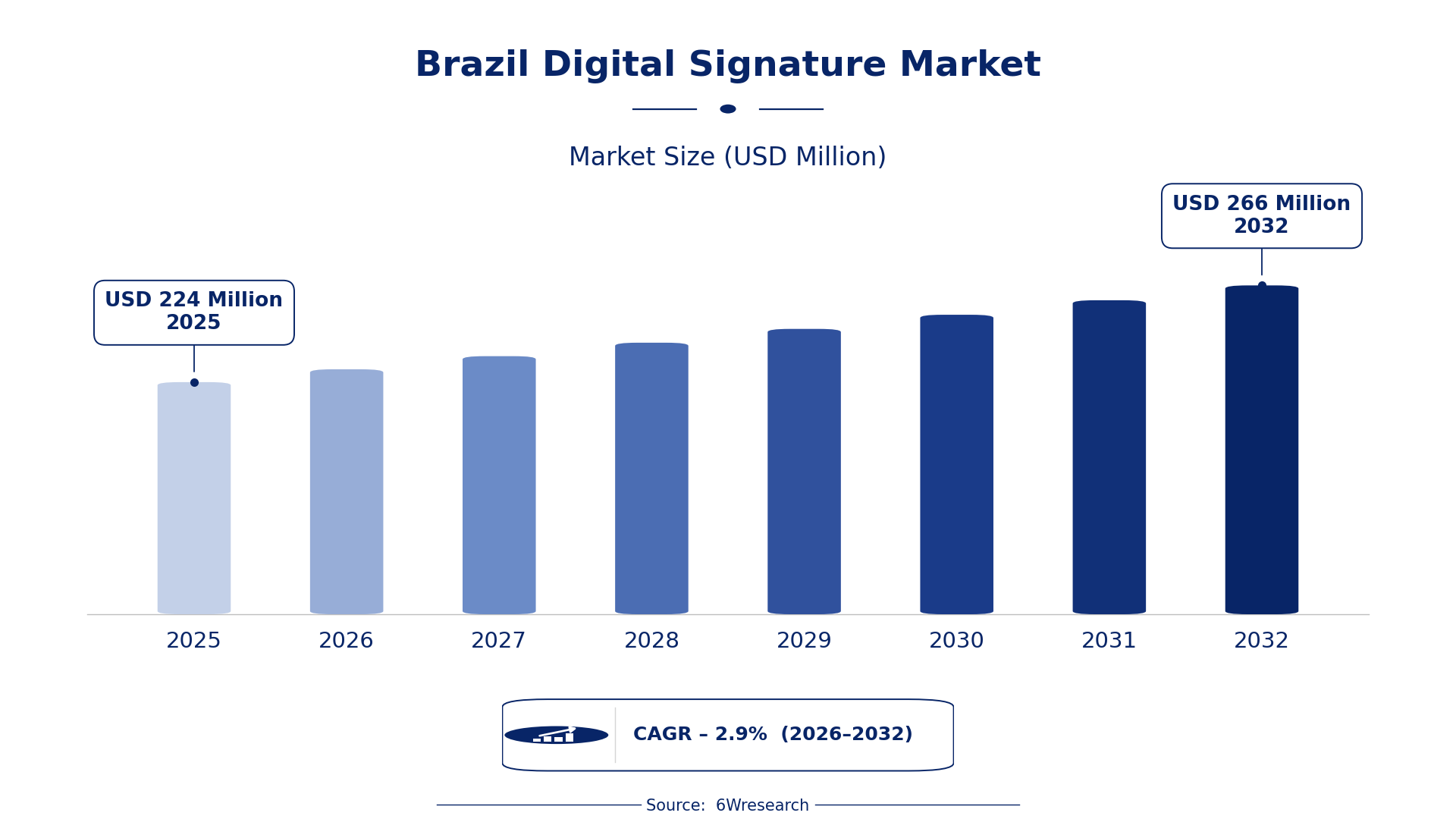
The Brazil Digital Signature Market was estimated at USD 224 Million in 2025 and is projected to reach USD 266 Million by 2032, growing at a CAGR of 2.9% from 2026 to 2032.
Brazil Digital Signature Market Synopsis
The Brazil Digital Signature market is currently experiencing significant growth, driven by an increasing shift towards digitalization across various sectors. This momentum is shifting focus from traditional paper-based processes to more efficient and secure electronic transactions.
As organizations strive for enhanced operational efficiency and security in transactions, the demand for digital signatures continues to rise. However, the market must overcome challenges related to regulatory compliance and user education to fully capitalize on this growth potential.
Brazil Digital Signature Market Year-wise Growth Rate and Key Drivers
This graph illustrates the annual growth rates of the Brazil Digital Signature Market from 2021 to 2032, highlighting a steady upward trajectory and projected expansion over the forecast period.
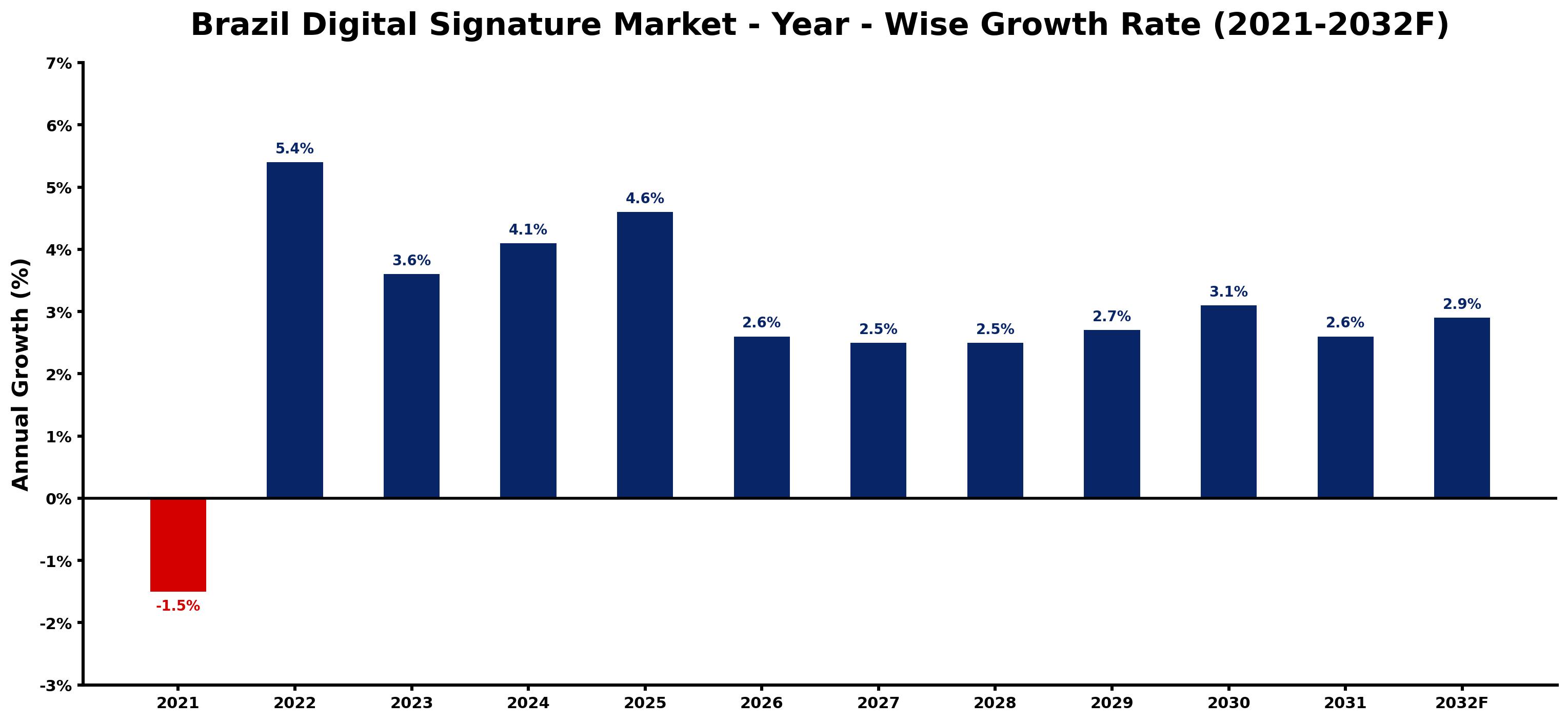
The table below presents the year‑wise growth rates along with the key drivers influencing the market
| Year | Growth Rate | Major Drivers |
| 2021 | -1.5% | Lack of adoption due to outdated Brazilian IT infrastructure. |
| 2022 | 5.4% | INPI's push for electronic patent signatures enhances adoption |
| 2023 | 3.6% | Legal framework supporting remote online notarization expands access |
| 2024 | 4.1% | Increase in e-governance initiatives drives digital signature demand |
| 2025 | 4.6% | Growing fintech sector requires secure digital transaction solutions |
| 2026 | 2.6% | Rise in telemedicine necessitates secure patient consent processes |
| 2027 | 2.5% | Educational institutions adopt digital signatures for enrollment efficiency |
| 2028 | 2.5% | Corporate digital transformation enhances document security needs |
| 2029 | 2.7% | Remote work trends increase demand for secure online signatures |
| 2030 | 3.1% | Regulatory compliance drives use of digital signatures in finance |
| 2031 | 2.6% | Government incentives promote eco-friendly e-signature solutions |
| 2032 | 2.9% | Emerging startups utilize digital signatures for rapid scaling |
Note: Market size estimations and growth projections presented in this report are based on 6Wresearch's proprietary forecasting methodology, utilizing the latest available industry data, government publications, and primary research inputs.
Brazil Digital Signature Market Key Takeaways
Below are some of the specific key takeaways from the market, including:
- The increasing digital transformation initiatives across multiple industries are driving demand.
- Regulatory compliance remains a significant challenge influencing market dynamics.
- Organizations are increasingly adopting digital signatures for contract signing and document authentication.
- The legal validity of digital signatures is gaining recognition, further encouraging adoption.
- Efforts to educate users about the benefits of digital signatures are crucial for growth.
Evaluation of Restraints in Brazil Digital Signature Market
Several real constraints are hindering the expansion of the Brazil Digital Signature market. One of the primary issues is the complex regulatory environment. Companies must navigate varying compliance requirements that can hinder swift implementation. Interoperability between different digital signature systems also poses a significant challenge, as it can complicate the user experience and reduce overall efficiency. Furthermore, there remains a degree of skepticism regarding the authenticity and security of digital signatures among users, necessitating robust educational initiatives to foster greater acceptance and understanding.
Brazil Digital Signature Market Trends
The market is increasingly influenced by a trend toward integrating advanced technologies such as blockchain, enhancing security and traceability in digital transactions. Additionally, as more organizations embrace remote work, the need for effective digital signing solutions is intensifying. The rise of electronic contracts in legal and financial services is also shaping demand, as firms seek solutions that streamline processes while ensuring compliance.
Brazil Digital Signature Market Opportunities
Emerging opportunities in the Brazil Digital Signature market lie in the increasing demand from small and medium-sized enterprises (SMEs) that are transitioning to digital operations. Educational institutions are also looking to implement digital signing processes to enhance administrative efficiency. Furthermore, partnerships between technology firms and government entities can drive further adoption, focusing on creating more accessible and user-friendly solutions for all sectors.
Government Initiatives in the Brazil Digital Signature Market
Government policies are playing a critical role in shaping the Brazil Digital Signature market, with a focus on establishing legal frameworks to support and recognize digital signatures. This emphasis on digitalization aligns with broader public sector initiatives aimed at modernizing Brazil’s electronic transaction capabilities.
- A regulatory framework established in 2025 promotes digital signatures and outlines their legal validity, enhancing user confidence.
- Currently, a nationwide campaign is underway to educate businesses and consumers about the benefits and functionalities of digital signatures.
- A planned public-private initiative is expected to launch in 2026, aimed at improving infrastructure for digital authentication services.
- The government is developing an accreditation system for digital signature providers to ensure quality and trustworthiness in the market.
- An initiative introduced in mid-2025 focuses on enhancing interoperability standards between different digital signature systems.
Future Insights of the Brazil Digital Signature Market
Looking ahead, the Brazil Digital Signature market is set to experience a steady increase in adoption driven by continued digital transformation efforts. As regulatory frameworks become more refined and user education initiatives expand, businesses will be more inclined to embrace digital signatures. The market's trajectory will be heavily influenced by technological advancements, with a clear shift towards more integrated solutions that combine digital signatures with other electronic transaction capabilities.
Brazil Digital Signature Market Latest Developments
Recent months have seen notable developments within the Brazil Digital Signature market, indicating a strong push toward wider adoption and integration of digital signing solutions. As organizations increasingly recognize the importance of secure electronic transactions, innovation in this space is ramping up.
- A leading technology provider launched a new digital signature platform in early 2025 that enhances user experience and security, receiving positive feedback from early adopters.
- An initiative that began in late 2025 focuses on integrating AI technologies with digital signatures to streamline authentication processes, currently underway.
- A major partnership between software developers and a financial institution was announced in Q1 2026, aimed at creating specialized solutions for banking transactions.
- Plans are in place for an expansion of digital signature services targeting public institutions by mid-2026, aiming to standardize processes across government entities.
Brazil Digital Signature Market - Key Attractiveness of the Report
- 10 Years of Market Numbers
- Historical Data Starting from 2022 to 2025
- Base Year: 2025
- Forecast Data until 2032
- Key Performance Indicators Impacting the Market
- Major Upcoming Developments and Projects
Key Highlights of the Report:
- Brazil Digital Signature Market Outlook
- Market Size of Brazil Digital Signature Market, 2025
- Forecast of Brazil Digital Signature Market, 2032
- Historical Data and Forecast of Brazil Digital Signature Revenues & Volume for the Period 2022-2032F
- Brazil Digital Signature Market Trend Evolution
- Brazil Digital Signature Market Drivers and Challenges
- Brazil Digital Signature Price Trends
- Brazil Digital Signature Porter's Five Forces
- Brazil Digital Signature Industry Life Cycle
- Historical Data and Forecast of Brazil Digital Signature Market Revenues & Volume By Component for the Period 2022-2032F
- Historical Data and Forecast of Brazil Digital Signature Market Revenues & Volume By Solutions for the Period 2022-2032F
- Historical Data and Forecast of Brazil Digital Signature Market Revenues & Volume By Services for the Period 2022-2032F
- Historical Data and Forecast of Brazil Digital Signature Market Revenues & Volume By Solution for the Period 2022-2032F
- Historical Data and Forecast of Brazil Digital Signature Market Revenues & Volume By Software for the Period 2022-2032F
- Historical Data and Forecast of Brazil Digital Signature Market Revenues & Volume By Hardware for the Period 2022-2032F
- Historical Data and Forecast of Brazil Digital Signature Market Revenues & Volume By Vertical for the Period 2022-2032F
- Historical Data and Forecast of Brazil Digital Signature Market Revenues & Volume By BFSI for the Period 2022-2032F
- Historical Data and Forecast of Brazil Digital Signature Market Revenues & Volume By Government for the Period 2022-2032F
- Historical Data and Forecast of Brazil Digital Signature Market Revenues & Volume By Defense for the Period 2022-2032F
- Historical Data and Forecast of Brazil Digital Signature Market Revenues & Volume By Legal for the Period 2022-2032F
- Historical Data and Forecast of Brazil Digital Signature Market Revenues & Volume By Real Estate for the Period 2022-2032F
- Historical Data and Forecast of Brazil Digital Signature Market Revenues & Volume By Organization Size for the Period 2022-2032F
- Historical Data and Forecast of Brazil Digital Signature Market Revenues & Volume By Large Enterprises for the Period 2022-2032F
- Historical Data and Forecast of Brazil Digital Signature Market Revenues & Volume By Small and Medium-Sized Enterprises (SMEs) for the Period 2022-2032F
- Historical Data and Forecast of Brazil Digital Signature Market Revenues & Volume By Deployment Mode for the Period 2022-2032F
- Historical Data and Forecast of Brazil Digital Signature Market Revenues & Volume By Cloud for the Period 2022-2032F
- Historical Data and Forecast of Brazil Digital Signature Market Revenues & Volume By On-Premises for the Period 2022-2032F
- Brazil Digital Signature Import Export Trade Statistics
- Market Opportunity Assessment By Component
- Market Opportunity Assessment By Solution
- Market Opportunity Assessment By Vertical
- Market Opportunity Assessment By Organization Size
- Market Opportunity Assessment By Deployment Mode
- Brazil Digital Signature Top Companies Market Share
- Brazil Digital Signature Competitive Benchmarking By Technical and Operational Parameters
- Brazil Digital Signature Company Profiles
- Brazil Digital Signature Key Strategic Recommendations






































