Brazil Electrical and electronics Market Summary
The brazil electrical and electronics market was estimated at USD 174 Million in 2025 and is projected to reach USD 207 Million by 2032, growing at a CAGR of 2.9% from 2026 to 2032.
Brazil Electrical and electronics Market Year-wise Growth Rate and Key Drivers
This graph highlights how the Brazil Electrical and electronics Market has steadily grown over the past five years, supported by major growth factors.
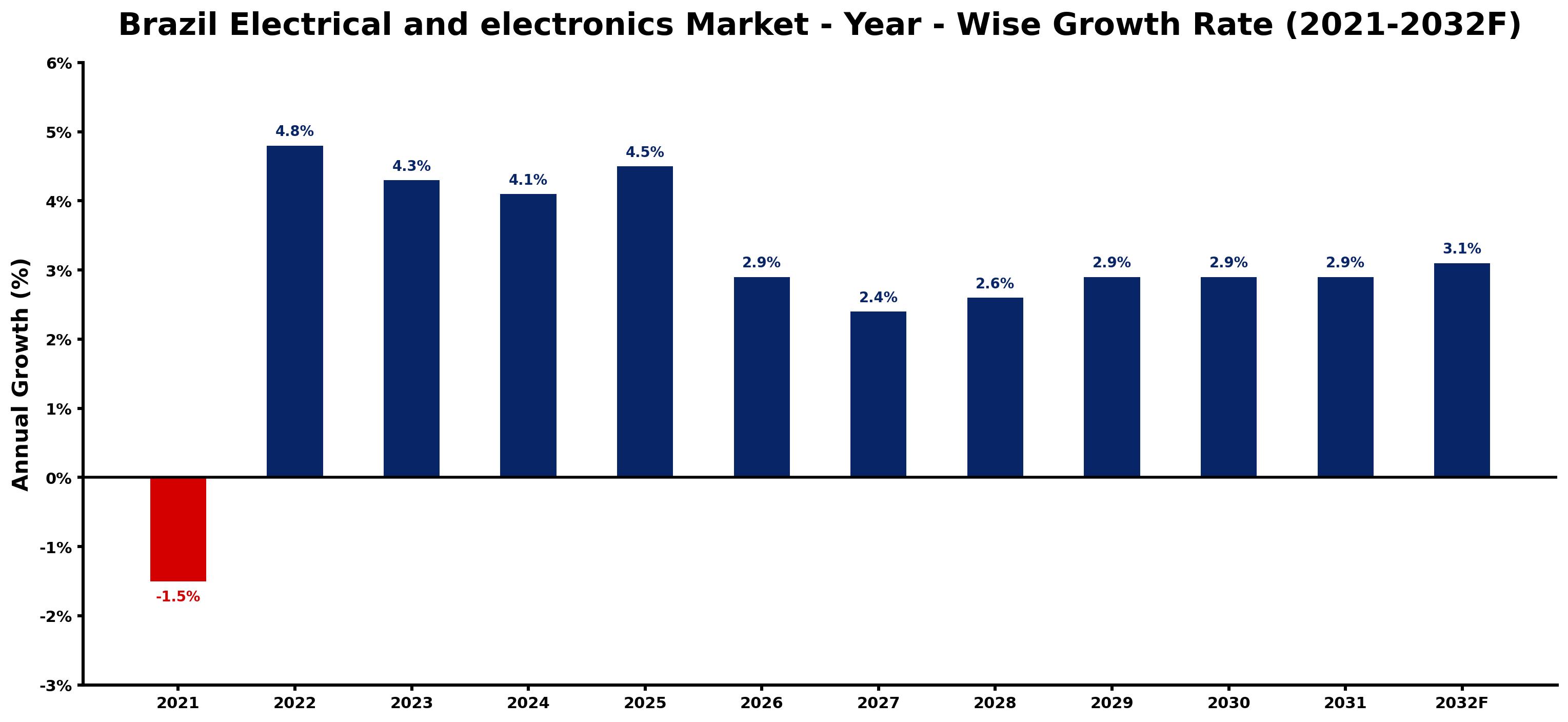
The table below presents the year wise growth rates along with the key drivers influencing the market
| Year | Growth Rate | Major Drivers |
| 2021 | -1.5% | Unanticipated supply chain disruptions hindered manufacturing capabilities, leading to a drop in product availability. |
| 2022 | 4.8% | Local manufacturers enhanced production capabilities to meet rising consumer demands effectively. |
| 2023 | 4.3% | Emerging technologies increased interest in smart home devices and automation solutions. |
| 2024 | 4.1% | Infrastructure upgrades aimed at enhancing energy efficiency attracted significant investment opportunities. |
| 2025 | 4.5% | An expanding middle class supported higher disposable incomes, fueling electronics consumption growth. |
| 2026 | 2.9% | Partnerships between local startups and global tech leaders fostered innovation in electronics. |
| 2027 | 2.4% | E-commerce platforms experienced unprecedented growth, altering traditional retail landscapes nationwide. |
| 2028 | 2.6% | The push for renewable energy solutions drew attention to sustainable electronics manufacturing. |
| 2029 | 2.9% | Intensified competition among brands led to advancements in product quality and affordability. |
| 2030 | 2.9% | Technological literacy programs initiated widespread adoption of digital devices across various sectors. |
| 2031 | 2.9% | Urbanization trends drove demand for smart appliances in metropolitan areas, boosting sales. |
| 2032 | 3.1% | Increased foreign investment catalyzed regional development, enhancing local electronics supply chains. |
Note - Market size estimations and growth projections presented in this report are based on 6Wresearch's advanced forecasting approach, validated with industry datasets as of June 2026.
Brazil Electrical and electronics Market Synopsis
The Brazil Electrical and electronics Market is projected to reach 2.9% and witness significant growth during the forecast period (2026-2032). This market plays a pivotal role in Brazil's industrial framework, encompassing a wide range of applications from consumer electronics to sophisticated industrial machinery. Continuous advancements in technology, a growing emphasis on energy efficiency, and a commitment to sustainability are key factors driving the evolution of this sector. The robust competition between local and international entities ensures that innovation remains at the forefront of market offerings.
Brazil Electrical and electronics Market Growth Drivers
Several factors are propelling the growth of the Brazil Electrical and electronics Market. Urbanization is a significant driver, as more consumers in urban areas seek modern electrical and electronic solutions for their homes and businesses.
- The rapid expansion of urban infrastructure is leading to higher demand for electrical installations and electronic devices.
- Technological advancements are enhancing product functionalities, making them more appealing to consumers and businesses alike.
- Increased penetration of electronic devices, fueled by consumer preferences for smart homes and automation, is further strengthening market dynamics.
- Growing emphasis on energy efficiency and eco-friendly products aligns with consumers' desire for sustainability, influencing purchasing decisions.
- Infrastructure development initiatives across Brazil, including investments in renewable energy, are creating new opportunities within the electrical and electronics sector.
Brazil Electrical and electronics Market Challenges and Restraints
Despite the promising growth trajectory, the Brazil Electrical and electronics Market faces several challenges that could hinder its overall development. Rapid technological obsolescence is a persistent issue, as companies must continuously innovate to keep pace with global standards.
- Global supply chain disruptions have resulted in increased costs and limited availability of essential components, impacting production timelines.
- Intense competition from international players complicates the market landscape, forcing local manufacturers to adopt aggressive strategies.
- Regulatory compliance regarding safety standards poses challenges for companies striving to meet Brazilian regulations.
- The shortage of skilled labor in technical areas adds another layer of complexity, as businesses compete for qualified professionals.
- Fluctuations in currency exchange rates can affect the profitability of companies operating within the export-import domain, creating uncertainty.
Brazil Electrical and electronics Market Government Investment and Initiatives
The Brazilian government is actively investing in the electrical and electronics sector to enhance its global competitiveness. Policies aimed at promoting research and development are integral to positioning Brazil as a leader in innovation.
- The government has launched several initiatives to attract foreign investment, facilitating partnerships between local and international entities.
- Programs focused on developing local talent are being implemented to ensure a skilled workforce is available to meet industry demands.
- Product safety standards are regularly reviewed and updated to align with international norms, fostering a more secure marketplace.
- Public spending is directed toward improving infrastructure capabilities, which will benefit the electrical and electronics sectors significantly.
- Collaborative efforts between the government and industry players create an environment conducive to technological advancements and innovation.
Brazil Electrical and electronics Market Latest Developments (May 2025 - June 2026)
The period between May 2025 and June 2026 has seen notable movements within the Brazil Electrical and electronics Market, reflecting the dynamic nature of this industry. This timeframe has been marked by increasing investments in green technology, focusing on energy-efficient solutions to meet consumer demand.
- Significant strides in smart home technology have been observed, with consumers adopting integrated solutions that enhance connectivity and convenience.
- The industrial sector is embracing automation technologies to improve operational efficiency and product quality, driven by the need for competitive advantage.
- Developments in electric vehicle infrastructure are gaining momentum, highlighting the government's commitment to renewable energy initiatives.
- Local manufacturers are focusing on enhancing product safety and compliance to navigate regulatory changes effectively.
- There is a growing trend in collaboration between technology firms and research institutions to foster innovation and accelerate product development.
Brazil Electrical and electronics Market - Key Attractiveness of the Report
- 10 Years of Market Numbers
- Historical Data Starting from 2022 to 2025
- Base Year: 2025
- Forecast Data until 2032
- Key Performance Indicators Impacting the Market
- Major Upcoming Developments and Projects
Key Highlights of the Report:
- Brazil Electrical and electronics Market Outlook
- Market Size of Brazil Electrical and electronics Market, 2025
- Forecast of Brazil Electrical and electronics Market, 2032
- Historical Data and Forecast of Brazil Electrical and electronics Revenues & Volume for the Period 2022-2032F
- Brazil Electrical and electronics Market Trend Evolution
- Brazil Electrical and electronics Market Drivers and Challenges
- Brazil Electrical and electronics Price Trends
- Brazil Electrical and electronics Porter's Five Forces
- Brazil Electrical and electronics Industry Life Cycle
- Historical Data and Forecast of Brazil Electrical and electronics Market Revenues & Volume By Type for the Period 2022-2032F
- Historical Data and Forecast of Brazil Electrical and electronics Market Revenues & Volume By Electric Motors for the Period 2022-2032F
- Historical Data and Forecast of Brazil Electrical and electronics Market Revenues & Volume By Primary And Storage Batteries for the Period 2022-2032F
- Historical Data and Forecast of Brazil Electrical and electronics Market Revenues & Volume By Generators for the Period 2022-2032F
- Historical Data and Forecast of Brazil Electrical and electronics Market Revenues & Volume By Semiconductors for the Period 2022-2032F
- Historical Data and Forecast of Brazil Electrical and electronics Market Revenues & Volume By Household Appliances for the Period 2022-2032F
- Historical Data and Forecast of Brazil Electrical and electronics Market Revenues & Volume By Applications for the Period 2022-2032F
- Historical Data and Forecast of Brazil Electrical and electronics Market Revenues & Volume By Online for the Period 2022-2032F
- Historical Data and Forecast of Brazil Electrical and electronics Market Revenues & Volume By Offline for the Period 2022-2032F
- Brazil Electrical and electronics Import Export Trade Statistics
- Market Opportunity Assessment By Type
- Market Opportunity Assessment By Applications
- Brazil Electrical and electronics Top Companies Market Share
- Brazil Electrical and electronics Competitive Benchmarking By Technical and Operational Parameters
- Brazil Electrical and electronics Company Profiles
- Brazil Electrical and electronics Key Strategic Recommendations






































