United States (US) Electrical and electronics Market Summary
The united states (us) electrical and electronics market was estimated at USD 193 Million in 2025 and is projected to reach USD 229 Million by 2032, growing at a CAGR of 3.0% from 2026 to 2032.
United States (US) Electrical and electronics Market Year-wise Growth Rate and Key Drivers
This graph highlights how the United States (US) Electrical and electronics Market has steadily grown over the past five years, supported by major growth factors.
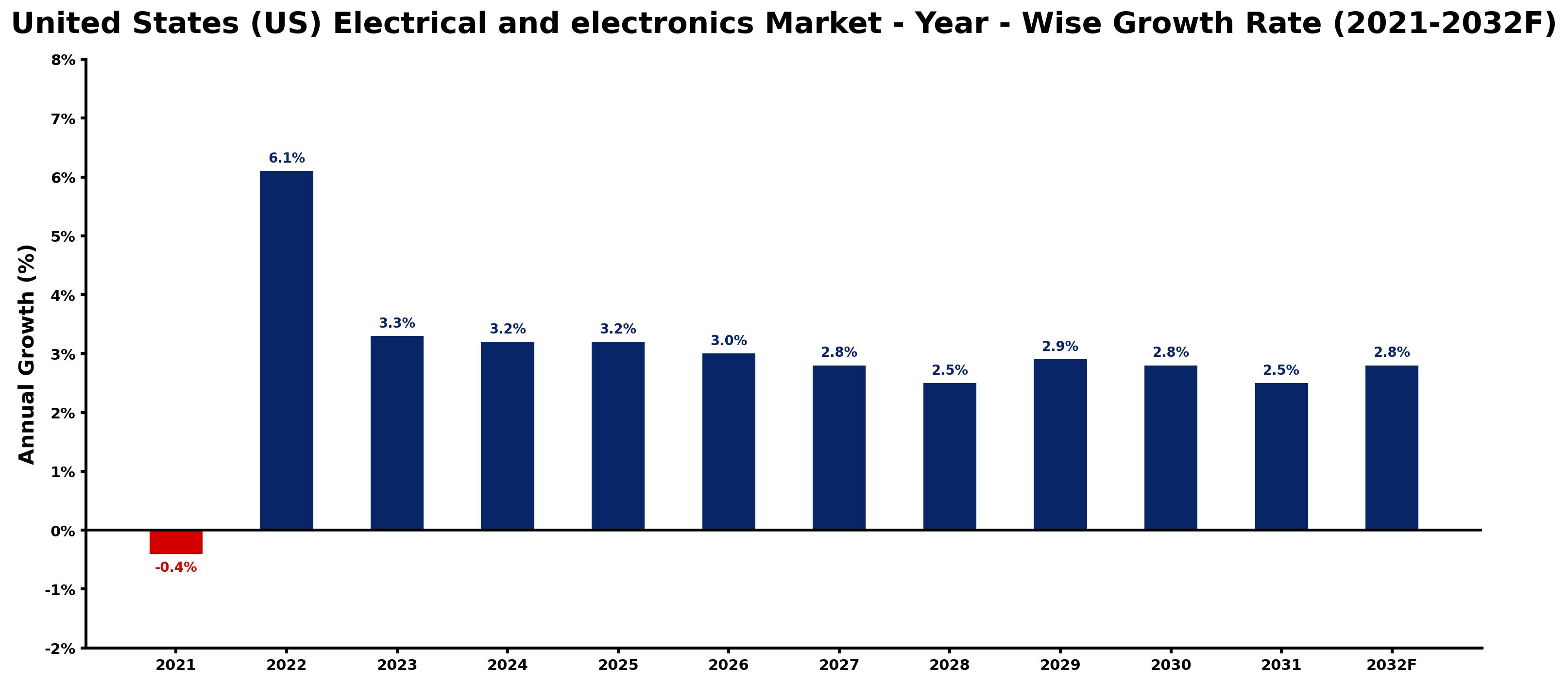
The table below presents the year wise growth rates along with the key drivers influencing the market
| Year | Growth Rate | Major Drivers |
| 2021 | -0.4% | Supply chain disruptions during the pandemic hindered production and led to shortages in electronic components. |
| 2022 | 6.1% | Emerging technologies, like AI and IoT, spurred investments in electronic infrastructure. |
| 2023 | 3.3% | Sustainability trends encouraged the development of energy-efficient electronic products. |
| 2024 | 3.2% | Consumer preferences shifted toward smart home devices, boosting market diversity. |
| 2025 | 3.2% | Manufacturers began focusing on domestic supply chains for electronics production. |
| 2026 | 3.0% | Cybersecurity concerns led to increased demand for secure electronic systems. |
| 2027 | 2.8% | Electric vehicle adoption accelerated the demand for advanced electronic components. |
| 2028 | 2.5% | 5G rollout facilitated new applications, enhancing demand for compatible electronics. |
| 2029 | 2.9% | Investment in renewable energy sources increased the need for power electronics. |
| 2030 | 2.8% | Remote work solutions continued evolving, spurring demand for high-performance electronics. |
| 2031 | 2.5% | Aging infrastructure raised concerns, increasing spending on modern electrical systems. |
| 2032 | 2.8% | Collaborations between tech firms and utilities aimed at enhancing grid reliability. |
Note - Market size estimations and growth projections presented in this report are based on 6Wresearch's advanced forecasting approach, validated with industry datasets as of June 2026.
United States (US) Electrical and electronics Market Synopsis
The United States (US) Electrical and electronics Market is projected to reach 3.0% and witness significant growth during the forecast period (2026-2032). This sector is undergoing notable transformation driven by rapid technological advancements, an escalating demand for smart and connected devices, and a surge in consumer interest in eco-friendly products. Encompassing a wide array of segments such as consumer electronics, industrial equipment, household appliances, and critical electrical components, the market is poised for robust expansion as it adapts to evolving consumer preferences and regulatory landscapes.
United States (US) Electrical and electronics Market Growth Drivers
Several key factors are driving growth within the United States Electrical and electronics Market. The rise of the Internet of Things (IoT) is a major contributor, fostering a demand for interconnected devices that enhance convenience and efficiency in homes and industries. Furthermore, the increasing adoption of renewable energy sources is stimulating the market for solar power technologies and energy-efficient products. The burgeoning electric vehicle sector is also playing a significant role, encouraging investments in supporting infrastructure and component technologies. Enhanced governmental and consumer focus on sustainability is propelling manufacturers toward creating eco-friendly products, thereby aligning with market trends. Finally, advancements in artificial intelligence and automation technologies are continuously reshaping product offerings and applications across the sector.
United States (US) Electrical and electronics Market Trends and Opportunities
Current trends in the United States Electrical and electronics Market underscore the shift towards smarter home solutions. Consumers are increasingly seeking intelligent devices that integrate IoT capabilities, paving the way for smart appliances and home automation systems. As renewable energy initiatives gain momentum, the market is witnessing growth in segments dedicated to energy storage solutions and solar energy products. Moreover, sustainability remains a focal point, with manufacturers increasingly prioritizing energy efficiency and responsible electronic waste management practices. The continuing expansion of 5G technology and its applications presents substantial opportunities for companies focusing on infrastructure development and connectivity solutions. These trends reveal a robust consumer inclination towards innovative, sustainable, and technology-enhanced electrical and electronic products.
United States (US) Electrical and electronics Market Challenges and Restraints
While the United States Electrical and electronics Market presents significant growth potential, it is not without challenges. Rapid technological changes necessitate continuous innovation, leading to shorter product life cycles that can strain manufacturing capabilities and profitability. The influx of global competitors introduces pressure on domestic companies, requiring them to differentiate themselves through unique value propositions. Additionally, supply chain disruptions, exacerbated by global events such as the COVID-19 pandemic, may impede the availability of critical components. Regulatory compliance is increasingly stringent; companies must navigate complex environmental regulations while striving to reduce their carbon footprints. Furthermore, as the market edges towards renewable energy, businesses need to invest heavily in new technologies to adapt, adding to the operational challenges they face.
United States (US) Electrical and electronics Market Investment Opportunities
The United States Electrical and electronics Market is ripe with investment opportunities across various segments. The surge in demand for smart home technologies presents significant prospects for companies developing connected devices, from smart thermostats to integrated home security systems. The renewable energy sector is another area of growth; companies creating innovative solutions in solar technology and energy management systems are well-positioned for future success. The electric vehicle market, buoyed by increasing consumer acceptance and governmental incentives, offers substantial opportunities for investments in charging infrastructure and related technologies. As digital transformation accelerates, businesses focusing on IoT applications stand to benefit from infrastructure and connectivity advancements. Engaging in these promising segments can provide strategic advantages for investors looking to capitalize on the evolving landscape.
United States (US) Electrical and electronics Market Government Investment and Initiatives
The US government is actively involved in fostering growth within the Electrical and electronics Market through various initiatives and policies. Regulatory agencies are implementing standards that ensure consumer safety while promoting technological innovation. The Federal Communications Commission (FCC) plays a critical role in managing radiofrequency use and setting technical standards necessary for the seamless operation of electronic devices. The Department of Energy (DOE) emphasizes energy efficiency, mandating standards for appliances and actively supporting research in energy-saving technologies. The Environmental Protection Agency (EPA) oversees the responsible disposal of electronic waste, aiming to mitigate environmental degradation. Additionally, public spending on infrastructure projects is expected to enhance the capabilities of electrical and electronics firms. Trade policies and tariff regulations also shape market dynamics, ensuring a competitive environment while safeguarding local industries.
United States (US) Electrical and electronics Market Latest Developments (May 2025 - June 2026)
From May 2025 to June 2026, the United States Electrical and electronics Market has witnessed several notable developments. The continuous push for smart home technologies has resulted in increased partnerships between tech firms and housing developers to integrate IoT solutions into new constructions. Advancements in battery technology and electric vehicle infrastructure have accelerated, reflecting the government's commitment to enhancing the electric vehicle ecosystem. Meanwhile, consumer electronics have seen innovations focused on sustainability, addressing growing concerns over electronic waste. Regulatory changes aimed at improving energy efficiency and sustainability standards have also emerged, influencing production strategies. The emphasis on 5G deployment has led to greater investments in network infrastructure to support connected devices, thereby positioning the market for future growth.
United States (US) Electrical and electronics Market - Key Attractiveness of the Report
- 10 Years of Market Numbers
- Historical Data Starting from 2022 to 2025
- Base Year: 2025
- Forecast Data until 2032
- Key Performance Indicators Impacting the Market
- Major Upcoming Developments and Projects
Key Highlights of the Report:
- United States (US) Electrical and electronics Market Outlook
- Market Size of United States (US) Electrical and electronics Market, 2025
- Forecast of United States (US) Electrical and electronics Market, 2032F
- Historical Data and Forecast of United States (US) Electrical and electronics Revenues & Volume for the Period 2022-2032F
- United States (US) Electrical and electronics Market Trend Evolution
- United States (US) Electrical and electronics Market Drivers and Challenges
- United States (US) Electrical and electronics Price Trends
- United States (US) Electrical and electronics Porter's Five Forces
- United States (US) Electrical and electronics Industry Life Cycle
- Historical Data and Forecast of United States (US) Electrical and electronics Market Revenues & Volume By Type for the Period 2022-2032F
- Historical Data and Forecast of United States (US) Electrical and electronics Market Revenues & Volume By Electric Motors for the Period 2022-2032F
- Historical Data and Forecast of United States (US) Electrical and electronics Market Revenues & Volume By Primary And Storage Batteries for the Period 2022-2032F
- Historical Data and Forecast of United States (US) Electrical and electronics Market Revenues & Volume By Generators for the Period 2022-2032F
- Historical Data and Forecast of United States (US) Electrical and electronics Market Revenues & Volume By Semiconductors for the Period 2022-2032F
- Historical Data and Forecast of United States (US) Electrical and electronics Market Revenues & Volume By Household Appliances for the Period 2022-2032F
- Historical Data and Forecast of United States (US) Electrical and electronics Market Revenues & Volume By Applications for the Period 2022-2032F
- Historical Data and Forecast of United States (US) Electrical and electronics Market Revenues & Volume By Online for the Period 2022-2032F
- Historical Data and Forecast of United States (US) Electrical and electronics Market Revenues & Volume By Offline for the Period 2022-2032F
- United States (US) Electrical and electronics Import Export Trade Statistics
- Market Opportunity Assessment By Type
- Market Opportunity Assessment By Applications
- United States (US) Electrical and electronics Top Companies Market Share
- United States (US) Electrical and electronics Competitive Benchmarking By Technical and Operational Parameters
- United States (US) Electrical and electronics Company Profiles
- United States (US) Electrical and electronics Key Strategic Recommendations






































