Brazil Ethnic Clothing Market Summary
The brazil ethnic clothing market was estimated at USD 165 Million in 2025 and is projected to reach USD 197 Million by 2032, growing at a CAGR of 2.9% from 2026 to 2032.
Brazil Ethnic Clothing Market Year-wise Growth Rate and Key Drivers
This graph highlights how the Brazil Ethnic Clothing Market has steadily grown over the past five years, supported by major growth factors.
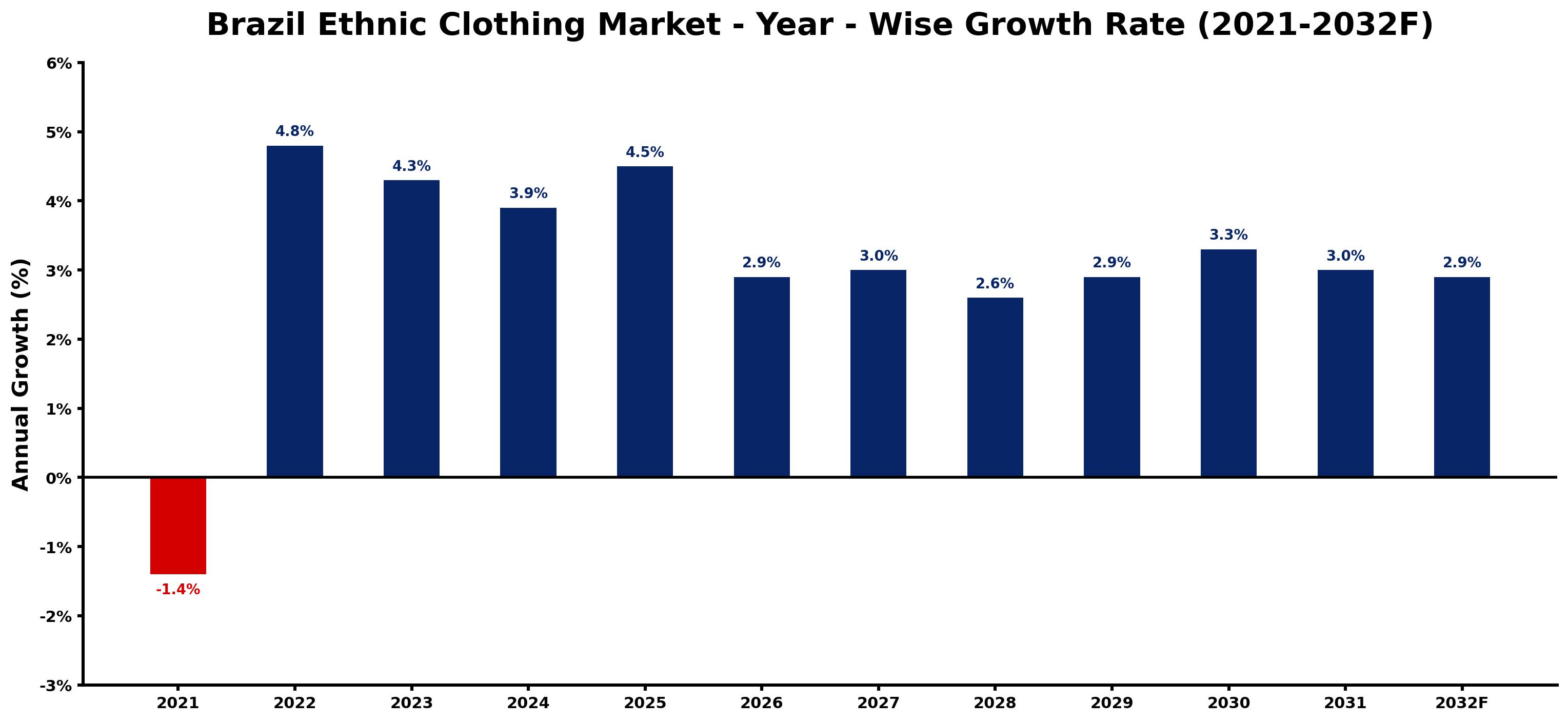
The table below presents the year wise growth rates along with the key drivers influencing the market
| Year | Growth Rate | Major Drivers |
| 2021 | -1.4% | Pandemicrelated restrictions hindered cultural events, leading to diminished demand for ethnic clothing in Brazil. |
| 2022 | 4.8% | Cultural celebrations revived interest in traditional attire among diverse Brazilian communities. |
| 2023 | 4.3% | Social media influencers showcased ethnic fashion, enhancing visibility and consumer interest. |
| 2024 | 3.9% | E-commerce platforms expanded reach, making ethnic clothing accessible to wider audiences. |
| 2025 | 4.5% | Collaborations with local artisans increased authenticity and value in ethnic fashion offerings. |
| 2026 | 2.9% | Sustainable practices became prevalent, attracting eco-conscious consumers to ethnic brands. |
| 2027 | 3.0% | Cultural festivals served as significant events, driving demand for ethnic clothing sales. |
| 2028 | 2.6% | Increased urbanization led to a blend of traditional and contemporary fashion trends. |
| 2029 | 2.9% | Youth-led movements championed inclusivity, further popularizing ethnic clothing among younger demographics. |
| 2030 | 3.3% | Consumer education focused on heritage and craftsmanship fostered deeper connections with brands. |
| 2031 | 3.0% | Global fashion weeks featured Brazilian ethnic designs, positioning them on international stages. |
| 2032 | 2.9% | Technological innovations in textile production enhanced quality and sustainability of ethnic garments. |
Note - Market size estimations and growth projections presented in this report are based on 6Wresearch's advanced forecasting approach, validated with industry datasets as of June 2026.
Brazil Ethnic Clothing Market Synopsis
The Brazil Ethnic Clothing Market is projected to reach 2.9% and witness significant growth during the forecast period (2026-2032). This market encapsulates a rich mosaic of cultural expressions, as traditional garments from numerous Brazilian regions blend seamlessly with modern fashion influences. There is an increasing trend among consumers to celebrate their cultural roots through clothing, resulting in a dynamic interplay of traditional and contemporary designs. The importance of artisanal craftsmanship in ethnic clothing is also notable, reinforcing the market's vibrancy and authenticity.
Brazil Ethnic Clothing Market Growth Drivers
Key drivers propelling the Brazil Ethnic Clothing Market include a growing appreciation for cultural diversity and an ongoing celebration of traditional attire. The following factors are instrumental in shaping the market landscape:
- The resurgence of pride in cultural identity encourages consumers to make clothing choices that reflect their heritage, resulting in increased demand for ethnic wear.
- Fashion trends increasingly incorporate ethnic elements, making cultural attire relevant in mainstream fashion, thus broadening the consumer base.
- The influence of social media platforms has heightened visibility for diverse styles, empowering consumers to explore ethnic fashion choices that resonate on personal and social levels.
- Cultural festivals and events serve as catalysts for market expansion, prompting individuals to wear ethnic clothing and embrace their cultural narratives.
- Increased accessibility to ethnic clothing through online platforms has made it easier for consumers to explore and purchase a variety of styles, further enhancing market growth.
Brazil Ethnic Clothing Market Challenges and Restraints
Despite its promising trajectory, the Brazil Ethnic Clothing Market faces several challenges that could impede its growth. These include:
- The diverse cultural landscape poses difficulties for designers aiming to create products that honor traditional aesthetics while appealing to modern sensibilities.
- Economic factors, such as income disparity and inflation, significantly impact consumer purchasing power, potentially limiting market expansion.
- The industry grapples with the sensitive issue of cultural appropriation, necessitating a responsible and respectful approach in design and marketing practices.
- Consumer preferences are rapidly evolving, demanding continuous innovation from manufacturers to keep ethnic clothing relevant and appealing.
- Supply chain disruptions, which can arise due to economic fluctuations, affect the availability of raw materials traditionally used in ethnic clothing production.
Brazil Ethnic Clothing Market Government Investment and Initiatives
Government policies regarding the Brazil Ethnic Clothing Market play a pivotal role in safeguarding cultural heritage while promoting diversity in the fashion industry. The following initiatives illustrate the government's commitment:
- Regulatory bodies collaborate with cultural organizations to formulate guidelines that uphold the integrity of ethnic clothing production and marketing.
- Public spending is directed towards initiatives that educate and raise awareness about cultural preservation, specifically concerning traditional attire.
- Government programs encourage the participation of local artisans and craftspeople, ensuring that traditional skills and design techniques are passed down through generations.
- Efforts to curb cultural appropriation are strengthened with policies that promote ethical design practices and require proper acknowledgment of cultural elements used in fashion.
- Investment in cultural festivals and events that celebrate ethnic attire fosters community pride and encourages consumers to engage with their heritage through fashion.
Brazil Ethnic Clothing Market Latest Developments (May 2025 - June 2026)
Recent developments within the Brazil Ethnic Clothing Market reflect a growing fusion of traditional and contemporary styles. During the period from May 2025 to June 2026, several notable trends emerged:
- Increased collaboration between local artisans and contemporary designers has resulted in innovative collections that honor traditional craftsmanship while appealing to modern aesthetics.
- The popularity of sustainable and eco-friendly practices in the fashion industry has led to a rise in ethically produced ethnic clothing that resonates with environmentally conscious consumers.
- Digital platforms have expanded their offerings of ethnic clothing, making it more accessible to a wider audience and allowing for greater consumer engagement.
- Social media campaigns highlighting cultural diversity and ethnic attire have gained traction, encouraging younger consumers to explore and embrace their heritage through fashion.
- Emerging pop-up events and markets centered around ethnic clothing have fostered community engagement and provided a platform for local designers to showcase their work.
Brazil Ethnic Clothing Market - Key Attractiveness of the Report
- 10 Years of Market Numbers
- Historical Data Starting from 2022 to 2025
- Base Year: 2025
- Forecast Data until 2032
- Key Performance Indicators Impacting the Market
- Major Upcoming Developments and Projects
Key Highlights of the Report:
- Brazil Ethnic Clothing Market Outlook
- Market Size of Brazil Ethnic Clothing Market, 2025
- Forecast of Brazil Ethnic Clothing Market, 2032
- Historical Data and Forecast of Brazil Ethnic Clothing Revenues & Volume for the Period 2022-2032F
- Brazil Ethnic Clothing Market Trend Evolution
- Brazil Ethnic Clothing Market Drivers and Challenges
- Brazil Ethnic Clothing Price Trends
- Brazil Ethnic Clothing Porter's Five Forces
- Brazil Ethnic Clothing Industry Life Cycle
- Historical Data and Forecast of Brazil Ethnic Clothing Market Revenues & Volume By Gender Type for the Period 2022-2032F
- Historical Data and Forecast of Brazil Ethnic Clothing Market Revenues & Volume By Men for the Period 2022-2032F
- Historical Data and Forecast of Brazil Ethnic Clothing Market Revenues & Volume By Women for the Period 2022-2032F
- Historical Data and Forecast of Brazil Ethnic Clothing Market Revenues & Volume By Kids for the Period 2022-2032F
- Historical Data and Forecast of Brazil Ethnic Clothing Market Revenues & Volume By Distribution Channel for the Period 2022-2032F
- Historical Data and Forecast of Brazil Ethnic Clothing Market Revenues & Volume By Online for the Period 2022-2032F
- Historical Data and Forecast of Brazil Ethnic Clothing Market Revenues & Volume By Offline for the Period 2022-2032F
- Brazil Ethnic Clothing Import Export Trade Statistics
- Market Opportunity Assessment By Gender Type
- Market Opportunity Assessment By Distribution Channel
- Brazil Ethnic Clothing Top Companies Market Share
- Brazil Ethnic Clothing Competitive Benchmarking By Technical and Operational Parameters
- Brazil Ethnic Clothing Company Profiles
- Brazil Ethnic Clothing Key Strategic Recommendations






































