Brazil Fish Market Size, Share & Growth Rate
The Brazil Fish Market was estimated at USD 210 Million in 2025 and is projected to reach USD 249 Million by 2032, growing at a CAGR of 2.5% from 2026 to 2032. This growth trajectory is fueled by increasing consumer demand for high-protein food sources and the expanding aquaculture sector, which is adapting to meet domestic and export needs. Moreover, supportive government policies aimed at promoting sustainable fishing practices are further enhancing the market's potential.
Brazil Fish Market Year-wise Growth Rate and Key Drivers
This graph highlights how the Brazil Fish Market has steadily grown over the years, supported by major growth factors.
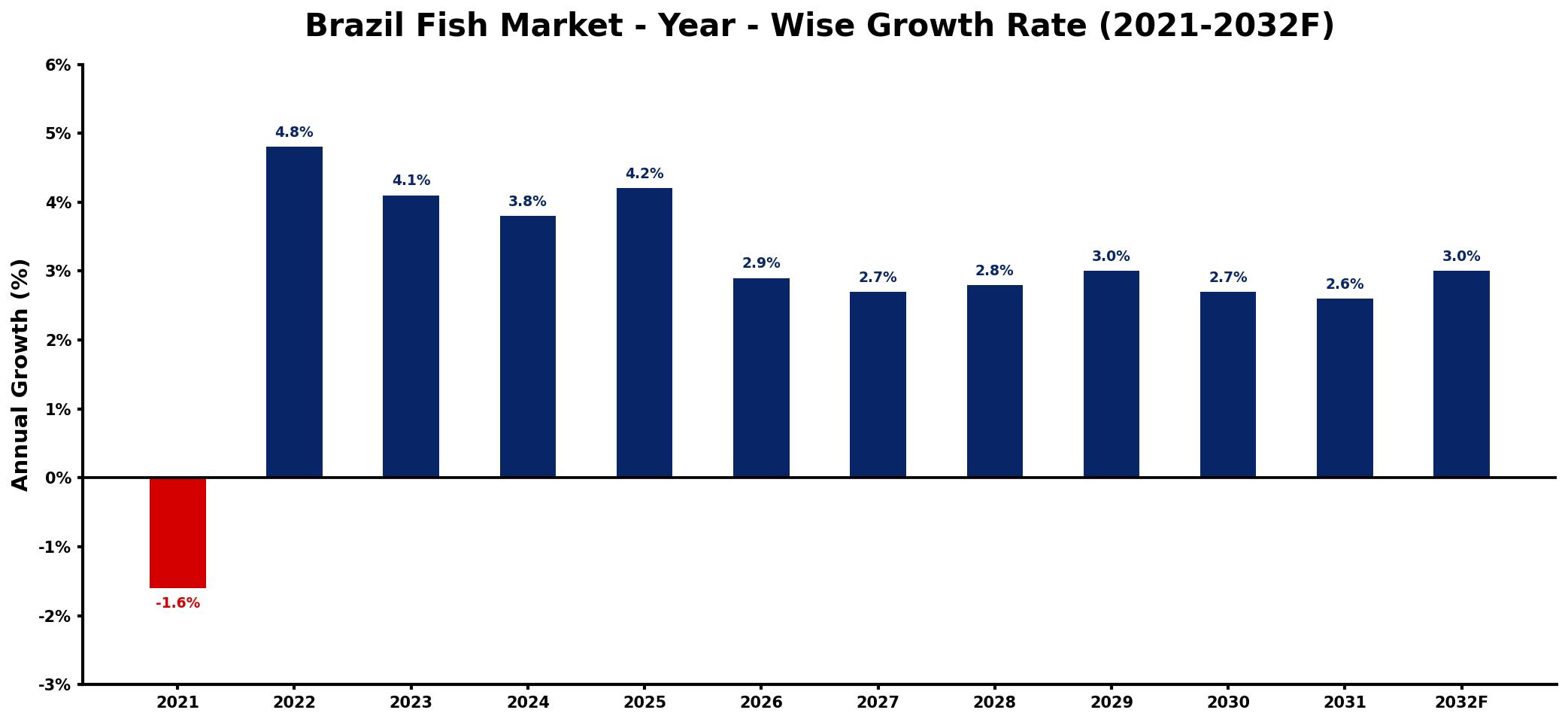
The table below presents the year‑wise growth rates along with the key drivers influencing the market
| Year | Growth Rate | Major Drivers |
| 2021 | -1.6% | Consumer interest in alternatives declines |
| 2022 | 4.8% | Sustainable sourcing practices expand |
| 2023 | 4.1% | Health trends drive consumption growth |
| 2024 | 3.8% | Export markets show significant demand |
| 2025 | 4.2% | Aquaculture investments increase rapidly |
| 2026 | 2.9% | Innovative processing technologies emerge |
| 2027 | 2.7% | Culinary tourism boosts local markets |
| 2028 | 2.8% | E-commerce platforms gain popularity |
| 2029 | 3.0% | Nutritional awareness enhances demand |
| 2030 | 2.7% | Regulatory support fosters industry stability |
| 2031 | 2.6% | Local production initiatives gain traction |
| 2032 | 3.0% | Cultural festivals promote regional specialties |
Note: Market size estimations and growth projections presented in this report are based on 6Wresearch's proprietary forecasting methodology, utilizing the latest available industry data, government publications, and primary research inputs.
Brazil Fish Market Synopsis
Brazil's diverse aquatic resources, encompassing both marine and freshwater species, are integral to its culinary culture. Fish and seafood hold a prominent position in Brazilian diets, offering essential nutrients and protein, particularly in coastal regions where fishing traditions thrive.
The countrys extensive coastline and numerous inland waterways serve as a foundation for a robust fishing industry. Not only do local fisheries contribute significantly to employment and food security, but they also bolster the nations export capabilities, tapping into global seafood markets.
Brazil Fish Market Key Takeaways
- The aquaculture sector plays a crucial role in meeting the growing demand for seafood in Brazil.
- Government regulations focus on promoting sustainable practices and safeguarding aquatic ecosystems.
- Consumer preferences are shifting towards high-protein seafood options, driving market growth.
- Logistics and supply chain management are pivotal for maintaining quality and safety standards.
- The market presents opportunities for innovation in sustainable fishing and seafood processing technologies.
Evaluation of Restraints in Brazil Fish Market
While the Brazil Fish Market shows significant potential, several restraints impede its full realization. Overfishing and habitat degradation present sustainability challenges that could undermine the fishing industrys long-term viability. Additionally, ensuring compliance with stringent seafood safety and quality standards can strain resources, particularly for smaller operators. The market also grapples with logistical hurdles, including transportation inefficiencies and fluctuating market prices, which can affect profitability and supply consistency.
Brazil Fish Market Trends
Several trends are currently shaping the Brazil Fish Market. The demand for sustainably sourced fish is on the rise, with consumers increasingly aware of the environmental impact of their food choices. Furthermore, advancements in aquaculture technology are enhancing production efficiency and fish quality. The integration of digital platforms for seafood distribution is also gaining traction, enabling better access for consumers and retailers alike.
Brazil Fish Market Opportunities
Emerging opportunities within the Brazil Fish Market lie predominantly in the aquaculture sector, which is poised for expansion as it adapts to sustainable practices. Investments in innovative farming techniques, such as aquaponics and biofloc technology, present avenues for growth. Additionally, niche markets for organic and specialty seafood products are gaining momentum, catering to health-conscious consumers. Expanding export avenues, particularly in premium segments, can also provide significant revenue boosts for market participants.
Government Initiatives in the Brazil Fish Market
Brazilian government initiatives significantly influence the fish market landscape through regulatory frameworks focused on sustainable fishing and aquaculture management. Policies are being developed to enforce fishing quotas, promote responsible harvesting methods, and ensure food safety through rigorous inspection protocols. These efforts aim to balance economic growth with the preservation of marine ecosystems, thus ensuring the long-term health of the fishing industry.
Future Insights of the Brazil Fish Market
Looking ahead to 2026-2032, the Brazil Fish Market is likely to evolve significantly. Sustainable aquaculture practices will become increasingly vital as consumer preferences shift toward ethically sourced products. Technological innovations will facilitate higher production rates while ensuring minimal environmental impact. Furthermore, as trade regulations adjust to global demands, Brazil's position as a key exporter of seafood products is expected to strengthen, aligning with international sustainability goals.
Brazil Fish Market Latest Developments (2025 - 2026)
Recent developments in the Brazil Fish Market indicate a strong focus on sustainability and innovation. Industry stakeholders are increasingly investing in technologies that enhance aquaculture efficiency and seafood quality. Additionally, collaborative efforts between government and private sectors are being observed, aimed at promoting best practices in fishing and aquaculture. These initiatives are expected to drive market evolution and improve competitiveness in both domestic and international markets.
Brazil Fish Market - Key Attractiveness of the Report
- 10 Years of Market Numbers
- Historical Data Starting from 2022 to 2025
- Base Year: 2025
- Forecast Data until 2032
- Key Performance Indicators Impacting the Market
- Major Upcoming Developments and Projects
Key Highlights of the Report:
- Brazil Fish Market Outlook
- Market Size of Brazil Fish Market, 2025
- Forecast of Brazil Fish Market, 2032
- Historical Data and Forecast of Brazil Fish Revenues & Volume for the Period 2022-2032F
- Brazil Fish Market Trend Evolution
- Brazil Fish Market Drivers and Challenges
- Brazil Fish Price Trends
- Brazil Fish Porter's Five Forces
- Brazil Fish Industry Life Cycle
- Historical Data and Forecast of Brazil Fish Market Revenues & Volume By Fish Type for the Period 2022-2032F
- Historical Data and Forecast of Brazil Fish Market Revenues & Volume By Inland Fishes for the Period 2022-2032F
- Historical Data and Forecast of Brazil Fish Market Revenues & Volume By Marine Fishes for the Period 2022-2032F
- Historical Data and Forecast of Brazil Fish Market Revenues & Volume By Shrimps for the Period 2022-2032F
- Historical Data and Forecast of Brazil Fish Market Revenues & Volume By Scampi for the Period 2022-2032F
- Historical Data and Forecast of Brazil Fish Market Revenues & Volume By Product Type for the Period 2022-2032F
- Historical Data and Forecast of Brazil Fish Market Revenues & Volume By Fresh for the Period 2022-2032F
- Historical Data and Forecast of Brazil Fish Market Revenues & Volume By Frozen for the Period 2022-2032F
- Historical Data and Forecast of Brazil Fish Market Revenues & Volume By Canned for the Period 2022-2032F
- Historical Data and Forecast of Brazil Fish Market Revenues & Volume By Others for the Period 2022-2032F
- Historical Data and Forecast of Brazil Fish Market Revenues & Volume By Distribution Channel for the Period 2022-2032F
- Historical Data and Forecast of Brazil Fish Market Revenues & Volume By Retail for the Period 2022-2032F
- Historical Data and Forecast of Brazil Fish Market Revenues & Volume By Institutional for the Period 2022-2032F
- Historical Data and Forecast of Brazil Fish Market Revenues & Volume By Sector for the Period 2022-2032F
- Historical Data and Forecast of Brazil Fish Market Revenues & Volume By Organised for the Period 2022-2032F
- Historical Data and Forecast of Brazil Fish Market Revenues & Volume By Unorganised for the Period 2022-2032F
- Brazil Fish Import Export Trade Statistics
- Market Opportunity Assessment By Fish Type
- Market Opportunity Assessment By Product Type
- Market Opportunity Assessment By Distribution Channel
- Market Opportunity Assessment By Sector
- Brazil Fish Top Companies Market Share
- Brazil Fish Competitive Benchmarking By Technical and Operational Parameters
- Brazil Fish Company Profiles
- Brazil Fish Key Strategic Recommendations






































