Peru Fish Market Size, Share & Growth Rate
The Peru Fish Market was estimated at USD 438 Million in 2025 and is projected to reach USD 583 Million by 2032, growing at a CAGR of 4.2% from 2026 to 2032. This growth trajectory is driven by an increasing global demand for sustainably sourced seafood, alongside a rise in local consumption due to health trends emphasizing the nutritional benefits of fish. The market is also benefiting from Peru's reputation for high-quality seafood products, particularly anchovies and ceviche, which resonate well both domestically and internationally.
Peru Fish Market Year-wise Growth Rate and Key Drivers
This graph highlights how the Peru Fish Market has steadily grown over the years, supported by major growth factors.
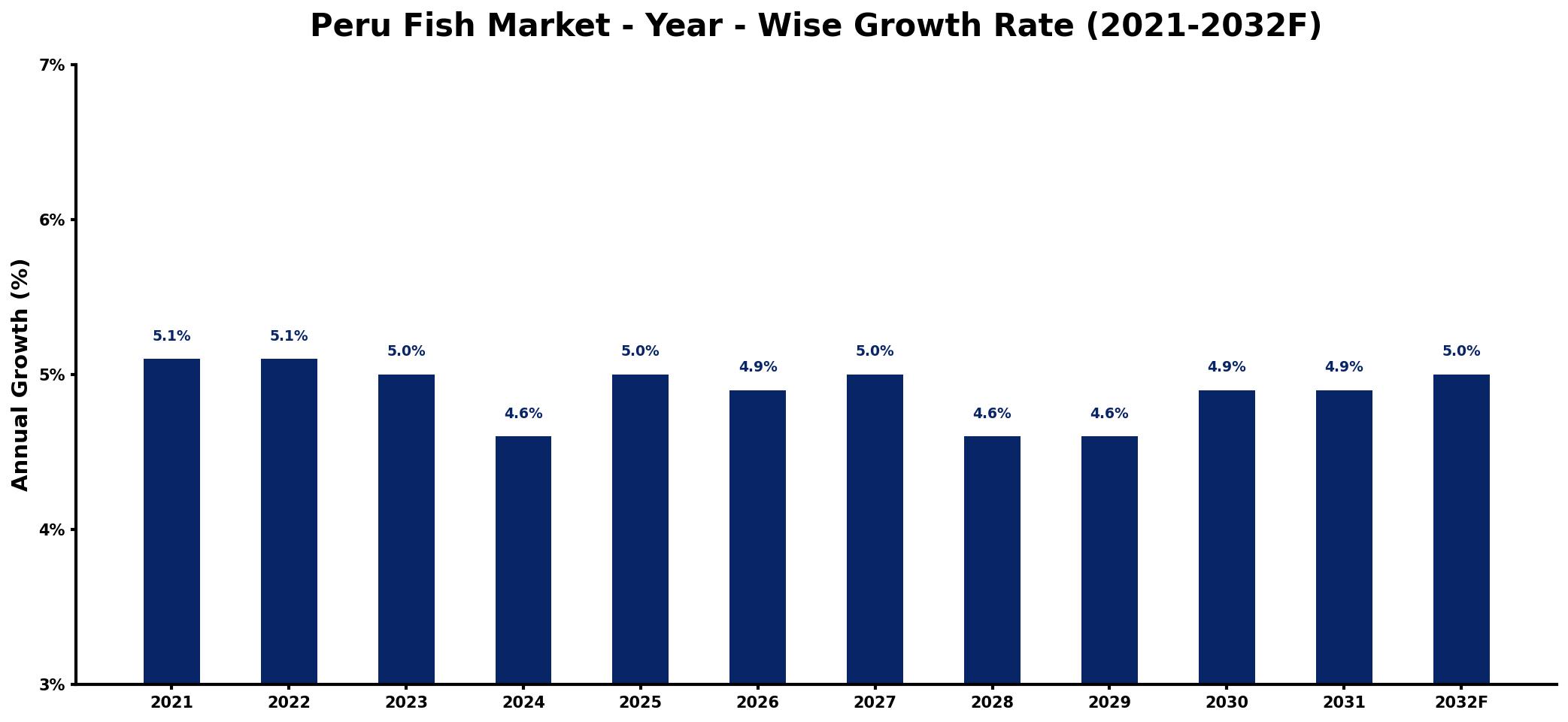
The table below presents the year‑wise growth rates along with the key drivers influencing the market
| Year | Growth Rate | Major Drivers |
| 2021 | 5.1% | Rising demand for sustainable seafood |
| 2022 | 5.1% | Increased export opportunities globally |
| 2023 | 5.0% | Growth in aquaculture technologies |
| 2024 | 4.6% | Expansion of local processing facilities |
| 2025 | 5.0% | Higher consumer health awareness trends |
| 2026 | 4.9% | Investment in cold chain logistics |
| 2027 | 5.0% | Emergence of online retail platforms |
| 2028 | 4.6% | Development of eco-friendly packaging |
| 2029 | 4.6% | Strengthening regional trade agreements |
| 2030 | 4.9% | Adoption of innovative farming techniques |
| 2031 | 4.9% | Diversification of product offerings |
| 2032 | 5.0% | Enhancement of supply chain efficiency |
Note: Market size estimations and growth projections presented in this report are based on 6Wresearch's proprietary forecasting methodology, utilizing the latest available industry data, government publications, and primary research inputs.
Peru Fish Market Synopsis
Sustainability is the strongest force currently shaping the Peru Fish Market. The rising consumer awareness around environmental issues is pushing suppliers to adopt practices that ensure the sustainability of fish stocks, thereby enhancing the overall quality and reputation of Peruvian seafood.
Moreover, the market is experiencing a paradigm shift towards higher-value fish species, reflecting changing consumer preferences. This shift is not only enhancing the profitability of local fisheries but is also encouraging the development of aquaculture and value-added processing initiatives.
Peru Fish Market Key Takeaways
- The market is projected to grow steadily, driven by increased global demand for seafood.
- Sustainable fishing practices are becoming a critical component for suppliers to remain competitive.
- There is a notable shift towards high-value fish species like mahi-mahi and tuna.
- Health consciousness among consumers is increasing, boosting the sales of omega-3 rich fish.
- Infrastructure improvements are essential for addressing storage and transportation challenges.
Evaluation of Restraints in Peru Fish Market
Despite its potential, the Peru Fish Market faces significant restraints. Regulatory issues regarding overfishing and illegal fishing practices are paramount, posing a threat to the sustainability of critical fish stocks. Additionally, local fishers encounter stiff competition from imported seafood, often available at lower price points, which can undermine domestic production. Furthermore, inadequate storage and transportation infrastructure can lead to quality deterioration and increased waste within the supply chain, compounding the challenges for local businesses.
Peru Fish Market Trends
Current trends in the Peru Fish Market reflect a growing consumer preference for sustainably sourced seafood. Certifications like MSC (Marine Stewardship Council) are becoming more prevalent among suppliers, indicating a commitment to responsible fishing practices. Furthermore, health and wellness trends are shaping demand, as consumers increasingly seek out fish rich in omega-3 fatty acids. The market is also witnessing a shift towards innovative processing techniques, enhancing product quality and shelf life.
Peru Fish Market Opportunities
The Peru Fish Market offers diverse investment opportunities, particularly in aquaculture for high-demand species such as anchovies and trout. Additionally, there is significant potential in value-added processing facilities, which can cater to both domestic and international markets. Investments aimed at adopting sustainable fishing technologies are expected to yield long-term benefits, particularly as global demand for responsible seafood increases. Overall, the market presents a plethora of prospects across various segments, from production to export.
Government Initiatives in the Peru Fish Market
Government policies in Peru are increasingly focused on promoting sustainable fishing practices and conserving marine resources. The Peruvian government has implemented stringent regulations and quotas to mitigate overfishing and protect vulnerable species. Additionally, efforts to combat illegal fishing are in place, with penalties established to deter violations. Public spending and support for responsible aquaculture initiatives further underscore the government's commitment to enhancing sustainability within the fish market.
Future Insights of the Peru Fish Market
Looking ahead, the Peru Fish Market is on a path of growth and innovation from 2026 to 2032. Factors driving this momentum include an upsurge in health-conscious consumers seeking fish as a protein source and the expansion of export markets for high-quality seafood. Technological advancements in fishing and processing methods will likely play a critical role in enhancing operational efficiency. However, addressing sustainability concerns and market volatility remains vital for ensuring the long-term success and viability of this thriving market.
Peru Fish Market Latest Developments (2025 - 2026)
Recent developments in the Peru Fish Market indicate a growing emphasis on sustainability and quality. Industry stakeholders are increasingly adopting advanced technologies to improve processing efficiency and reduce environmental impacts. Additionally, there has been an uptick in partnerships between local communities and international organizations aimed at promoting responsible fishing practices. These initiatives are expected to fortify the market's position on the global stage while enhancing local economic opportunities.
Peru Fish Market - Key Attractiveness of the Report
- 10 Years of Market Numbers
- Historical Data Starting from 2022 to 2025
- Base Year: 2025
- Forecast Data until 2032
- Key Performance Indicators Impacting the Market
- Major Upcoming Developments and Projects
Key Highlights of the Report:
- Peru Fish Market Outlook
- Market Size of Peru Fish Market, 2025
- Forecast of Peru Fish Market, 2032
- Historical Data and Forecast of Peru Fish Revenues & Volume for the Period 2022-2032F
- Peru Fish Market Trend Evolution
- Peru Fish Market Drivers and Challenges
- Peru Fish Price Trends
- Peru Fish Porter's Five Forces
- Peru Fish Industry Life Cycle
- Historical Data and Forecast of Peru Fish Market Revenues & Volume By Fish Type for the Period 2022-2032F
- Historical Data and Forecast of Peru Fish Market Revenues & Volume By Inland Fishes for the Period 2022-2032F
- Historical Data and Forecast of Peru Fish Market Revenues & Volume By Marine Fishes for the Period 2022-2032F
- Historical Data and Forecast of Peru Fish Market Revenues & Volume By Shrimps for the Period 2022-2032F
- Historical Data and Forecast of Peru Fish Market Revenues & Volume By Scampi for the Period 2022-2032F
- Historical Data and Forecast of Peru Fish Market Revenues & Volume By Product Type for the Period 2022-2032F
- Historical Data and Forecast of Peru Fish Market Revenues & Volume By Fresh for the Period 2022-2032F
- Historical Data and Forecast of Peru Fish Market Revenues & Volume By Frozen for the Period 2022-2032F
- Historical Data and Forecast of Peru Fish Market Revenues & Volume By Canned for the Period 2022-2032F
- Historical Data and Forecast of Peru Fish Market Revenues & Volume By Others for the Period 2022-2032F
- Historical Data and Forecast of Peru Fish Market Revenues & Volume By Distribution Channel for the Period 2022-2032F
- Historical Data and Forecast of Peru Fish Market Revenues & Volume By Retail for the Period 2022-2032F
- Historical Data and Forecast of Peru Fish Market Revenues & Volume By Institutional for the Period 2022-2032F
- Historical Data and Forecast of Peru Fish Market Revenues & Volume By Sector for the Period 2022-2032F
- Historical Data and Forecast of Peru Fish Market Revenues & Volume By Organised for the Period 2022-2032F
- Historical Data and Forecast of Peru Fish Market Revenues & Volume By Unorganised for the Period 2022-2032F
- Peru Fish Import Export Trade Statistics
- Market Opportunity Assessment By Fish Type
- Market Opportunity Assessment By Product Type
- Market Opportunity Assessment By Distribution Channel
- Market Opportunity Assessment By Sector
- Peru Fish Top Companies Market Share
- Peru Fish Competitive Benchmarking By Technical and Operational Parameters
- Peru Fish Company Profiles
- Peru Fish Key Strategic Recommendations






































