Brazil Food Enzymes Market Growth Rate Analysis (2021-2031)
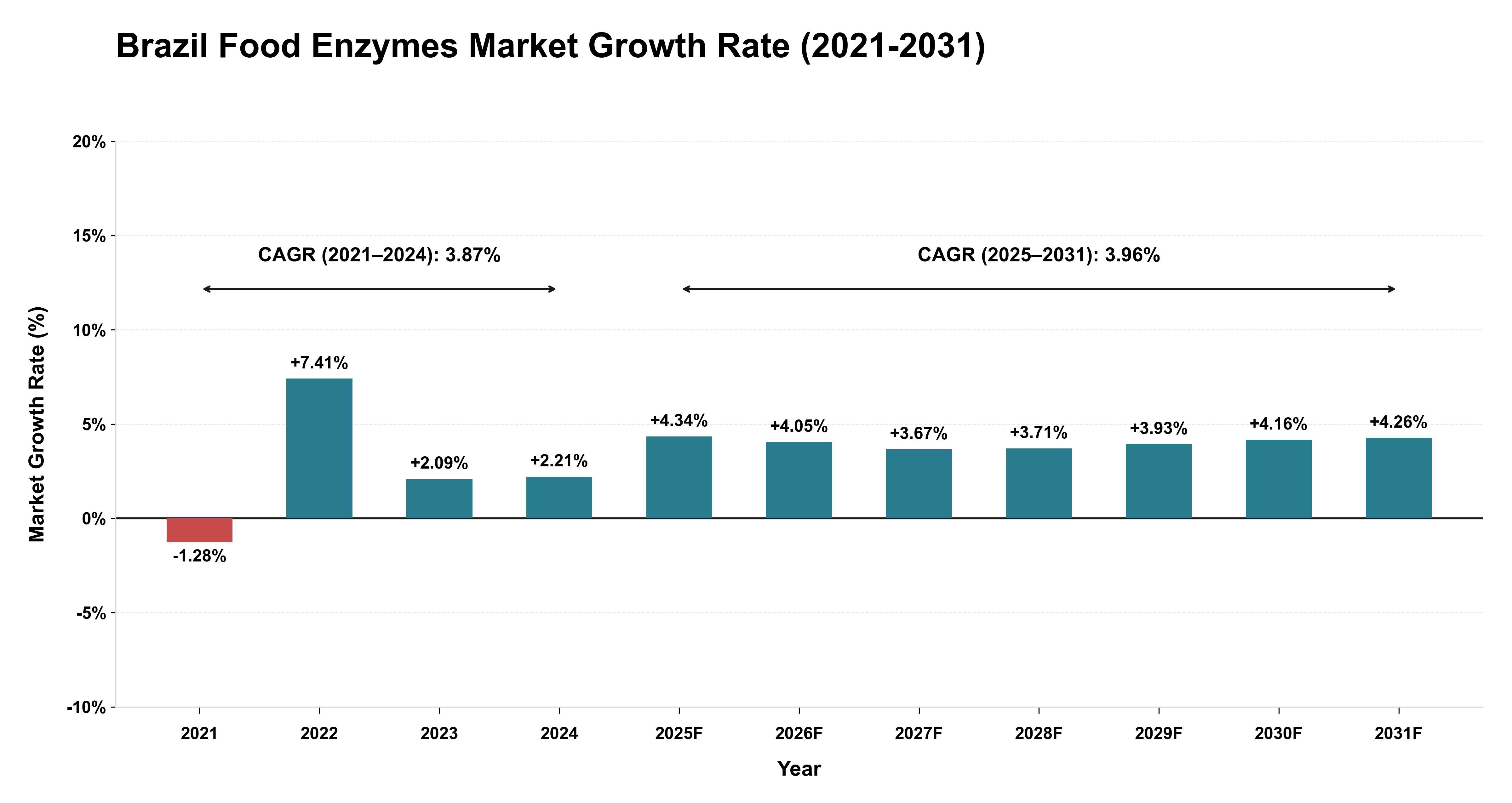
The Brazil Food Enzymes Market faced a challenging start in 2021 with a contraction of -1.28%, likely influenced by supply chain disruptions or economic uncertainties. However, the market showed resilience in 2022, achieving robust growth of 7.41%. Subsequent years demonstrated steady expansion in line with the historical CAGR of 3.87%. Looking ahead, the market is expected to sustain growth at a slightly accelerated pace, with a forecasted CAGR of 3.96% from 2025 to 2031. This trajectory indicates a maturing market stabilizing after initial fluctuations, driven by increased consumer demand for processed foods, advancements in enzyme production technology, and evolving regulatory landscapes shaping the industry's future.
Brazil Food Enzymes Market Overview
The food enzymes market in Brazil is witnessing growth, fueled by the increasing demand for processed and convenience foods. Enzymes play a crucial role in food processing, improving texture, flavor, and shelf life. The market`s expansion is driven by consumer preferences for natural and sustainable food additives, as well as advancements in enzyme technology.
Drivers of the market
The Brazil Food Enzymes Market is thriving due to the growing awareness of healthier food options and the demand for natural food processing solutions. Food enzymes play a crucial role in enhancing the quality and nutritional value of various food products. The market growth is supported by the evolving food and beverage industry and the consumer shift towards clean-label and enzyme-enhanced products.
Challenges of the market
In the Brazil Food Enzymes market, challenges stem from consumer preferences, regulatory complexities, and the need for continuous research and development. Shifting consumer preferences towards natural and clean-label products impact the demand for food enzymes, necessitating adjustments in product formulations. Regulatory requirements for enzyme usage in the food industry demand rigorous compliance and may pose obstacles for market players. Continuous investment in research and development to address evolving market demands and technological advancements becomes crucial for sustained growth in the food enzymes market.
Government Policy of the market
The Brazil Food Enzymes Market is closely regulated to ensure food safety and product quality. Government policies may include standards for enzyme usage in the food industry, labeling requirements, and measures to address potential health and safety concerns.
Key Highlights of the Report:
- Brazil Food Enzymes Market Outlook
- Market Size of Brazil Food Enzymes Market, 2024
- Forecast of Brazil Food Enzymes Market, 2031
- Historical Data and Forecast of Brazil Food Enzymes Revenues & Volume for the Period 2018 - 2031
- Brazil Food Enzymes Market Trend Evolution
- Brazil Food Enzymes Market Drivers and Challenges
- Brazil Food Enzymes Price Trends
- Brazil Food Enzymes Porter's Five Forces
- Brazil Food Enzymes Industry Life Cycle
- Historical Data and Forecast of Brazil Food Enzymes Market Revenues & Volume By Source for the Period 2018 - 2031
- Historical Data and Forecast of Brazil Food Enzymes Market Revenues & Volume By Microorganisms for the Period 2018 - 2031
- Historical Data and Forecast of Brazil Food Enzymes Market Revenues & Volume By Animal for the Period 2018 - 2031
- Historical Data and Forecast of Brazil Food Enzymes Market Revenues & Volume By Plant for the Period 2018 - 2031
- Historical Data and Forecast of Brazil Food Enzymes Market Revenues & Volume By Type for the Period 2018 - 2031
- Historical Data and Forecast of Brazil Food Enzymes Market Revenues & Volume By Carbohydarse for the Period 2018 - 2031
- Historical Data and Forecast of Brazil Food Enzymes Market Revenues & Volume By Protease for the Period 2018 - 2031
- Historical Data and Forecast of Brazil Food Enzymes Market Revenues & Volume By Lipase for the Period 2018 - 2031
- Historical Data and Forecast of Brazil Food Enzymes Market Revenues & Volume By Others for the Period 2018 - 2031
- Historical Data and Forecast of Brazil Food Enzymes Market Revenues & Volume By Form for the Period 2018 - 2031
- Historical Data and Forecast of Brazil Food Enzymes Market Revenues & Volume By Liquid for the Period 2018 - 2031
- Historical Data and Forecast of Brazil Food Enzymes Market Revenues & Volume By Solid for the Period 2018 - 2031
- Historical Data and Forecast of Brazil Food Enzymes Market Revenues & Volume By Application for the Period 2018 - 2031
- Historical Data and Forecast of Brazil Food Enzymes Market Revenues & Volume By Bakery for the Period 2018 - 2031
- Historical Data and Forecast of Brazil Food Enzymes Market Revenues & Volume By Dairy for the Period 2018 - 2031
- Historical Data and Forecast of Brazil Food Enzymes Market Revenues & Volume By Beverage for the Period 2018 - 2031
- Historical Data and Forecast of Brazil Food Enzymes Market Revenues & Volume By Meat, Fish, and Egg Processing for the Period 2018 - 2031
- Historical Data and Forecast of Brazil Food Enzymes Market Revenues & Volume By Grain and Oilseed Processing for the Period 2018 - 2031
- Historical Data and Forecast of Brazil Food Enzymes Market Revenues & Volume By Others for the Period 2018 - 2031
- Brazil Food Enzymes Import Export Trade Statistics
- Market Opportunity Assessment By Source
- Market Opportunity Assessment By Type
- Market Opportunity Assessment By Form
- Market Opportunity Assessment By Application
- Brazil Food Enzymes Top Companies Market Share
- Brazil Food Enzymes Competitive Benchmarking By Technical and Operational Parameters
- Brazil Food Enzymes Company Profiles
- Brazil Food Enzymes Key Strategic Recommendations






































