Brazil Gas Chromatography Systems Market Size, Share & Growth Rate
The Brazil Gas Chromatography Systems Market was estimated at USD 472 Million in 2025 and is projected to reach USD 566 Million by 2032, growing at a CAGR of 2.6% from 2026 to 2032. This growth trajectory is largely driven by the increasing demand for sophisticated analytical instruments in key industries such as pharmaceuticals and environmental monitoring. The adoption of advanced gas chromatography systems is bolstered by ongoing technological advancements that enhance sensitivity and automation, meeting the stringent quality control standards across sectors.
Brazil Gas Chromatography Systems Market Year-wise Growth Rate and Key Drivers
This graph highlights how the Brazil Gas Chromatography Systems Market has steadily grown over the years, supported by major growth factors.
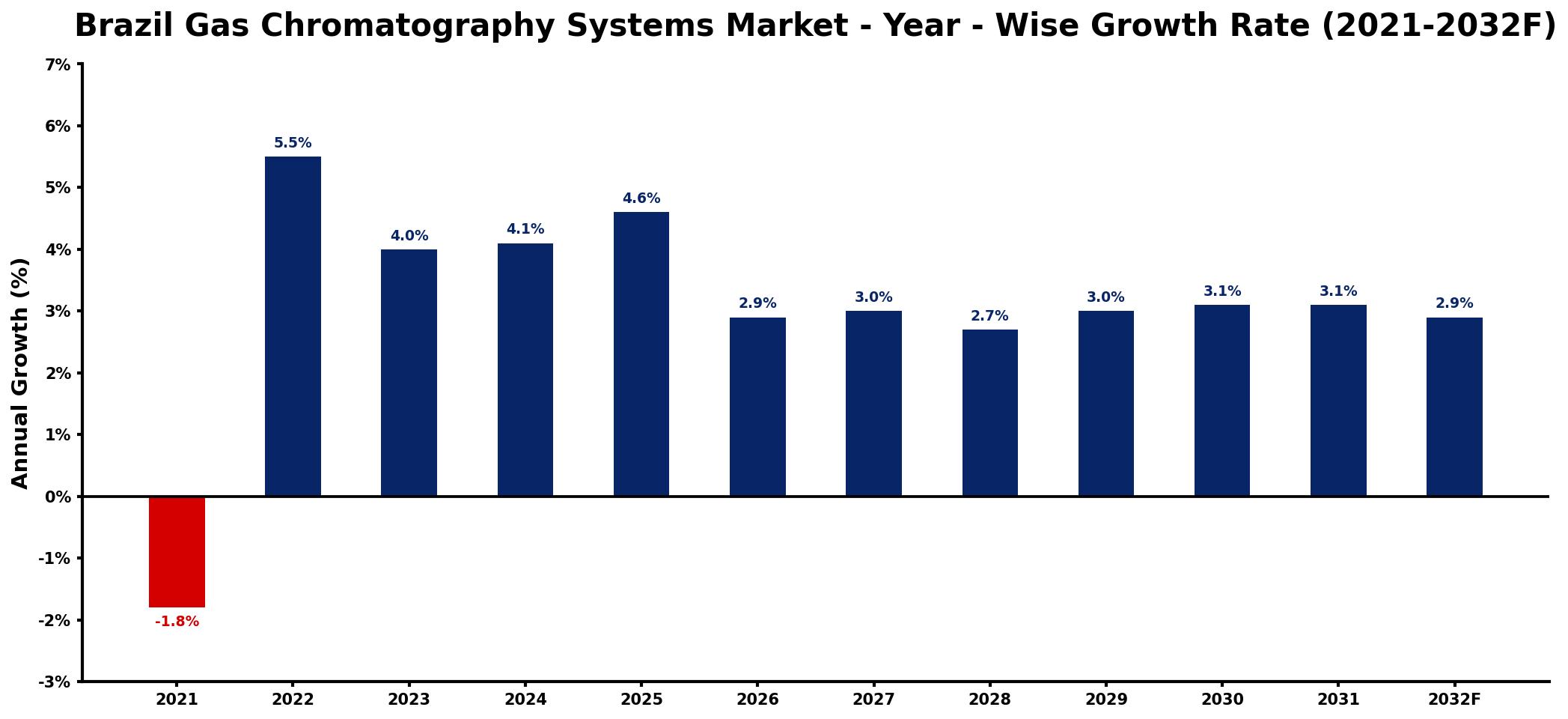
The table below presents the year‑wise growth rates along with the key drivers influencing the market
| Year | Growth Rate | Major Drivers |
| 2021 | -1.8% | Decreased investment in laboratory infrastructure |
| 2022 | 5.5% | Increased demand from pharmaceutical sector |
| 2023 | 4.0% | Expansion of environmental monitoring initiatives |
| 2024 | 4.1% | Growth in food safety regulations |
| 2025 | 4.6% | Rising applications in petrochemical analysis |
| 2026 | 2.9% | Investment in research and development |
| 2027 | 3.0% | Emergence of new industrial applications |
| 2028 | 2.7% | Growing focus on quality control |
| 2029 | 3.0% | Strengthened regulatory compliance requirements |
| 2030 | 3.1% | Increased adoption in academic research |
| 2031 | 3.1% | Enhanced technological advancements in analytics |
| 2032 | 2.9% | Diversification of applications across industries |
Note: Market size estimations and growth projections presented in this report are based on 6Wresearch's proprietary forecasting methodology, utilizing the latest available industry data, government publications, and primary research inputs.
Brazil Gas Chromatography Systems Market Synopsis
Technological advancement stands out as the most influential force currently shaping the Brazil Gas Chromatography Systems Market. The introduction of new technologies has expanded the analytical capabilities of gas chromatography systems, driving their increased adoption in laboratories and industrial applications.
Moreover, the necessity for compliance with rigorous quality and safety standards is a critical motivator. Industries are increasingly reliant on gas chromatography for precise chemical analysis and quality assurance, highlighting its integral role in enhancing operational efficiencies.
Brazil Gas Chromatography Systems Market Key Takeaways
- The market is anticipated to grow from USD 472 Million in 2025 to USD 566 Million by 2032.
- Technological innovations are rapidly transforming gas chromatography systems, increasing their capabilities.
- Pharmaceuticals and environmental monitoring sectors are the primary drivers of market demand.
- Stringent regulatory requirements continue to propel the need for advanced analytical solutions.
- Investment in R&D is vital for adapting to evolving industry standards and regulations.
Evaluation of Restraints in Brazil Gas Chromatography Systems Market
Despite its promising growth, the Brazil Gas Chromatography Systems Market faces notable restraints. One significant challenge is the stringent compliance required with environmental regulations, which demands ongoing adaptation of technologies. Companies must prioritize investment in research and development to ensure their systems not only meet these evolving standards but also maintain competitiveness. Additionally, fluctuating economic conditions may impact funding for new technologies, potentially slowing market growth.
Brazil Gas Chromatography Systems Market Trends
One of the leading trends in the Brazil Gas Chromatography Systems Market is the integration of automation and AI into analytical processes. Automation increases throughput and reduces human error, while AI facilitates data analysis and interpretation. These innovations are particularly advantageous in high-demand sectors such as pharmaceuticals and environmental monitoring, where precision is paramount.
Another emerging trend is the increasing focus on sustainability. Companies are actively seeking eco-friendly solutions and minimizing waste in laboratory processes. This shift not only aligns with global sustainability goals but also enhances brand reputation, making it a crucial component of corporate strategy moving forward.
Brazil Gas Chromatography Systems Market Opportunities
The Brazilian Gas Chromatography Systems Market presents numerous growth opportunities, particularly in developing customized solutions for niche applications. As industries expand their operations and regulatory demands increase, there is a significant opportunity for companies to offer tailored gas chromatography systems that meet specific analytical needs. Additionally, partnerships with academic institutions can foster innovation and enhance R&D capabilities, providing a competitive edge in the market.
Government Initiatives in the Brazil Gas Chromatography Systems Market
The Brazilian government is actively promoting technological advancements and quality assurance in the gas chromatography systems market. Initiatives aimed at enhancing collaboration between industry stakeholders and academic institutions are being implemented to stimulate research and development. These policies not only support innovation but also encourage investment in new technologies that can improve the performance and reliability of gas chromatography systems.
Future Insights of the Brazil Gas Chromatography Systems Market
Looking ahead to 2026-2032, the Brazil Gas Chromatography Systems Market is poised for sustained growth. The increasing complexity of analytical requirements across various industries will drive demand for more advanced and efficient gas chromatography systems. As technological innovations continue to evolve, including the adoption of hybrid systems and enhanced data analytics, the market will likely expand to meet these emerging needs. Furthermore, the focus on regulatory compliance will necessitate investments in high-quality analytical solutions, solidifying the market's growth potential.
Brazil Gas Chromatography Systems Market Latest Developments (2025 - 2026)
In the latest developments within the Brazil Gas Chromatography Systems Market, there is a notable push towards the adoption of multi-dimensional gas chromatography techniques that enhance analytical precision. Moreover, industry stakeholders are increasingly focusing on developing more environmentally friendly products, aligning with global sustainability trends. Investments in automation are also becoming more prevalent, reflecting a shift towards improving operational efficiencies in laboratories across Brazil.
Brazil Gas Chromatography Systems Market - Key Attractiveness of the Report
- 10 Years of Market Numbers
- Historical Data Starting from 2022 to 2025
- Base Year: 2025
- Forecast Data until 2032
- Key Performance Indicators Impacting the Market
- Major Upcoming Developments and Projects
Key Highlights of the Report:
- Brazil Gas Chromatography Systems Market Outlook
- Market Size of Brazil Gas Chromatography Systems Market, 2025
- Forecast of Brazil Gas Chromatography Systems Market, 2032
- Historical Data and Forecast of Brazil Gas Chromatography Systems Revenues & Volume for the Period 2022-2032F
- Brazil Gas Chromatography Systems Market Trend Evolution
- Brazil Gas Chromatography Systems Market Drivers and Challenges
- Brazil Gas Chromatography Systems Price Trends
- Brazil Gas Chromatography Systems Porter's Five Forces
- Brazil Gas Chromatography Systems Industry Life Cycle
- Historical Data and Forecast of Brazil Gas Chromatography Systems Market Revenues & Volume By Product for the Period 2022-2032F
- Historical Data and Forecast of Brazil Gas Chromatography Systems Market Revenues & Volume By Systems for the Period 2022-2032F
- Historical Data and Forecast of Brazil Gas Chromatography Systems Market Revenues & Volume By Detectors for the Period 2022-2032F
- Historical Data and Forecast of Brazil Gas Chromatography Systems Market Revenues & Volume By Auto-samplers for the Period 2022-2032F
- Historical Data and Forecast of Brazil Gas Chromatography Systems Market Revenues & Volume By Fraction Collectors for the Period 2022-2032F
- Historical Data and Forecast of Brazil Gas Chromatography Systems Market Revenues & Volume By Other Products for the Period 2022-2032F
- Historical Data and Forecast of Brazil Gas Chromatography Systems Market Revenues & Volume By End User for the Period 2022-2032F
- Historical Data and Forecast of Brazil Gas Chromatography Systems Market Revenues & Volume By Pharmaceutical and Bioindustries for the Period 2022-2032F
- Historical Data and Forecast of Brazil Gas Chromatography Systems Market Revenues & Volume By Academic Research Institutes for the Period 2022-2032F
- Historical Data and Forecast of Brazil Gas Chromatography Systems Market Revenues & Volume By Other End Users for the Period 2022-2032F
- Brazil Gas Chromatography Systems Import Export Trade Statistics
- Market Opportunity Assessment By Product
- Market Opportunity Assessment By End User
- Brazil Gas Chromatography Systems Top Companies Market Share
- Brazil Gas Chromatography Systems Competitive Benchmarking By Technical and Operational Parameters
- Brazil Gas Chromatography Systems Company Profiles
- Brazil Gas Chromatography Systems Key Strategic Recommendations






































