Brazil Greenhouse, Nursery, And Flowers Market Size, Share & Growth Rate
The Brazil Greenhouse, Nursery, And Flowers Market was estimated at USD 165 Million in 2025 and is projected to reach USD 198 Million by 2032, growing at a CAGR of 2.6% from 2026 to 2032. This growth is being driven by Brazils rich biodiversity and the increasing preference for ornamental plants, both in local and international markets. The country's favorable climate allows for a wide range of horticultural products, enhancing its position as a leading exporter in the floriculture industry.
Brazil Greenhouse, Nursery, And Flowers Market Year-wise Growth Rate and Key Drivers
This graph highlights how the Brazil Greenhouse, Nursery, And Flowers Market has steadily grown over the years, supported by major growth factors.
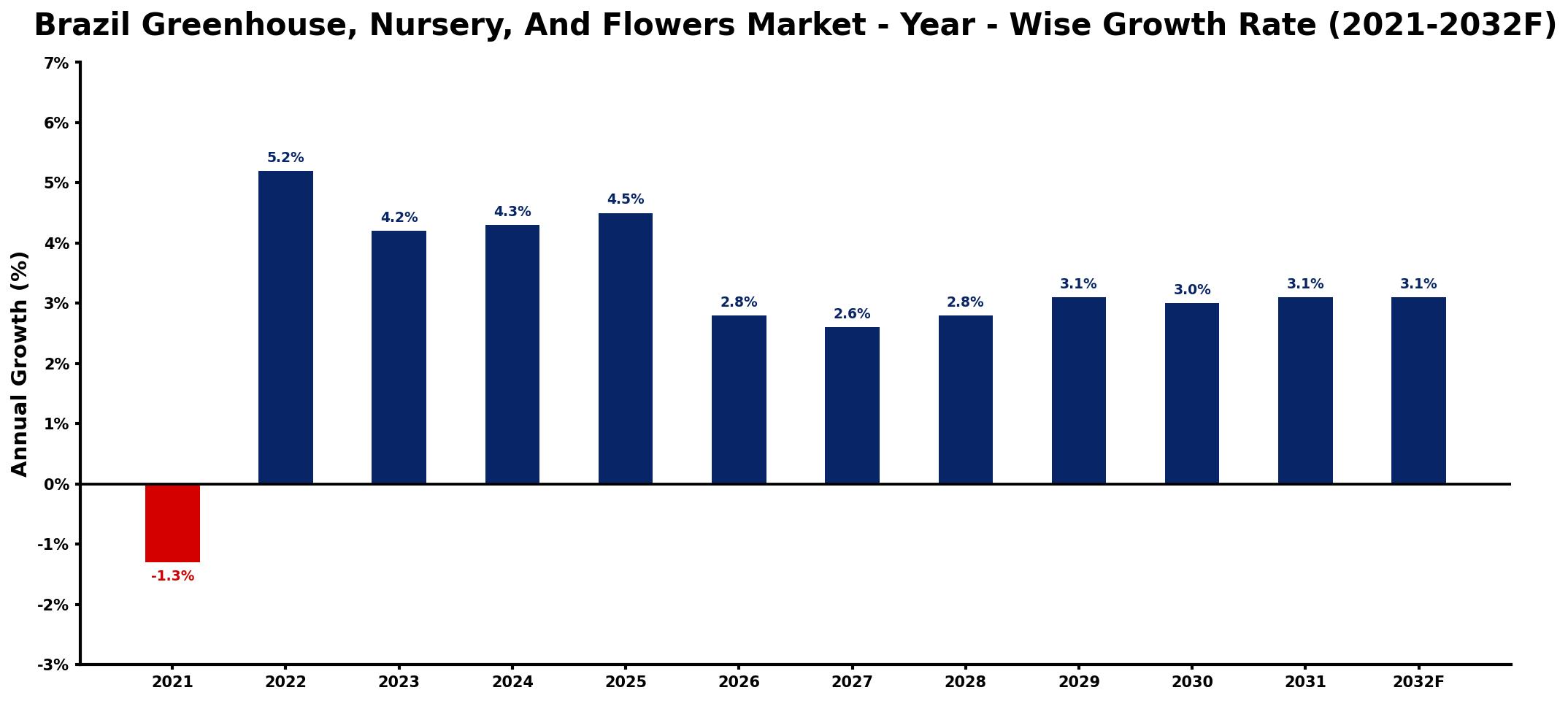
The table below presents the year‑wise growth rates along with the key drivers influencing the market
| Year | Growth Rate | Major Drivers |
| 2021 | -1.3% | decreased consumer spending on gardening |
| 2022 | 5.2% | increased interest in home gardening |
| 2023 | 4.2% | growth in sustainable gardening practices |
| 2024 | 4.3% | rising demand for organic products |
| 2025 | 4.5% | expansion of urban gardening initiatives |
| 2026 | 2.8% | investments in eco-friendly technologies |
| 2027 | 2.6% | growing popularity of indoor plants |
| 2028 | 2.8% | enhanced distribution network efficiency |
| 2029 | 3.1% | increased awareness of biodiversity importance |
| 2030 | 3.0% | development of new gardening technologies |
| 2031 | 3.1% | rise in gardening as therapy |
| 2032 | 3.1% | strengthening community gardening programs |
Note: Market size estimations and growth projections presented in this report are based on 6Wresearch's proprietary forecasting methodology, utilizing the latest available industry data, government publications, and primary research inputs.
Brazil Greenhouse, Nursery, And Flowers Market Synopsis
Recently, the Brazil greenhouse, nursery, and flowers market has experienced notable momentum, propelled by a surge in domestic and global demand for ornamental plants. However, as the market matures, it is positioned for a steady growth trajectory, with increasing governmental support and advancements in greenhouse technology playing vital roles.
As market players adapt to consumer preferences and sustainability trends, the future looks promising. With Brazil's lush ecosystems contributing to its floricultural richness, both cultivation and export opportunities are set to expand, catering to both aesthetic and environmental needs.
Brazil Greenhouse, Nursery, And Flowers Market Key Takeaways
- Brazil leverages its diverse flora to become a significant player in the global ornamental plant market.
- The controlled environments of greenhouse nurseries lead to higher yields and improved product quality.
- Government initiatives are fostering growth through subsidies and access to credit for nursery operators.
- Increasing demand for eco-friendly and sustainable plants is reshaping market dynamics.
- Climate variability presents ongoing challenges that necessitate proactive resource management.
Evaluation of Restraints in Brazil Greenhouse, Nursery, And Flowers Market
Despite its strengths, the Brazil greenhouse, nursery, and flowers market faces several restraints that hinder its growth potential. Resource management remains a significant concern, as ensuring optimal conditions for plant growth demands meticulous monitoring and careful allocation of water, nutrients, and energy. Additionally, the impacts of climate variability can disrupt production cycles and affect the consistency of supply. As stakeholders navigate these challenges, strategic planning and investment in adaptive technologies will be critical to overcoming these hurdles.
Brazil Greenhouse, Nursery, And Flowers Market Trends
Current trends in the Brazil greenhouse, nursery, and flowers market include a growing emphasis on sustainability and organic horticulture. Consumers are increasingly prioritizing eco-friendly practices, prompting nurseries to adopt organic growing methods and reduce chemical inputs. Moreover, technological advancements such as smart greenhouse systems are enhancing cultivation efficiency, while social media platforms are playing a crucial role in promoting floral products to a broader audience, particularly among younger demographics.
Brazil Greenhouse, Nursery, And Flowers Market Opportunities
The most promising growth opportunities in the Brazil greenhouse, nursery, and flowers market lie within the export sector and the rise of e-commerce platforms. As global demand for ornamental plants escalates, Brazilian exporters can capitalize on their unique floral varieties. Additionally, the increasing use of online sales channels allows growers to reach consumers directly, reducing overhead costs and expanding their market reach. Investments in innovative breeding techniques and specialty plants, such as native species and drought-resistant varieties, also present lucrative avenues for growth.
Government Initiatives in the Brazil Greenhouse, Nursery, And Flowers Market
To enhance the competitiveness of the greenhouse, nursery, and flowers market, the Brazilian government has implemented supportive policies aimed at bolstering the floriculture sector. These initiatives include financial subsidies for greenhouse development, efforts to improve access to financing for nursery operators, and campaigns to promote Brazilian floral products both domestically and internationally. Such measures are designed to sustain the industry's growth, providing a solid foundation for both existing and new market players.
Future Insights of the Brazil Greenhouse, Nursery, And Flowers Market
Looking ahead to 2026-2032, the Brazil greenhouse, nursery, and flowers market is expected to witness gradual expansion driven by increasing consumer interest in ornamental plants. The integration of advanced technologies, such as automation and artificial intelligence in greenhouse management, will likely enhance efficiency and productivity. Furthermore, sustainability will remain a core focus, with growers exploring ways to minimize environmental impact while meeting evolving consumer preferences. As a result, this market is set for a promising future, reflecting both economic potential and ecological responsibility.
Brazil Greenhouse, Nursery, And Flowers Market Latest Developments (2025 - 2026)
The market is currently experiencing a shift toward greater investment in sustainable practices and technologies. Recent developments include the adoption of precision agriculture techniques that optimize resource usage, as well as collaborative efforts among growers to address climate-related challenges. Additionally, there is a notable increase in partnerships aimed at expanding export capabilities, positioning Brazilian nurseries to better serve international markets. Such developments reflect an industry in transformation, responsive to both environmental needs and global market demands.
Brazil Greenhouse, Nursery, And Flowers Market - Key Attractiveness of the Report
- 10 Years of Market Numbers
- Historical Data Starting from 2022 to 2025
- Base Year: 2025
- Forecast Data until 2032
- Key Performance Indicators Impacting the Market
- Major Upcoming Developments and Projects
Key Highlights of the Report:
- Brazil Greenhouse, Nursery, And Flowers Market Outlook
- Market Size of Brazil Greenhouse, Nursery, And Flowers Market, 2025
- Forecast of Brazil Greenhouse, Nursery, And Flowers Market, 2032
- Historical Data and Forecast of Brazil Greenhouse, Nursery, And Flowers Revenues & Volume for the Period 2022-2032F
- Brazil Greenhouse, Nursery, And Flowers Market Trend Evolution
- Brazil Greenhouse, Nursery, And Flowers Market Drivers and Challenges
- Brazil Greenhouse, Nursery, And Flowers Price Trends
- Brazil Greenhouse, Nursery, And Flowers Porter's Five Forces
- Brazil Greenhouse, Nursery, And Flowers Industry Life Cycle
- Historical Data and Forecast of Brazil Greenhouse, Nursery, And Flowers Market Revenues & Volume By Type for the Period 2022-2032F
- Historical Data and Forecast of Brazil Greenhouse, Nursery, And Flowers Market Revenues & Volume By Food Crops Grown Under Cover for the Period 2022-2032F
- Historical Data and Forecast of Brazil Greenhouse, Nursery, And Flowers Market Revenues & Volume By Nursery and Floriculture Production for the Period 2022-2032F
- Historical Data and Forecast of Brazil Greenhouse, Nursery, And Flowers Market Revenues & Volume By End-User for the Period 2022-2032F
- Historical Data and Forecast of Brazil Greenhouse, Nursery, And Flowers Market Revenues & Volume By B2B for the Period 2022-2032F
- Historical Data and Forecast of Brazil Greenhouse, Nursery, And Flowers Market Revenues & Volume By B2C for the Period 2022-2032F
- Brazil Greenhouse, Nursery, And Flowers Import Export Trade Statistics
- Market Opportunity Assessment By Type
- Market Opportunity Assessment By End-User
- Brazil Greenhouse, Nursery, And Flowers Top Companies Market Share
- Brazil Greenhouse, Nursery, And Flowers Competitive Benchmarking By Technical and Operational Parameters
- Brazil Greenhouse, Nursery, And Flowers Company Profiles
- Brazil Greenhouse, Nursery, And Flowers Key Strategic Recommendations






































